

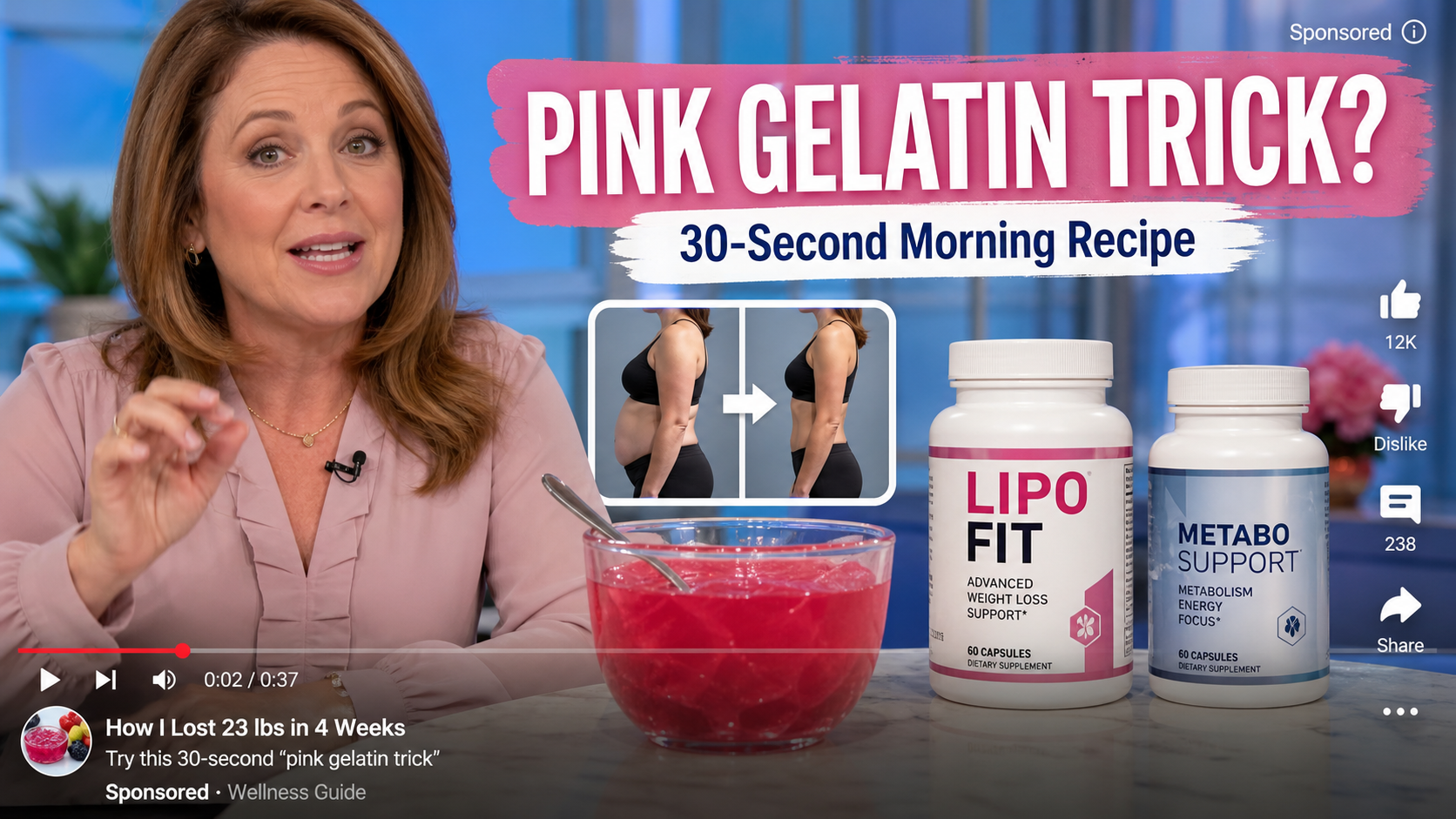
A bright pink bowl of gelatin sits beside a smiling television host. The caption promises a 30-second morning recipe that melts fat without dieting, but the video keeps the measurements hidden just long enough to introduce a bottle.
That is the gelatin trick weight loss scam. Lipo Fit is one supplement associated with the pitch, while LipoLess, Fit Burn, Gelatide, and other names show how easily the same story can move from one product to the next.
Overview
The pink recipe is designed for the camera
Gelatin is familiar, inexpensive, and visually distinctive. A vivid pink mixture makes a strong thumbnail and gives the viewer the impression that the solution is already sitting in a grocery aisle.
The campaign may describe a bariatric recipe, celebrity trick, morning ritual, or hormone reset. These labels are marketing themes, not standardized medical protocols.
The endorsement and transformation are manufactured
Versions use fake doctors, altered television clips, AI presenters, and before-and-after images that cannot be verified. The person appears to explain a personal discovery, but the account hosting the ad is often unrelated to that person.
A dramatic body transformation can be generated, edited, or borrowed from somewhere else. Even a genuine photograph does not show what caused the change or prove that the viewer will get the same result.
Lipo Fit is an example, not the lasting identity
Lipo Fit has appeared at the commercial end of a gelatin-trick story. Closely related funnels have promoted LipoLess, Fit Burn Gummies, Gelatide Drops, and other formulas while keeping the recipe and emotional script.
The stable subject is the bait-and-switch from a free household trick to an opaque proprietary product. A product-first title becomes obsolete when advertisers change the label but preserve the same funnel.
- A short video teases a bright gelatin recipe.
- A fake host, doctor, or celebrity claims effortless results.
- A long advertorial delays the measurements.
- Scientific-sounding hormone language justifies the delay.
- A supplement replaces the promised home recipe.
- Bundles, upsells, and possible continuity increase the total.
Why the Gelatin Story Spreads So Easily
The recipe is visual and simple enough to understand in a few seconds. People can imagine trying it tomorrow morning, which gives the ad an advantage over ordinary supplement marketing.
Gelatin also has legitimate culinary and protein uses. The campaign borrows that familiarity, then leaps from a food property to claims about rapid fat loss, appetite hormones, or metabolism without proving the finished commercial formula.
Social platforms reward short, surprising transformations. A before-and-after frame can reach thousands of viewers before fact-checks and complaints catch up with the newest product name.
The story adapts to trends. One version uses pink gelatin, another says bariatric gelatin, and another adds a celebrity or foreign ritual. The bottle appears late enough that the top half of the campaign can be reused almost unchanged.
Search results reinforce the cycle. A fresh label initially has few independent warnings, so affiliates can occupy the space before complaints accumulate. Once the name becomes difficult to defend, the recipe can feed a new product.
That is why two viewers can remember the same host and gelatin bowl but receive different checkouts. Affiliate links can route the shared creative to different sellers by date, device, or campaign.
Examples of products tied to this wider story include Lipo Fit, LipoLess, and Fit Burn Gummies.
What Gelatin Can and Cannot Prove
Gelatin provides protein and may affect fullness in some contexts, but that does not establish a 30-second recipe that causes large, effortless, and lasting weight loss. Energy intake, activity, sleep, medication, health conditions, and many other factors remain relevant.
Research about protein or one ingredient cannot validate Lipo Fit or another finished formula. Product-level proof must match the exact dose, composition, population, duration, and outcome claimed in the advertisement.
Supplements promoted for weight loss deserve particular caution because the FDA has repeatedly found products in this category containing undeclared active ingredients. A pretty label and a natural claim do not exclude adulteration.
A person with sudden or unexplained weight change, an eating disorder history, pregnancy, chronic illness, or medication concerns should seek individualized advice rather than follow an anonymous social-media protocol.
Sustainable weight change is usually judged over time, not through a single edited photograph or scale reading. Water shifts, camera angle, clothing, posture, and image manipulation can create a dramatic comparison without showing meaningful or lasting fat loss.
How the Gelatin Trick Weight Loss Scam Works
Step 1: A colorful recipe creates curiosity
The ad opens with pink gelatin being stirred in a glass or bowl. Text promises a short ritual that supposedly targets stubborn belly fat while requiring no meaningful lifestyle change.
Because the ingredient looks ordinary, viewers may assume there is little risk in clicking. The commercial purpose is hidden behind the appearance of a free cooking demonstration.
Step 2: A fake expert or celebrity claims a transformation
An AI host, cloned voice, or edited public figure tells a personal story about rapid loss. Before-and-after images and a large number on the scale make the result feel measurable.
Check the person’s verified channels and search the exact quote. A transformation presented only by sponsored accounts and seller-controlled pages is not an authenticated endorsement.
Step 3: The click opens a trusted-looking advertorial
The landing page may resemble a morning show, health magazine, or news report. Its address bar reveals an unrelated domain, while navigation is limited to keeping the viewer on the video.
Fake comments beneath the presentation create urgency and social proof. They are placed by the seller and are not equivalent to verified purchases on an independent platform.
Step 4: The measurements are endlessly delayed
The narrator promises the recipe after explaining hormones, metabolism, a doctor’s discovery, or a remote community. A progress bar suggests the useful part is always moments away.
This structure lets the video repeat the desired result before disclosing a price. The viewer becomes emotionally committed to the idea before seeing the product.
Step 5: Science language turns gelatin into a miracle
The campaign may invoke GLP-1, collagen, fat-burning cells, or a metabolic switch. These terms can be real while the advertised conclusion remains unsupported.
The crucial evidence would test the exact finished offer against an appropriate comparison and report side effects. Ingredient citations and animated diagrams do not provide that proof.
Step 6: Lipo Fit or another supplement replaces the trick
The recipe is suddenly described as inconvenient, inconsistent, or missing a rare component. Lipo Fit, LipoLess, Fit Burn, Gelatide, or another product then appears as the complete solution.
Package cards emphasize the lowest per-bottle amount and mark a large bundle as most popular. Buyers must identify the selected quantity and total charge before entering card information.
Step 7: Upsells and refill terms can follow
After the first order, the funnel may offer digestive support, metabolism capsules, coaching, or extra bottles. Declining one offer should not require accepting another.
Some supplement campaigns use recurring shipments and others do not. Save the exact checkout terms, confirmation, and cancellation process instead of assuming either outcome from the product category alone.
Company, Address, and Fulfillment Red Flags
The rotating brand hides the accountable business
Lipo Fit appears as a product name, but the promotional trail does not consistently identify a verifiable founder, operating company, staff, and manufacturing business behind every advertisement.
A separate seller may control LipoLess, Fit Burn, or another bottle even when the ad story looks identical. Similar creative material is evidence of a marketing pattern, not automatic proof that every brand has one legal owner.
A return center is not the company headquarters
Supplement policies often point to shared fulfillment warehouses, mailboxes, or third-party logistics providers. These locations can receive returns without owning the advertising or formula.
Search the address with several brand names and ask who decides refunds. If the answer is unclear, obtain written authorization before mailing a tracked package.
Support should answer six questions before an order
Ask for the legal merchant, full package total, bottle count, recurring status, billing descriptor, and return address. A seller that will not answer before payment is unlikely to become easier to reach afterward.
Use the contact details on the order confirmation and card statement. A phone number found on a review page may serve a different affiliate, checkout, or product generation.
Unknown manufacturing can create real health risk
The finished bottle should provide a legible Supplement Facts panel, ingredient amounts, warnings, lot number, and responsible manufacturer or distributor. Marketing phrases such as doctor formulated do not answer those questions.
Private-label weight-loss products can be mass-produced in the U.S., China, or elsewhere. The meaningful red flag is missing traceability and batch testing, especially when a seller promises drug-like results without medical oversight.
Warning Signs to Check Before You Order
- The recipe has a catchy name but no standardized instructions.
- The apparent celebrity endorsement exists only in ads.
- Before-and-after photos cannot be traced to verified people.
- The publisher layout appears on an unrelated domain.
- The video cites ingredients but no trial of the finished product.
- The free recipe becomes a proprietary bottle at the end.
- The largest bundle is preselected or marked most popular.
- The legal merchant and manufacturer are difficult to identify.
The key switch happens when the free gelatin demonstration becomes a proprietary product. That is the moment to stop, calculate the full charge, and verify who would receive the payment and ship the bottle.
What to Do if You Have Fallen Victim to This Scam
- Stop the order before more bottles move. Email the seller and identify the gelatin-trick checkout, selected quantity, and expected total. Ask it to cancel unshipped goods and any continuing plan, and request written confirmation rather than relying only on a telephone promise.
- Compare the checkout with the posted card charge. Call the issuer from the number on the card if the total, bottle count, or merchant is not what you authorized. Ask about dispute deadlines, blocking later charges, and replacing the card if continuity billing is suspected.
- Keep evidence from the pink bowl to the delivered bottle. Save the video, fake presenter, advertorial address, package grid, upsells, terms, confirmation, shipping label, and every product received. Record whether the bottle says Lipo Fit, LipoLess, Fit Burn, Gelatide, or another name.
- Monitor for related-product charges. Weight-loss funnels may offer digestive, metabolism, or coaching add-ons under different descriptors. Review statements and shipment emails for several months and report an unauthorized transaction promptly.
- Check the product before taking more. Give the bottle and Supplement Facts panel to a doctor or pharmacist, especially if you take prescription medicine or developed symptoms. Seek urgent care for a severe reaction and do not rely on the ad’s natural-safety claim.
- Inspect the browser used for the purchase. Remove unfamiliar extensions, downloads, and push-notification permissions. Run a complete Malwarebytes scan if the redirect asked you to install anything or the device began showing new pop-ups.
- Limit repeat exposure to the same affiliate network. AdGuard can block many deceptive advertising domains, pop-ups, and tracking redirects. It will not evaluate a transformation photo or clinical claim, so independent verification is still necessary.
- Report the rotating campaign. Flag the sponsored post, then send the FTC at ReportFraud.ftc.gov the story name, every bottle label, URLs, receipt, and billing descriptor. Report a serious supplement reaction through FDA MedWatch.
- Avoid refund helpers that demand payment first. A recovery scammer may claim to know a special bank contact or government reimbursement process. Do not provide more card data or pay a processing fee. Use the bank and official complaint channels directly.
Frequently Asked Questions
Is the pink gelatin trick a proven weight-loss treatment?
No standardized pink gelatin protocol has been shown to cause the dramatic effortless results promised in these ads. Gelatin as food is not proof of the commercial claim.
Is Lipo Fit the only product used in this scam?
No. Lipo Fit is one example. Related gelatin stories have led to LipoLess, Fit Burn, Gelatide, and other rotating formulas.
Why are product names kept out of the title?
The ad story lasts longer than the bottle. Keeping the title focused on the gelatin trick helps readers recognize the same funnel after a marketer changes products.
Does every gelatin supplement order include refills?
No. Checkout terms vary. Some offers are one-time bundles, while others may include continuity. Save and read the exact terms before payment.
Can a weight-loss supplement contain undeclared ingredients?
Yes. Regulators have found undeclared active ingredients in some weight-loss products. Traceable manufacturing and independent testing matter.
What if six bottles arrived after I expected one?
Keep the package and invoice, compare them with the checkout screenshot, contact the seller in writing, and call the card issuer if the quantity or charge was not authorized.
The Bottom Line
The gelatin trick weight loss scam is a story engine. Pink food, fake authority, transformation images, delayed instructions, and pseudoscience prepare viewers for a commercial reveal that can change from week to week.
Lipo Fit is one example, while LipoLess, Fit Burn, Gelatide, and other labels demonstrate why the scheme should not be defined by a single bottle.
If the promised household recipe becomes a proprietary product only after a long video, step back. Verify the endorsement, evidence, merchant, manufacturer, total, and refill terms before the funnel turns curiosity into an expensive order.

Join the discussion
0 commentsShare your experience or ask a question about this article.
Discussion
Start the conversation
Have a question or something useful to share? Add the first comment.