

If you have ever searched for help with varicose veins, leg swelling, or that heavy, aching feeling after standing all day, you already know how tempting a quick fix can feel.
That is exactly why the Gfouk VeinTarget Microneedle Patch pitch lands so hard.
The sales pages promise a “breakthrough” transdermal system that targets chronic venous insufficiency, claims it is “clinically proven,” and suggests visible vein reduction in 7 to 14 days. Some versions even claim a 96% success rate, “TGA-registered,” “GMP-certified,” and “trusted by 150,000+ users worldwide.”
It reads like medicine. It looks like a medical device.
But when you zoom out, the pattern looks far more familiar: a cheap, generic patch sourced from China, rebranded into a miracle treatment, sold through multiple storefronts at a steep markup, and protected by a return process that becomes impractical the moment you need help.
This article breaks down how the Gfouk VeinTarget Patch operation works, what the red flags are, why the claims do not add up, and what to do if you already bought it.
Overview
The Gfouk VeinTarget Patch is marketed as a microneedle patch that can “firm and relieve varicose veins within 1 to 3 weeks,” “improve blood flow,” and address the underlying pathology of venous valve failure.
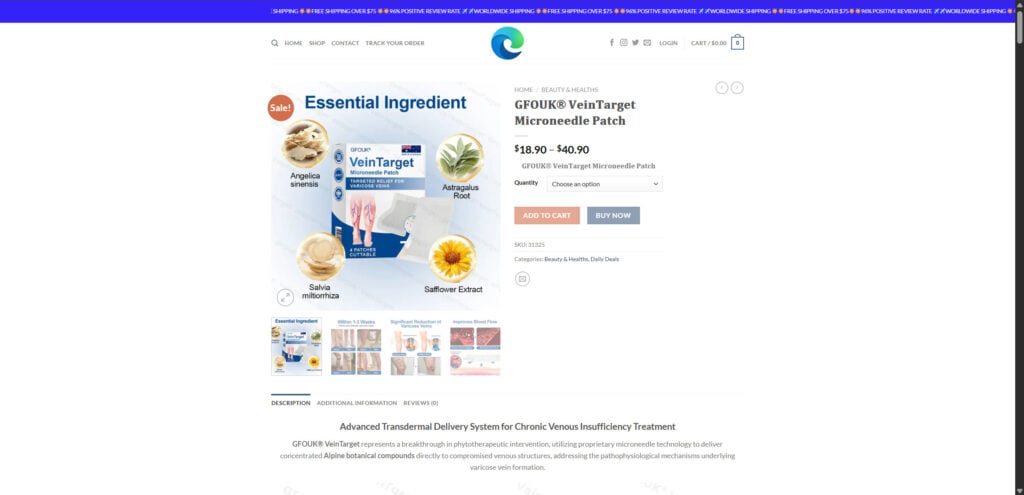
In the screenshots you shared, the product page is built like a medical landing page. It includes:
- “Advanced Transdermal Delivery System for Chronic Venous Insufficiency Treatment”
- Claims about “proprietary microneedle technology”
- Botanical ingredient callouts (for example, Angelica sinensis, Astragalus root, Salvia miltiorrhiza, Safflower extract)
- A chart-style “comparative therapeutic analysis” that frames the patch as superior to surgery and topical agents
- Highly specific performance claims like 96% success rate
- A “penetrates 100x deeper than topical creams” statement
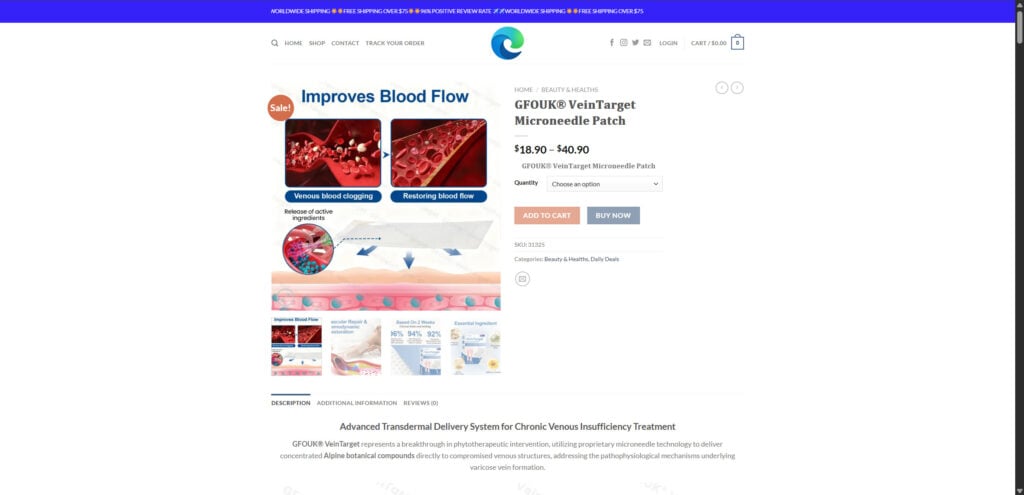
- Before-and-after photos showing dramatic improvements in bulging veins
The price point on these storefronts is typically around $18.90 to $40.90, often shown as a “sale,” with urgent language suggesting high demand and limited time pricing.
Now here is the part that changes the entire story.
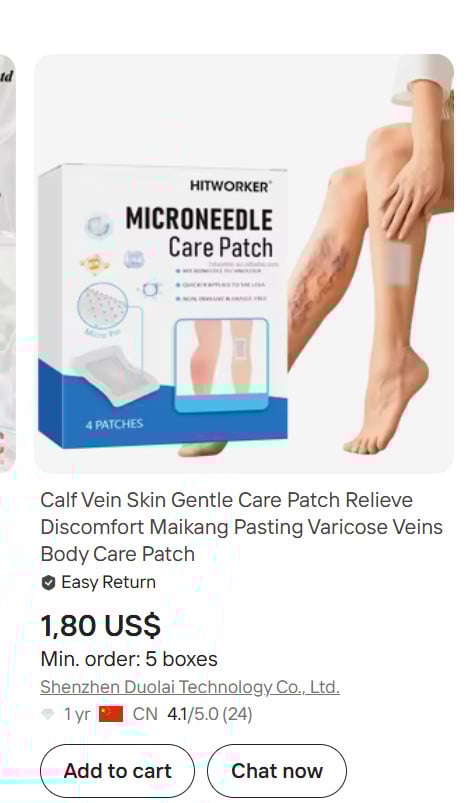
You also shared a wholesale-style listing image showing a nearly identical “microneedle care patch” product priced around $1.80 per unit (often with minimum order quantities), sold by a China-based supplier. Even the packaging style and product concept match the same “microneedle patch for leg veins” narrative.
That price gap is not a small discount. It is the backbone of the business model.
What this product appears to be in practice
This looks like a classic dropshipping funnel:
- A generic patch is manufactured cheaply in bulk.
- Sellers buy inventory or route orders directly through suppliers.
- The patch is rebranded under rotating names.
- A medical-sounding story is built around it.
- Ads and landing pages push urgency and authority.
- Refunds and returns are made difficult, slow, or expensive.
That does not automatically mean every single unit is “fake” in the sense that nothing arrives. Many dropshipped products do arrive.
The problem is what buyers are actually being sold: confidence, urgency, and medical-sounding certainty.
And that is where this becomes a scammy operation, even when a package shows up.
Why the claims are a major red flag
Varicose veins and chronic venous insufficiency are not cosmetic problems that can be reliably fixed by a simple patch. These are circulatory and structural issues involving:
- Venous valve dysfunction (blood flowing backward in veins)
- Increased venous pressure
- Vein wall stretching and remodeling over time
- Inflammation and chronic swelling in some cases
Real treatments focus on compression therapy, lifestyle changes, medical evaluation, and in many cases procedures like sclerotherapy, ablation, or surgery.
A patch claiming it can reverse these structural changes quickly, from home, with “herbal microneedles” and “targeted delivery” is a huge claim that would require real clinical evidence.
Credible medical products that make these kinds of claims usually provide:
- Detailed ingredients and concentrations
- Mechanism of action supported by research
- Clinical trial identifiers and publication references
- Safety data, contraindications, and realistic limitations
- A real manufacturer identity and regulated product classification
These sales pages typically provide none of that in a verifiable way.
Instead, they provide marketing graphics and impressive numbers.
Red flag #1: “TGA-registered” and “GMP-certified” language used as a trust shortcut
The page text in your screenshots includes language such as:
- “TGA-registered”
- “GMP-certified”
- “Clinically proven”
- “96% success rate”
These phrases are powerful because they sound like regulation and science.
But here is the issue: in scammy dropshipping funnels, these labels are often used without:
- A verifiable registration number
- A searchable listing tied to the exact product name
- The legal sponsor or manufacturer identity
- The specific standard the GMP claim refers to
- Any documentation you can actually confirm
When a company is legitimately regulated, it is typically easy to find clear product identifiers and trace the responsible party.
When the page gives you big credibility words but no traceable proof, that is not oversight. That is the strategy.
Red flag #2: The “96% success rate” is a classic made-up statistic
A 96% success rate for a non-invasive home patch treating chronic venous insufficiency is an extraordinary claim.
Extraordinary claims require extraordinary evidence, and evidence looks like published data, not a marketing slide.
Dropshipping pages love specific numbers because:
- They feel scientific
- They reduce buyer doubt
- They make the product seem “proven”
But without clinical references, the number is just decoration.
Red flag #3: “Penetrates 100x deeper than topical creams” is not a medical statement
“100x deeper” sounds precise, but it is not a standard medical measurement. Deeper than what, measured how, with what test method, and delivering which active ingredient at what concentration?
Microneedles can increase permeability, yes.
That does not mean a botanical patch can “repair valves,” reverse varicose veins, or deliver a clinically meaningful dose to deep venous structures.
Even if a microneedle patch delivers something into the superficial layers of skin, varicose veins are not just a skin-surface issue.
Red flag #4: The product page tries to treat a medical condition like an impulse buy
The layout is built to convert quickly:
- Big promises in short time windows (7 to 14 days, 1 to 3 weeks)
- Heavy before-and-after visuals
- “Comparative analysis” charts that make surgery look scary and inferior
- “Trusted by 150,000+ users” style claims
- Discount pricing and sale banners
This is not how reputable medical treatment information is presented.
It is how viral ecommerce products are sold.
Red flag #5: The before-and-after photos are not reliable evidence
Before-and-after images are one of the easiest things to manipulate:
- Different lighting
- Different angles
- Different leg positioning
- Different levels of swelling that fluctuate naturally
- Different timing, and not necessarily the same person
- Compression garments removed or worn
With varicose veins, daily changes in swelling and vein prominence can happen even without treatment.
So a dramatic before-and-after image on a sales page is not proof. It is persuasion.
Red flag #6: The same “microneedle vein patch” exists as a generic wholesale product
Your wholesale image shows a near-identical concept priced around $1.80, under different packaging.
That matters because it strongly suggests the Gfouk VeinTarget Patch is not a unique medical breakthrough. It is a generic item that multiple sellers can slap a new brand on.
That is exactly how dropshipping works.
The seller does not need to invest in research, manufacturing, or clinical validation. They just need a story, a storefront, and ad spend.
Red flag #7: The brand footprint looks thin
These operations often have:
- Limited company information
- No clear medical advisory board or clinician identity
- Generic policy pages
- A contact form and one email
- Few credible independent reviews
- A rotating product catalog that changes with trends
This matters because if something goes wrong, you have no accountable manufacturer to escalate to.
Why this is especially concerning for a “vein treatment” product
Skin tag patches are questionable.
But vein and circulatory claims move into higher-stakes territory.
People seeking varicose vein relief may have:
- Chronic venous insufficiency
- Swelling and pain
- Skin changes (stasis dermatitis)
- Risk of ulcers
- Past blood clots or circulation issues
A marketing patch that encourages people to self-treat a potentially serious condition is not harmless ecommerce. It can delay proper evaluation and real care.
What a patch can realistically do
Let’s separate reasonable from unrealistic.
A topical patch might:
- Provide mild soothing effect
- Offer a warming or cooling sensation
- Reduce discomfort temporarily
- Help moisturize skin
What it cannot reliably do, especially in 7 to 14 days:
- Repair damaged venous valves
- Reverse vein wall stretching
- Eliminate varicose veins at their source
- Restore normal venous circulation in a clinically meaningful way
Those are not “maybe” claims. Those are structural and physiological outcomes.
If a product claims them, it needs serious evidence.
The most likely consumer outcome
Many buyers end up in one of these scenarios:
- The patch arrives, feels like a basic patch, and produces little to no change
- The patch causes irritation, redness, or itching
- The buyer sees no meaningful reduction in veins and seeks a refund
- The refund process becomes difficult, delayed, or expensive
- The buyer gives up or accepts a partial refund offer
That is why this type of dropshipping product keeps working as a business model.
It does not need to satisfy everyone. It needs to convert enough people fast, and prevent enough refunds, to stay profitable.
How The Operation Works
To understand why Gfouk VeinTarget Patch pages look the way they do, it helps to look at them as a conversion funnel, not as a healthcare company.
Here is the typical playbook.
Step 1: Source a generic “vein patch” product cheaply
The wholesale listing you shared is the key clue.
When you can buy a vein patch for around $1.80 per unit in bulk, you can afford to:
- Pay for advertising
- Offer “free shipping”
- Offer big discounts
- Still profit heavily on a $18.90 to $40.90 sale
This also explains why multiple brands can sell nearly identical patches. The product is not exclusive.
Step 2: Rebrand with medical-sounding naming
Names like “VeinTarget” are chosen on purpose:
- They sound clinical
- They imply specificity and precision
- They suggest the product is engineered for a medical target
This naming style helps shoppers subconsciously treat the product like a legitimate medical solution.
Step 3: Build a landing page that imitates medical authority
The page uses several trust-building tricks:
A) Scientific visuals
- Blood flow diagrams
- Vein cross-section graphics
- “Step 1, Step 2” process diagrams
- Microchannel illustrations for microneedles
These visuals look scientific, but they are typically generic stock-style graphics.
B) Authority labels
- “Clinically proven”
- “GMP-certified”
- “TGA-registered”
- “Breakthrough”
- “Proprietary technology”
Again, these can be legitimate words in real medicine, but on dropshipping pages they are often unverified.
C) Precise-sounding numbers
- “96% success rate”
- “100x deeper”
- “7 to 14 days”
Numbers reduce doubt because they feel measurable, even when they are not supported.
Step 4: Use aggressive before-and-after storytelling
The page shows:
- Large varicose veins labeled “Before”
- Smoother legs labeled “After”
- A short timeframe (1 to 3 weeks)
That is a direct appeal to hope and impatience.
It is also strategically chosen because people with vein concerns often feel self-conscious, especially in summer or when wearing shorts.
The marketing is targeting emotion, not evidence.
Step 5: Create a “comparison chart” that makes real treatment look bad
One screenshot shows a “Comparative Therapeutic Analysis” chart comparing:
- Gfouk VeinTarget
- Surgical intervention
- Oral or topical agents
These charts usually do three things:
- Overstate the benefits of the patch
- Overstate the risks or complexity of medical care
- Position the patch as the only “easy” option
This works because many people fear procedures, costs, and doctor visits.
But it is misleading. Medical evaluation is often the safest starting point, especially when symptoms are significant.
Step 6: Drive traffic through social ads and trend targeting
These products are commonly pushed through:
- Facebook and Instagram ads
- TikTok video ads
- Native ad networks
Ad creative often includes:
- Close-up “shock” visuals of veins
- Testimonials with profile photos
- Quick claims about “circulation repair”
- Overconfident timeframes
Once you click, retargeting often follows you around the internet.
Step 7: Push checkout upgrades and higher quantities
Dropshipping stores optimize revenue per customer with:
- Bundle pricing (2 boxes, 3 boxes, 5 boxes)
- “Best value” options that make spending more feel rational
- Upsells after purchase
- Add-ons like shipping insurance
This is also where some buyers report receiving multiple units or being charged more than expected, depending on how the checkout is structured.
Even without outright fraud, confusing quantity selectors and upsells can produce “I only ordered 1” complaints.
Step 8: Fulfillment and delivery are outsourced, often overseas
When the order is placed:
- The store may not ship from a local warehouse
- The order may route to a supplier or fulfillment center in China
- Shipping times can stretch far beyond what the site implies
- Tracking can be delayed or unclear
This is a classic pain point for buyers who thought they were purchasing from a legitimate “brand.”
Step 9: Refunds become difficult in practice
Most dropshipping refund systems rely on friction.
Common tactics include:
- Asking you to wait longer
- Requesting extra proof, photos, or repeated steps
- Offering partial refunds if you keep it
- Requiring returns to China at the buyer’s expense
- Only refunding after the return is received, which can take weeks
- Denying returns if packaging is opened
Even if a refund policy exists on paper, it can be designed to fail in practice.
Step 10: If complaints rise, the product rotates to new storefronts
If a domain gets too many negative signals, sellers can:
- Move to a new site
- Change the brand name
- Reuse the same product photos
- Launch a new “viral” story
That is why you see similar microneedle patches sold under many names.
What To Do If You Bought the Gfouk VeinTarget Patch
If you already placed an order, focus on practical steps that protect your money and your health.
1) Treat the medical claims with caution
If you have significant symptoms like:
- Leg swelling that worsens during the day
- Pain, heaviness, or cramping
- Skin discoloration around ankles
- Itching, eczema-like changes, or thickened skin
- Non-healing wounds or ulcers
- A history of blood clots
Do not rely on an online patch. Consider medical evaluation. Varicose veins are sometimes more than cosmetic.
2) Document everything immediately
Save:
- Order confirmation email
- Receipt and transaction ID
- Screenshots of the product page claims (especially “96% success rate,” “TGA-registered,” “7 to 14 days”)
- Screenshots of the refund and return policy
- Any communication with support
- Photos of what arrives, including packaging and label
Documentation is your leverage if you dispute the charge.
3) Watch your payment method for extra charges
Check your statement for:
- Multiple charges
- Unexpected billing names that do not match the brand
- Shipping insurance add-ons
- Delayed charges that appear days later
If anything looks wrong, contact your bank or card issuer quickly.
4) Try one clear refund request, in writing
If you want a refund, send a direct message that includes:
- Your order number
- Your request for a full refund
- A request for a timeframe and confirmation
Keep it short. You are creating a record.
5) If the seller stalls, file a dispute or chargeback
If you paid by card or PayPal, you may be able to dispute for:
- Item not received
- Item not as described
- Misleading advertising
- Failure to honor refund policy
Do not wait too long. Many people lose protection windows by hoping support will suddenly become helpful.
6) Be cautious about return-to-China requirements
If the company demands international return shipping at your expense, consider:
- The shipping cost can exceed the refund value
- Tracking and delivery confirmation can take weeks
- Some addresses are hard to verify or change
If you decide not to return because it is unreasonable, a dispute may be the better path.
7) Stop using the patch if you have irritation
If you notice:
- Burning
- Blistering
- Rash
- Worsening skin irritation
Stop using it. Take photos if needed for evidence, and consider medical guidance if symptoms persist.
8) Do not let the patch delay proper care
If you suspect circulation issues, do not gamble on a marketing patch.
Varicose veins and venous insufficiency can worsen over time. Early evaluation often gives more options and better outcomes.
9) Report the ad and the store if the claims appear misleading
You can report:
- The ad platform where you found it
- The payment platform if a dispute is involved
- Consumer protection channels in your region if you want to escalate
Reporting helps reduce the spread of the same funnel.
10) Learn the pattern to avoid the next version
This specific scam pattern repeats across health categories:
- “Breakthrough” patch or device
- Strong medical claims without proof
- Clinical-sounding labels and numbers
- A short timeframe promise
- A high markup over a generic China product
- Refund friction and return shipping barriers
Once you recognize it, you can spot it in minutes.
The Bottom Line
The Gfouk VeinTarget Microneedle Patch is marketed like a medically validated solution for varicose veins and chronic venous insufficiency, using bold claims like 96% success, “TGA-registered,” “GMP-certified,” and dramatic before-and-after images.
But the operation fits the common dropshipping blueprint: a low-cost generic patch sourced from China (often seen around $1.80 wholesale), rebranded and sold for $18.90 to $40.90 through persuasive landing pages, with medical-sounding language that is difficult to verify and a refund process that can become impractical.
If you are considering buying it, skip it.
If you already bought it, document everything, monitor your charges, and use your payment protections quickly if the seller delays, refuses a reasonable refund, or the product does not match the promises.
And if your symptoms are significant, treat this as the signal to seek real evaluation. Varicose veins are not a trend product. They are a health issue that deserves real solutions, not a viral patch.

Reviews & discussion
2 commentsShare a firsthand experience, or ask a question.
Community reviews
Gfouk VeinTarget Patch
Moderated reader experiences, not an editorial verdict.
Great article. Very informative. Thanks for saving me a bunch of money.
In reply to Carla m Justice
Carla, thank you for taking the time to say that. I’m glad the article helped you avoid wasting money on it.