

GlycoHarmony is sold as a simple bottle of drops that can supposedly support blood sugar, improve insulin response, reduce cravings, stabilize energy and sometimes even help with weight loss. The pitch targets people who may already be worried about glucose readings, diabetes or the long-term effects of metabolic problems.
That makes the marketing unusually sensitive. A weak beauty product may waste money; an unproven blood-sugar supplement can influence decisions about medical care. GlycoHarmony’s online footprint does not provide the clarity needed for that level of trust.
We found numerous “official” websites using slightly different spellings, ingredient lists, guarantees and product stories. One page describes six active ingredients, another promotes a proprietary blend of more than 20, while a similarly named Glyco Reset site lists a completely different seven-ingredient formula. Several pages claim thousands of customers and near-perfect ratings without showing a verifiable review system.
Our verdict: avoid GlycoHarmony and the surrounding network of Glyco Harmony/Glyco Reset drops pages. The sales funnel uses medical-sounding claims, copied authority signals and conflicting product information, but does not provide a credible clinical trial on the exact formula being sold. This is not a safe basis for managing blood sugar.
Overview
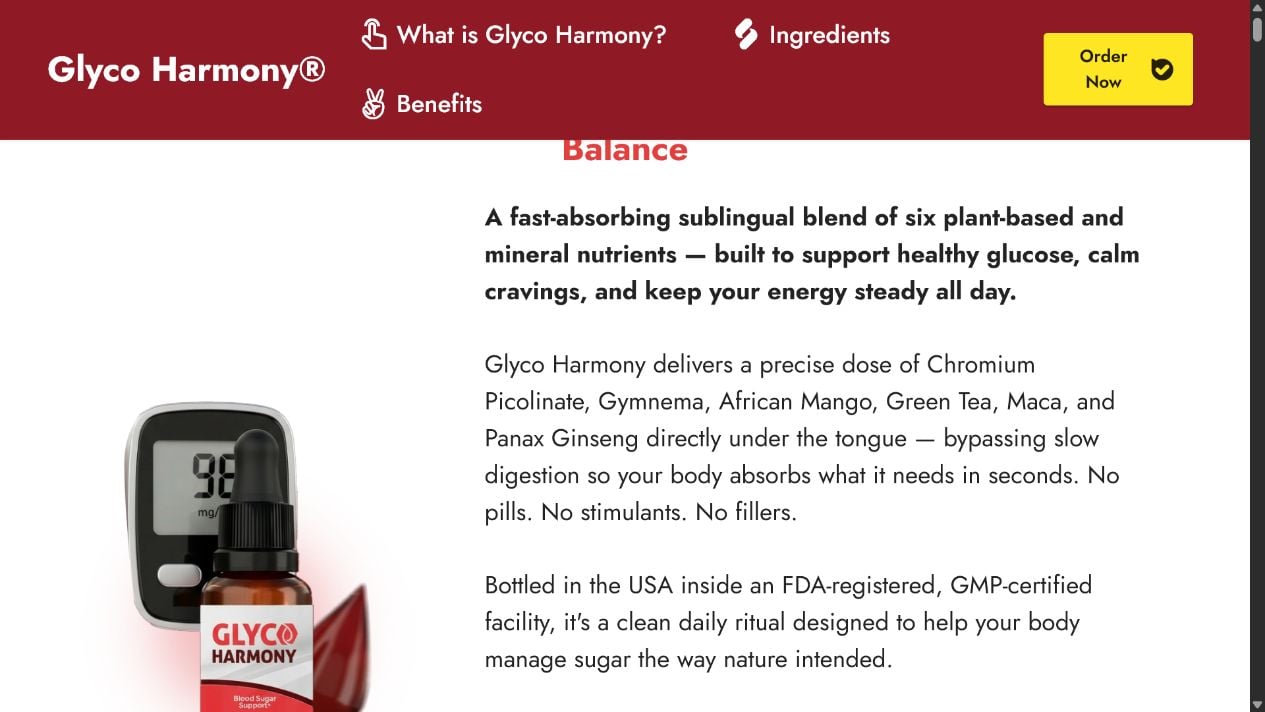
GlycoHarmony is promoted as a liquid dietary supplement taken with a dropper. Depending on the website, the formula may be described as containing chromium, Gymnema, African mango, green tea, maca and Panax ginseng, or a much larger blend that adds amino acids, guarana, raspberry ketones and other compounds.
Pricing follows the familiar direct-response structure. Buyers are pushed toward two, three or six bottles, with the six-bottle package commonly shown at $49 per bottle. Claimed retail prices and savings are extremely large, while countdowns, limited-stock warnings and free digital bonuses create pressure to commit to several months immediately.
The problem is not simply that multiple retailers sell the same supplement. Pages independently call themselves official, use domains with misspellings or extra words, and disagree about the product’s composition. A buyer cannot evaluate interactions, doses or refund rights when the basic identity of the formula changes from one “official” source to another.
The evidence problem at a glance
- Several sales domains present themselves as the product’s home: buyers may not know which operator, formula or policy governs an order.
- The ingredient stories do not line up: one page emphasizes a short list, another promotes a much larger proprietary blend, and Glyco Reset presents yet another formula.
- Testimonials are used where clinical evidence should be: personal success stories do not prove that the finished drops control blood sugar or reverse a medical condition.
- The target audience faces genuine health risk: people using insulin or other medication cannot safely replace treatment or add a supplement based on an affiliate sales pitch.
- Conflicting guarantees weaken refund confidence: a promise is only useful when the responsible company, return address and exact deadline are unambiguous.
Any one of these issues would justify caution. Together, they make the offer too unreliable for a product tied to diabetes and metabolic health. A buyer should be able to match one name, one label, one manufacturer and one policy before swallowing the first dose. GlycoHarmony’s web footprint makes that basic verification unusually difficult.
The Conflicting GlycoHarmony Websites
Different domains claim official status
Search results produce a collection of domains such as glycoharmmony.com, glyco-harmony.com, glycoo-harmony.com and other close variations. This pattern is common in affiliate supplement campaigns, where marketers build separate landing pages around the same name and direct visitors toward a shared checkout or a different product entirely.
Ingredient lists do not match
One current page says the drops contain six ingredients. Another widely circulated description lists chromium plus a 200 mg proprietary blend containing more than 20 ingredients. Glyco Reset pages list berberine, cinnamon, chromium, Gymnema, alpha lipoic acid, banaba and bitter melon. These are not minor wording differences; they are materially different formulas.
Guarantees change between pages
Some pages advertise a 60-day guarantee, others display a 30-day guarantee, and individual refund pages may calculate the deadline from purchase rather than delivery. Buyers who assume every website offers the same protection may discover that the checkout merchant applies a different policy.
The product story changes
Certain pages focus on blood sugar, others add fat burning, brown-fat activation, brain health, gut health or dramatic energy improvements. When one small bottle is continuously repositioned to match different search terms, the marketing appears to be driving the formula rather than the evidence.
Why the Health Claims Are Not Proven
Ingredient research is not a product trial
Berberine, chromium, cinnamon and Gymnema have been studied in metabolic contexts, but results depend on dose, population, quality and medical supervision. A citation attached to one ingredient does not prove that an undisclosed or changing multi-ingredient dropper has the same effect.
Sublingual claims need evidence
One sales page says nutrients placed under the tongue bypass digestion and reach the bloodstream within seconds. Absorption varies by molecule and formulation. The seller does not publish pharmacokinetic testing showing that its finished blend is absorbed at the speed or amount claimed.
“FDA registered” is not FDA approved
A facility registration does not mean the FDA reviewed GlycoHarmony for safety or effectiveness. Dietary supplements generally reach the market without pre-approval as treatments. A badge about manufacturing cannot replace clinical evidence or accurate labeling.
Customer stories are not measurements
Sales pages display people claiming better readings, fewer cravings and dramatic changes. The sites do not show how reviewers were verified, what other treatments they used or whether the quotes can be independently confirmed. Testimonials are especially weak evidence for a condition that naturally fluctuates.
Safety Questions the Sales Pages Do Not Resolve
A multi-ingredient formula can create risks that do not appear when each ingredient is discussed separately. Berberine and Gymnema may affect glucose; green tea or guarana can contribute stimulants; grapefruit compounds can alter how certain medicines are metabolized; and proprietary blends can hide whether an ingredient is present at a meaningful or excessive dose. The conflicting labels make a responsible interaction check difficult.
People who are pregnant, nursing, preparing for surgery or taking medication for diabetes, blood pressure, clotting or another chronic condition should not experiment with an uncertain blend. Even healthy adults deserve a complete Supplement Facts panel and a company willing to provide batch testing. “Natural” describes origin, not predictability or safety.
The seller’s disclaimer that the drops are not intended to diagnose, treat, cure or prevent disease does not neutralize the rest of the funnel. When surrounding copy promises better readings, sharper insulin sensitivity or restored glucose balance, the practical impression remains medicinal. The bolder the implied outcome, the stronger the evidence should be.
How the GlycoHarmony Funnel Works
Step 1: The ad finds a frightening health concern
The campaign targets people worried about glucose spikes, fatigue, cravings or diabetes complications. Medical language creates the feeling that delaying the purchase could allow the problem to worsen.
Step 2: A natural formula is positioned against medication
Botanical ingredients are framed as gentle support while prescription treatment feels complicated or harsh. Disclaimers may say the supplement is not medication, but the surrounding story encourages expectations that resemble treatment.
Step 3: Authority signals reduce hesitation
Claims such as doctor-formulated, reviewed by a physician, made in the USA, GMP certified and FDA registered appear near purchase buttons. Unless the professional identity, facility and documentation can be verified, these signals are marketing claims rather than proof.
Step 4: The largest package is made to look rational
The seller says meaningful results require several months, then makes the six-bottle package the cheapest per bottle. The buyer is asked to spend close to $300 before learning whether the formula matches the advertisement or is tolerated safely.
Step 5: Affiliate pages crowd the search results
Dozens of sites repeat favorable reviews and “official website” language. This manufactured consensus can hide the fact that many pages are promotional rather than independent evaluations.
Step 6: The guarantee carries the remaining risk
If results do not appear, the buyer must identify the actual merchant, obtain return instructions and act within the correct version of the guarantee. Conflicting domains make that process harder than the sales copy suggests.
Why the Domain Confusion Matters at Refund Time
A guarantee is only as useful as the merchant that must honor it. If an affiliate page routes payment through another company, the domain shown in the browser may not match the name on the card statement or return address. Buyers can waste days contacting the wrong “official” site while the refund clock continues to run.
Before ordering any supplement sold through multiple lookalike domains, the buyer should be able to identify the legal seller, customer-service email, physical return address and checkout processor. GlycoHarmony pages emphasize product benefits and package savings far more prominently than this accountability chain.
Red Flags We Found
- Multiple official-looking domains: there is no single, easily verified source of truth.
- Contradictory formulas: ingredient lists range from six actives to more than 20, while Glyco Reset uses another blend.
- No finished-product trial: the exact drops have not been shown to produce the advertised outcomes in a credible clinical study.
- Medical-sounding promises: sales pages imply improved glucose control and insulin response.
- Unverifiable ratings: enormous customer counts and near-perfect scores appear without transparent review records.
- Extreme price anchoring: claimed savings make a $294 package appear urgent and inexpensive.
- Inconsistent guarantees: refund windows and conditions vary across pages.
- Weak corporate transparency: many pages reveal more about affiliates and checkout buttons than the accountable manufacturer.
Is GlycoHarmony a Scam or Legit?
A buyer may receive bottles, so the campaign is not necessarily a checkout page that takes money and sends nothing. That narrow form of fulfillment does not make the health offer trustworthy. The product identity is fragmented, the evidence is inadequate and the marketing borrows the language of medical treatment.
The reasonable consumer conclusion is to avoid it. A blood-sugar supplement should provide one authoritative label, exact doses, independent quality testing, a traceable manufacturer and evidence on the finished formula. GlycoHarmony’s current web presence fails that basic clarity test.
What to Do If You Already Ordered GlycoHarmony
1. Identify the exact website and merchant
Save the domain, checkout receipt, card descriptor and confirmation email. Do not use a different GlycoHarmony site for refund instructions because it may be operated by another affiliate or merchant.
2. Compare the bottle with the sales page
Photograph the Supplement Facts panel, lot number, manufacturer and seal. Compare the ingredients and serving size with the page you relied on. A different formula is an important reason to stop and request clarification.
3. Do not change diabetes treatment
Never reduce insulin or prescribed medication because of a supplement advertisement or early glucose reading. Discuss the bottle with the clinician managing your blood sugar, especially because several botanicals can interact with glucose-lowering medication.
4. Request return instructions immediately
Ask the merchant to confirm the deadline, return address, opened-bottle rules and refundable amount in writing. Keep tracking if you send a return and photograph the package before mailing it.
5. Monitor for side effects and low blood sugar
Stop using the drops and seek medical guidance if you experience dizziness, sweating, confusion, stomach symptoms or another concerning reaction. Hypoglycemia can be urgent, particularly when supplements are combined with medication.
6. Escalate unresolved billing problems
If the merchant ignores the written guarantee or the charged amount differs from your authorization, contact the payment provider promptly. Provide the sales page, receipt, messages and proof of return.
The Bottom Line
GlycoHarmony is not one clear product supported by one clear body of evidence. It is a shifting collection of official-looking pages, ingredient stories, guarantees and health promises built around the same marketable name.
That confusion is unacceptable for a supplement aimed at people concerned about blood sugar. Skip GlycoHarmony, verify any metabolic supplement with a healthcare professional and never let a countdown, testimonial or “FDA registered” badge replace an accurate label and credible medical evidence.








