


A phone bill turns up for a line you never opened. All you have is a folded sheet in an envelope and a balance you cannot explain.
A request for identity theft records can help you find out what happened. Start by writing down exactly what the bill leaves unanswered.

Overview
Start with the question the paperwork must answer
Imagine finding an unfamiliar signature in an application. You could tell an investigator which signature you question without having to name the person who wrote it.
Suppose a carrier says it closed the line. That answers whether service continues today. It leaves open how the account started and whether someone also ordered a phone.
Identify the business that handled the transaction
In the United States, Section 609(e) of the Fair Credit Reporting Act covers applications and transaction records a business controls that document alleged identity theft.
Under the statutory conditions, a business has 30 days after receiving a qualifying written request to provide free copies, subject to verification.
A lender can hold the loan application while a credit bureau shows only an inquiry. A store can hold the order while a bank statement shows only the charge.
Give each problem its own destination
- Request records from the business holding them.
- Take a disputed entry on a consumer report to the appropriate reporting and dispute channels.
- Contact your card issuer promptly about an unauthorized charge, even while you seek documents from the store.
- If a collector writes, keep its notice and attend to its dispute deadline separately.
You might need more than one of these actions. Sending a letter to the store gives you no reason to assume your card issuer knows what happened.
Choose the document before writing the request
Try finishing this sentence before gathering your paperwork. “When I called about the line, nobody could tell me why the balance included a charge for a second phone.”
Read that sentence as if someone else had written it. Would you know which line the person disputed and which charge prompted the second question?
What does your current paperwork already establish?
Circle the entries that prompted your question on a working copy. If one amount is for monthly service and another is for equipment, preserve the printed description beside each amount.
Imagine a charge labeled only with a short internal code. Copy it as printed and ask the business what the code meant on that date.
If the letter mentions delivery, underline the verb the writer used. A note that a customer requested delivery leaves open whether anyone actually received the item.
For example, keep the phrase “asked for Tuesday delivery” in your notes. Changing it to “delivered Tuesday” silently adds an event that the original words never established.
Turn a broad demand into a request someone can locate
Wisconsin’s optional fraudulent-account worksheet lists applications, statements, charge slips and delivery information. Its fields distinguish an account number from another reference.
Your letter may have a collection reference and a service month, with no subscriber number. Label those details as they appear on the letter so nobody mistakes one for another.
If a notice shows only when payment became due, describe it as a due date. Calling it the application date could send a records search into the wrong month.
Give the identifying details you know or can readily obtain when the business asks for them. Perhaps your notice identifies only a billing month.
There is no need to invent the rest of a number. Tell the business what document supplied the partial reference and what period the notice actually covers.
Two businesses explain where their records requests go
A wireless account you never opened
T-Mobile provides separate directions for records requests. In its Privacy Center, find “File a FACTA request.”
The carrier lists a written letter specifying the documents, a police report, a completed FTC affidavit and a state-issued picture ID. It publishes mail and fax directions for this packet.
T-Mobile lists bills, credit applications and shipping requests. It requires a separate legal request for surveillance video.
Imagine a first letter that lists a wireless line and an equipment balance. Put each amount beside its description before asking the carrier which documents relate to it.
For the line, request the application associated with the disputed opening. For the handset, identify the equipment charge and ask about the corresponding order.
If the reply discusses only the line, copy your original question about the equipment into the follow-up. Keep the wording precise enough for someone new to the matter.
A retail transaction on your existing bank card
Kohl’s security guidance gives victims seeking records a choice of mail, fax or email. Its written-request instructions ask for enough information to identify the application or transaction.
The retailer also lists government identification, the related police report and an identity theft affidavit. Its instructions direct customers with unauthorized bank-card charges to their bank or card issuer.
Suppose two transactions at the same store appear on your statement. Your receipt explains the first purchase, and the second remains unfamiliar after you check your records.
Before describing identity theft, look at whether the unfamiliar entry might belong to a purchase you authorized. Confusing a posting date with the shopping date can misidentify the transaction.
If you have grounds to suspect misuse, identify the second charge by its displayed amount and posting date. Say explicitly that the first purchase is yours.
That lets the store distinguish two orders without suggesting that both purchases are disputed. The receipt for the known purchase is a point of comparison you can retain.
Suppose the statement also shows a credit near the unfamiliar purchase. Compare its reference or description before assuming it settled that purchase rather than a separate return.
If the retailer supplies an order record, check which of those purchases it describes. A perfectly legible receipt for the purchase you recognize still leaves your question unanswered.
Put together a request you can explain later
The FTC’s consumer instructions recommend sending identity proof, a completed FTC Identity Theft Report and a local police report. Check the verified recipient’s current directions before sending sensitive copies.
Two envelopes may carry the same name and street address. If one is the notice you dispute, mark your working copy so you can tell it from your own correspondence.
Imagine you continued receiving mail at an old apartment for several weeks. A letter delivered there tells you where someone mailed it that month.
Find the records recipient independently using the company’s official instructions. An ordinary return envelope might be addressed only to the department that processes payments.
Prepare a separate request for each business involved. The Wisconsin worksheet lets you designate an investigator to receive records, but using that particular form is optional.
You can receive copies or authorize law enforcement to receive them. A relative helping sort envelopes can work from your checklist at home.
A short request with a traceable paper trail
Describe the transaction you believe used your identity, then list the particular records you want. Leave enough detail to distinguish the disputed activity from business you actually conducted.
Describe the equipment purchase on its own line if you want a separate answer about it. Give the two questions short names you will recognize in a reply.
Give the business a way to reply that you control. If the disputed paperwork lists an unfamiliar email address, label it as an entry you question.
Put your reply address at the top of the letter. When you quote the disputed address later, introduce it as part of the paperwork you are questioning.
Make a private list of the copies that went into that particular packet. A delivery receipt for an envelope does not show which documents were inside it.
Record the date sent, destination used and delivery evidence you actually have. If you retained only a sent message, describe it accurately rather than treating it as confirmed receipt.
When a second letter asks for something more, lay both letters side by side. Check whether the new letter names a missing document, an unreadable copy or a different transaction.
If a message directs you to a new recipient, check that destination against the company’s own instructions. Someone who knows your balance has not established their identity.
Read the reply against your original questions
Lay your request beside the response. Mark each item received, each document mentioned but absent, and anything the business says it could not locate.
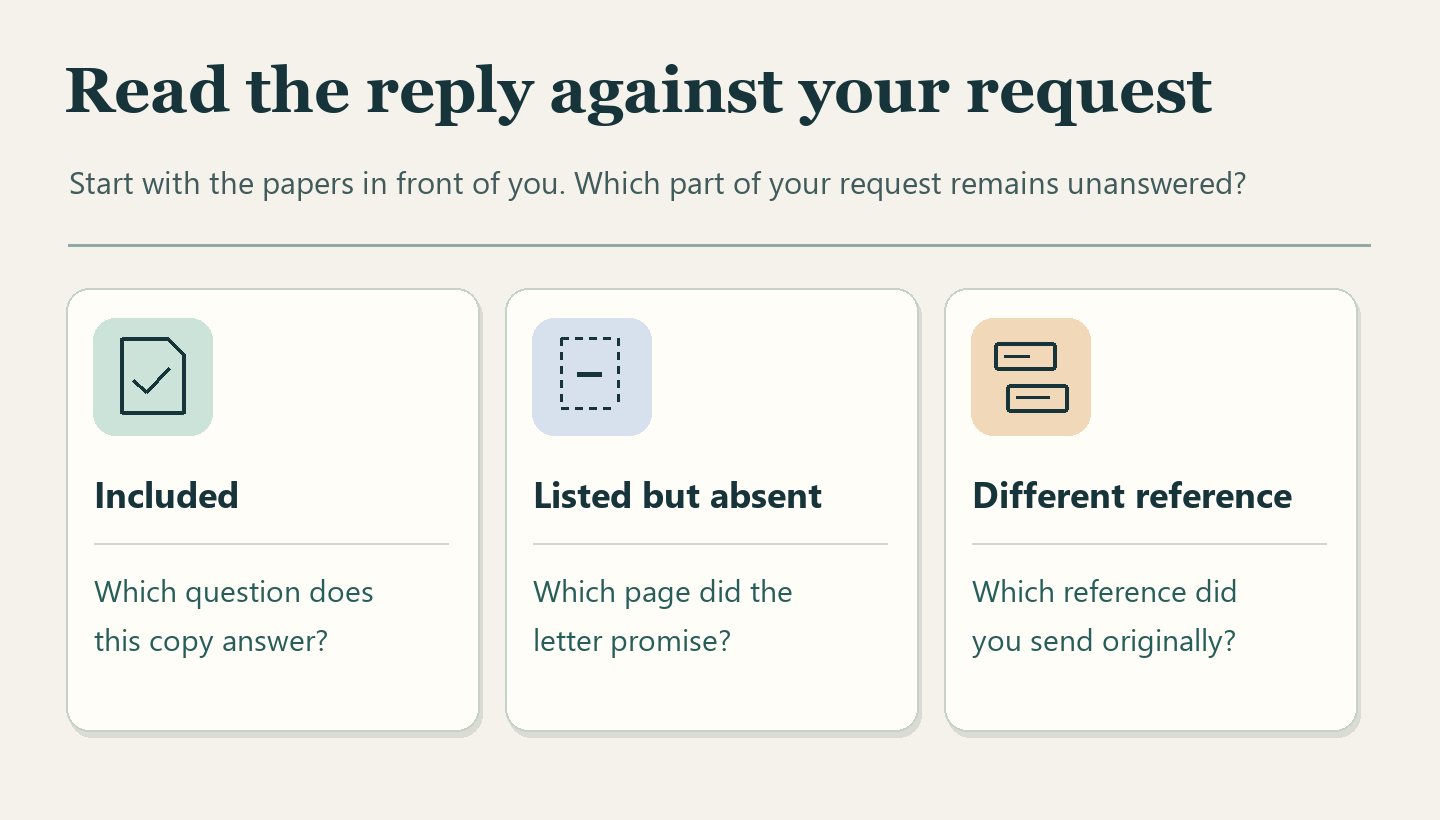
| What you expected | Reply contents | Question still open |
|---|---|---|
| Two pages promised | The letter refers to two enclosed pages. | Did both pages actually arrive with that letter? |
| Different reference | The reply describes an order with another reference. | Which reference did the business use for its search? |
| Duplicate page | The envelope contains two copies of one page. | Was the other promised page included somewhere else? |
For the first example, a letter promising two pages gives you something specific to quote. Say how many pages arrived and identify the one already in your possession.
For the second, look for the reference you supplied before assuming the business searched the wrong account. The reply might explicitly say that an old reference was replaced.
Look at pagination and enclosures when a reply refers to supporting pages. A missing attachment calls for a different follow-up than an application the business expressly declined to supply.
If an attachment opens blank, note its filename and what happened when you tried to read it. Ask for a readable copy before treating that item as missing.
Check whether the response concerns the same product and transaction before treating a missing item as a refusal. One customer can have a legitimate account alongside an unauthorized one.
When a search comes back empty
Consider a request based on a collection letter dated in April. Later, you find a provider letter identifying an opening date in February.
The later letter changes the search period. Tell the business where the new date came from and ask whether it can search the disputed February opening.
Keep the original April correspondence with the corrected request. Together they explain why the first search and the second search covered different months.
The law creates no new recordkeeping duty. It permits certain good-faith refusals involving inadequate identity verification or requests for internet browsing information.
An answer that no application was found leaves the question open. It does not establish that you opened the account, that no transaction occurred or that records were destroyed.
The business asks for additional proof
If the business says your copy was unreadable, ask which portion it could not read. A torn edge and a missing second page call for different replacements.
The response answers a different question
If the letter answers only your first question, quote the second question exactly as you sent it. Include the date of the reply that resolved the first one.
The business says it found nothing
Check the spelling, product, date type and reference you originally supplied. If those were accurate, ask which transaction the business understood you to mean.
What to Do With the Identity Theft Records You Receive
- Keep the reply as received and make a working copy for your notes. Mark a disputed entry on the copy so you retain the original context.
- Separate what the page actually says from what you infer. If a name appears beside the word “requested,” quote both together rather than describing the person as the recipient.
- Identify the question each copy helps answer. Send an investigator the relevant copies following that agency’s directions and keep a note of what you supplied.
- Set an unresolved item beside the original request and the business’s reply. Name the precise gap before asking the business or an appropriate agency for further help.
The Scottsdale Police victim packet illustrates the distinction. It seeks transaction evidence for misuse of an existing account and opening documents when a new account appeared.
Scottsdale asks people following its process to identify submitted copies with their police report number. Check your own investigator’s directions before using another department’s submission procedure.
Suppose two pages bearing the same reference show different spellings of a surname. Give the investigator the spelling on each page and identify the one you normally use.
That observation is more useful than guessing that a particular neighbor or relative placed the order. An investigator can evaluate other explanations without having to untangle your guess.
If a bank or lender fails to provide the records, the FTC points to the Consumer Financial Protection Bureau’s complaint process. It asks for key facts, dates and supporting communications.
For that purpose, a dated request, its enclosure list and the reply can explain the outstanding problem. Identify precisely which requested record still has no answer.
Frequently Asked Questions
Can I use this process for an order I placed myself?
Buying something yourself does not make a refund disagreement identity theft. Begin with the facts you know about the disputed purchase.
What if the letter came from a collection agency?
The letter can help identify the original business. The collector’s own notice and dispute process remain separate from obtaining the account-opening documents held by that business.
Can I ask for electronic application records?
Wisconsin’s example includes internet and telephone application records. Ask for the relevant format without assuming the record carries a handwritten signature.
Does getting the paperwork close the fraudulent account?
A response containing the paperwork answers a records request. Ask separately for written confirmation of what the business decided about continuing service, billing or the disputed balance.
What if I receive information about an unrelated customer?
Avoid circulating the unrelated record or using it to investigate that person. Alert the business through its verified privacy or fraud channel and ask how to handle the misdirected information.
Can someone helping me keep a copy of my identification?
A friend can read your list of unanswered questions while you keep your identification put away. Remove unrelated private information before sharing even a working copy at home.
The Bottom Line
Ask for the identity theft records that answer the question still open. With your request beside the reply, you can identify the missing piece without starting the story over.
If the company explains only the monthly charge, point to its answer and repeat the separate question about the equipment. Keep both letters so the next reader can follow.

Join the discussion
0 commentsShare your experience or ask a question about this article.
Community experiences
Did this happen to you?
Your experience could help someone recognize the same scam. Submit a private report for our team to review.
I experienced this tooReports are reviewed before publication. Sharing publicly is always your choice.
Discussion
Start the conversation
Have a question or something useful to share? Add the first comment.