


A 1099-G arrives with an amount you can’t place. You put it on the table beside the envelopes you were about to file away.
The payer, payment category, and tax year on that sheet give you a place to start, even if the envelope came from another state.
Overview
Which government payment the form describes
A Form 1099-G can cover several government payments, including unemployment compensation and certain state or local income tax refunds. Look at the label beside the unfamiliar figure.
States report unemployment compensation in box 1. Check the year on your copy before pulling statements from a different stretch of unemployment.
Which amount you actually recognize
A bank deposit gives you one piece of the picture. Find the benefit payment details for the same period so you can compare the amount before deductions.
If the entire claim is unfamiliar, write that down. A person who collected nothing needs a different explanation than someone who recognizes five payments and disputes the rest.
Which office can put the record right
Use the Labor Department’s state directory to find the unemployment agency where the disputed claim occurred.
For the papers you keep at home, start with these three questions. Each points to a different part of the problem.
- Which state or agency says it issued the payment, and for which tax year?
- Which amounts can I trace to my own benefit history, including any documented withholding?
- Have I received an actual payment, a tax statement, or a separate notice requesting a response?
Read the 1099-G before treating it as an unemployment claim
Consider a household that received a state income tax refund last spring. A government envelope arrives months later, when neither spouse has recently been out of work.
A form identifying a state income tax refund in the refund box calls for a different inquiry. Look for a box actually labeled unemployment compensation before pursuing an unemployment claim.
If the only figure is a refund you recognize, put the document with your tax papers. Ask about its tax treatment separately if you need help preparing your return.
Now imagine the same envelope contains two sheets. Read the recipient and payer on each page before combining anything, even when two relatives have the same last name.
A state logo and a form number can tell you what a document purports to be. They cannot tell you where any money went or who made a claim.
Keep the original intact, including a page explaining how to question the amount. If something seems suspicious, find the issuing agency independently before following instructions or sharing identifiers.
A useful note might describe a form from a named state, for a specific year, with an unfamiliar total in box 1. That gives the agency something definite to check.
Put gross benefits and bank deposits on the same footing
Suppose you recognize four weeks of benefits at $300 each. Your payment history shows $30 withheld from each payment and four matching deposits of $270.
The deposits add up to $1,080, while the benefits total $1,200. The $120 difference is already explained by the withholding entries attached to those four weeks.
In this example, a box 1 amount of $1,200 would agree with the benefit record. Those deposits alone give you no reason to report $120 missing.
California’s explanation of its benefit statement explains why a deposit can be smaller than expected. Federal withholding and child support deductions can affect what reaches your account.
California also points readers to the date a payment was issued. A week of unemployment at the end of December may need a closer look when comparing calendar years.
For your comparison, put the issue date, benefit amount before deductions, documented deductions, and amount received on one line for each payment you recognize.
If a statement groups several weeks into one deposit, match those weeks to the deposit total. Adding the deposit to the weekly figures counts the money twice.
Check the payment method used at the time. Searching only your present checking account can miss a genuine payment made to a different account or through a benefits card.
If records are missing, ask the state for the issue date and payment method behind each unfamiliar amount. A date range gives you a starting point for your own search.
When none of the benefits belong to you
Imagine that Jonah receives an out-of-state form showing $3,600 for a year when he never applied for unemployment anywhere. He has no benefit record to compare with that total.
His account statements can help establish what he received. They cannot tell him who opened a claim, which address was used, or what account received a payment.
Jonah can point to the issuer, year, and $3,600 in question. He can request a corrected statement without guessing who received the money.
Jonah records zero for the benefits he received. Keeping the original $3,600 figure in his notes helps him explain exactly what he challenged.
If another state later sends its own form, keep the documents apart. Jonah needs to know which agency received which report before he can match a correction to its source.
A corrected statement from the first state could resolve its $3,600 entry while leaving a second state’s figure unexplained. Compare the payer as well as the revised amount.
When you recognize part of the money
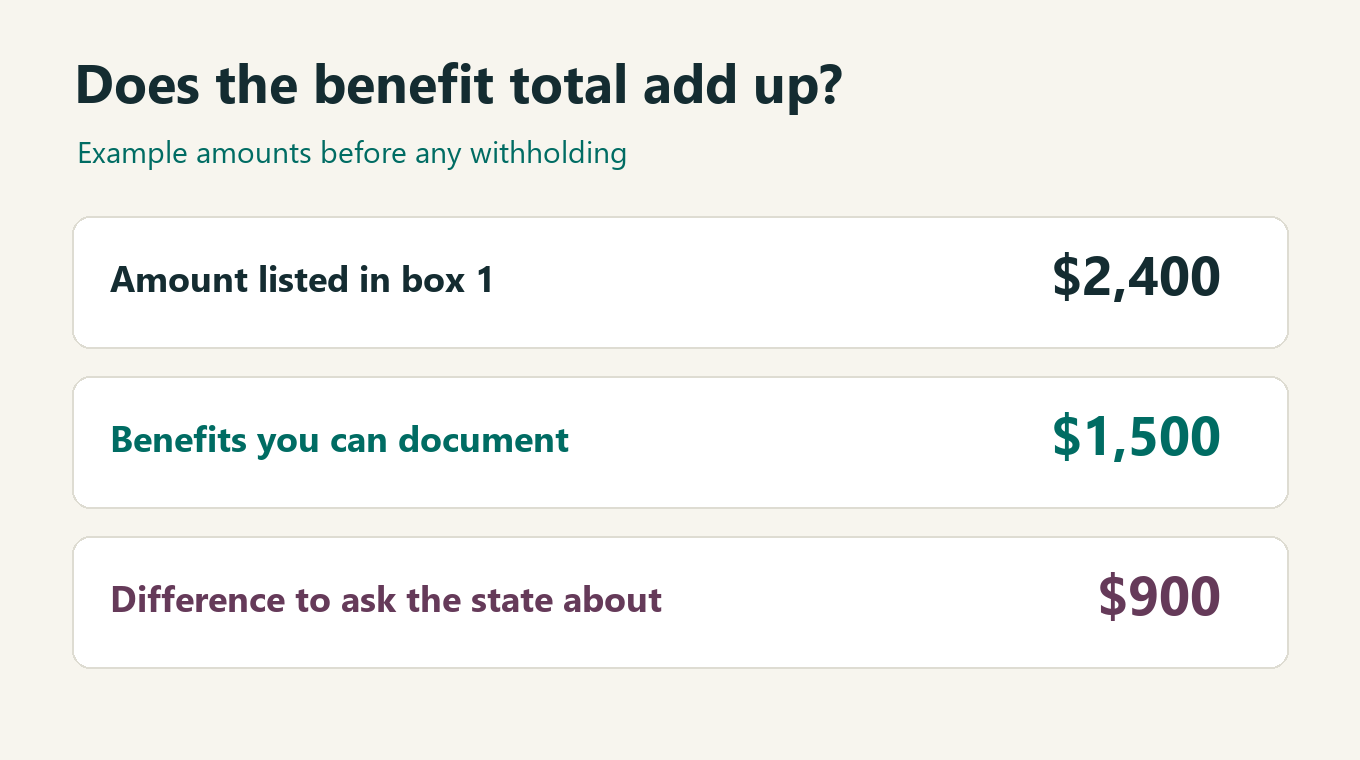
Take the example of Elena, who has payment records for five weeks at $300 before deductions. The state lists $2,400 in box 1 for the same year.
Five payments account for $1,500, leaving $900 unexplained. Elena can identify the weeks she recognizes and ask the state for the payment history behind the remainder.
She doesn’t need to accuse someone of stealing three checks. The arithmetic identifies a difference that the state can investigate using its payment records.
If the state identifies a later payment, Elena can compare its date and method against her own records. She can update the $900 difference as evidence arrives.
Tell the state promptly if someone redirected payments from a legitimate claim by changing the payment destination without your permission.
Include the last payment you received and the first one that went missing. That gives the agency useful dates without asserting that the entire claim belongs to somebody else.
Use these examples to identify the next question for the state and the information to retain for federal filing. The amounts assume the same year and no unexplained deductions.
| Box 1 on the form | What the reader established | Issuing-state question | Federal income comparison |
|---|---|---|---|
| $3,600 | No claim and no benefits received | Who can investigate the claim and correct this form? | No benefits from that claim |
| $2,400 | Five genuine payments totaling $1,500 | Which payments account for the remaining $900? | Keep the documented $1,500 visible |
| $1,200 | $1,080 received plus $120 withheld | Payment history explains the difference | Compare against $1,200 before withholding |
When an unexpected check, deposit, or debit card actually arrives
Money appearing in your account changes what you need to tell the state. Describe the date, amount, and payment method without treating the funds as yours to spend.
If you found only a tax statement, say that too. An instruction aimed at someone holding a check makes little sense for a reader who never had possession of one.
Pennsylvania’s unemployment fraud FAQ illustrates why the distinction matters. People who never applied should leave deposits unused, checks uncashed, and mistakenly issued cards inactive.
Pennsylvania gives different handling instructions for those items. Use the actual issuing state’s current guidance and confirm the route before sending a card, a check, or any payment.
If a caller says money was sent by mistake and offers a new account for repayment, end the conversation. Ask the issuing agency directly how to handle the original transaction.
Keep the envelope with the check or card. For an electronic deposit, preserve the transaction description and reference privately so the bank can identify the precise entry.
A card arriving in the mail tells you something different from a payment you accepted. Record whether it was activated or used and give the agency the facts exactly.
If funds were received and later returned, document both events, including who authorized the return. Ask the agency and a qualified tax professional how to account for your circumstances.
What to Do While the State Reviews Your Report
- Select the issuing state in the federal directory and open its reporting instructions.
- Describe the discrepancy in plain language, request a corrected statement, and keep the date and any reference you receive. Follow the state’s instructions for supporting documents.
- Put your calculation on top of the original form before handing the papers to your preparer. Mark any payment dates the agency still needs to explain.
The IRS guidance for unemployment identity theft says to file using only your actual income, even while you await a corrected form.
The state corrects the information it sent to the IRS. States vary in what proof they request and when they acknowledge reports.
A receipt that says your report was submitted tells you when it went in. Look for a separate decision or corrected statement before marking the state issue resolved.
If you use a preparer, bring the original document, the payment details, and your explanation together. A form dropped into a stack of tax papers can lose its context.
What should go in my private follow-up note?
On paper, record the issuing state, form year, reported benefits, documented benefits, and unexplained balance. Put the date of your report beside the case reference if one was provided.
Leave space for the next request and its deadline. Record which documents you sent so you can identify any later request for the same statement.
Record the date you receive a correction and check the revised amount against the benefits you recognize. If it still differs, refer to the same case when questioning the figure.
If the IRS later writes about your return
A state correction and an IRS letter can cross in the mail. Set the letter alongside the return for the year it names and read what the IRS is asking.
Use the IRS notice and letter guide to look up the notice number. Follow the instructions for that notice and respond by its deadline when a response is requested.
If the IRS asks about disputed unemployment, assemble the original statement, your calculation, and the state’s acknowledgment or correction. Identify which paper supports each part of your explanation.
For instance, the acknowledgment might establish the report date, while a payment history supports the actual amount. A confirmation of receipt alone cannot establish what the agency ultimately decided.
When you disagree with a notice, the IRS directs you to explain the disagreement and supply copies of supporting documents as instructed. Retain a copy of what you send.
If an electronic return is rejected, read the specific reason before assuming it concerns the state claim. An amount mismatch and a duplicate federal return are different problems.
Unemployment identity fraud alone doesn’t require Form 14039. File it if your e-return is rejected because the IRS already has a duplicate return under your Social Security number.
Also file the affidavit if the IRS specifically instructs you to do so.
Frequently Asked Questions
Should I report a tax refund elsewhere on the form as unemployment?
Read the label and identify the payment that produced the entry. Questions about a state tax refund belong with the payer or your tax preparer under that payment category.
Where can I check federal tax withheld from genuine payments?
The IRS instructions for Form 1099-G put voluntary federal withholding on unemployment in box 4. Box 1 shows the benefit amount before any income tax was taken out.
In the four-week example, four deductions of $30 give you $120 to compare with box 4. Adding that $120 to the $1,200 gross would count the withholding twice.
If the withheld amount itself is in question, ask for a breakdown by payment. Your preparer can then see which deductions belong to the benefits you recognize.
Does the $900 difference tell me how much tax I owe?
That figure measures how much of the reported benefits the example reader cannot explain. It contains no information about the reader’s tax rate, other income, or final liability.
What if I already filed before the form arrived?
The Labor Department advises against amending a filed return for this issue alone. Check current IRS guidance if the figures you reported were incorrect.
Can I use the federal instructions for my state tax return?
Your state income tax return has its own rules. Check that state’s tax agency guidance or ask a qualified preparer about your filing obligations there.
What if the corrected statement still includes unfamiliar payments?
On a copy of the revised statement, identify which entries changed and which ones remain unexplained. Keep the earlier statement attached so the reviewer can reproduce your comparison.
The Bottom Line
Report suspected unemployment identity fraud to the issuing state and request a corrected 1099-G. File your federal return on time using only the income you actually received.
If you already reported the claim, keep the acknowledgment with your payment calculation. Check the corrected form when it arrives and answer any separate IRS notice by its own deadline.

Join the discussion
0 commentsShare your experience or ask a question about this article.
Community experiences
Did this happen to you?
Your experience could help someone recognize the same scam. Submit a private report for our team to review.
I experienced this tooReports are reviewed before publication. Sharing publicly is always your choice.
Discussion
Start the conversation
Have a question or something useful to share? Add the first comment.