


If you feel seriously ill right now, get medical help first. In a US medical emergency, call 911 without waiting to identify the supplement.
When you’re ready to report a suspected reaction, someone may ask which bottle you used. That sounds simple until you’re looking at two almost identical labels.
Overview
Care comes before the paperwork
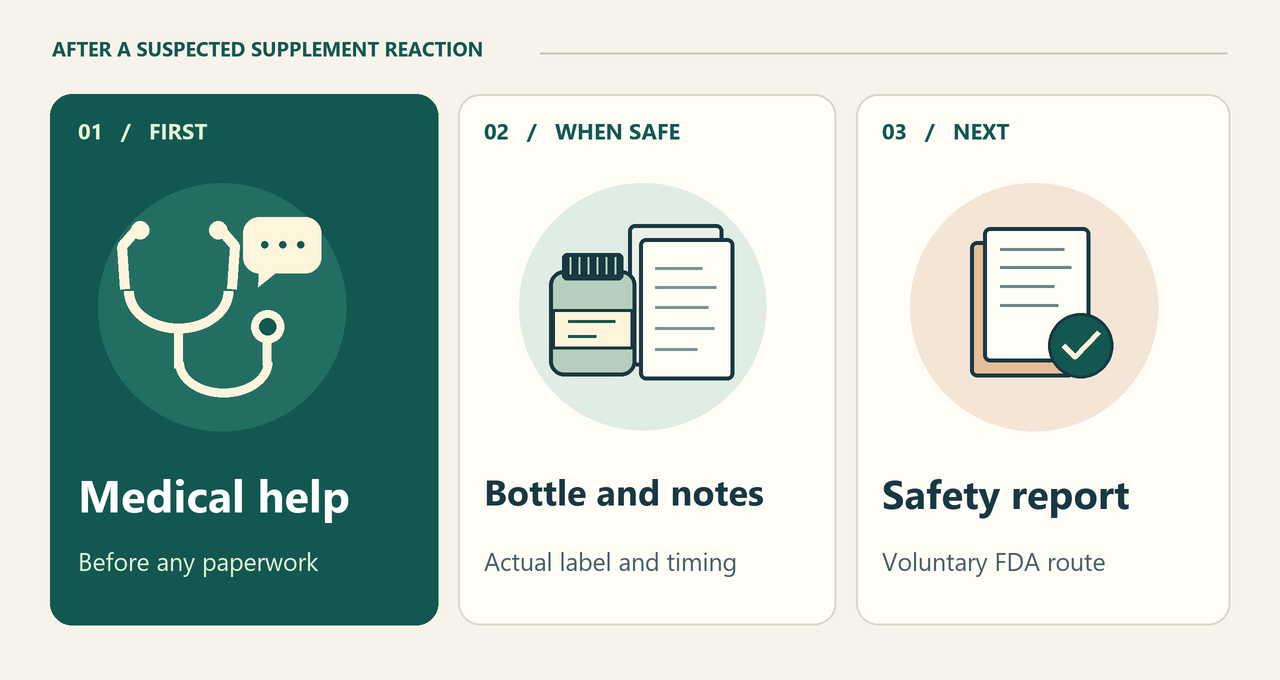
If you suspect a serious reaction, stop that supplement immediately and seek medical help. The label and the report can wait.
For a suspected reaction, contact your healthcare provider promptly. Your clinician can help you decide what to do next.
If someone is with you, they can bring the container if it’s handy. Otherwise, tell the care team what you remember and leave the cupboard search for later.
What belongs in a supplement reaction report
When you’re reporting a suspected reaction, you aren’t being asked to prove its cause. Your job is to describe what happened in terms another person can follow.
Think of the story in three parts. Keeping them separate makes it easier for someone who wasn’t there to understand what you actually know.
- The package tells you which product you have in hand, down to the particular version if the markings are readable.
- Your account tells someone what happened to you, including what you noticed before you thought to check the time.
- A receipt tells you what a store sold you, even when you can’t tell which container supplied a particular capsule.
Illness and a damaged package are different concerns
Imagine opening a carton and finding a split pouch that nobody has used. Describe where the split is; you don’t have to invent symptoms to make the complaint count.
Now imagine someone used the product and later felt ill. Describe both the illness and anything unusual about the package, without assuming that one explains the other.
The FDA accepts reports about either concern. This guide follows the US route for a dietary supplement used by a person.
How to Report a Suspected Supplement Reaction
Step 1: Tell the person caring for you what you actually took
Start with the name you know, even if that means saying you need someone at home to check the label. Plain language is enough for a first conversation.
Describe what you noticed, when you last used the supplement, and how you’re feeling now. There’s no need to find a medical term for something you can describe yourself.
The NIH consumer guide recommends telling your care team about the supplements and medicines you use. Remember the ones you take only occasionally.
Record how much you actually took if you know it. The serving printed on a label is somebody’s instruction, not a record of what happened in your kitchen.
Leave decisions about prescribed medicines to your clinician. Don’t take the suspect supplement again to find out whether the same thing happens.
Step 2: Pair each label with its own container
When you’re safe and ready, set the actual package aside. Keep its carton, insert, or individual wrappers if you still have them, preferably without separating matching pieces.
With a phone, take one picture of the whole container before photographing small print. That first picture gives the close-ups a home if several similar files land together.
Capture the front, ingredient panel, company information, and any readable lot or date marking. Turn the container to avoid glare rather than tracing over faint ink.
Keep the original pictures even if you crop a copy for readability. A tight crop can make one character clearer while cutting away the word that identifies the code.
For instance, a sharp number beneath an expiration heading is still an expiration marking. Don’t put it in the lot field just because it’s the clearest number you have.
Single-use packets deserve their own look. If you saved the empty packet but not the carton, its wrapper may be the only item you know you actually opened.
Record the words on that wrapper first. An unopened packet from the same pantry is useful for comparison, but label its photo as a comparison, not the used wrapper.
Suppose two open bottles sit next to a weekly organizer. One says citrus and one says berry, but the loose gummies in the organizer look alike.
Photograph each bottle on its own and describe the organizer separately. Two candidate bottles do not add up to evidence that you used both products that day.
If the person who filled the organizer remembers using the berry bottle, record whose recollection that is. If nobody remembers, leave the choice between bottles open.
Step 3: Use the order record without making it speak for the bottle
Read the purchased item line from your actual receipt or order confirmation. An online store may show a different version today, even when the link in your email still works.
Imagine your order says powder, but the jar left beside the kitchen sink says gummies. The receipt can establish a purchase without identifying what you swallowed.
Write those as two separate entries and flag the mismatch. You might later find the powder carton, or learn that the jar belonged to somebody else.
A gift presents a different problem. You may know exactly which pouch you opened but have no idea where it was bought. That still leaves a useful product description.
Ask the person who gave it to you for the package description if appropriate. You don’t need access to their shopping account or a copy of their entire order history.
Step 4: Put the events in order before reaching for a clock
Start with the event you can place most confidently. Build outward from there instead of starting with an exact time and trying to make everything else fit.
Your first notice of a symptom, the first time you told someone, and the first time they saw you are three different moments. Label whichever moments you can place.
Here’s a fictional example: You remember using a supplement after breakfast. You later texted a friend that you felt unwell, but you didn’t look at the clock when that began.
Too certain: “My symptoms began at exactly 10:18 that morning.” The time on your message shows when you sent it, not the moment you first felt unwell.
More useful: “I used the supplement after breakfast. I already felt unwell when I sent my message at 10:18, but I don’t know when the symptoms started.”
Now suppose a friend texted you at 10:05 asking how you were. That incoming message doesn’t establish that you felt well then, particularly if you didn’t answer it.
If the day is uncertain, use a meaningful range. “Between returning home Sunday evening and leaving for work Monday morning” tells a reader more than a guessed calendar date.
Travel can make an accurate clock time look wrong. Suppose you used a product before a flight and first noticed a change after landing in another time zone.
Write the departure city beside the first time and the arrival city beside the second. There’s no need to convert them in your head while you’re feeling ill.
If all you remember is that it happened during the flight, keep that description. The time printed on a boarding pass is not the time a symptom appeared.
When a clinician gives you a written finding, use their wording and identify it as theirs. If you’re still waiting for results, say which information isn’t back yet.
Step 5: Send what you know through the consumer route
Follow the FDA’s supplement reporting instructions to the Safety Reporting Portal. Choose the voluntary route for consumers.
Consumers have the option to report as guests. Manufacturers have separate reporting obligations that don’t set a deadline for you.
A missing lot number needn’t hold up your report. If a mark is partly visible, describe the legible part instead of guessing the rest.
Before submitting, read the account as if it concerned a stranger. Can you tell which details came from the package, which came from memory, and which remain uncertain?
For assistance, the FDA Human Foods Program lists a phone option for complaints. Keep the package; don’t mail products to its general correspondence address.
A Private Worksheet for the Bottle, the Receipt, and Your Notes
Use a sheet of paper or a private note with room for later corrections. You don’t need a special app, and this worksheet doesn’t send anything anywhere.
| What to record | A useful place to look | When the detail doesn’t fit |
|---|---|---|
| Full product name and form | Copy the wording on the container you used. | Identify other possible containers separately rather than combining their names. |
| Lot or other printed code | Keep a photo that includes the words next to the marking. | Describe a rubbed-off character instead of completing the string from memory. |
| Purchase source and date | Look at the actual order confirmation or store receipt. | Separate when you ordered something from when you first used it. |
| Your experience and its timing | Start with what you noticed or what a witness saw. | Explain whether the time comes from memory or a dated record. |
| Care and subsequent changes | Refer to your own visit notes if readily available. | Distinguish a planned appointment from one that has already happened. |
On paper, leave space next to each uncertain entry. A correction can then sit beside the original instead of floating on another page without a clear reference.
Consider a smudged lot marking ending in either a zero or the letter O. Write down the portion you can read and say why the last character is unclear.
If you later find a box with crisp printing, work out whether it belongs to this bottle. A clean label from last month’s purchase doesn’t repair this month’s smudge.
There is also a difference between the date a photo was taken and the date someone sent it to you. Label a forwarded photo with whichever date you know.
For photos you plan to share, look at the edges as well as the label. A readable lot code doesn’t require a relative’s prescription label in the background.
Keep an untouched copy somewhere private and make a separate copy containing just the relevant material. A group text or public product review isn’t the place for health records.
What to Do After You Submit Your Report
-
Save the confirmation while it’s in front of you. The portal help identifies the ICSR ID (Individual Case Safety Report ID) as your receipt.
If offered a copy, save it privately with the date submitted. Give it a name you can distinguish from the notes you were still editing beforehand.
-
Keep any guest Report Key private. The latest key lets a guest follow up; the receipt number serves a different purpose.
If you need help finding a file on a shared computer, ask about its location without forwarding the file itself.
-
Keep a short note about anything that changes. For that person’s correction, update the latest report. Save a separate copy of the new version.
Suppose someone finds a clear photo taken before the bottle got wet. Give the corrected character and explain where you could read it.
-
Give another affected person a separate report. Make a fresh page in your notes before talking through the second person’s experience.
For example, one sibling used the product on Monday and another on Wednesday. Check the dates against their own notes before using a shared package photo.
What if I can’t find the guest key?
Check your saved copy for the key. If you can’t recover it, make a new report mentioning the earlier submission.
What the FDA Can Learn From One Report
A receipt tells you that information arrived, not what caused an illness. The FDA’s explanation of its complaint data shows why those are different things.
One person’s report can mention several products. In the product-based data, those entries occupy separate rows; counting rows as though each were a different person gives the wrong answer.
Imagine two products listed for one person who used both. That gives you two names to consider, not two independent witnesses and certainly not a comparison between the products.
A stack of reports doesn’t tell you how often a reaction occurs among everyone who uses a product. Someone else’s entry also can’t explain what happened to you.
Reports can help the agency decide what deserves attention. Submitting one doesn’t guarantee a personal investigation, a recall, or reimbursement, and waiting for those outcomes isn’t a care plan.
Frequently Asked Questions
Can I report if I didn’t visit a clinic?
Yes, the FDA welcomes suspected supplement reactions even without a clinic visit. Say whether you sought care, without treating the absence of a visit as evidence about the cause.
What if my sister is helping write my account?
Tell her what you felt in your own words. She can add what she actually saw, such as when you stopped an activity, without turning your recollection into her observation.
Which date belongs in my notes if shipping took a week?
Label the order date, delivery date, and first use separately when known. A tracking notice can pin down delivery without telling anyone when you opened the package.
Should I use a retailer’s photo if my container is gone?
A store photo can illustrate what you think you bought, but identify it as a listing photo. It cannot recover your missing lot code or establish which version arrived.
What if the label lists a blend, not separate amounts?
Copy what the label actually says and keep any stated amount attached to the right line. Don’t divide a blend total among its ingredients to create missing numbers.
Do I need the company’s agreement before contacting the FDA?
You can report directly without waiting for a company representative. If you separately contact the company, keep its reply identifiable as company correspondence, not an FDA acknowledgment.
The Bottom Line
Get medical help first, then report the suspected supplement reaction through the FDA’s consumer route. An honest account with a missing detail is more useful than a confident guess.
Keep the bottle apart from everyday supplies so nobody accidentally uses it. If someone asks which product you meant, you can show them the actual label.

Join the discussion
0 commentsShare your experience or ask a question about this article.
Community experiences
Did this happen to you?
Your experience could help someone recognize the same scam. Submit a private report for our team to review.
I experienced this tooReports are reviewed before publication. Sharing publicly is always your choice.
Discussion
Start the conversation
Have a question or something useful to share? Add the first comment.