


You turn a supplement bottle over to read its lot number. On your screen, the certificate of analysis has three different numbers near the top.
Which one goes with the bottle, and what should you make of the neat column of results underneath it?
Overview
What was actually inside the sample?
Before reading the results, look for the description of the material that arrived at the lab. It might name a single ingredient rather than anything you’d recognize from the shelf.
A bag of powdered lemon extract and a finished lemon chew could both carry the same brand name. A finding about the powder belongs to the powder.
The FDA manufacturing guide for dietary supplements, for example, uses “certificate of analysis” for information a supplier provides about a component.
When a store offers a supplement certificate of analysis, find out which material its document describes. The heading alone won’t tell you where the sample came from.
Which number connects that sample to your purchase?
A laboratory needs a way to find its own paperwork. A packer needs a way to identify the packages it filled. Those numbers can serve quite different purposes.
Think of a repair ticket and a bicycle serial number. Repeating your ticket number doesn’t identify the bicycle without the shop’s record connecting the two.
Make two short notes before trying to connect anything. Keep words like “sample” or “lot” beside their numbers, rather than collecting a string of digits without their labels.
- On the package side, copy the product name, form, identifying code and the words printed next to that code.
- On the document side, copy the sample description, its identifier, the report reference and any packaging lots it explicitly covers.
- Between those notes, leave room for the answer to one question: who says the finished sample came from the batch used for this package?
What are you hoping the result will tell you?
Suppose you want to know whether a tablet contains a particular ingredient. That calls for different information than a question about how much of it the tablet contains.
Write the question before browsing the tables. Otherwise, it’s easy to find an impressive number, forget what you wanted to know, and give the seller credit for answering.
The FTC’s guidance on evidence for health claims explains why evidence must fit the promised benefit. Measuring an ingredient in a tablet doesn’t tell you whether anyone slept better.
How to Match a Supplement Certificate of Analysis to a Package
Step 1: Read the package before opening the report
Use the package you’re actually asking about, not a product photo from an order history. Include the flavor, strength wording, and whether you bought tablets, powder, capsules or another form.
Photograph the whole identification area, then take a closer picture if the ink is faint. Keep the edge of the label in view so you know where the number appeared.
Say your bottle shows LOT A081 beside a best-by date. Copy the leading zero, and keep the date separate. Don’t quietly turn a blurry character into an eight.
If nothing says “lot,” use the words you actually see. A purchase date or product barcode can help describe the item without necessarily distinguishing one production run from another.
FDA’s guide explains that manufacturers can use other ways to trace products besides printing a lot number on the package. A missing code alone doesn’t establish a violation.
Step 2: Find the sentence that describes the sample
Read the report header together with the description beside the results. A product name on the cover might be the customer’s project name, not the lab’s description of the sample.
Look for words you can picture, such as loose powder, uncoated tablet, or finished chew. If the report says only “sample supplied,” the stage is still an open question.
In a two-page file, check that both pages carry the same report reference. A page number can tell you something is missing without explaining what the missing page says.
A report number identifies a document; a sample number identifies material within that document. This matters when one report discusses several samples.
If a table has separate columns for sample A and sample B, follow one column down. Don’t borrow the description from the first and the result from the second.
Step 3: Ask for the link between packaging and finished batch
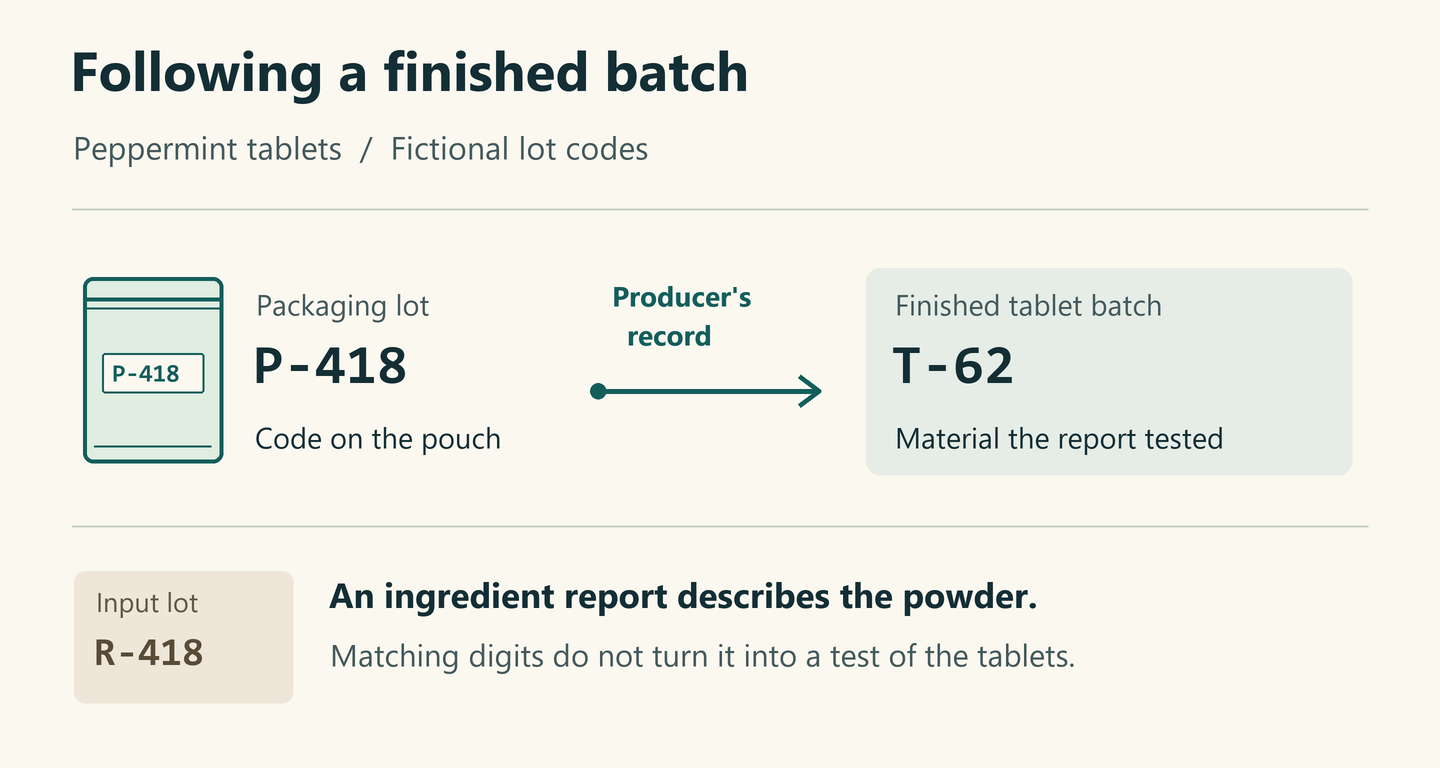
Consider a fictional pouch of peppermint tablets marked P-418. The report covers finished peppermint tablets T-62. A second document covers peppermint powder R-418. These invented letters have no standard meaning.
The powder shares the pouch’s last three digits. Even if the producer confirms that powder went into the tablets, the powder test still happened before those tablets existed.
Suppose the producer identifies T-62 as the finished batch packed into P-418 and names the corresponding report. Now there’s a reason to read that report’s tablet results for this pouch.
A different reply might say T-62 went into P-419 only. In that case the report belongs with a different pouch. Ask for the record that covers P-418.
What if the reply simply says all peppermint products undergo testing? That reply leaves your pouch unidentified. Keep it as a general statement, not as a link to T-62.
These are three distinct outcomes: a documented connection, a specific contradiction, or no answer about this package. Only the first gets you to the next question about the results.
Step 4: Read one test across the page
Put a finger on the property tested, then follow that row to the method, result, units and criterion. A criterion is the target or limit used to judge the result.
The method is how the lab looked for that property. A method name beside an empty result shows what the document references, not what the sample actually yielded.
Read the heading above a number as carefully as the number itself. “Maximum” at the top of the specification column is a requirement, not a measured amount in the sample.
For an identification test, a finding that the material matched a reference can be useful without a concentration. The lab wasn’t trying to measure an amount.
Conversely, if the only outcome shown is “pass,” you can describe the stated judgment. You can’t calculate how close the measurement came to the limit without more information.
Put a substance on your list only when the test names or clearly includes it. If a summary skips the test you wanted, the omission isn’t evidence the sample failed.
For a less-than sign, try the four comparisons below. If a label and a result seem to disagree, check the quantity each number describes.
When a Number Is Too Vague to Answer the Question
Here’s a pencil-and-paper exercise using invented, unitless scores. There is no real substance or safety threshold behind these numbers. The sole rule for this exercise is “at most seven.”
| What the row says | What you can decide |
|---|---|
| The reported score falls somewhere below nine. | Both six and eight fit the description, so the rule remains undecided. |
| The reported score falls somewhere below five. | Every score below five is also below seven, which settles this particular comparison. |
| The report gives a score of seven. | Seven meets this rule because “at most” includes the endpoint itself. |
| No score appears for this sample. | There is nothing here to compare with the stated maximum. |
Watch what changes if the criterion says “less than seven” instead. The third row now misses the target, although the measured score hasn’t changed at all.
For a result marked “ND,” start with the report’s key. If ND means “not detected,” ask for the detection limit of that test in the same units.
The EPA’s explanation of detection and quantification makes a useful distinction: a method can pick something up at a level too low to measure precisely.
Read “below the quantification limit” with that distinction in mind. Ask which bound applies before comparing it with a maximum, and don’t replace an undisclosed bound with zero.
Get the Two Quantities onto the Same Basis
Compare two descriptions of an invented tablet coating. One reports an average of eight milligrams of coating per tablet. The other describes 24 milligrams of coating per three tablets.
Three times eight gives 24, so the numbers agree on average for the same tablet count. That arithmetic doesn’t tell you precisely how much coating any single tablet carries.
Change one word in the second description from “coating” to “colorant,” and the answer changes. The total coating can include more than colorant; multiplying by three won’t separate its constituents.
Now imagine the first number is eight milligrams per gram of finished tablets instead. Three tablets are a count, not a mass. You need their weight to make that conversion.
For a per-serving label comparison, use the number of units the label actually identifies as a serving. Keep the same ingredient, chemical form and measurement basis on both sides.
If a sheet gives an amount per gram of dry material, adding water changes the denominator. Don’t use the prepared drink’s total weight as the weight of the powder.
Write down what you multiplied and what canceled out. If you still have “per gram” on one side and “per tablet” on the other, put the calculator aside.
This exercise compares quantities on paper. It isn’t a way to choose a serving, adjust what you take, or decide whether a supplement suits you.
What a Lot Match Leaves Open
Suppose someone shares the right tablet report but crops off the footer identifying the version. Ask for the complete file so that corrections or qualifications aren’t separated from the result.
Two versions of one report need not describe two tests. Compare their report references, revision notes and sample identifiers before treating the newer date as fresh testing.
A correction changing the sample from powder to tablets matters more than a corrected street address. Find out which version the issuer stands behind before using it.
If a result comes from several tablets pooled together, describe it as a finding about that combined sample. You can’t pick out the highest individual value from the average.
The U.S. finished-batch verification rule allows manufacturers to verify every finished batch or a statistically sound selection of batches. It doesn’t require a separate test for each retail bottle.
The same rule sets conditions for relying on supplier certificates for certain component checks. Dietary ingredient identity has a separate testing requirement, with an exemption available by approved petition.
Those manufacturing requirements don’t give shoppers a right to download a finished-lot certificate. If a company doesn’t share one, the immediate conclusion is about what you can verify, not contamination.
Bundle and refill warning
A lab report applies to a sample. It cannot tell you how many bottles are in your cart, the total you’ll pay, or whether you’ve agreed to refills.
Before paying, compare the final quantity and full charge with the order you meant to place. Check for a recurring price and schedule if a refill option is offered.
What to Do If You Have the Bottle but Not the Answer
-
Keep the package and the report together while you check. If you have two bottles, mark their pictures separately so the receipt for one doesn’t get attached to the other.
-
Give the company the smallest useful set of details: product variant, package code, report reference and the exact test you care about. A label photo can resolve a hard-to-read character.
-
Ask one answerable question about the missing link. For instance, which finished batch filled this packaging lot, and which sample and page show the result for that batch?
-
If some information is confidential, ask for a written confirmation naming both codes and the sample stage. There’s no need to request a supplier’s prices or another customer’s information.
-
Save the reply alongside the version you read. Record whether it resolved product identity, supplied a missing result or simply explained why no further information is available.
-
If lot-specific testing was the reason you ordered, check the seller’s return conditions while you await clarification. Keep the package unopened if opening it would affect your options.
Frequently Asked Questions
Can two packaging lots share a finished-batch report?
Yes, if both lots came from the identified finished batch. Ask for both packaging codes in the explanation instead of assuming that what covers one pouch also covers its neighbor.
Should the lab’s sample date match my purchase date?
No, those dates describe different events. Use the sample date to identify the test and the purchase date to document your order; neither date supplies a missing batch connection.
What if a lookup returns a different flavor?
Keep the mismatch even if the bottle count and strength agree. Ask whether the file covers your flavor explicitly, since an entry for mint alone doesn’t identify orange tablets.
Can I compare two laboratories just by their results?
First check that both examined the same type of material for the same property on the same basis. If the methods differ, ask for help interpreting any apparent disagreement.
Does hiding the customer’s address invalidate the report?
No, that detail alone doesn’t settle its usefulness. A redacted address matters less for matching a bottle than a hidden sample description or half a lot number.
What if I haven’t ordered and don’t know the lot?
An example can show what information the company shares. If the seller can’t identify the lot you’ll receive, read the file as a sample of its reporting, not your result.
The Bottom Line
Rely on a supplement certificate of analysis for a specific finding only when you can trace your package to the finished sample and read what that test actually measured.
If you bought the bottle for a result that still doesn’t match, keep its packaging, request the missing link in writing and check your return deadline before it passes.

Join the discussion
0 commentsShare your experience or ask a question about this article.
Community experiences
Did this happen to you?
Your experience could help someone recognize the same scam. Submit a private report for our team to review.
I experienced this tooReports are reviewed before publication. Sharing publicly is always your choice.
Discussion
Start the conversation
Have a question or something useful to share? Add the first comment.