


You’ve picked the mixer, checked the delivery date, and nearly finished paying. Then the store asks whether you want two years of protection.
The mixer already comes with a warranty. Before deciding what another two years might be worth, find out when the clock starts and what would actually get fixed.
Overview
Three promises can travel with one order
Say the mixer arrives and doesn’t fit under your cabinets. Nothing has broken, so the first document you want is the store’s return policy, not its repair instructions.
Now picture the same mixer sitting comfortably on the counter when its motor stops. A closed return window doesn’t answer whether you still have a warranty remedy.
A paid protection plan is a third agreement.
Give the extra charge a specific job
Before reading the pitch, decide which inconvenience you’d gladly pay to avoid. A costly motor replacement, broken glass, and three weeks without the appliance are three different problems.
- Write down the particular failure or accident that worries you, using ordinary words.
- Look for something the paid agreement changes: the covered event, your bill, the available service, or the time protection lasts.
A return label and a repair ticket go to different places
You might need the store for a return, the manufacturer for an included repair, and a separate business for the paid plan, all for one purchase.
The useful name is the one next to the promise you’re trying to use. A familiar logo at checkout doesn’t tell you who will authorize work next spring.
What the shelf price already bought
Find the warranty for the exact model and condition you’re considering. The FTC’s consumer guide to warranties says warranty terms should be available before purchase, including online.
A comparison between a new mixer and an open-box one is only useful if you have the promise that goes with each. Don’t borrow the new unit’s document by default.
Look for the part, the work, and the remedy in separate sentences. A promise to supply a replacement motor answers the parts question but might leave an installation bill.
Imagine a fictional warranty that supplies a covered motor without charge but makes the owner pay the technician. A proposed service contract says only that covered parts are free.
Would the plan pick up the labor charge? Neither the heading nor the word “parts” says it would. Until the contract addresses labor, leave that potential saving out.
A plan that explicitly includes installation would change the comparison. It could add a benefit during the first year even if both agreements finish on the very same day.
Read what happens after the provider accepts a claim as well. A repaired appliance may be exactly what was promised, even when you’d rather put the money toward another model.
Sometimes the better deal is a different purchase
Consider two fictional mixers that suit the same kitchen equally well. One costs $215 with parts and labor included for a year; another costs $190 with parts alone.
The cheaper mixer offers a $40 plan that adds first-year labor. Buying it brings the total to $230, or $15 more than the mixer with labor already included.
That doesn’t make the $215 mixer better in every respect. It answers a narrower question: which purchase costs less if this particular repair benefit is all you’re comparing?
If the $40 plan also includes an in-home visit you would genuinely use, give that separate benefit a name. You can then decide whether it’s worth the $15 difference.
Put the fault on the calendar
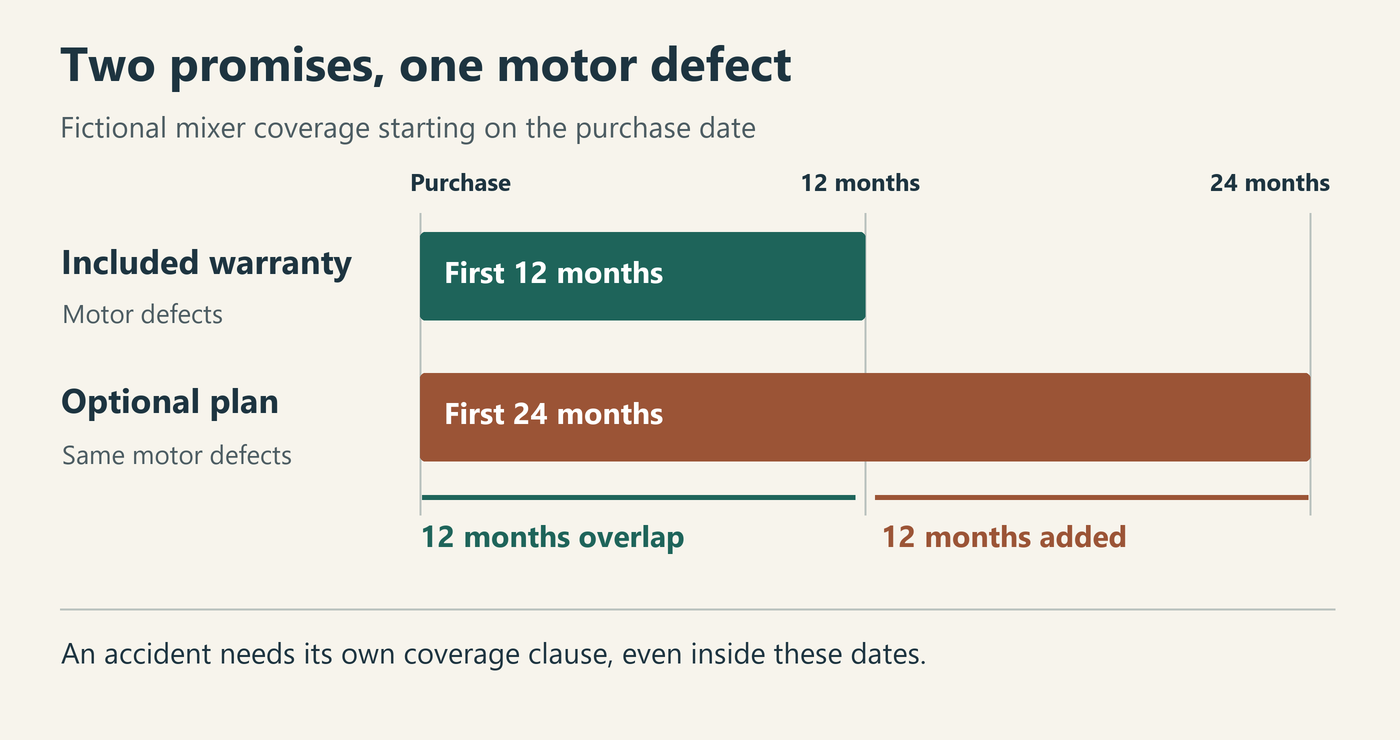
For a fictional mixer, assume the included warranty covers motor defects in months one through twelve. An optional motor repair plan covers the same defects in months one through twenty-four.
Count from the purchase date for both, as these invented terms specify. The second bar has twenty-four months on it, but only twelve extend that motor protection beyond the first.
At month eight, the two bars cover the same motor defect. At month eighteen, only the paid bar remains. Nothing in that arithmetic predicts when a motor will actually fail.
Move a dropped glass bowl along those same bars. If both promises exclude accidental breakage, the longer bar gives you no bowl protection, even on its last day.
Change just one term: suppose the paid plan covers one accidental bowl break from purchase. Now it adds something in month eight, although it doesn’t add motor coverage time there.
Keep the event and the month together when describing the benefit. “One bowl accident in the first year” says much more than “two years instead of one.”
Some offers may genuinely start after the included warranty ends. Look for a starting event in the agreement instead of adding its advertised term to the manufacturer’s term yourself.
More months can still miss the part you need
Consider a different fictional purchase, a portable speaker with an optional plan that starts in month thirteen. The plan covers an electronic amplifier fault but expressly excludes battery capacity loss.
The buyer’s concern is a battery that holds progressively less charge. There is no first-year time overlap, yet this plan buys nothing for the one problem driving the purchase.
If the buyer instead worries about amplifier repair, the very same dates become relevant. Read the price and repair terms for that specific benefit before deciding.
Price one repair both ways
Suppose a service contract costs $48 upfront. For one approved repair outside any other coverage, the buyer also owes a $25 deductible and $12 shipping.
These are fictional US prices, not market averages. Assume the repair is eligible, the plan pays the rest, and no taxes, reimbursement caps, or additional charges affect either choice.
| What happens in this example | Without the plan | With the plan | Difference for the buyer |
|---|---|---|---|
| No repair needed | $0 | $48 | The plan costs $48 more this time. |
| One eligible $65 repair | $65 | $85 | The plan costs $20 more this time. |
| One eligible $180 repair | $180 | $85 | The plan costs $95 less this time. |
The right comparison at checkout is $85 against the whole repair bill: $48 to buy the contract, plus $37 to use it once. Under these assumptions, $85 is the tie.
That isn’t a prediction that a repair will cost $85 or that you’ll need one. It’s a dividing line you can use with an actual repair quote.
Your question changes if you’ve already bought a nonrefundable plan. With the $48 spent either way, compare the remaining $37 with the price of handling this repair yourself.
On the $65 repair, making an eligible claim now saves $28 in additional spending. Buying the plan originally still cost $20 more for this particular outcome.
Both answers can be right because they answer different questions. This is why a successful claim doesn’t necessarily mean buying that contract made financial sense beforehand.
What changes if the plan reimburses only part of the bill?
Try a different fictional contract with no deductible or shipping, a $48 plan price, and a maximum payment of $100 toward one otherwise eligible $180 repair.
You pay the remaining $80, bringing your total to $128. The saving is $52 against paying $180 yourself, not the full repair cost advertised on the estimate.
The FTC’s service contract guide recommends checking charges, limits, and the claims process. Use the actual contract’s numbers where this exercise uses invented ones.
When you don’t know the repair price, write it as an open question. A single owner’s expensive repair story isn’t a reliable estimate of how often yours will fail.
Who promises the repair, and who books it?
Look for the warrantor on the included warranty and the provider or obligor on the service contract. Those names tell you who made each promise.
The administrator may be the company arranging appointments and issuing claim numbers for the provider.
The FTC’s business guide distinguishes a seller making a contract from one acting as another company’s agent. Selling the plan doesn’t necessarily make the retailer its issuer.
Here’s how that distinction helps with a purchase. Suppose your receipt names the store and your plan confirmation names a separate provider, but neither gives a repair address.
Find the contract’s service instructions before shipping anything. A provider may ask for authorization first; posting a mixer to the address used for ordinary returns doesn’t open that claim.
If somebody says to arrange your own repair, ask whether you need written approval, which work is authorized, and what you’ll need to be reimbursed.
Someone who can’t advance the full repair bill may prefer a direct-pay repair even when two plans promise the same final benefit. Time without the money matters too.
Consider the physical trip as well. A carry-in repair across town and a mail-in repair requiring the original-size box impose very different burdens on a buyer without a car.
If the main draw is getting back to work quickly, look for an actual turnaround promise or loaner benefit. The words “priority service” alone don’t set a completion date.
When the written warranty doesn’t settle everything
US state law can supply implied warranties, including a merchant’s promise that goods are fit for their ordinary purpose. The rules vary, including what an “as is” sale can exclude.
A legal deadline for bringing a claim isn’t a promise that every household appliance will last that long. Don’t use a nationwide lifespan as the baseline for your calculation.
If a seller steered you to a particular model for a special job, preserve that exchange. Write down the job you described and the specific recommendation you relied on.
For a dispute about a particular state’s protections, take those details to the state’s consumer protection office or a qualified lawyer. Keep that question separate from the paid plan’s wording.
What to Do If You Already Bought the Product or Plan
-
Put the order receipt, exact model number, written warranty, and any separate plan confirmation together. Label the documents so another person could find the correct one without your help.
A family member given the appliance may have only a gift receipt. Check transfer or registration requirements before promising that someone else can claim under your agreement.
-
Identify what went wrong and when you first noticed it. Describe what the appliance did, not which internal part you think caused it to fail.
A short recording of a mixer stopping under ordinary use can explain the symptom. Don’t keep running damaged equipment just to make a more convincing recording.
-
Report the problem through the route for the promise you’re relying on. Save a dated acknowledgment, claim number, or delivery confirmation, not just a copy of an unsent message.
Imagine you report a covered fault in month twelve, then receive the first repair appointment in month thirteen. Keep the original ticket tied to that same fault.
The FTC says a covered defect reported during the warranty must still be corrected if the repair remains unresolved at expiration. That doesn’t extend coverage to unrelated later failures.
-
Ask what remedy has been authorized before you commit to postage, parts, or local labor. A company may be entitled to repair a product before giving a refund.
If a repaired item comes back with the same problem, refer to the previous work order. Ask the warrantor what it will do next under that original report.
-
If a claim is declined, request the reason and the contract provision used. Compare both with your dated records before deciding whether the response answers your actual claim.
A denial for accidental damage, for instance, deserves a different reply from a denial based on the purchase date. Address the stated reason with the evidence that bears on it.
Frequently Asked Questions
Do I lose the product warranty if I decline the paid plan?
An included warranty and an optional paid agreement are separate. Read the included warranty’s own eligibility terms; turning down an add-on isn’t the same as giving up that promise.
Must I register every product to have any protection?
Check the applicable warranty and its conditions rather than assuming registration always matters or never matters. Registration for a paid plan is another question, as are state-law rights.
Can I use a protection plan for a fault I already noticed?
Don’t buy coverage expecting it to solve an existing problem. Check when the fault appeared and use the applicable return or warranty route already available to you.
What if the plan offers replacement instead of repair?
Find out whether the agreement promises a new unit, a refurbished substitute, or credit toward another purchase. Compare that particular remedy with what you would otherwise pay for.
Does returning the product automatically cancel the service contract?
Check both confirmations and the contract’s cancellation terms. If your merchandise receipt shows only the product refund, ask separately what happened to the plan charge and keep the answer.
Which papers matter if the product was a bundle?
Match the covered model or serial number to each item. A plan naming the main appliance may leave an accessory outside the agreement even though both arrived together.
The Bottom Line
Buy the protection plan only if you can name a useful benefit beyond the included warranty and justify its full cost. Otherwise, leave the extra charge out of your order.
If something has already broken, use the promise that covers that fault. Report it before the applicable deadline, keep proof, and ask who must authorize the next repair.

Join the discussion
0 commentsShare your experience or ask a question about this article.
Community experiences
Did this happen to you?
Your experience could help someone recognize the same scam. Submit a private report for our team to review.
I experienced this tooReports are reviewed before publication. Sharing publicly is always your choice.
Discussion
Start the conversation
Have a question or something useful to share? Add the first comment.