


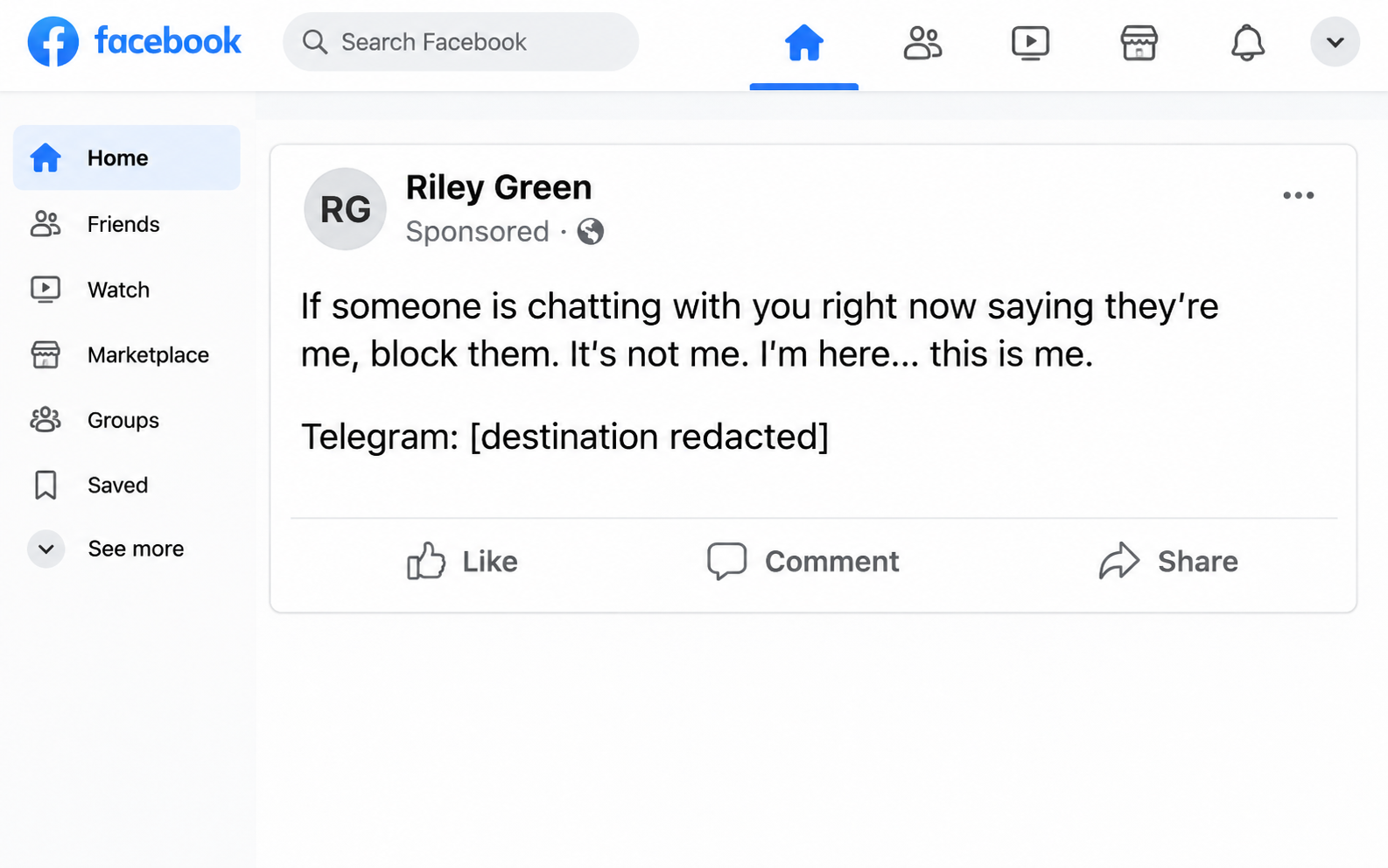
A sponsored post appears to be a personal message from Riley Green. It sounds as though a private relationship already exists and someone has interfered with it.
The post asks you to continue the conversation somewhere else. For a fan who recognizes the name, that invitation can feel surprisingly personal.
Overview
These posts impersonate the singer to approach fans
Fake Riley Green romance ads use the country artist’s identity as an introduction to private contact. The warning concerns impersonators, not the real performer.
Mozo’s original campaign research documents sponsored celebrity-impersonation posts, including Riley Green accounts directing readers toward Telegram. It describes a wider group of rotating profiles.
The ad tries to turn suspicion against other accounts
One recorded lure tells readers that other people claiming the same identity are impostors. It presents its own account as the person they should trust instead.
That claim is part of the deception. Someone warning you about fake accounts still needs to establish their own identity independently.
Keep the decision attached to the actual request
Do not send money, documents or account codes to a private contact claiming a celebrity relationship. A familiar face or paid placement cannot authenticate that relationship.
- Start verification through the artist’s established official channels.
- Keep a private conversation separate from public promotional material.
- Refuse payments requested to unlock a supposed personal relationship.
- Preserve the profile and conversation before blocking contact.
The Message Begins With a Relationship You Never Established
An ordinary advertisement introduces an offer. This kind of post instead talks as though you already share a private history with the person named above it.
That can make a reader work backward, wondering whether a missed message or an earlier conversation explains the affectionate tone. The account has supplied familiarity without verification.
A fan may recognize performances, interviews and photographs immediately. Recognition of public material, however, is different from knowing who operates a private account using that material.
The deception also offers a convenient explanation for conflicting messages. If another account disagrees, the reader has already been told to consider other accounts the problem.
The lead image reconstructs that appeal without an active destination. It does not depict a post authenticated as belonging to the real singer.
How the Fake Riley Green Romance Ad Scam Works
Step 1: A recognizable name interrupts ordinary browsing
The celebrity identity makes an unfamiliar account feel less unfamiliar. You may know the artist’s voice and public life while knowing nothing about the account contacting you.
A sponsored label adds another layer of apparent legitimacy. It describes how a post reaches readers, rather than proving that the named performer approved its contents.
Focus on the account and request rather than the fame of the person pictured. Public recognition cannot establish who is typing a private message.
Step 2: The account claims special personal access
The emotional appeal invites you to believe this is an unusually direct connection. It may frame ordinary skepticism as interference from people keeping you apart.
That framing matters because it can discourage outside checks. A conversation becomes harder to evaluate when every concern is treated as another person’s attempt to spoil it.
You do not owe an unverified correspondent secrecy while establishing their identity. Someone else’s insistence on privacy cannot supply the missing verification.
Step 3: The conversation moves beyond the original post
The documented ads direct readers to messaging destinations, including Telegram. A move into private conversation does not authenticate the person continuing it.
Telegram is a legitimate messaging service, just as Facebook is a legitimate social platform. The problem is the impersonation and what the correspondent asks you to do.
Reporting an advertisement will not necessarily provide the platform with the later conversation. Preserve the relevant records from each service if you need to explain the contact.
Step 4: Repeated contact can make the claimed bond feel real
The FTC’s romance-scam guidance describes repeated conversations used to build trust before requests for money. The attention helps the invented relationship feel established.
Time spent talking does not resolve the original identity question. A person can answer messages regularly while continuing to misrepresent who they are.
If you have already shared personal concerns, the correspondent may know how to reassure you. That knowledge can come from your conversation rather than a genuine connection.
Step 5: A private request introduces financial or personal risk
A romance impersonator may eventually ask for money, gift cards or help with an investment. The request can be presented as protecting or advancing the relationship.
Those are broader romance-fraud patterns, rather than proof that every person who saw these particular ads received the same demand or lost money.
If a private contact requests payment for access, travel or a supposed emergency, stop and verify independently. Do not pay merely to prevent the conversation ending.
Check the Artist’s Identity Without Asking the Impersonator
Use an established official starting point
Riley Green’s official website provides a starting point for public artist information. Follow established channels instead of a link supplied by the stranger.
A display name is insufficient because more than one account can use similar wording. Compare the actual account address and its connection with the independently established official presence.
Do not assume a page calling itself official has completed that check for you. The word is part of the page’s own presentation.
Separate a public appearance from a private relationship
An authentic interview, concert video or promotional photo proves something about the public material. It does not establish that the person sending it is the performer.
The same distinction applies to information about tour dates. Knowing publicly available details is different from proving authority over an artist’s personal communications.
Do not send private photographs or identifying documents in return for supposed proof. Verification should not require creating another exposure before the original identity question is answered.
Keep ordinary paid services separate from a stranger’s demand
Real artists can sell tickets, merchandise or fan experiences. Those ordinary services should not be confused with a private correspondent asking you to finance a personal relationship.
If someone describes a fan offer, locate that actual offer through established channels. Compare what it includes and who is taking payment.
An authentic ticket purchase does not authenticate a separate private conversation. Likewise, rejecting an impersonator does not mean the artist’s legitimate products or appearances are fraudulent.
When Someone Says Other Accounts Are the Scammers
A warning about impersonation can sound like a sign of honesty. In this context, it is also a way for the unverified account to appoint itself the authority.
Ask what evidence exists outside that person’s own statements. Repeated assurances from the same correspondent remain one source, even when they arrive through different messages.
A new account should not inherit trust because it says an older account was hacked. Verify that explanation through an independently established channel.
Do not contact several suspicious profiles to decide which one sounds most convincing. The choice is whether any of them has been authenticated at all.
You can end contact while leaving uncertainty about the operator’s identity. You do not need to identify the person behind the profile before refusing a risky request.
Helping a Relative Without Turning It Into an Argument
Start with the request that can cause harm. Ask whether the correspondent wants money, documents, account access or a change involving an actual financial account.
Review the messages together if your relative agrees. Look at what the person asked them to do, rather than debating how sincere the attention felt.
Suggest a pause before any transfer or major commitment. That pause gives the family time to check the claimed identity through established channels.
If money is already involved, offer practical help contacting the payment provider. A calm explanation of the actual transaction is more useful than a broad argument about celebrity relationships.
Avoid publicly posting private conversations to embarrass the person. Preserve evidence for the appropriate provider or authority while protecting personal information.
Keep the door open for later messages. Someone who feels they must defend every previous decision may be less willing to mention the next demand.
You can acknowledge that the conversation mattered to them without accepting the claimed identity. The objective is to stop further harm and support an independent check.
What to Do if You Have Fallen Victim to This Scam
-
Stop payments and further disclosure to the private contact.
Do not send another gift card, document or verification code to prove trust. End the conversation without negotiating a final payment.
-
Preserve the profile and relevant conversation records.
Save the account address, messages, payment instructions and available transaction references. Keep separate records for the original advertisement and any later messaging service.
-
Contact the company used to send money promptly.
For a bank transfer, payment app or gift card, explain what happened to the actual provider. Ask which reversal, blocking or dispute options remain.
-
Secure accounts if credentials or codes were shared.
Use the affected account’s established recovery process. Review unfamiliar access and recovery details; do not rely on the impersonator to return control voluntarily.
-
Respond to sensitive identity information separately from the romance story.
If you disclosed an identification document or sensitive identifier, ask its issuing authority about protective steps. Preserve copies of what was sent for your private records.
-
Report the impersonation where the contact took place.
Use each platform’s reporting controls for the relevant profile or content. Provide the actual account identifier rather than only the celebrity’s display name.
-
Report criminal losses through the appropriate official channels.
U.S. readers can use ReportFraud.ftc.gov and IC3.gov. Keep the report reference alongside provider case numbers and transaction records.
-
Arrange support before the next account contacts you.
Tell someone you trust about the impersonation and any money involved. Reject a new stranger’s offer to recover losses for an advance fee.
What Matters If You Have Not Sent Money
Do not wait for a payment demand before leaving a deceptive conversation. The absence of a financial loss does not authenticate the person claiming the relationship.
At the same time, keep the response proportional to your exposure. Seeing an advertisement is different from sending documents or sharing an account password.
If all you did was read or exchange ordinary messages, preserve the contact and stop replying. Investigate any separate sign-in, installation or payment on its own facts.
A later correspondent may repeat details you shared earlier. Familiar information should prompt a check of where it came from, rather than automatic trust in the new account.
Make your next decision outside the conversation’s pressure. You can consult someone you trust without asking the unverified person for permission.
Preserve Evidence Without Publishing Your Private Life
A useful private record connects the account to the request and any transaction. You do not need to publish an entire personal conversation to establish that connection.
Keep the actual profile address or identifier where available. A display name alone can make it difficult to distinguish one impersonation account from another.
If you recorded the advertisement, preserve that version alongside the later conversation. Explain where each contact took place instead of treating all the messages as one platform’s record.
For payments, retain receipts and transaction references in their original form. They help the provider locate a transfer without requiring you to share a password.
When asking relatives for help, show only the material needed to understand the request. Keep identification documents, account numbers and intimate content away from public discussions.
Use the provider’s established reporting channel for sensitive evidence. A person posting publicly that they can investigate your case is not automatically authorized to receive it.
Continue protecting these records after you block the account. They may still be useful when a payment provider or investigating authority asks you to clarify the timeline.
Frequently Asked Questions
Are these ads being placed by the real Riley Green?
The documented campaign concerns accounts impersonating him. It does not establish misconduct by the singer or make his legitimate public activities fraudulent.
Does a sponsored label prove the account was authenticated?
No, paid distribution is different from proof of identity. Verify the actual account and its request through independently established official channels.
Is using Telegram itself a sign of fraud?
No, many legitimate people also use Telegram. Here the concern is an unverified celebrity identity leading into private contact, together with the requests that follow.
What if the person warns me about other fake profiles?
That warning cannot authenticate the account making it. Check the person’s own claimed identity independently instead of accepting their explanation about competing profiles.
What if we have talked for weeks without money requests?
Frequent conversation does not prove the claimed identity. You can stop contact and verify independently without waiting for a financial demand.
Can a recovery agent guarantee my money back?
No stranger’s guarantee establishes a genuine recovery service. Contact your actual payment provider and appropriate authorities, and refuse unsolicited advance-fee recovery offers.
The Bottom Line
Do not treat these fake Riley Green romance ads as a personal invitation from the singer. Verify independently and refuse private requests for money or sensitive information.
If you already paid or shared account details, preserve the conversation and contact the relevant provider promptly. Get help from someone you trust while ending further contact.

Join the discussion
0 commentsShare your experience or ask a question about this article.
Community experiences
Did this happen to you?
Your experience could help someone recognize the same scam. Submit a private report for our team to review.
I experienced this tooReports are reviewed before publication. Sharing publicly is always your choice.
Discussion
Start the conversation
Have a question or something useful to share? Add the first comment.