


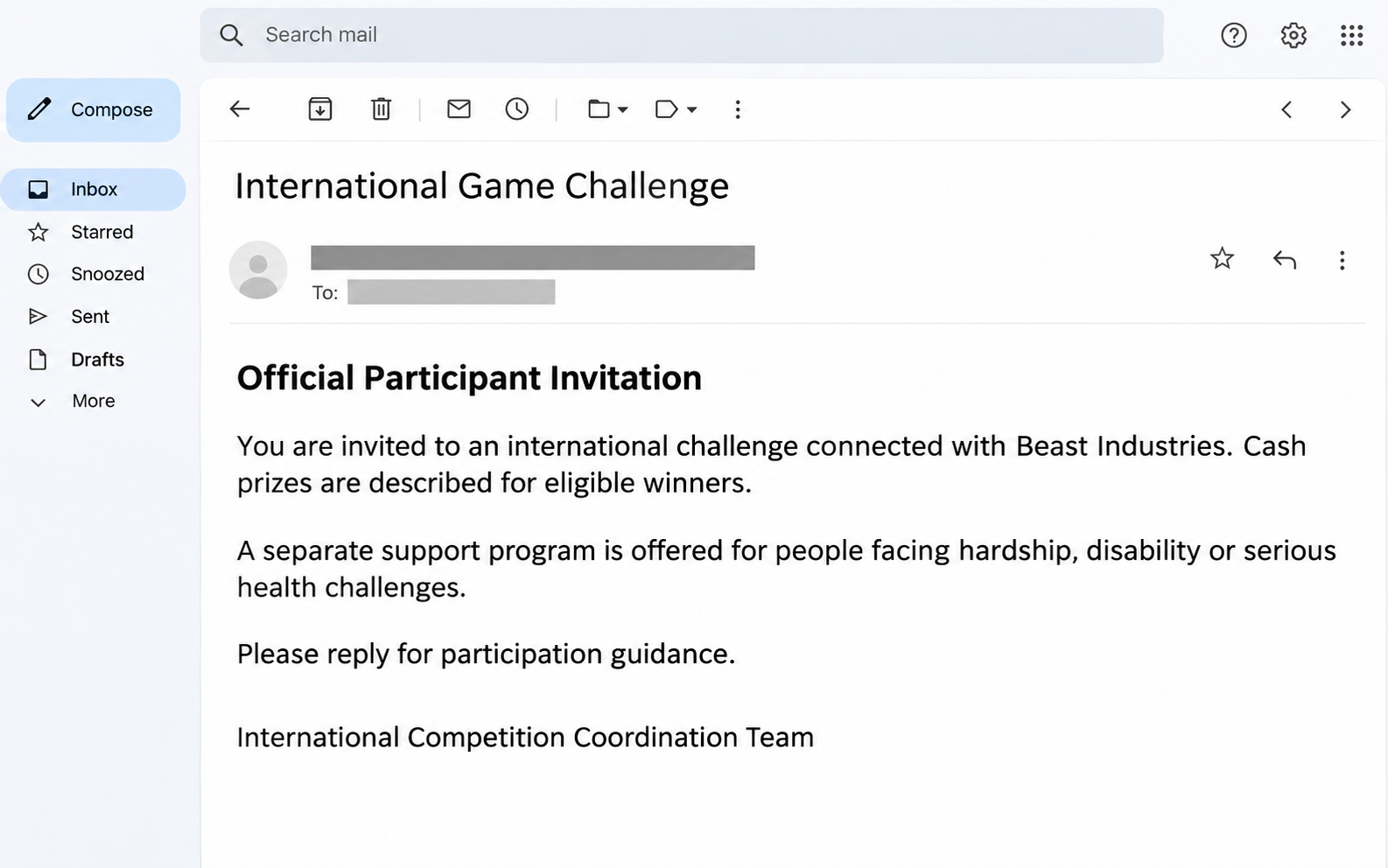
An email offers a route into an international challenge connected with Beast Industries. It even describes a separate opportunity for people who cannot take part.
For a fan or someone struggling financially, that combination can sound unusually welcoming. The next request is simply to reply for more guidance.
Overview
A fake invitation borrows the creator’s business identity
The International Game Challenge email scam uses the Beast Industries name to suggest a connection with MrBeast. The invitation is not an authenticated casting opportunity.
Its two hooks are competition prizes and supposed charitable assistance. People who cannot participate are still encouraged to respond for financial support.
The first reply opens the conversation
This is a correspondence lure, rather than proof that you won anything. The sender wants you discussing participation before you have independently established who runs the offer.
Do not assume that replying is a harmless way to verify the invitation. A convincing answer from the same unverified sender cannot authenticate that sender.
Real opportunities have an independent route
The verified MrBeast Casting link page lists actual application routes and explicitly warns that the team will not ask for payment information.
Check opportunities through established creator channels. A familiar company name inside an email does not connect its reply address to those channels.
- Verify the actual competition through an independent official route.
- Distinguish an application from a confirmed selection or prize.
- Do not pay a stranger to release supposed winnings.
- Keep identity and financial documents away from unverified correspondents.
Why the Charity Offer Changes the Pitch
A competition normally has a natural limitation: some readers cannot or do not want to enter. The second promise keeps those people in the conversation.
Instead of letting someone dismiss the invitation, the email supplies another reason to reply. Financial hardship becomes a proposed qualification rather than a reason to stay away.
That can feel personal even when the message was not written for you. A broad promise allows each reader to imagine a different form of help.
You may picture travel assistance, money for treatment or relief from overdue bills. Those expectations come from your situation, not from a verified award decision.
A trustworthy program should let you establish who operates it before asking you to discuss sensitive circumstances. Recognition of a famous name is not that verification.
The illustration above summarizes the invitation’s two promises. It is a reconstruction with identifying details obscured, rather than a collected email from an actual applicant.
How the International Game Challenge Email Scam Works
Step 1: A recognizable identity gets the message opened
MrBeast is associated with competitions and giveaways, which makes the borrowed business name a plausible introduction. The familiarity encourages readers to fill in the missing connection.
An email does not need to prove that connection if the recipient assumes it already exists. The sender benefits when recognition substitutes for checking the actual account.
Keep that missing connection in view. A company name printed beneath a message is a statement by the sender, rather than independent evidence of employment or authority.
Step 2: Multiple promises give different readers a reason to reply
The invitation describes both a challenge and a support initiative. It therefore reaches beyond people who believe they could compete successfully.
Someone hoping for a prize and someone seeking assistance may respond to the same letter for entirely different reasons. Both would be contacting an unverified correspondent.
You do not need to prove that your circumstances qualify before checking the organizer. Verification belongs before the disclosure of private details.
Step 3: Correspondence can make the opportunity feel established
Once a conversation begins, practical questions can create a sense of progress. You may start planning documents, travel or availability before confirming the underlying offer.
Receiving a polite response does not move that verification forward. It only shows that someone is answering from the address already in question.
If they send a document naming you, treat it as another claim to check. A personalized attachment can be produced without any genuine casting or charity decision.
Step 4: Eligibility language can become a request for sensitive information
Unverified correspondents may seek identity documents or detailed financial circumstances under an application pretext. Do not send those materials merely because the conversation has become friendly.
A legitimate application can also request personal information. The difference is whether you have established the actual organizer, intended application and relevant privacy terms independently.
Ask yourself what the information would allow someone else to do. An ID scan deserves a different level of scrutiny from a general question about availability.
Step 5: A promised benefit can turn into a demand for money
Advance-fee fraud uses supposed registration, processing or release requirements to seek payments. The initial invitation does not document every possible follow-up or a completed payment.
If a correspondent later demands money to release a prize, stop. The FTC’s prize-scam guidance explains why that demand is a decisive warning.
Do not treat a smaller fee as a reasonable test. Paying it would establish only that you sent money, rather than that a prize or support fund exists.
Check a Casting Opportunity Before You Apply
Begin outside the unexpected conversation
Use the creator’s established official channels and follow the application links published there. Do not let the person offering the opportunity supply your only verification route.
A search result, display name or copied profile description can look persuasive in isolation. Compare the actual account and destination with the independently established channel.
If you cannot find the supposed competition through that route, leave the email unanswered. There is no need to submit documents to earn permission to verify it.
Check which opportunity the application actually describes
A job application, video casting call and competition entry are different processes. Finding one legitimate form does not authenticate another offer sent by a stranger.
Check the project name, eligibility requirements and organization receiving the application. Read those details before assuming that a familiar logo settles the relationship.
A legitimate service may host an application on a third-party platform. Verify the official link into that platform rather than assuming every external form is fraudulent.
Keep applying separate from being selected
Submitting an application does not establish that you were accepted. Likewise, an unsolicited invitation to learn more is not proof that someone awarded you money.
This distinction helps when another message arrives later. Compare it with the process you actually joined and the contact details provided through that verified process.
If the sender suddenly changes the project, payment conditions or application route, pause again. Earlier legitimate activity does not authenticate a new request automatically.
Verify the Assistance Offer on Its Own Terms
The charity angle should receive its own check. A genuine entertainment project does not automatically authenticate every support program using an associated name.
The FTC warns about impersonated charities and sweepstakes. A real organization’s reputation can be used to make an unrelated financial promise feel trustworthy.
Look for a program described through the actual organization’s channels. Check who administers it, what applicants must provide and how decisions are communicated.
You should not have to tell a stranger your medical history simply to learn whether their claimed program exists. Establish that connection before discussing eligibility.
For someone helping a relative, offer to verify the opportunity together. Focusing on the organizer is more useful than arguing about whether your relative deserves assistance.
The need for help may be real even when the promised program is fabricated. Rejecting the message does not require dismissing the person’s financial or health concerns.
What to Do if You Have Fallen Victim to This Scam
-
Stop replying to the unverified invitation.
Do not send another document or payment to complete the process. Preserve the conversation before blocking the sender through the service you use.
-
List the information you already provided.
Separate a name or general reply from a password, identification document or bank details. Describe actual disclosures rather than assuming every account has been compromised.
-
Secure any account whose credentials were exposed.
Use that provider’s established recovery route and replace reused passwords. Report unexpected verification approvals to the organization responsible for the affected account.
-
Contact the payment company immediately if you paid.
The FTC’s recovery guidance directs people to the company used for payment. Explain the transaction and ask what options remain.
-
Respond specifically to any identity-document exposure.
If an ID copy or sensitive identifier was shared, contact its issuing authority about protective options. U.S. readers can also consult IdentityTheft.gov.
-
Keep the records needed to explain the scheme.
Save the original email, full conversation, payment references and documents received. Record the claimed organizer and the exact action requested at each stage.
-
Report the impersonation through appropriate established channels.
Notify your email provider and, where relevant, the actual organization’s published reporting route. U.S. readers can submit the incident through ReportFraud.ftc.gov.
-
Reject a second offer promising guaranteed recovery.
The FTC’s recovery-scam warning describes strangers seeking fees from people already deceived. Do not pay someone who contacts you to unlock a refund.
If You Replied Without Sending Money
A simple reply is not the same as giving away an account password. Do not let fear of the first response push you into unnecessary payments or installations.
Stop the correspondence and review what you actually shared. If the answer was only your availability, the next useful action is usually preserving and reporting the message.
If the sender knows something private, consider where it came from before drawing conclusions. Information you included in your reply may explain a later personalized approach.
A follow-up that mentions your circumstances can feel like evidence of an official case file. It may simply repeat details you already supplied to the same correspondent.
Tell a trusted person about the contact before another offer arrives. Having someone available makes it easier to pause when an apparently helpful sender introduces a new deadline.
If a child responded, work through the conversation calmly with them. Focus on ending contact and securing exposed information, rather than making them hide subsequent messages.
Before Sending a Video or Identification Document
Genuine casting and fraudulent correspondence can both involve personal questions. Evaluate the organization receiving the information and the specific process you intend to join.
Begin by identifying the application itself. A casting form reached from an established official channel is different from a document requested by an unverified email correspondent.
Read the form’s privacy information before uploading anything. Look for who receives the material and how to raise questions about its use.
If a request is unclear, seek clarification through the organization’s established contact route. Do not send extra documents simply to keep the unexpected conversation moving.
For a video application, consider what appears behind you as well as what you say. Avoid including account details, identification documents or sensitive personal correspondence unnecessarily.
The same care applies to screenshots requested as evidence of eligibility. A screen may contain information unrelated to the application that you did not intend to share.
Keep your own copy of the application terms and acknowledgment where practical. Those records help distinguish the process you actually joined from a later unrelated approach.
If another sender claims you were selected, compare that claim with the verified process. An application acknowledgment and a selection decision mean different things.
Likewise, a casting opportunity and hardship assistance require separate verification. A real application for one should not be used as proof that the other program exists.
If you shared an ID through the false invitation, describe that document accurately when seeking help. Do not assume every detail printed on it has already been misused.
Ask its issuing authority what protective options apply to that specific document. Replacing an account password does not address a copy of a passport or driver’s license.
Keep necessary records securely, rather than sending the document again to a stranger offering assistance. The next contact should begin through an established service you independently choose.
Frequently Asked Questions
Is this an official Beast Industries invitation?
No, the documented email impersonates the organization. Verify genuine casting opportunities through established creator channels instead of replying to this invitation.
Does the charity section make the email more trustworthy?
No, a promise of assistance is another claim requiring verification. Check the actual program independently before discussing health, identity or financial circumstances.
Has the email already awarded me a prize?
No, an invitation and a description of possible prizes are not an award decision. Do not treat either as money already belonging to you.
Do real applications ever request personal information?
Yes, legitimate applications can request relevant information. Establish the organizer and authentic application route before deciding whether a particular request is appropriate.
What if the sender asks for a processing fee?
Do not pay to release supposed winnings or assistance from this correspondent. Preserve the request and contact your payment provider promptly if you already paid.
Should I install security software because I replied?
A reply alone does not establish a malware infection. Report any separate download, installation or account sign-in so the response matches what actually happened.
The Bottom Line
Ignore the International Game Challenge invitation and verify genuine opportunities independently. The borrowed Beast Industries name does not authenticate this sender or its assistance promises.
If you already responded, stop contact and address the information or payment actually exposed. Use your account provider, payment company or identity-document issuer for practical help.

Join the discussion
0 commentsShare your experience or ask a question about this article.
Community experiences
Did this happen to you?
Your experience could help someone recognize the same scam. Submit a private report for our team to review.
I experienced this tooReports are reviewed before publication. Sharing publicly is always your choice.
Discussion
Start the conversation
Have a question or something useful to share? Add the first comment.