

The JavaTide page speaks to a familiar frustration: trying to lose weight while every new plan promises to explain why the last one failed.
Its offer looks unusually confident. Before committing to several bottles, it is worth separating the appealing story from the evidence and the order terms.
Overview
JavaTide is sold through a long-form weight-loss page
JavaTide is marketed as a daily capsule combining prebiotic fiber and probiotic organisms. Its page says the formula supports the gut microbiome, metabolism, and weight management.
The sales story goes further. It describes harmful bacteria that supposedly sabotage weight loss and beneficial bacteria that supposedly activate fat burning.
That explanation turns a complex health issue into one villain and one convenient solution. The page does not prove that this product achieves that result.
We found no product-specific clinical trial on the reviewed page establishing the promised weight-loss outcomes. Research on gut microbes cannot automatically validate a particular capsule.
The National Center for Complementary and Integrative Health notes that probiotic evidence varies by use and formulation. Strains, doses, and study conditions matter.
The most important money claim is easy to miss
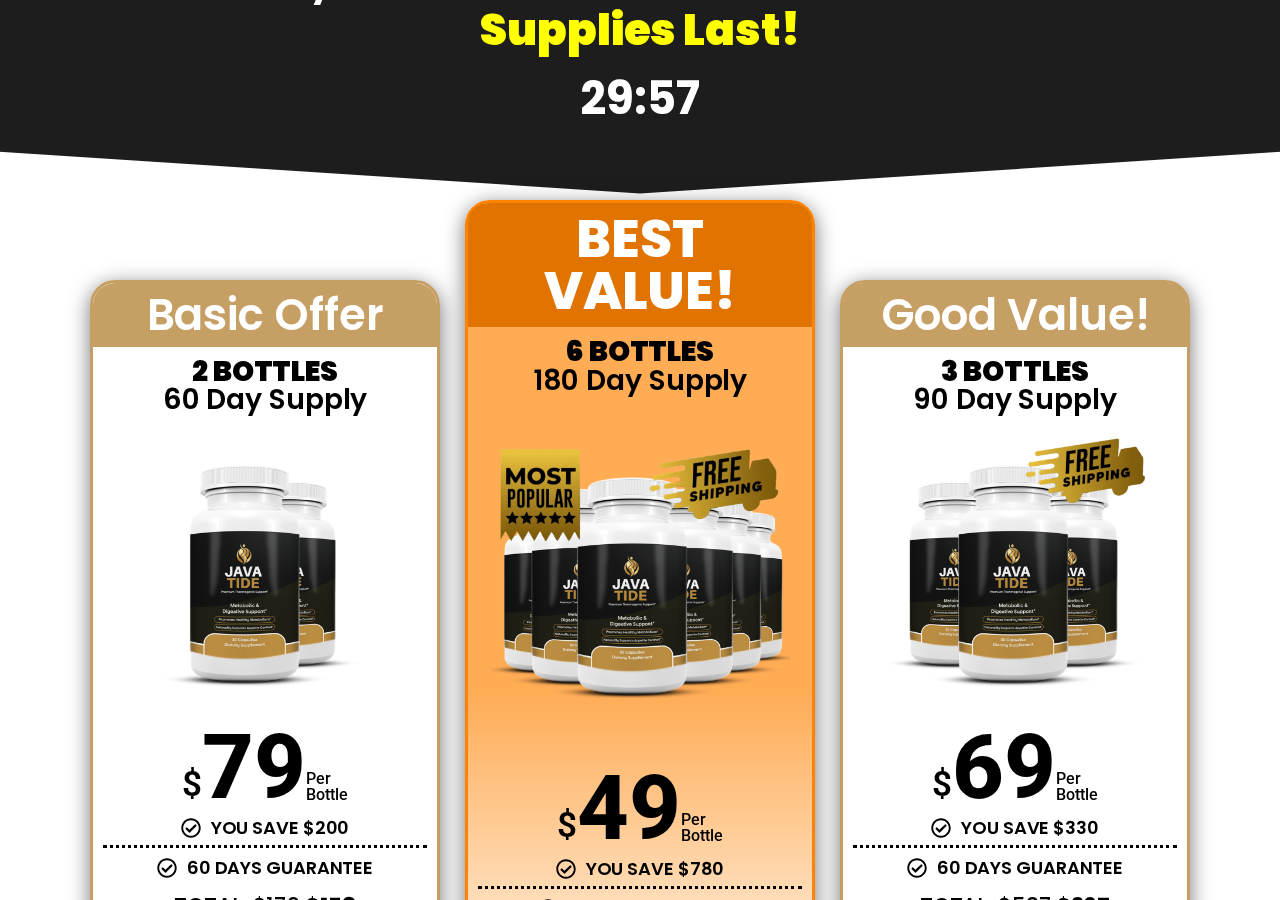
The reviewed offer presented two bottles for $158, three for $207, and six for $294. The six-bottle package receives the strongest “best value” framing.
Those are totals, not just per-bottle prices. The smallest displayed package already commits the buyer to two bottles, plus shipping according to the page.
A visible countdown and “while supplies last” language encourage a decision before the buyer checks the formula, seller identity, and refund process.
The page also says a 60-day guarantee starts on the purchase date. Its explanation asks buyers to use the product for at least thirty days before requesting help.
That combination leaves a narrower practical period for evaluating and returning it than “two full months” might suggest at first glance.
We did not find a documented automatic refill on this page
Some online supplement funnels do enroll customers in recurring shipments. JavaTide’s reviewed page expressly says this is a one-time purchase without automatic renewals.
We did not complete a checkout, so we cannot certify every later payment screen. We also cannot responsibly call this a subscription trap based on the page we examined.
The distinction matters. There are substantial questions about claims, price framing, identity, and policy access without inventing a refill charge that the available evidence contradicts.
- The page offers two, three, or six bottles, not a clearly displayed single bottle.
- It uses a countdown and large claimed savings to emphasize immediate purchase.
- Its weight-loss mechanism is marketing, not product-specific clinical proof.
- The seller states that checkout is a one-time order with no automatic renewal.
- Footer policy links lead to a different domain that did not load reliably in our checks.
JavaTide is therefore a supplement-marketing and buyer-risk investigation, not a finding that its customers are automatically subscribed or that the product is fake.
The Health Claims Need More Than a Plausible Story
Gut research does not certify the finished formula
The page names chicory-root inulin, resistant potato starch, and a probiotic blend. It also mentions Akkermansia muciniphila in its explanation of the microbiome.
Those ingredients and organisms are subjects of real research. What matters to a buyer is whether the exact commercial product was tested at its actual doses.
For probiotics, species names alone are often insufficient. A study of one strain at a particular dose does not establish the effect of another strain.
A “blend” without a clearly readable Supplement Facts panel can make it difficult to compare the marketed formula with the research being invoked.
Ask for the full label before purchase. It should identify amounts, strain designations where relevant, other ingredients, serving size, and storage requirements.
The reviewed page says users should refrigerate the product after opening. That instruction makes shipping temperature and viable-count claims relevant questions for support.
Weight loss is not one bacterial switch
The site says its ingredients can accelerate fat burning, suppress appetite, improve metabolism, and support lean muscle. These are broad and attractive outcomes.
Body weight changes through many interacting factors, including diet, activity, medication, sleep, illness, and genetics. A single gut-bacteria explanation is too simple to diagnose an individual.
The NCCIH consumer guidance on weight-loss supplements warns that testimonials are not objective evidence and that natural products can carry risks.
That does not mean every probiotic is useless. It means the promise should be matched to credible studies, realistic effect sizes, and the exact formulation sold.
A page full of confident benefit statements cannot replace a clinician’s advice, particularly for people with chronic illness or those taking medication.
Facility registration does not equal product approval
JavaTide says it is produced in an FDA-registered United States facility. We did not independently verify the facility or identify its registration from the reviewed page.
Even if the facility claim is accurate, it does not mean the FDA approved the supplement’s safety or effectiveness. Those are different concepts.
The FDA’s dietary supplement guidance explains that supplements generally are not approved before marketing in the way drugs are.
The JavaTide footer itself says its statements have not been evaluated by the FDA. Read that disclaimer alongside the confident headline claims.
If safety matters because of medication, pregnancy, immune conditions, or another concern, ask a qualified healthcare professional about the full ingredient label first.
How the JavaTide Sales Funnel Works
Step 1: A difficult problem receives a simple explanation
The page begins with weight-loss frustration and points toward the gut microbiome. It tells readers that harmful bacteria interfere with progress.
There is genuine interest in microbiome science. The marketing leap is the suggestion that JavaTide specifically corrects a buyer’s underlying problem.
No questionnaire, examination, or medical history can establish that cause from a landing page. The story may feel personal without being a personal diagnosis.
Recognize the difference between “researchers study this pathway” and “this capsule will change your outcome.” The seller needs evidence for the second claim.
Step 2: Testimonials turn possibility into expectation
The page publishes positive stories about weight, energy, blood sugar, and life after menopause. The emotional appeal is stronger than a list of ingredients.
These are selected customer accounts presented by the seller. We did not verify the purchases, individual health histories, or whether other changes affected the results.
Importantly, the footer says testimonials may not reflect a typical buyer’s experience. It also says some personal details have been changed for privacy.
Read those caveats before treating a dramatic story as a likely outcome. A buyer should expect evidence on the finished product, not a promise based on anecdotes.
Step 3: Bundles and a timer raise the commitment
The visible offer moves directly to multiple bottles. Two cost $158, three cost $207, and six cost $294 in the reviewed version.
Per-bottle pricing falls with larger packages, making the highest total look economical. That framing can hide the simpler question: how much money leaves today?
The page adds claimed savings, free United States shipping for larger kits, and digital bonuses. None proves the supplement works.
Its timer appears alongside repeated urgency language. We did not establish whether the deadline corresponds to real inventory or merely a marketing countdown.
Pause long enough to take a screenshot, read the order details, and calculate a realistic maximum loss if the return proves difficult.
Step 4: A guarantee lowers perceived risk
JavaTide describes a 60-day money-back guarantee from purchase. Its explanation then asks for at least thirty days of use before contacting support about dissatisfaction.
A customer may spend days waiting for delivery, then another month testing it. The remaining time can become short if a return is required.
Ask whether opened bottles can be returned, whether every bottle must be sent back, and who pays return shipping. The landing page does not answer every operational question.
Get the exact instructions from the formal returns policy and save them. In our checks, the linked policy domain did not reliably provide an inspectable page.
Step 5: The buyer must verify what checkout actually says
The JavaTide FAQ explicitly promises no automatic renewals or hidden subscription. That statement should be preserved with the receipt and final payment terms.
We did not submit payment details, so we cannot rule on later upsells or processor screens. Only the final order screen confirms the selected products and total.
Look for subscriptions, continuity plans, checkboxes, extra digital items, and a merchant name different from the page brand. Decline anything you did not intend to buy.
If an unexpected recurring charge later appears despite the one-time promise, document the discrepancy and contact both the seller and card issuer.

What the Disclaimers and Policy Links Actually Tell Us
Publication logos are not endorsements
Near the bottom, JavaTide displays names and logos associated with scientific publications and organizations. A casual reader could mistake that arrangement for external validation.
The page immediately says the company is not endorsed, sponsored, or affiliated with those organizations. Its own disclaimer is the key context.
A scientific reference can support a general idea while saying nothing about the product in the cart. Demand a study that identifies JavaTide by formula.
Do not treat a journal masthead as if researchers tested this batch of capsules. That inference is not supported by the page.
The policy domain is not the sales domain
JavaTide’s footer points to terms, privacy, returns, disclaimer, and contact pages on lp.institutoexperience.com.br, a different domain from javatide.com.
Different domains can be legitimate when a marketing agency or platform manages legal pages. They also make it harder to know which entity accepts responsibility.
Our attempts to open several linked pages produced access errors or timeouts. That may be a temporary technical failure, not evidence that policies do not exist.
Before paying, open each policy in your own browser and save it. If it remains unavailable, ask support to provide the full terms in writing.
One stray asset deserves an explanation
The page markup references an image labeled “Rótulo Flash Burn” from the external policy domain. That looks like a different product name in a JavaTide sales context.
This could be a reused media asset or a publishing mistake. It does not prove that JavaTide and Flash Burn share a manufacturer or legal owner.
It does, however, justify asking for the actual JavaTide label and the company that makes or distributes it. The physical package should match the offer.
Do not infer the country of manufacture from a domain, image label, or marketing language. Verify what the bottle itself and seller documentation say.
Company, Address, and Fulfillment Checks
Identify the company that takes the payment
The JavaTide brand is prominent, but a brand is not always the legal seller. Check the checkout, receipt, policy, and card descriptor for the responsible entity.
If those records name different companies, ask how they relate. A payment processor and a fulfillment partner may be separate, but the contracting seller should be clear.
Do not rely on a support address alone as proof of a business identity. The seller should be able to state its legal name and return obligations.
Similarly named JavaTide domains exist. We did not establish that every spelling variation belongs to the same operation, so keep records for the exact domain used.
Verify the label, lot, and manufacturing claim
Ask for a complete Supplement Facts panel before purchase. It should include ingredient amounts, probiotic strain information, other ingredients, warnings, and serving instructions.
On arrival, inspect the seal, expiration date, lot number, manufacturer or distributor details, and storage directions. Photograph discrepancies before opening anything.
The site says the formula is made in an FDA-registered United States facility, but that claim needs documentation. Registration itself does not certify effectiveness.
We cannot identify the factory from the landing page. We also cannot claim the bottles are manufactured in China without evidence.
Pin down the return route before a problem occurs
A 60-day guarantee sounds simple until the buyer needs a return authorization. Ask for the required address, permitted condition, packaging, and shipping responsibility.
Confirm whether the timer begins at purchase, shipment, or delivery. The reviewed page says purchase, which matters if a parcel takes time to arrive.
If the formal policy sits on another domain, save its exact text alongside the JavaTide offer. A broken link is a reason to seek clarification before payment.
Do not send bottles to an address guessed from the label. A fulfillment center can dispatch parcels without accepting returns.
Keep the health question separate from the refund question
Even an honored refund cannot undo a medical risk. Check ingredients with a clinician if you have a condition, take medication, or are unsure about probiotics.
Never stop a prescribed treatment because a supplement page promises better blood sugar or metabolism. Seller testimonials are not individualized care.
Report adverse effects to a healthcare professional and, where appropriate, to the relevant regulator. Keep the package and lot number for identification.
A trustworthy seller should not object to detailed questions about safety, identity, and policy. Specific answers matter more than confident marketing language.
What to Do If You Ordered JavaTide
- Save the exact offer. Capture the bundle, final charge, guarantee, one-time-order promise, contact details, and the policies visible when you purchased.
- Check your payment statement. Confirm the amount, merchant descriptor, and any later charges. A recurring charge would conflict with the reviewed page’s explicit promise.
- Inspect the shipment. Compare bottle count and label with the order. Photograph seals, lot numbers, expiration dates, and any mismatch.
- Ask a clinician about use. Bring the full ingredient panel if you have a health condition, take medication, or experience symptoms after starting the capsules.
- Start refund questions early. The advertised 60 days run from purchase, while the page suggests thirty days of use. Request return instructions before the deadline nears.
- Escalate documented failures. If the seller does not deliver or ignores an applicable written remedy, contact the card issuer promptly with receipts and support messages.
Frequently Asked Questions
Is JavaTide an automatic-refill subscription?
The reviewed page expressly says no and describes a one-time purchase. We did not complete checkout, so verify the final payment screen and monitor statements.
Does JavaTide have proven weight-loss results?
We found broad ingredient and microbiome claims, but no product-specific clinical trial on the reviewed page establishing the advertised outcomes.
Is an FDA-registered facility the same as FDA approval?
No. Facility registration and product approval are different. Dietary supplements generally are not approved for safety and effectiveness before marketing.
Why does the smallest offer include two bottles?
That is how the reviewed sales page frames its packages. The two-bottle total was $158 plus shipping, rather than a single-bottle trial.
When does the guarantee expire?
The page says sixty days from purchase and mentions using the product for at least thirty days before requesting help. Confirm the formal procedure immediately.
Are scientific publication logos evidence of endorsement?
No. JavaTide’s own footer says the company is not endorsed by or affiliated with those organizations. A logo is not a product trial.
The Bottom Line
JavaTide’s sales page asks buyers to trust a sweeping microbiome story and commit to multiple bottles. The product-specific proof and practical refund route deserve scrutiny.
It also explicitly denies automatic refills, so calling it a confirmed subscription trap would be inaccurate. Check the final checkout, full label, seller identity, and policy before paying.








