

A convincing video, a familiar face, and the promise of a simple kitchen ingredient can make an online weight-loss claim feel surprisingly credible. That is exactly the reaction behind ads promoting a supposed Kelly Clarkson baking soda shot recipe.
The campaign is designed to look like entertainment news rather than a product pitch. Before trusting it, however, there are several important details every viewer should understand.
Overview
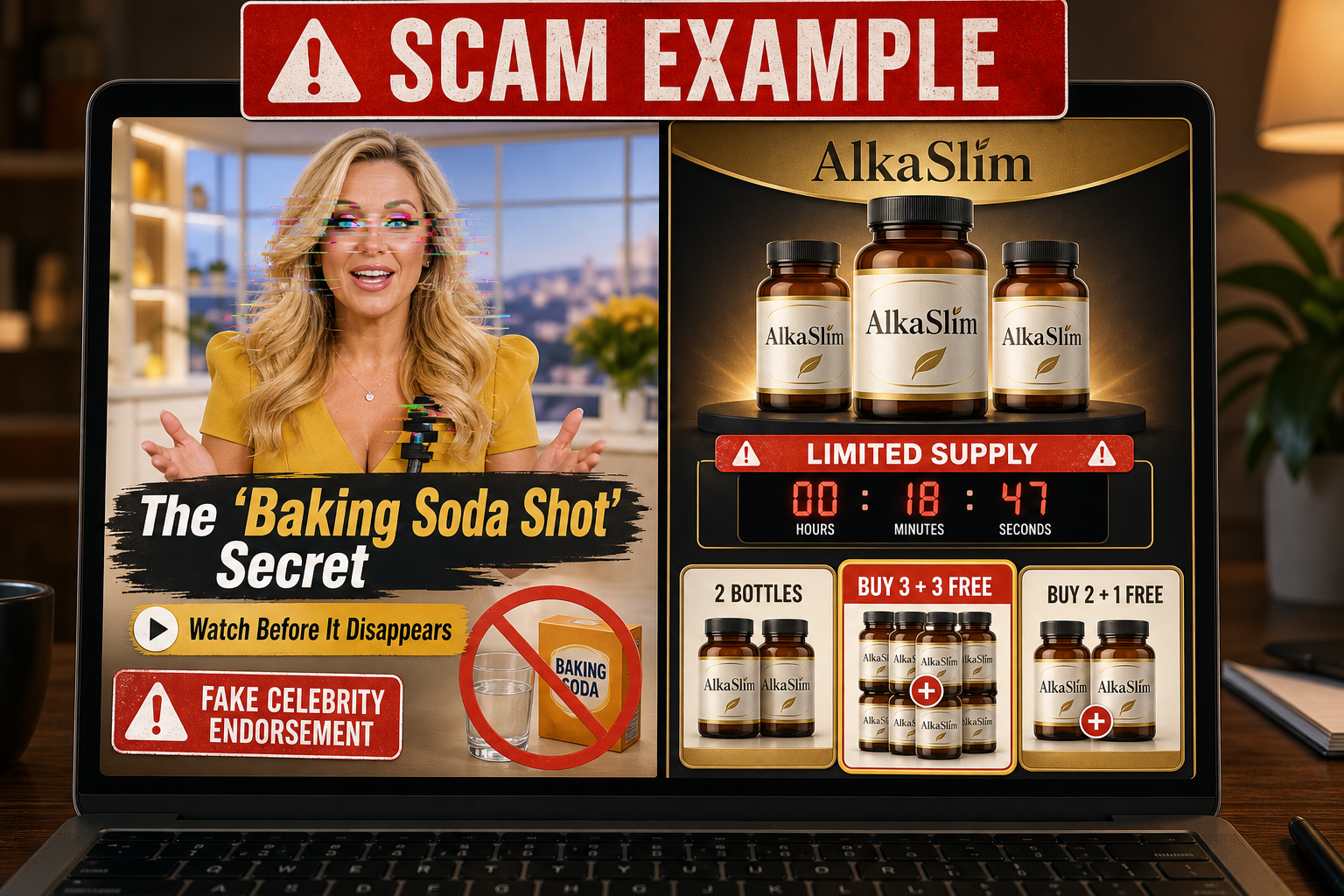
The Kelly Clarkson baking soda shot scam is an online advertising campaign that uses a fabricated celebrity endorsement to attract people interested in losing weight. Ads claim that Kelly Clarkson revealed a simple baking soda drink, sometimes described as a shot, ritual, trick, or secret recipe, that supposedly explains a dramatic transformation.
There is no credible evidence that Kelly Clarkson endorsed this baking soda method or the AlkaSlim product sold at the end of the campaign. The video presentation is not a trustworthy interview, and the apparent recommendation should not be treated as a genuine statement from her.
The central promise is also misleading. People click because they expect to learn the Kelly Clarkson baking soda shot recipe and its ingredients. Instead, they are taken through a long promotional presentation that delays the answer, builds suspense, and eventually pivots to a commercial supplement called AlkaSlim.
In other words, the recipe is the bait. The supplement offer is the destination.
A fake celebrity video creates instant trust
Scammers know that a recognizable celebrity can lower a viewer’s guard. A video that appears to show a well-known singer or television personality discussing a personal health breakthrough feels more persuasive than an ordinary banner ad.
Modern editing and artificial intelligence can imitate a person’s face, voice, lip movements, and interview style. The result may look convincing on a phone screen, especially when it appears briefly in a social media feed. Small visual errors can be hidden by compression, captions, fast cuts, and background music.
The Federal Trade Commission warns that scammers use doctored video and audio to create fake celebrity endorsements for weight-loss products and other offers. A familiar face in an ad is therefore not proof that the person approved, used, or even knows about the product.
The promised baking soda recipe never arrives
The ad commonly uses phrases such as “baking soda shot,” “baking soda water trick,” or “secret ingredients.” These phrases target people looking for an inexpensive home remedy and create an information gap that makes them want to keep watching.
A legitimate recipe would state what it contains, explain the evidence behind it, discuss meaningful risks, and avoid promising extraordinary results. This funnel does the opposite. It withholds useful information while repeating claims about fat loss, appetite, metabolism, or effortless results.
Eventually, the presentation moves away from baking soda and introduces AlkaSlim. The viewer who arrived for a free kitchen recipe is now asked to buy several bottles of a supplement. That abrupt change is a classic bait-and-switch pattern.
The fake news page makes the pitch look independent
Some versions of the campaign use a page styled to resemble a familiar television or news website. A TODAY-style header, interview layout, embedded video, and apparent viewer comments can make the promotion look like independent reporting.
The page is not reliable merely because it copies the colors, layout, or visual language of a respected media outlet. Look at the actual domain in the address bar. Scam advertorials often use unrelated domains, recently registered addresses, extra words, or subdomains that have no connection to the organization being imitated.
Comments and testimonials on these pages may be static text written into the design. They are not necessarily posted by real customers, and there may be no functioning profile, timestamp history, or reply system behind them.
The sales page uses urgency and oversized bundles
After the promotional video, visitors may see an AlkaSlim order page offering multiple packages. Observed versions displayed choices such as two bottles, “buy 3 get 3 free,” and “buy 2 get 1 free.” The page also used limited-supply language and a live-looking count of bottles remaining.
These elements are meant to shift the shopper from careful evaluation to fast action. A countdown, a changing stock number, a “best value” label, and a larger bundle in the center can create the feeling that waiting will cause a special opportunity to disappear.
Do not assume those counters reflect real inventory. Refreshing or reopening this type of page often reveals that the same urgent offer remains available. Even when a discount is real, it does not prove the underlying health claims.
There is no proven baking soda shortcut for weight loss
Baking soda is sodium bicarbonate, a chemical used in cooking and in certain medical products. Its everyday presence in the kitchen does not make it a proven fat-loss treatment, and “natural” or familiar does not automatically mean safe to swallow in a concentrated drink.
There is no good clinical evidence that a homemade baking soda shot produces the rapid, effortless weight loss claimed in these advertisements. Sustainable weight management is complex and depends on factors such as nutrition, physical activity, sleep, medications, medical conditions, and individual physiology.
The FTC’s guidance on weight-loss advertising says that promises of extremely fast weight loss are a scam warning sign. False stories, fake news websites, social media ads, and fabricated testimonials are all commonly used to sell questionable products.
Drinking too much baking soda can be dangerous
This scam is not only a financial concern. A person who tries to recreate an alleged baking soda shot without medical guidance can put their health at risk. This article intentionally does not provide a recipe, dose, or mixing instructions.
Poison Control explains that too much sodium bicarbonate can cause serious toxicity. It can produce a large amount of carbon dioxide in the stomach and disturb sodium levels and the body’s acid-base balance.
Possible effects of excessive ingestion include vomiting, diarrhea, dehydration, abnormal breathing, seizures, kidney problems, and dangerous pressure in the stomach. The risk may be especially concerning for people with kidney disease, heart problems, high blood pressure, fluid restrictions, or medicines that can interact with sodium bicarbonate.
The Food and Drug Administration also cautions consumers that products described as “all natural” are not automatically safe. Weight-loss products sold through aggressive online promotions may carry additional risks, including unlisted ingredients or unsupported claims.
Quick warning signs
You do not need to analyze every frame of a video to recognize this pattern. Treat the offer as unsafe when several of the following signs appear together:
- A celebrity appears to reveal a secret weight-loss recipe in a social media ad.
- The voice, mouth movements, facial expressions, or lighting look slightly unnatural.
- The ad promises dramatic results without diet, exercise, medical care, or meaningful effort.
- A familiar news or television design appears on an unrelated web address.
- The presentation withholds the promised recipe and forces viewers through a long video.
- The story suddenly changes from a kitchen ingredient to a paid supplement.
- Doctors, researchers, or customers are quoted without links to verifiable evidence.
- Badges and seals look official but cannot be checked with the organization supposedly issuing them.
- A countdown, low-stock message, or expiring discount pressures visitors to order immediately.
- The checkout strongly pushes multi-bottle packages before clearly explaining terms and refund conditions.
How The Scam Works
The funnel is effective because each stage asks for only a small commitment. First the viewer pauses, then clicks, then watches, and finally enters payment details. Understanding that sequence makes it much easier to step away before money or personal information is lost.
1. A social media ad interrupts the viewer’s feed
The campaign often begins on Facebook, Instagram, TikTok, YouTube, or an ad network serving content across ordinary websites. The ad may use a short clip of Kelly Clarkson alongside a headline about a baking soda shot, a secret weight-loss ingredient, or a revelation that powerful interests supposedly want removed.
The opening is optimized for attention, not accuracy. Captions make the claim understandable without sound, while a dramatic before-and-after narrative encourages viewers to connect the celebrity’s appearance with the advertised method.
2. Synthetic video makes the endorsement feel personal
A manipulated clip may combine authentic footage with an artificial voice, edited dialogue, or replaced mouth movements. Because part of the footage can be real, the whole video may initially feel authentic.
Listen for unnatural pacing, odd pronunciation, abrupt changes in tone, or speech that does not match the lips. Watch the boundaries around the mouth, teeth, hair, and jaw. Those clues can help, but a well-made deepfake may not show an obvious flaw. Independent verification remains more reliable than visual inspection alone.
3. The click opens an imitation editorial page
Instead of going to an official celebrity account or a recognized media domain, the ad opens a promotional page. It may look like a television segment or health article and may place the video below a copied header.
This borrowed appearance gives the sales message a layer of false authority. Visitors may believe a newsroom investigated the story when the entire page was created to move them toward an order button.
4. The presentation builds a conspiracy around the secret
Long-form scam videos often suggest that doctors, drug companies, television networks, or the weight-loss industry do not want the audience to know the method. This narrative explains why the viewer has never heard of it and discourages them from trusting legitimate criticism.
The presentation may spend many minutes discussing metabolism, hormones, toxins, or a newly discovered process. Scientific words and diagrams can sound impressive without demonstrating that the claims are supported by a properly designed human study.
5. The free recipe becomes a paid AlkaSlim offer
After repeatedly teasing the baking soda shot, the page introduces AlkaSlim as the convenient or complete version of the supposed discovery. The promised recipe either remains vague or is never provided at all.
This transition is important. If the advertisement clearly began with “buy this supplement,” many viewers would scroll past. By first promising celebrity news and a free household trick, the campaign earns attention before revealing the commercial purpose.
6. Invented authority attempts to replace evidence
The pitch may display celebrity images, an alleged medical expert, customer stories, star ratings, laboratory graphics, certificates, or official-looking seals. None of these elements prove that the product is effective.
A real endorsement should be traceable to the celebrity’s verified channels or a reputable publication. A real clinical claim should point to research that identifies the exact product, methods, participants, outcomes, funding, and limitations. Generic references to “research” or “experts” are not enough.
Be cautious when a page invokes a named doctor but provides no link to that person’s verified institution or published work supporting the offer. A real person’s name can be used without their knowledge just as easily as a celebrity image.
7. Fake social proof quiets last-minute doubts
When visitors hesitate, enthusiastic comments and transformation stories make the purchase appear normal. The page may claim that thousands of people are watching, that a customer just ordered, or that bottles are selling every few seconds.
These notices can be generated by a script rather than real activity. Before relying on a review, search outside the seller’s website and look for specific, independent reporting. Remember that even a real customer’s personal result would not establish that the same product is safe or effective for everyone.
8. Urgency pushes the shopper toward a larger package
The AlkaSlim page places bundle options side by side and makes a multi-bottle package look like the obvious value. “Free” bottles and shipping incentives can distract from the total charge and from the fact that the shopper did not originally set out to buy a supplement.
A timer or low-stock counter makes reading the fine print feel costly. Take the opposite approach. Close the page, wait, and research the seller independently. A legitimate health decision should still make sense after the artificial urgency is gone.
9. Checkout collects valuable personal and payment data
To place an order, the shopper may provide a name, email address, phone number, shipping address, and card details. Even if a package arrives, that data can expose the buyer to aggressive marketing, follow-up offers, or attempts to sell related products.
Before authorizing any online health purchase, the buyer should be able to identify the legal seller, exact total, shipping cost, return address, cancellation method, privacy policy, and whether any recurring plan is involved. Do not assume that a “free” bottle means the final order is free.
10. Refund friction can prolong the loss
Questionable supplement funnels may make support difficult to locate or require repeated calls and emails. Return windows, unopened-product rules, shipping deductions, or international return addresses may be disclosed only after the purchase.
Some victims wait because they are embarrassed or hope the seller will resolve the problem. Acting promptly is better. Card dispute deadlines and merchant return periods can be limited, and early documentation gives a bank clearer evidence to review.
11. The original buyer may be targeted again
A person who clicked or purchased has shown interest in weight-loss offers. That can lead to more ads, emails, calls, or texts promoting supplements, refund services, investment opportunities, or other celebrity-branded schemes.
A follow-up caller may even claim to represent the seller, a regulator, or a recovery company. Never pay an upfront fee to recover money from a previous scam. Verify organizations through contact details you find independently.
What To Do If You Have Fallen Victim
If you ordered AlkaSlim, tried a baking soda mixture, or entered payment information, take a breath. These funnels are deliberately engineered to look credible. The best response is calm, documented, and prompt.
- Stop using an unknown product or homemade baking soda shot. Do not take another dose simply because the video promised that results require consistency. Keep the bottle, packaging, label, receipt, and remaining contents in case a clinician, bank, regulator, or poison specialist needs exact information.
- Get medical help for concerning symptoms. In the United States, if someone swallowed baking soda or has questions about a possible exposure, use webPOISONCONTROL or call Poison Control at 1-800-222-1222. Call emergency services immediately for severe abdominal pain, trouble breathing, a seizure, collapse, confusion, or another life-threatening symptom. Do not induce vomiting unless a medical professional specifically instructs you to do so.
- Speak with a healthcare professional about the supplement. This is especially important after a reaction, during pregnancy, or if you have kidney disease, heart disease, high blood pressure, diabetes, fluid restrictions, or take prescription medicine. Bring the product or clear photographs of every side of the label, including ingredients and lot numbers.
- Contact the card issuer promptly. Use the number printed on the back of the card or the bank’s official app. Explain that the purchase followed a deceptive celebrity endorsement and a bait-and-switch weight-loss promotion. Ask what dispute options apply and whether the card should be replaced.
- Check the exact amount and merchant descriptor. Compare the checkout confirmation with the posted charge. Look for shipping fees, bundle quantities, separate charges, and unfamiliar company names. Continue reviewing statements for several months because a later charge may use a different descriptor.
- Look for recurring-billing language without assuming it exists. Review the confirmation email, checkout terms, receipt, and card statement for words such as subscription, membership, continuity, autoship, trial, or monthly shipment. If a recurring plan is disclosed, cancel through a verified channel and save proof of the cancellation.
- Request a refund in writing. Use a support address or form shown in the order confirmation or on the product packaging, not a phone number supplied by an unexpected caller. State the order number, date, amount, requested resolution, and reason. Keep the message factual and do not send additional identity documents unless your bank or a verified organization truly requires them.
- Preserve evidence before pages disappear. Save screenshots of the ad, video, web address, fake news page, claims, timer, bundle offer, checkout, receipt, emails, shipping label, and support conversations. Record the dates and the platform where you saw the promotion. This timeline can strengthen a dispute or report.
- Report the deceptive advertisement. Use the social platform’s reporting controls to flag a scam, manipulated media, impersonation, or misleading health claim. Then submit a report to the FTC at ReportFraud.ftc.gov. Reports help investigators connect domains, advertisers, payment processors, and recurring campaign patterns.
- Report a suspected supplement reaction to the FDA. Consumers and healthcare professionals can report serious problems involving dietary supplements through the FDA MedWatch program. You do not need to prove with certainty that the product caused the event. Include the full product name, lot number, dates, symptoms, and relevant medical details when available.
- Change a reused password. If you created an account on the seller’s site with a password used elsewhere, change it everywhere it was reused, beginning with your email account. Use a unique password and turn on two-factor authentication. Entering card details alone does not require changing every password, but password reuse does.
- Expect recovery scams and more health offers. Ignore anyone who contacts you unexpectedly and guarantees a refund for an upfront payment. Be skeptical of new celebrity videos, miracle supplements, and callers who already know details of the purchase. Knowing those details does not prove they are legitimate.
The Bottom Line
The Kelly Clarkson baking soda shot scam uses a fake celebrity endorsement and a news-style presentation to turn curiosity about a simple recipe into an AlkaSlim supplement sale. The missing recipe, deepfake-style video, imitation media page, unverified claims, bundle upsells, and artificial scarcity are all strong reasons to leave.
There is no credible evidence that Kelly Clarkson endorsed this offer, and baking soda is not a proven shortcut to weight loss. If you already paid or tried a mixture, focus on your health first, contact the card issuer quickly, preserve the evidence, and report the campaign. A convincing video can be manufactured, but a careful pause and independent verification can stop the funnel before it reaches your wallet.








