

If you’ve been on Instagram, TikTok, or YouTube lately, you’ve probably seen the flood of ads from KloneScents — a perfume brand that promises to deliver “luxury fragrances inspired by Dior, Chanel, and Creed for only $39.99.”
They claim their perfumes smell identical to designer scents that usually cost hundreds, using the same “premium ingredients” and “long-lasting formulas.” With slick ads and minimalist bottles, KloneScents presents itself as the next big disruptor in luxury fragrance.
But when you dig deeper, the story starts to smell… off.
Identical perfume bottles can be found on Alibaba for less than a dollar.
The brand’s Trustpilot rating is just 2.5 stars, with customers reporting weeks-long shipping delays, cheap alcohol-like scents, and zero customer service.
In this article, we’ll break down everything you need to know before buying KloneScents — how their operation works, the red flags behind their marketing, what customers are really saying, and how this perfume dupe trend has become one of the biggest dropshipping fads of 2025.
Overview: What Is KloneScents?
KloneScents markets itself as an affordable luxury perfume company that offers “high-quality alternatives” to expensive designer fragrances.
Their tagline:
“Smell the same, pay less.”
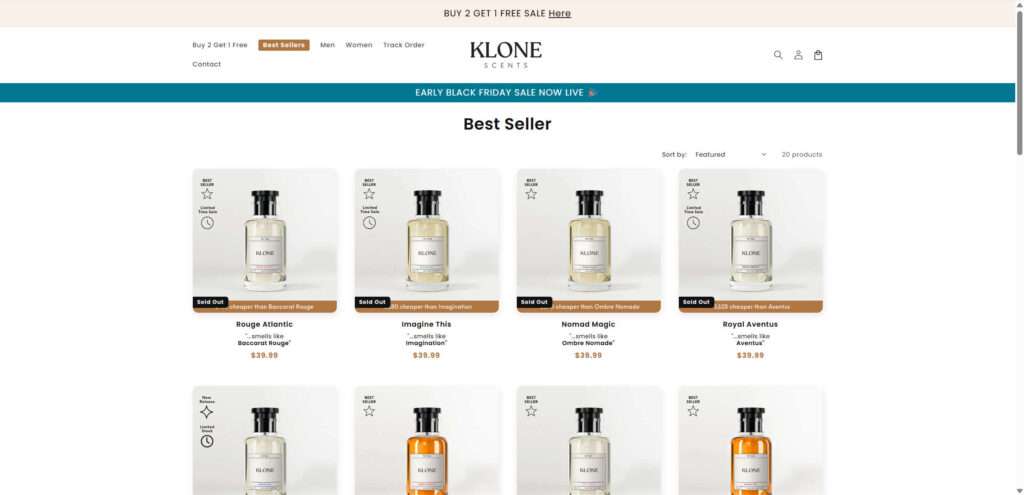
On their website — klonescents.com — every perfume bottle is priced at $39.99, no matter the fragrance. They feature names like “Royal Aventus” (a supposed clone of Creed Aventus), “Rouge Atlantic” (a dupe of Baccarat Rouge 540), and “Cherry Blossom” (inspired by Tom Ford Lost Cherry).
Each product claims:
- “Smells identical to designer perfumes”
- “Lasts 12+ hours”
- “Contains premium ingredients”
- “No influencer markup — fair pricing for everyone”
They even compare their prices visually, showing $39 next to “$300 Designer Scents,” implying they use the same materials and manufacturing methods — just without the luxury branding.
Sounds great, right? Except there’s little to no evidence that KloneScents has any real connection to legitimate perfumeries, laboratories, or fragrance houses.
The Too-Good-To-Be-True Promise
KloneScents is tapping into the “dupe perfume” craze — a booming market where online sellers promise to recreate luxury fragrances for a fraction of the price.
They claim their products are “crafted with the same ingredients” found in $400 designer perfumes, but “without the luxury markup.”
However, independent perfumers note that this is nearly impossible.
Real luxury fragrances rely on:
- Proprietary essential oils and accords.
- Precise ratios, aged ingredients, and IFRA-approved blends.
- Trademarked scent profiles that can’t legally be copied.
Even professional clone brands like Dossier, Alt. Fragrances, and Aromatic 1791 invest heavily in laboratory formulation and transparent ingredient sourcing.
KloneScents, on the other hand, offers no ingredient lists, no IFRA compliance statements, and no manufacturer disclosures.
Fake Perfection on the Website
Everything on KloneScents.com feels polished — almost too polished.
1. Every Product Has 4.9 Stars
Every single perfume — from Rouge Atlantic to Nomad Magic — shows the same “4.9/5 rating from 1,124+ reviews.”
The reviews themselves sound repetitive and generic:
“Smells exactly like the original!”
“I get compliments all the time!”
“Lasts all day — better than my Dior!”
There are no verified purchase badges, no timestamps, and no negative reviews visible on the site.
That’s statistically impossible for any real consumer brand.
2. Identical Pricing
All perfumes are $39.99.
There are no variants, limited editions, or ingredient-based pricing differences.
Even mass-market dupe brands vary pricing depending on raw materials — yet KloneScents sells every product at the same “flat rate,” a telltale sign of template-driven dropshipping.
3. The “Sold Out” Illusion
Nearly every product is labeled “Sold Out” or “Limited Time Only.”
These stock statuses refresh daily.
This trick creates a false sense of scarcity, pressuring customers to buy fast before the product “disappears.”
4. Recycled Copywriting
Sections like “Fair Pricing” and “Smell the Same, Pay Less” are copy-pasted from other clone sites. The text even repeats grammatical quirks and identical comparisons like:
“We believe everyone deserves access to luxury scents.”
This recycled copy shows KloneScents is not a fragrance house — it’s a template-based Shopify storefront.
What Real Customers Are Saying
While the KloneScents website paints a picture of universal satisfaction, third-party review platforms tell a very different story.
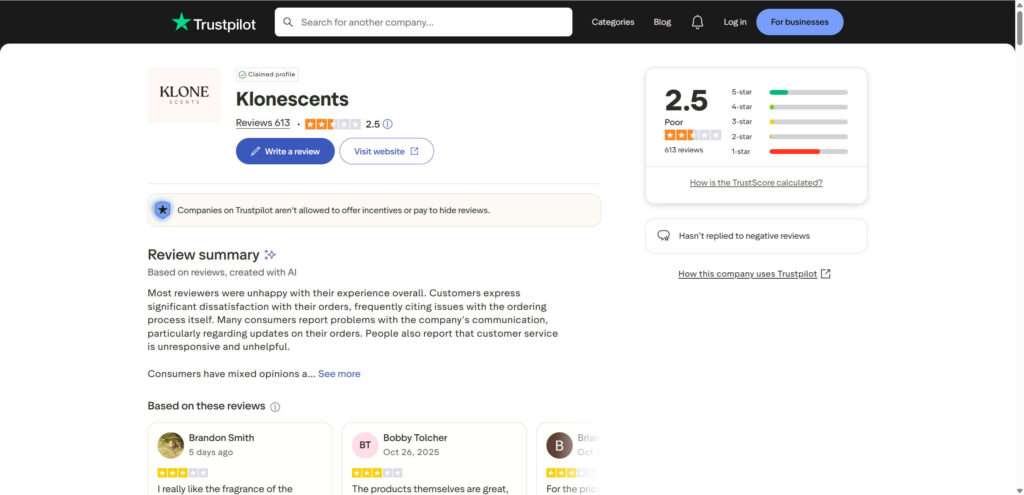
Trustpilot: 2.5 Stars (613 Reviews)
On Trustpilot, KloneScents holds a 2.5/5 rating. The AI-generated summary of reviews reads:
“Most reviewers were unhappy with their experience overall. Customers express significant dissatisfaction with their orders, frequently citing issues with the ordering process itself. Many consumers report problems with the company’s communication, particularly regarding updates on their orders. People also report that customer service is unresponsive and unhelpful.”
The top complaints include:
- Shipping delays: Many customers waited over a month for their order.
- No tracking updates: Emails go unanswered.
- Weak scent quality: “Smells like alcohol,” “fades in 30 minutes,” and “nothing like the original.”
- No refunds: The “money-back guarantee” is nearly impossible to claim.
One reviewer writes:
“The bottle looks cheap, smells cheap, and they never replied to my refund request. Complete scam.”
Another says:
“They sent me the wrong scent, and it smells like cleaning chemicals. I’ve been emailing them for two weeks — no response.”
Reddit Discussions
On Reddit’s fragrance and consumer forums, KloneScents has been repeatedly called out as a “dupe dropship scam.”
Common points raised include:
- Fake review manipulation.
- Lack of return address.
- Similar branding to other short-lived dupe websites.
- Unrealistic claims of “12+ hour longevity.”
One user summed it up perfectly:
“They’re not a clone house, they’re a Shopify reseller with a perfume label.”
Red Flags You Can’t Ignore
Let’s break down the clearest warning signs that KloneScents is not a legitimate fragrance house.
1. Unrealistic Price Claims
Real niche perfumes cost more because they use natural oils, IFRA-certified bases, and controlled blends. $39.99 bottles can’t replicate that quality.
2. No Ingredient Transparency
Not one perfume lists detailed ingredients or allergen info — a regulatory requirement for all legitimate fragrance sellers in the U.S. and EU.
3. Fake “12+ Hour” Claims
Cheap synthetic bases evaporate fast. Customers confirm these scents fade within an hour.
4. Fake Reviews
All five-star reviews on the site use identical phrasing and repeat across multiple products.
5. Questionable Shipping
No real tracking, multiple reports of lost packages, and ghosted support emails.
6. No Business Credentials
The website provides no company registration, VAT ID, or physical address — only a support email.
7. Trustpilot Neglect
KloneScents has not responded to a single negative review. Legitimate brands use Trustpilot for reputation management; scammers ignore it.
What to Do If You Bought from KloneScents
If you’ve already ordered and regret it, there are steps you can take to protect yourself and possibly get your money back.
1. Gather Documentation
Save:
- Order confirmation emails
- Screenshots of the website promises
- Tracking numbers
- All email exchanges with customer support
2. Request a Refund
Email support@klonescents.com (if active).
Use formal language:
“I am requesting a full refund under false advertising claims. The product received does not match the description or quality advertised.”
If no response within 3 business days, proceed to the next step.
3. File a Dispute
- PayPal: File under “Item Not as Described.”
- Credit card: Request a chargeback through your bank.
- Klarna / Shop Pay: Use the dispute system in your order dashboard.
Attach screenshots of customer complaints and your communication attempts.
4. Report the Store
You can help others avoid the same trap by reporting KloneScents to:
- FTC – reportfraud.ftc.gov
- Better Business Bureau
- Trustpilot and Reddit’s r/Scams
- Shopify Legal (if confirmed as a Shopify store)
5. Leave a Review
Leaving a verified review on public platforms helps expose deceptive sellers and prevents future victims from being misled by polished marketing.
Safer Alternatives
If you love the idea of affordable designer-inspired fragrances but want authentic, transparent brands, here are some proven alternatives:
- Dossier: U.S.-based, IFRA-certified, transparent ingredient lists.
- ALT. Fragrances: Made in the U.S., cruelty-free, long-established.
- Aromatic 1791: Boutique-level dupes with detailed scent pyramids.
- LAYERED: Transparent about manufacturing and partnerships.
All of these brands publicly list ingredients, production locations, and batch numbers — something KloneScents doesn’t.
The Bottom Line
KloneScents isn’t a luxury perfume house — it’s a dropshipping operation disguised as a fragrance brand.
From fake five-star reviews to Alibaba-sourced bottles and countless negative Trustpilot reports, everything about this brand suggests it’s designed for short-term profit, not customer satisfaction.
If something sounds too good to be true — like a “$39 perfume that smells exactly like Creed Aventus” — it probably is.
Final Verdict:
KloneScents relies on misleading marketing, fake reviews, and poor-quality imported perfumes. It’s not worth your money, and in many cases, buyers report never receiving their order at all.








