

A Lombard BARD staking offer says your tokens can earn points. For someone already following the project, another rewards dashboard can look like routine account housekeeping.
But a familiar name is only the beginning of the check. Before opening the wallet prompt, compare this offer with the program the real project currently describes.
Overview
A points offer impersonates Lombard Finance
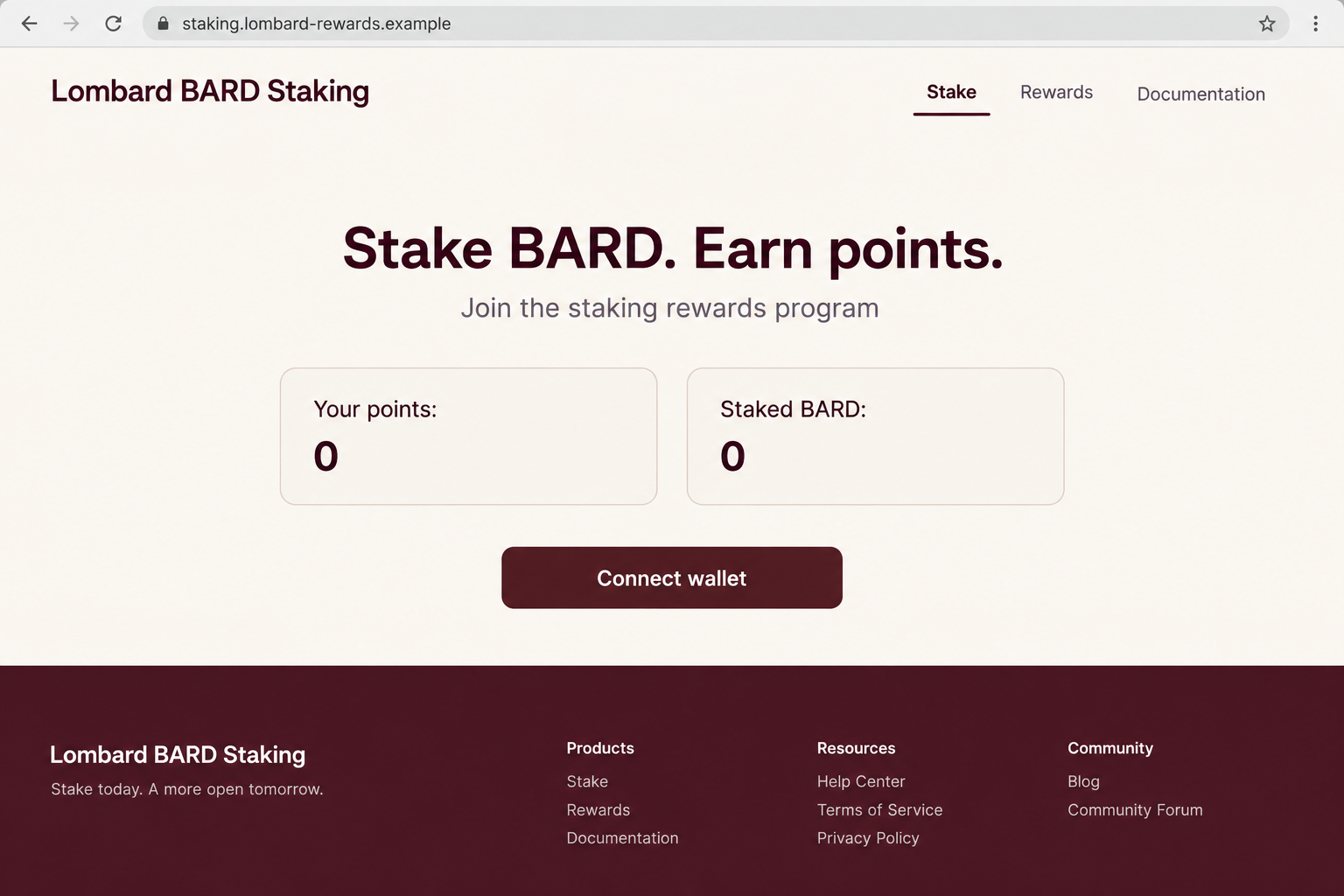
The Lombard BARD staking scam is a false rewards interface borrowing the identity of Lombard Finance. It should not be confused with the genuine project’s services.
A copy documented in September 2025 used staking.lombard-fin[.]com and encouraged visitors to stake BARD for points. The reward story supplied the reason to involve a wallet.
The reported imitation was identified as a crypto-draining page. We have not independently executed its code or traced a particular stolen transaction.
That limits what can be said about the precise authorization used. It does not make the recorded third-party points page an official Lombard product.
The real BARD staking program has since closed
There was a genuine BARD staking program. Lombard’s current BARD FAQ says new staking closed September 17, 2026, and rewards ended October 1.
Those dates matter when evaluating a fresh invitation today. An offer cannot be authenticated using an older screenshot showing a feature that the actual project has retired.
The retirement does not mean every earlier stake was fraudulent. It means readers need current instructions instead of treating the word “staking” as sufficient verification.
- Confirm the exact destination through Lombard’s independently opened website and documentation.
- Distinguish BARD, stBARD, LBTC, and a website’s promotional points.
- Check the requested token, spending limit, recipient, and network in the wallet.
- Do not accept a stranger’s migration or rewards-verification instructions.
A connection label does not describe every permission
An ordinary wallet connection is not the same as sending tokens or authorizing future spending. A deceptive interface may place consequential requests after an apparently familiar connection step.
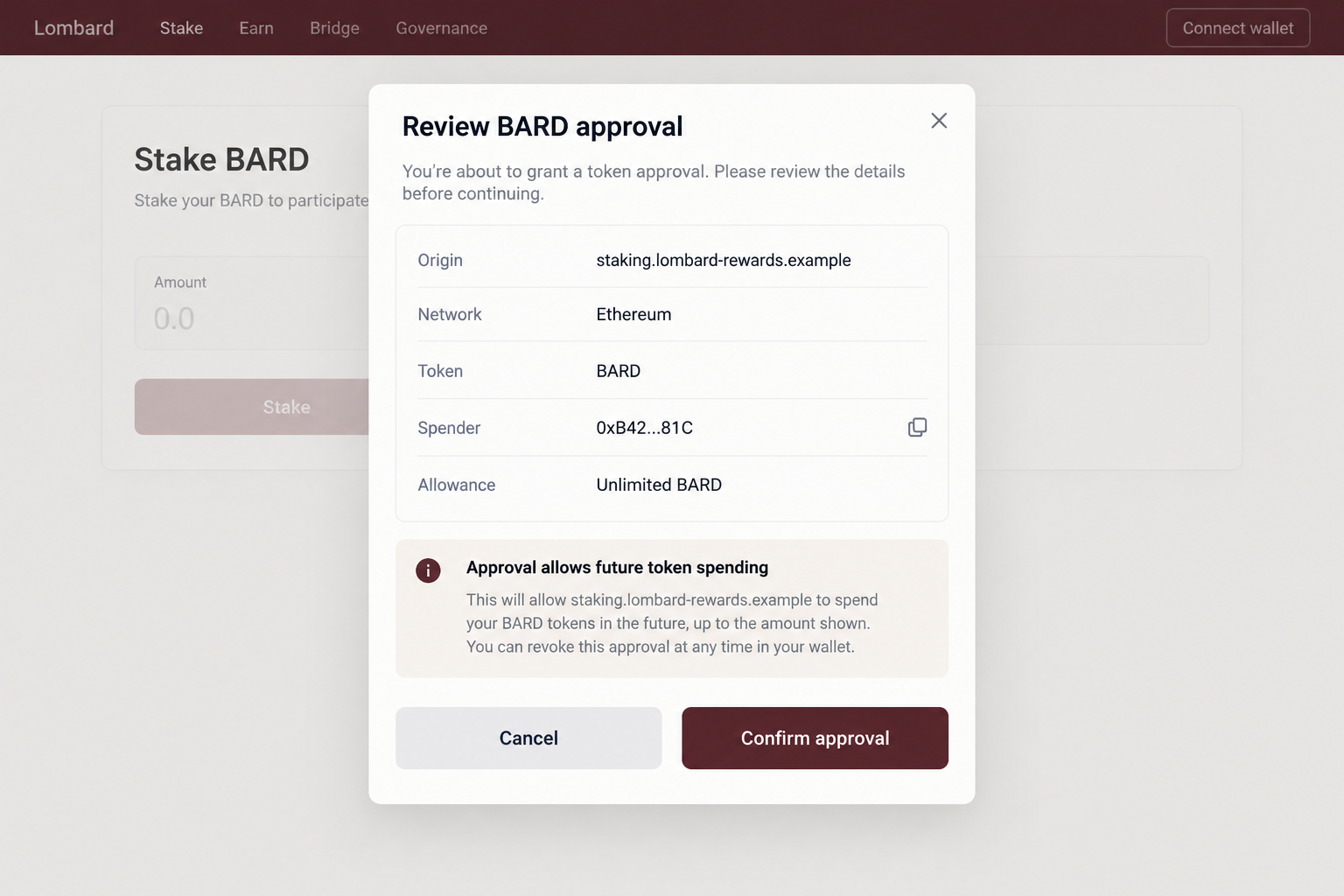
The images here illustrate that difference with fictional addresses. The allowance screen is an example, not a captured contract request from staking.lombard-fin[.]com.
Anyone who interacted should inspect the actual wallet record. Your response depends on what was signed, transferred, or disclosed, not merely which button was clicked.
This is a previously documented impersonation case reviewed against present information. We are not asserting that its original host remains live or that every current staking page is fake.
Why Points Can Distract From the Real Financial Decision
A points counter can feel less serious than a payment
People collect points in games, shopping programs, and online communities. That everyday association can make a crypto rewards interface feel like participation rather than an authorization request.
A visitor may focus on whether the score is increasing. The important event, however, happens in the wallet if tokens move or spending authority changes.
A score displayed by a website is not money in your custody. It does not establish a redemption right, a staking position, or a funded obligation.
Ask what exists outside that page. A real transaction record and independently documented program offer better evidence than a counter controlled by the same operator making the promise.
A real brand can make an unofficial rewards claim seem plausible
Lombard’s genuine site describes Bitcoin-related infrastructure and products. That legitimate activity creates a recognizable identity which an impersonator can borrow without permission.
A reader following product updates may reasonably expect new features. The counterfeit exploits that expectation by placing its own destination inside a familiar-looking story.
None of the legitimate platform’s partnerships or marketing statistics authenticate the copy. A scam page can reproduce those details without having any relationship to the organizations named.
Keep two questions separate: does the real project exist, and did it authorize this exact program and website? Answering the first does not settle the second.
BARD is not the same asset as LBTC
The real project’s documentation distinguishes BARD’s role from Bitcoin-backed LBTC. A shared platform name does not make every token a claim on the same underlying asset.
That distinction helps expose vague offers. A page discussing Bitcoin yield while requesting a different token should explain the intended arrangement through verifiable terms.
It should not rely on a reader assuming that every product wearing the Lombard name carries the same backing, redemption process, or risk.
This is not a recommendation to buy either asset. Understanding what a request concerns is a safety step, separate from deciding whether an investment suits you.
How the Lombard BARD Staking Scam Works
Step 1: A rewards invitation turns existing interest into an errand
The copy offers points for staking a recognizable token. Instead of asking the visitor to trust an entirely new financial brand, it acts like another part of Lombard.
Picture a holder checking community news and encountering the offer in a forwarded post. That example explains the hook; it is not a documented victim’s experience.
The reader may assume the task is simply registering an existing wallet. No assumption about eligibility or brand affiliation should be made before checking the official route.
A forwarded link is not an endorsement from the project. Even a friend who follows Lombard can share a page without understanding its wallet requests.
The original report does not identify one universal advertising channel for this copy. Evaluate the specific invitation you received rather than inventing a campaign history.
Step 2: The hostname presents itself as a specialized service
The recorded address begins with “staking” and includes a shortened Lombard-related name. To a hurried reader, that can look like a dedicated subdomain.
The distinction is the parent domain. A staking subdomain of an unrelated lombard-fin address is not automatically a subdomain of the real lombard.finance site.
Compare complete hostnames rather than a memorable word. The right word at the front can coexist with an entirely different organization controlling the address.
Navigate from Lombard’s official website to its current instructions. Do not let a reply, advertisement, or direct message define the legitimate staking route.
The reported fraudulent spelling is included for recognition only. There is no benefit in opening it to test a supposedly empty wallet.
Step 3: The points promise moves attention away from authorization
The page asks for wallet participation while discussing rewards. That lets the operator frame every subsequent request as a necessary step toward the score.
A button can be labeled “Stake” without creating a genuine position. The label says what the website wants you to believe, not what the transaction necessarily does.
Before proceeding, identify the chain and asset in the wallet. An unfamiliar spender or an unexpected amount needs an explanation supported outside the offer.
Do not dismiss a warning because there is no immediate purchase price. Permission to move existing holdings can be more consequential than a small stated charge.
You can decline the request and still research the program. A wallet prompt does not create an obligation to finish what the page calls enrollment.
Step 4: A financial permission can be disguised as participation
Some malicious crypto journeys ask for a direct transfer. Others obtain token allowances or signatures that facilitate later spending. The recorded copy’s exact implementation is not independently established here.
The illustrated approval concerns a particular token and spender. An unlimited limit can create exposure beyond the quantity someone thought they were staking.
Legitimate applications also use approvals. The relevant questions are whether the destination is authentic and whether the permission’s scope matches the transaction you intend.
Review the request without the points counter in mind. If it authorizes something you did not choose, reject it instead of trusting the site’s reassuring description.
A demand for the recovery phrase is not a normal staking permission. Supplying that secret compromises control in a much broader way than granting one token allowance.
Step 5: The operator’s display and the wallet record can diverge
A page can claim participation succeeded even if the transaction did something else. Its points total is not an independent account statement.
Inspect the wallet or explorer record to learn whether assets were transferred, authority was granted, or a request was rejected. Those outcomes require different responses.
If an unwanted allowance remains, later activity may still be possible. Closing the staking page does not necessarily extinguish permission already recorded on-chain.
Do not pay an additional charge to “release” the promised points. A new transfer to the same unverified operator is not proof of an existing reward.
Recovery conversations can also imitate project support. Use independently confirmed channels rather than anyone who appears after you mention a loss publicly.
The Real Program’s Retirement Is a Useful Verification Check
Current instructions are more useful than an old feature screenshot
The official BARD usage documentation should be checked alongside the FAQ before interpreting a staking invitation.
A historic feature image might have been genuine when created. It cannot establish that the feature is still available, or that a different site operates it now.
A new message offering enrollment needs present authorization. The retired program creates a particularly concrete reason to question claims about continuing new BARD staking.
Do not extend that conclusion to every Lombard product. The article concerns this impersonation and the specified program, not the status of unrelated services.
Existing stakes follow an official exit process
The FAQ says stBARD remains redeemable through the linked Mellow interface, with the applicable 21-day withdrawal period. That is different from enrolling on an impostor’s points dashboard.
Use the route linked from current official documentation. A familiar third-party name in a message does not authenticate the particular link supplied beside it.
A waiting period described by a genuine program should not be confused with an operator inventing another payment demand. First verify which arrangement your actual transaction belongs to.
If you have a legitimate position, do not sign a stranger’s supposed migration merely because a scam warning made you anxious. Follow the real program’s instructions.
There is no separate recovery claim owed by the counterfeit
The official FAQ explains that historical staking rewards accrued into stBARD. It does not authorize strangers to contact you for a special verification payment.
A scammer can misuse the retirement announcement as another pretext, even though that follow-up is not a confirmed stage of the recorded 2025 page.
Be especially wary of unsolicited help that combines true dates with an unrelated destination. Accurate background information can accompany a false instruction.
Verify any recovery or exit request through official documentation, then compare the actual wallet action. Do not let an accurate sentence authenticate everything else in the message.
What to Do if You Have Fallen Victim to This Scam
- Stop the points workflow without making another deposit.
Record the offer, hostname, and time of use. Note whether the interaction concerned BARD, another token, a signature, a transfer, or a disclosed secret.
Ignore instructions to complete one more step for the reward counter. Evidence from the existing interaction is enough to begin investigating.
- Check what your account actually authorized.
Review the transaction history through your normal wallet. Save hashes, network details, recipient addresses, and the token involved in any unexpected activity.
A site saying “staked” does not prove a valid position. Compare its claim with the account record before seeking a refund from a supposed points balance.
- Disconnect the copy and revoke unwanted token authority.
Remove the suspicious application connection, then inspect relevant allowances separately. Use your wallet’s official instructions for the chain on which you interacted.
MetaMask’s revocation guide explains why an allowance can remain after disconnection. Revoking it cannot return assets already sent elsewhere.
- Protect remaining assets if a secret was disclosed.
A leaked recovery phrase or private key requires a new wallet with a fresh secret on a trusted device. Changing an application password is insufficient.
If funds move automatically, stop improvising fee deposits and obtain reputable technical assistance. Do not share the exposed secret with a volunteer recovery account.
- Investigate any software installed during the process.
If the page supplied a staking extension or verifier, review browser applications and run updated Malwarebytes to check for unwanted software.
AdGuard may help reduce malicious-ad exposure and some phishing destinations. Its protection does not validate a points offer, revoke an allowance, or reimburse a completed transfer.
- Use genuine program support only for genuine positions.
For an established stBARD position, consult official exit instructions. For the counterfeit interaction, report the impersonation through verified project and platform channels.
Contact local authorities about losses and preserve their case reference. Avoid posting confidential financial information while explaining the incident publicly.
- Reject guaranteed recovery and rewards-unlock charges.
Someone promising to recover funds for an advance crypto payment may be exploiting the same anxiety. Ask how their identity and services can be independently verified.
A public transaction trail can support investigation. It does not give any stranger a reliable reversal button or justify sending them your wallet secrets.
Frequently Asked Questions
Is Lombard Finance itself being called a scam?
No. The warning addresses an unauthorized BARD points-and-staking copy. It distinguishes that impersonation from the real project and its legitimate historical program.
Can I still start a new stake in the original BARD program?
Current official documentation says the program stopped accepting new stakes in September 2026. Check the latest official instructions rather than an older promotional screenshot.
Does a points balance prove I earned cryptocurrency?
No. A website counter does not establish an on-chain asset, payment obligation, or redeemable position. Verify the program and real account record separately.
Is BARD the same as Bitcoin-backed LBTC?
No. The project’s documentation describes different purposes for those assets. Do not infer the backing or redemption rights of one from another’s marketing.
What if I already have a genuine stBARD position?
Follow the exit route linked by official documentation. Do not migrate through an unsolicited rewards page or confuse a real withdrawal process with this imitation.
Does disconnecting end every permission the page obtained?
No. A token allowance can survive disconnection. Check the specific chain and authorization using trusted wallet guidance, and assess secret exposure separately.
The Bottom Line
The Lombard BARD staking scam uses a points offer to blur the boundary between participation and financial permission. The genuine project’s existence does not authenticate the copy.
Compare new invitations with current official instructions. If you approved an unwanted action, focus on the wallet record and remaining authority, not the counterfeit points total.








