


A runner in your club says an injury has ruled them out of London. They offer you the place you’ve been trying to get.
The message sounds like it came from someone who understands what the race means to you. Before you pay, check what can actually be transferred.
Overview
London isn’t an event where runners can resell their entries
The London Marathon place scam uses a private sale to promise a race entry the seller cannot transfer to you. The claimed place may or may not exist.
London Marathon Events answers the transfer question in its official event FAQ. A participant cannot transfer their entry to somebody else.
You don’t need to work out whether the seller really ran last year or really picked up an injury. Even a genuine entrant can’t make this private arrangement valid.
A convincing price doesn’t change that rule
The Guardian reported an offer ahead of the 2026 race that asked for £79 by transfer, along with a name and email address.
The amount was close to the official race fee for that edition. Paying an amount that resembles a real entry fee doesn’t put your name on the organizer’s list.
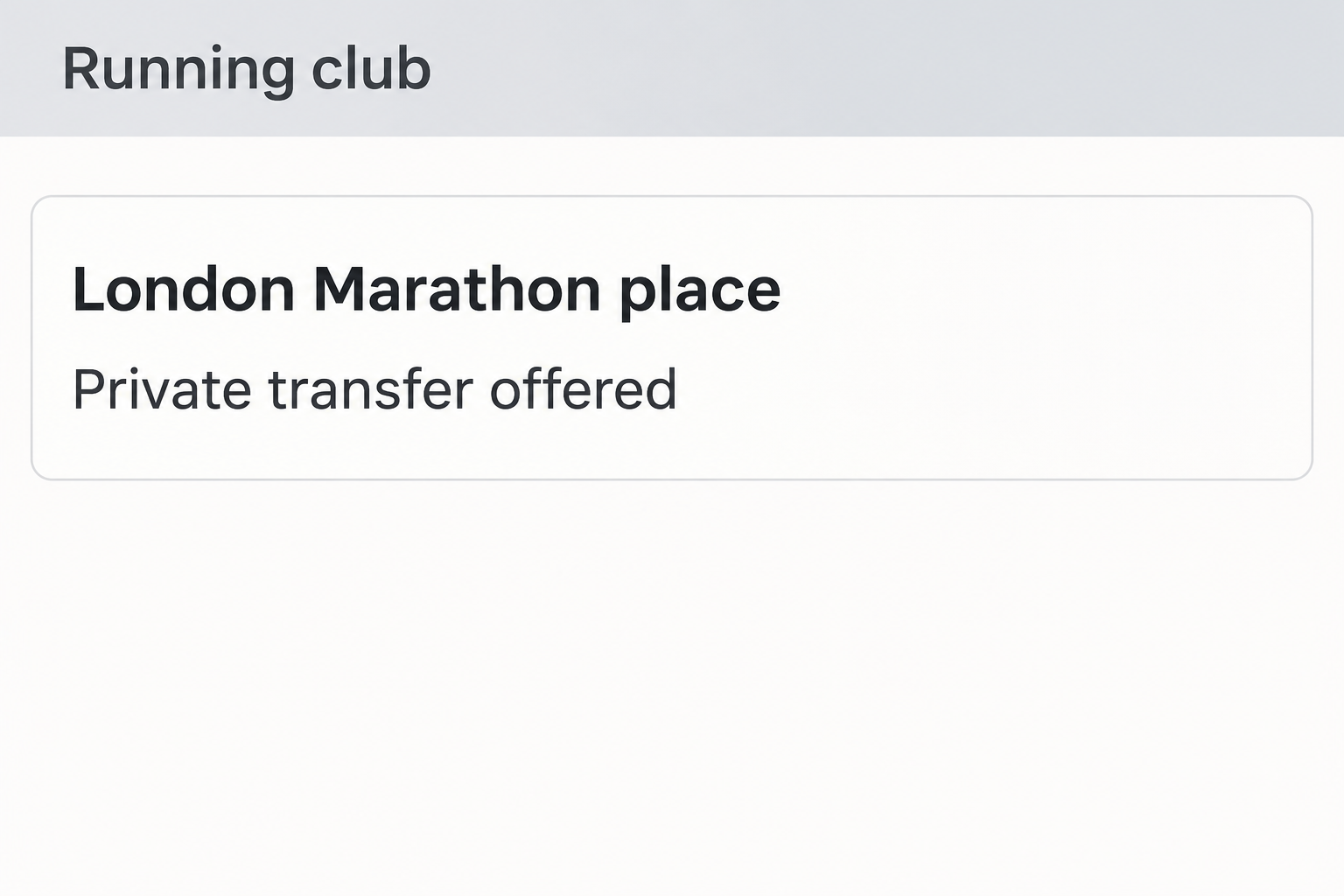
The illustration shows the kind of private listing involved, not a copy of the seller’s account or a race registration.
Things you can verify without messaging the seller
- The exact edition and event you want to enter have official terms published by the organizer.
- Any entry route described by the organizer starts through its own site or an official partner.
- A transfer between two runners is different from an organizer allowing someone to defer their own place.
Start with those distinctions, not with the seller’s claim that someone else is ready to pay. You can decide whether the offer is possible before discussing the money.
How the London Marathon Place Scam Works
Step 1: The offer turns up where runners already talk
A listing in a training group can blend into messages about long runs and missed races. People do get injured and decide not to start.
That familiar story doesn’t make the proposed sale legitimate. It makes the initial message easier to understand without raising questions about the actual rules.
If a club has members who know each other, don’t let the community’s reputation stand in for the poster’s authority. Public or shared groups can include strangers.
Step 2: The conversation becomes a private arrangement
In the offer reported by The Guardian, the seller directed people toward WhatsApp. A private chat can make a claimed bargain feel like something only you can act on.
It also means other members may not see the payment request. If you found the post in a club, save it before it disappears from the feed.
Moving to another app doesn’t create any new evidence about the place. It mainly changes where the story and payment details appear.
Step 3: The seller claims a ballot entry can be put in your name
The hook isn’t just that someone has a race bib. It’s that you’ll supposedly get a valid entry in your own name after the handover.
That claim fails before you need to inspect an email screenshot. London Marathon Events says a place cannot be transferred between people.
A screenshot might show somebody else’s real entry. What you need is a valid entry issued to you through the organizer’s own process, not proof the other runner registered.
Step 4: Payment and personal details are requested
The offer can ask for a bank transfer plus the name and email supposedly needed to complete the change. A plausible explanation for that information does not establish permission.
Don’t send proof of identity or account credentials later if they say the handover failed. There is no private transfer procedure to salvage with another payment or document.
If the deal does not result in a place, you can lose more than the transfer. Nonrefundable travel and lodging may have to be unwound as well.
The Difference Between an Entry, a Bib, and a Deferral
An entry belongs to the person the organizer registered
The general conditions of entry are the rules for this specific event. Look at them for the edition and route you are considering.
A bib number isn’t a bearer ticket that anyone can use. It is tied to the registered participant, including information that can matter for race operations and medical care.
Don’t rely on the argument that you could pick up a packet or wear somebody else’s bib. Possessing it does not give you a valid entry.
A deferral is not a right to nominate another runner
A registered runner may have a way to withdraw or defer under their own terms. The availability and conditions can depend on the route by which they entered.
That is a matter between them and the organizer. It does not let them take your money and assign their place to you.
Someone may point to a deferral page as evidence that changes are possible. Read what kind of change the page describes and who is allowed to make it.
An official charity allocation is not a runner reselling a place
A recognized charity can have places that it allocates through the event’s own arrangements. Look up the charity through the organizer rather than trusting a message from a stranger.
An application may come with fundraising expectations. Ask the charity about those commitments and how the organizer confirms your entry before making travel plans.
Nobody needs to sell you an existing runner’s bib to connect you with a real charity. If they claim to represent one, contact the charity independently.
If a Running Group Shares a Suspicious Listing
Tell the moderator what the post promises and which race it names.
A short explanation of the actual London transfer rule is more useful than arguing about the poster’s motives.
If you’re showing other members the message, cover the payment details and personal information. Leave enough context for people to recognize the purported private transfer.
Don’t let a real friend’s account settle the question. If someone you know appears to have posted the offer, check with them through a different route.
A different event might have a legitimate transfer scheme.
If the listing changes to another race, identify the organizer and check that event’s own rules rather than treating London as a general rule.
If you missed London this time, compare another event’s official entries or check the London organizer’s current routes for a future year. That gives your training a realistic target.
Four Ways the Offer Can Change Without Becoming Valid
The seller produces what looks like a confirmation email
An image may show a real event name, date, and registration reference. It can belong to the original runner, or it can be a copy that proves nothing.
Don’t ask for more of another runner’s personal information to resolve this. Even an authentic confirmation says who currently holds the place, not who can take it over.
If someone says your entry is now registered, access the organizer’s real account route independently. A forwarded screen or email cannot establish that your own registration exists.
The seller calls the money a donation
A donation and a race entry are separate. Paying into a fundraiser does not automatically register you for the event, even if you can verify the fundraiser itself.
Ask the charity directly how it allocates places and what confirmation you’ll get. Start from its own channels, and check that the organizer recognizes the route you are offered.
Don’t assume a permission or benefit associated with the original runner is yours. Fundraising commitments and registration are both things you should understand in your own name.
The seller says you can settle after collecting the bib
That changes when money moves, not the organizer’s rule. Holding something physical can feel more secure than receiving a screenshot, but the bib is still tied to another participant.
If an emergency happens on the course, the identity linked to the entry can matter. This is more than an administrative distinction about whose name appears in the results.
Ask the organizer if you have a genuine problem collecting a race pack for a place you already hold.
That question is different from buying a place through somebody else.
The seller claims a volunteer or club can make an exception
Plenty of people help make a marathon happen, but membership or volunteering doesn’t necessarily confer authority over entries. Take any claimed exception straight to London Marathon Events.
Give the organizer the edition, the type of entry described, and the claim you were asked to rely on.
Avoid sending documents about another runner when a summary will do.
If the seller doesn’t want you to ask, there’s no practical way to settle the disagreement in the chat. The appropriate next step is to leave the arrangement.
What to Check Before Spending Money on the Trip
Separate registration from transport and lodging.
Your booking may be real even when the race entry is not, and your ability to change it will depend on its own terms.
If you’ve applied through a valid route and are waiting for an outcome, check when and how that provider sends confirmations.
A deadline in a private sale isn’t your application deadline.
Agree with anyone traveling with you when you’re comfortable making nonrefundable plans. Share the organizer confirmation when you have it, rather than setting the date around the seller’s assurances.
If entry is no longer possible, you can still assess whether you want to travel as a spectator. That’s a separate choice you can make without buying a bib.
People caught by the claim often had a sensible plan before the message arrived.
It’s fine to return to that plan rather than treating the unexpected offer as your only chance.
If a listing shows up just after the ballot, expect other runners to be looking for answers too.
Giving them the organizer’s rule can help without amplifying the suspicious post.
What to Do if You Have Fallen Victim to This Scam
-
Stop paying for the promised race place.
Don’t send a name-change charge or a fresh deposit. Save the original listing and chat, including which edition the person claimed to be selling.
Write down when they asked for money and when they said your name would appear in the organizer’s records. That makes the sequence easier to explain.
-
Contact the provider that handled the payment.
If you sent a bank transfer, use your bank’s own fraud route. Tell it you paid because someone misrepresented a London Marathon place as transferable.
Give the date, amount, reference and recipient from your transaction. Ask what action is possible and what records are needed, without assuming any outcome.
-
Don’t rely on an email the seller forwards.
Contact London Marathon Events through its official site if you need to check whether an entry in your name exists.
Don’t log in using a link from the private arrangement.
Explain whether you applied through a ballot, charity, or another official route before the offer. That will help separate any legitimate entry from the private claim.
-
Protect the details you already shared.
A name and email alone don’t establish that somebody accessed an account. Still, expect that a follow-up could use those details and claim to be registration support.
If you entered a password anywhere the person sent you, change it on the real service and check whether you reused it on another account.
-
Report the post and keep your travel costs separate.
Flag the listing to the platform and tell the event organizer so they can see where the claim appeared.
Report the financial fraud through the appropriate service in your location.
Check your lodging and transport cancellation terms directly. Resolving the payment doesn’t automatically cancel other bookings you made in the expectation of running.
Frequently Asked Questions
Can someone transfer me their London Marathon ballot place?
The organizer says entries cannot be transferred to somebody else. A claim that you can pay privately to take a ballot winner’s place contradicts that rule.
Can a runner sell me their bib instead?
A bib associated with another participant is not your race entry. You should not use it as a workaround for the restrictions on private transfers.
Is a charity place the same as a resale?
No, an official charity route allocates places under the event’s arrangements. Apply through the charity you reach from the organizer’s information and follow its official instructions.
What if the price matches the official entry fee?
A matching price is not proof of a valid entry. It may have been chosen precisely because it sounds like what an entrant would pay.
Do all marathons forbid runner-to-runner transfers?
Other events may have different transfer rules. Use the named organizer’s current conditions and its actual process, rather than treating a private message as authorization for any race.
Should I book a hotel while the seller completes the transfer?
Hold off on nonrefundable bookings based on a private sale. You need confirmation that you have a valid entry through an approved route.
The Bottom Line
Don’t buy a London Marathon place from another runner. The organizer’s rule is direct: a private sale cannot put their entry in your name.
If you already transferred money, contact your payment provider and retain the original listing and conversation. Choose an entry route that the organizer itself recognizes.

Join the discussion
0 commentsShare your experience or ask a question about this article.
Community experiences
Did this happen to you?
Your experience could help someone recognize the same scam. Submit a private report for our team to review.
I experienced this tooReports are reviewed before publication. Sharing publicly is always your choice.
Discussion
Start the conversation
Have a question or something useful to share? Add the first comment.