


A message that looks like it came from the school offers a discount if you pay next term’s fees early. The offer comes with a condition.
The payment has to go to different bank details. Before you work out how much you’ll save, establish who asked you to make that change.
Overview
The discount is what makes the new account look reasonable
A school fee discount scam can imitate a bursar, the person who handles a school’s finances.
The message offers a reduction for paying early, then directs the payment somewhere else.
Unlike an overdue bill scam, this one doesn’t need to threaten your child’s place. It invites you to do something that sounds sensible for the family budget.
A parent may be making their first payment, arranging boarding, or working from a different country. There may be no previous bank transfer to use as a comparison.
What the UK reporting establishes
The Guardian reported on independent schools whose families had been targeted by false fee messages. In some cases these messages offered discounts to persuade people to pay earlier.
IRIS Education’s underlying survey asked 100 UK private school bursars about incidents. Respondents estimated that families lost about £3,200 on average when the scams succeeded.
This is an estimate from the people surveyed, not an audited loss figure for all schools.
The report does not establish that every family was contacted in the same way.
The three questions to ask the real school
- Does the school recognize the discount for this student and this term?
- What is the exact amount due, and when does the bursar say it must arrive?
- Which payee and payment route does the school independently confirm for this bill?
A real amount doesn’t authenticate a new account. A real discount doesn’t make the attached invoice genuine, either. Check the school, the offer and the payment destination separately.
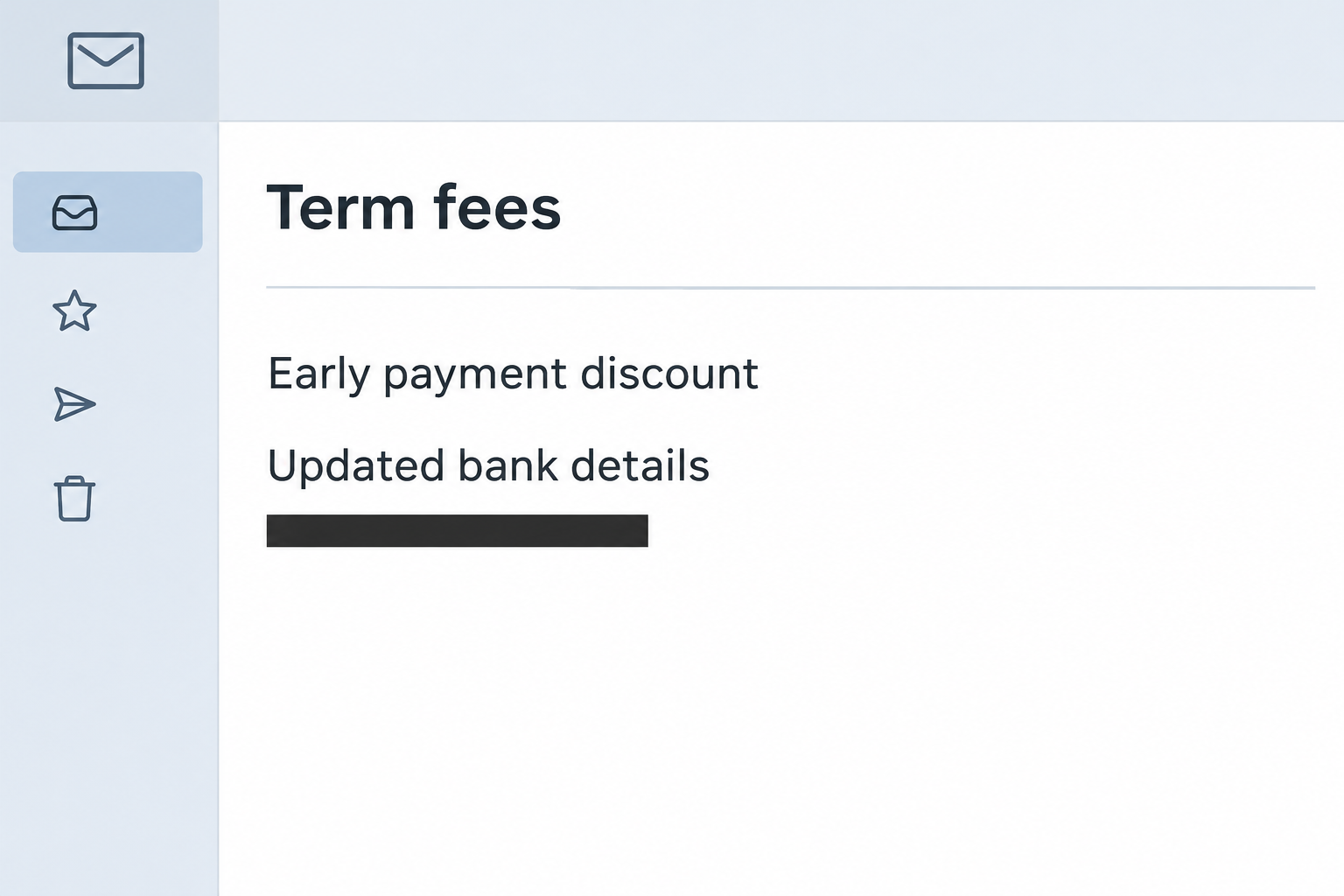
The image illustrates the two claims that arrive together. It isn’t an original invoice from a school or a reconstruction of actual bank details.
How the School Fee Discount Scam Works
Step 1: The family is expecting a bill anyway
Tuition and boarding charges have a rhythm. Admissions paperwork, a deposit, a first term invoice, and later bills can arrive through several people and services.
An email about payment doesn’t look out of place when you’ve been waiting for one. The sender doesn’t need to invent a relationship with a school you never contacted.
Someone can know a student is enrolling or name the right term without having authority to collect fees. Treat accurate background details and bank instructions as separate facts.
Step 2: An early payment discount gives the email a reason to exist
A reduction can sound like something a school would offer to encourage predictable payment. The sender uses that idea to make a new message feel welcome rather than alarming.
You’re invited to compare the full bill with the discounted one. The reduction is only valuable if it is real and the school will credit the payment.
If the sender says the figures are confidential or expire today, tell the real bursar exactly what you were offered.
A verified office is where the discount should be confirmed.
Step 3: The payment is redirected to a different recipient
The crucial detail may be only one line on a long email or PDF. The account given for payment is not the account the school has authorized.
The UK police explanation of mandate fraud describes this broader trick: using a familiar organization to persuade someone to change where money goes.
A PDF can look professional, and an email chain can look familiar. Neither is a substitute for getting the complete payee details through a route the sender didn’t choose.
Step 4: The school doesn’t see the payment the family thinks it made
After you transfer the money, you may see a confirmation in your banking app and assume that finishes the job. The real school may still see an unpaid invoice.
A normal processing delay can look similar at first. Once more time has passed than the school expects, contact the bursar with the amount and reference your bank recorded.
If the account was wrong, get the bank involved quickly. The aim is to report the transfer and protect your account, not to win an argument with the sender.
How to Verify a Discount Before Changing the Account
Start a new conversation with the bursar’s office
Use a number you already have or one listed by the school on its own website. Don’t use the phone number printed on the revised invoice.
Tell the office the student, term and offer you’re checking through its normal identity process. Ask whether it recognizes the discount and has issued a replacement bill.
If one parent approved the charges and another handles the banking, do the check together. Make sure both know what was verified and which document to use.
Ask for the full payment information, not just a yes or no
A staff member may recognize the amount without knowing which account was written on the email you received. Ask for confirmation of the beneficiary name and full details independently.
Read any changes back over the verified channel if the school uses bank transfers. If its policy requires a portal, start at the school’s own website instead.
A name check from your bank can help catch mismatches. Even a match can’t tell you whether the school approved a particular request or whether the price is correct.
Don’t treat a familiar admissions contact as a payment authority
An agent who handles admissions or visas may know the dates and fees. That doesn’t automatically make the agent the person who can approve a new destination.
Ask the school which party is authorized to collect money and under what arrangement.
If it uses a payment provider, get the route from the school rather than the agent’s forwarded link.
A family paying from abroad may also need a currency, reference or separate instructions for the transfer. Get those from the authorized office as part of the same check.
What a School Can Do Before the Next Billing Run
Make it easy for parents to find the real payment route before a bill arrives. The family should know whom to call and which channel can confirm a change.
Publish a plain description of how discounts, amended bills and bank changes are announced. If the school never changes payment instructions by email, tell families so before term starts.
Avoid telling everyone to rely on the same simple clue, such as a school logo or sender name. The warning should give parents something they can do independently.
Be clear about which third parties can communicate about admissions and which can actually collect money. Families should not have to guess from a forwarded PDF.
Give international families the official information in a form they can easily understand.
Invite them to ask for clarification rather than treating unfamiliarity with local banking as a reason to rush.
Inside the finance team, reconcile incoming payments with pupil accounts and follow up on anomalies. A family may report a suspicious receipt before other families realize anything is wrong.
How to Handle a Changed Bill When the Details Look Right
Compare the documents without opening an unfamiliar attachment
If you already have the original bill in your trusted portal, use it as your starting point. Note the dates, term, deposit credits, and total your family expected.
Sometimes a legitimate corrected bill will show prior payments or a revised schedule. The right comparison is with what the school confirms, not which document looks more polished.
Ask the bursar to send a clean copy through the normal channel if you need one.
You don’t have to open the suspect version just to learn which account is right.
Handle family arrangements before anyone presses send
Suppose a parent who normally reads the school emails forwards the discount to a relative who pays the bills. Neither should assume the other verified the account.
Share where the confirmation came from and which amount it covered.
If the last instruction was just a forwarded email, ask the parent with billing access to contact the office directly.
If the school cannot speak to another person for privacy reasons, don’t work around that with a stranger from the email.
Ask the school how authorized payers can verify instructions.
Ask for time rather than accepting a private deadline
When a real discount has a deadline, the school can explain what happens if you miss it. It can also tell you which other payment arrangements already exist.
Don’t ask a supposed bursar to extend a deadline by replying in the same thread. Keep the real billing relationship and the suspicious message apart.
Pay the school’s legitimate invoice once you have the right details and a clear plan.
The safe outcome is not ignoring your fees; it is paying the institution you intended.
If a transfer is delayed across time zones, agree on which date the school considers payment received.
Confirm that answer with the bursar rather than relying on a promise in the email.
Account details can change for completely legitimate reasons. Asking the school to confirm them in an independent conversation protects both sides and doesn’t require an accusation.
If someone else is translating the request for you, keep the original message intact. Let the school or bank see the wording when you ask it to investigate.
When you receive an independently verified receipt, check that it went against the student’s correct account.
A genuine bank transaction can still need reconciliation if a payment reference was missing.
Keep that official receipt with the invoice for the term. If another new discount appears later, you’ll have a clear record of what has already been settled.
What to Do if You Have Fallen Victim to This Scam
-
Tell the bank what happened before doing anything else.
Use your bank’s own fraud number or app and say that a false school fee request changed the destination for a transfer. Give the date, recipient, amount, and reference.
Ask what the bank can do to stop or recover the money. If you paid from abroad, tell it which bank or transfer provider sent the payment.
-
Let the real school know that the invoice was impersonated.
Contact the bursar through a trusted route and describe what the email said. Ask it to confirm the student’s current balance and what should happen next.
If the real bill is still due, ask the school about time to resolve the fraud. Don’t assume reporting to the bank changes your agreement with the school.
-
Keep a record showing exactly what changed.
Save the original message and attachment, your confirmed school details, and the transfer record. It helps to preserve the dates and account names from both sets of instructions.
If an admissions agent was involved, save their correspondence too. Don’t assume which system was compromised, and don’t publish the student’s details to warn other families.
-
Protect your account if you also entered a login or code.
Change anything you entered on a site you don’t trust through the legitimate portal or service. If you approved a bank prompt, tell the fraud team what it said.
Review recovery settings and unfamiliar activity through the official account. Don’t follow a second message claiming it can cancel the transfer with another authentication code.
-
Report through the appropriate fraud channel.
If you are in the UK, check the Report Fraud guidance for your area. Keep the reference together with your bank’s case number and the school’s contact.
A school alert can help other families, but it isn’t a replacement for contacting your payment provider. Keep both records and follow up separately.
Frequently Asked Questions
Is every early payment discount from a school fraudulent?
No, some schools may make genuine offers. Verify the discount and the exact payment destination independently before acting on any change you receive by email.
What if the email knows my child’s name or boarding arrangements?
That information does not settle who sent the message. Check the instruction with the school and avoid sharing extra personal or admissions details with an unverified contact.
What if the school has really changed banks?
The office can tell you how it confirms changes. Use the current details it provides through the verified channel, not the ones supplied by the suspicious email.
Can I use the same bank details I paid last term?
That earlier record is useful for comparison, but the school may have a genuine change. Independently confirm what is valid for this bill before sending a transfer.
Should I send a small test payment first?
It doesn’t establish that the recipient is the school. A school can confirm its authorized payee without asking you to risk even a small amount.
Can an agent confirm a discount for me?
An agent can help you understand the paperwork, but check who has authority for billing. Ask the school directly whether the offer and destination are valid.
The Bottom Line
Don’t send term fees to changed bank details just to keep an early payment discount. Ask the real bursar to confirm both the offer and the exact instructions.
If you paid already, contact your bank and then the school. Keep the altered message, transaction and official invoice so each can address its part of the problem.

Join the discussion
0 commentsShare your experience or ask a question about this article.
Community experiences
Did this happen to you?
Your experience could help someone recognize the same scam. Submit a private report for our team to review.
I experienced this tooReports are reviewed before publication. Sharing publicly is always your choice.
Discussion
Start the conversation
Have a question or something useful to share? Add the first comment.