


Looius.shop sold summer clothes at bargain prices in 2025. By late August, buyers were writing that they had paid and received nothing.
Today the Looius store is gone, and its domain no longer exists. Here is what buyers reported, what to do if you paid and whether Loopyzee and Lovuso are legit.
Overview
What Looius.shop Was
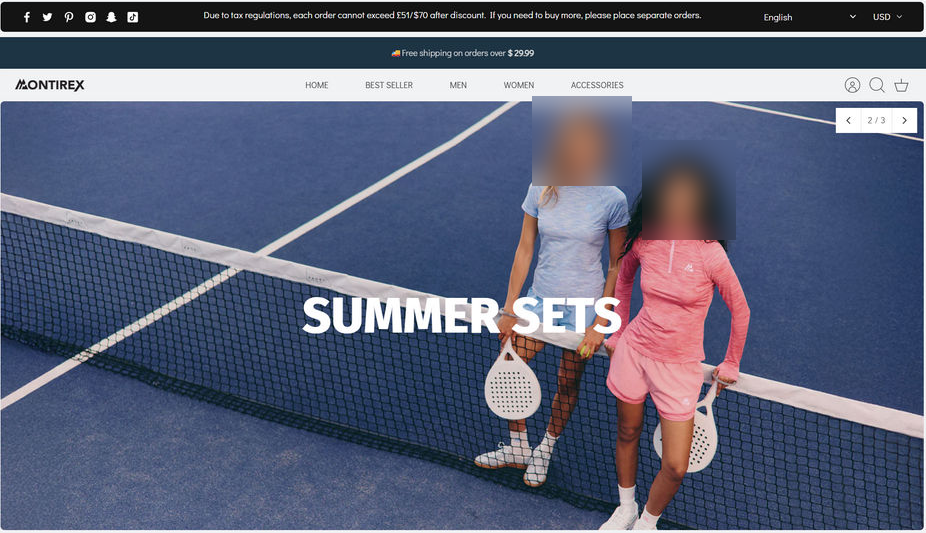
Looius.shop was an online clothing store that sold sportswear and summer sets. Our August 2025 screenshot shows it using the logo of Montirex, a real Liverpool sportswear brand.
A banner across the top capped every order at “£51/$70 after discount” because of “tax regulations.” Shoppers wanting more were told to place separate orders.
The order cap was quoted in both £ and $, and every amount buyers mention is in £, pointing mainly to UK shoppers.
What Happened to Buyers
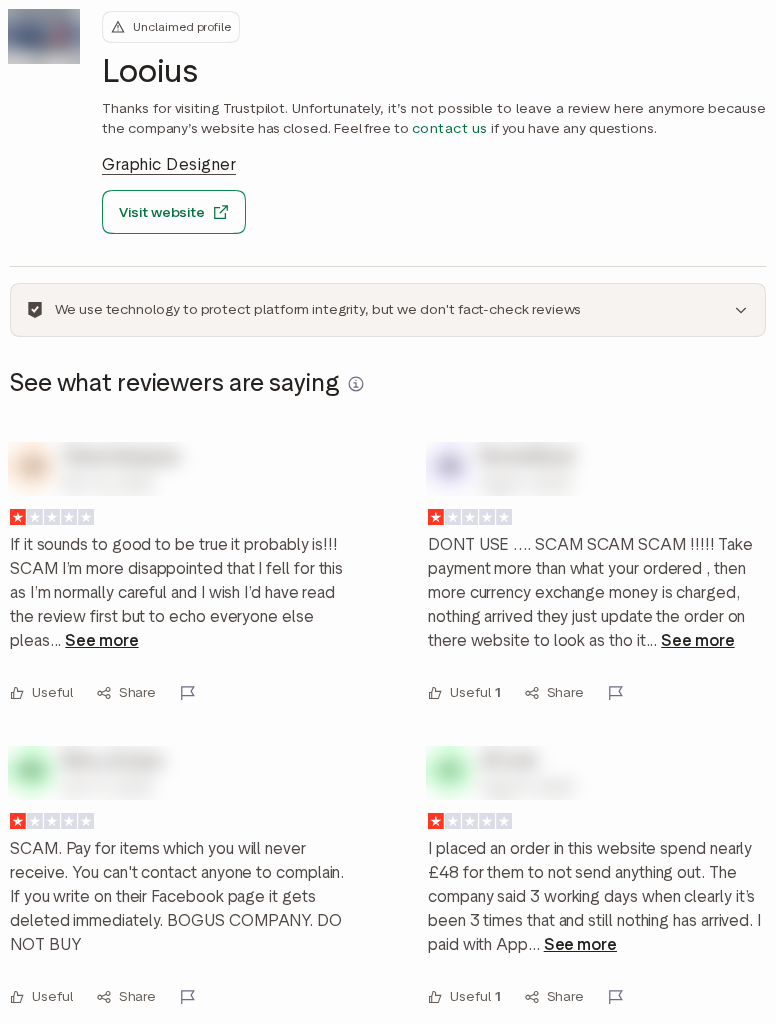
Trustpilot lists 33 reviews for Looius, and all 33 give one star. Its TrustScore is 1.4, and the profile now says the company’s website has closed.
Of the 33 reviews, 24 say the buyer paid and nothing arrived. The orders they describe date from mid-August to late September 2025.
Our Verdict
Looius.shop was a scam store that copied the logo of a real brand, Montirex. Don’t trust any site that reappears with the Looius name or its order-cap banner.
- All 33 Trustpilot reviews for Looius give one star, and not one reviewer says an order arrived.
- Buyers report being blocked from their order pages and having Facebook comments deleted.
- The looius.shop domain is no longer registered, and the site doesn’t load.
- If you paid, your card issuer or bank is now the only realistic route to your money.
- Loopyzee and Lovuso are separate businesses, and nothing links them to Looius.
Is Looius Still Working?
No. Looius.shop no longer opens, and the domain has no DNS records. The .shop registry’s lookup service returns “looius.shop not found.”
Trustpilot also marks the profile closed. Its notice says “it’s not possible to leave a review here anymore because the company’s website has closed.”
Archived copies of looius.shop from March and July 2025 show only server error pages. Their headers point to a PHP-based shop system behind Cloudflare, not Shopify.
Trustpilot files the business under the odd category “Graphic Designer.” Its contact details show only “United States” and the looius.shop address.
That makes our own August 2025 screenshot the clearest record of how the store looked while it was taking orders.
Looius Reviews: What Buyers Reported
The Looius reviews on Trustpilot tell a consistent story. Buyers paid, received confirmation emails or excuses, and then waited weeks for goods that never came.
One buyer said they ordered on August 28, 2025 and still had nothing in October. Another, who ordered September 6, got two scripted replies blaming a factory backlog, then silence.
Three reviewers say the store blocked them from seeing their orders or tracking. One wrote that they could no longer “see my orders or track them.”
Eight reviewers say the store deleted critical Facebook or social media comments, or blocked the people who posted them. Others say emails went unanswered or got scripted replies.
One buyer quoted a reply that began “Dear customer, Thanks for your order. We are sorry for the long-time waiting.” The order still never arrived.
The amounts were small but real. Reviewers mention losing about £30, £48 and £50, and three say they were charged more than their order, two citing currency fees.
Five reviewers say they got their money back through their bank or credit card. Three more had a bank or card claim open or planned when they posted.
How the Looius Scam Store Worked
The pattern matches many short-lived clothing stores. Each step is designed to collect payments quickly before complaints catch up.
Step 1: A Borrowed Brand and Summer Photos
The store put the Montirex logo above polished photos of models on a sports court. Nothing suggests the real Liverpool brand was involved.
Step 2: Prices Too Low to Question
Free shipping started at $29.99, and discounts made sets look like bargains. Low prices encourage quick orders with little research.
Step 3: An Order Cap Dressed Up as Tax Rules
The banner blamed the cap on tax regulations but named no actual rule or law.
Whatever the reason, the cap kept every payment small, so each buyer’s loss stayed small too.
Step 4: Confirmation, Then Delay
Buyers received order confirmations and, when they chased, replies about long waiting times. That bought time while the store kept taking new orders.
Step 5: Locked Accounts and Deleted Comments
As complaints grew, buyers say they lost access to their order pages and saw Facebook comments removed. Later, the site disappeared entirely.
Looius Timeline
Archived records, Trustpilot and our own screenshots show how quickly the store came and went:
- March 2025: the Wayback Machine records an error page from looius.shop, served by a PHP shop system behind Cloudflare.
- July 2025: further archived requests return server errors.
- August 2025: MalwareTips captures the store using a copied Montirex logo and publishes its first warning on August 30.
- Mid-August to late September 2025: buyers place orders that, according to their reviews, never arrive.
- August to November 2025: 33 one-star reviews appear on Trustpilot, the last on November 12.
- November 2026: the domain no longer exists, and Trustpilot marks the website closed.
Why Searches for Looius Turn Up Loopyzee and Lovuso
Looius, Loopyzee and Lovuso are short, made-up names that start with the same letters. People who half-remember a store name often type a lookalike into a search box.
A similar name proves nothing about who runs a store. The useful checks are the store platform, the published contact details, the domain’s registration date and any shared page template.
Here is how the three names compare on those checks:
- Looius.shop ran on a PHP-based shop system and showed an order-cap banner. Its domain is no longer registered.
- Loopyzee.com runs on its own site build, names a Portuguese sole trader with a tax number and address, and was registered in September 2024.
- Lovuso.com runs on Shopify, lists support@lovuso.com and was registered in December 2025.
No contact address, store template or banner is shared between them. Each name deserves its own verdict.
Is Loopyzee a Legitimate Website?
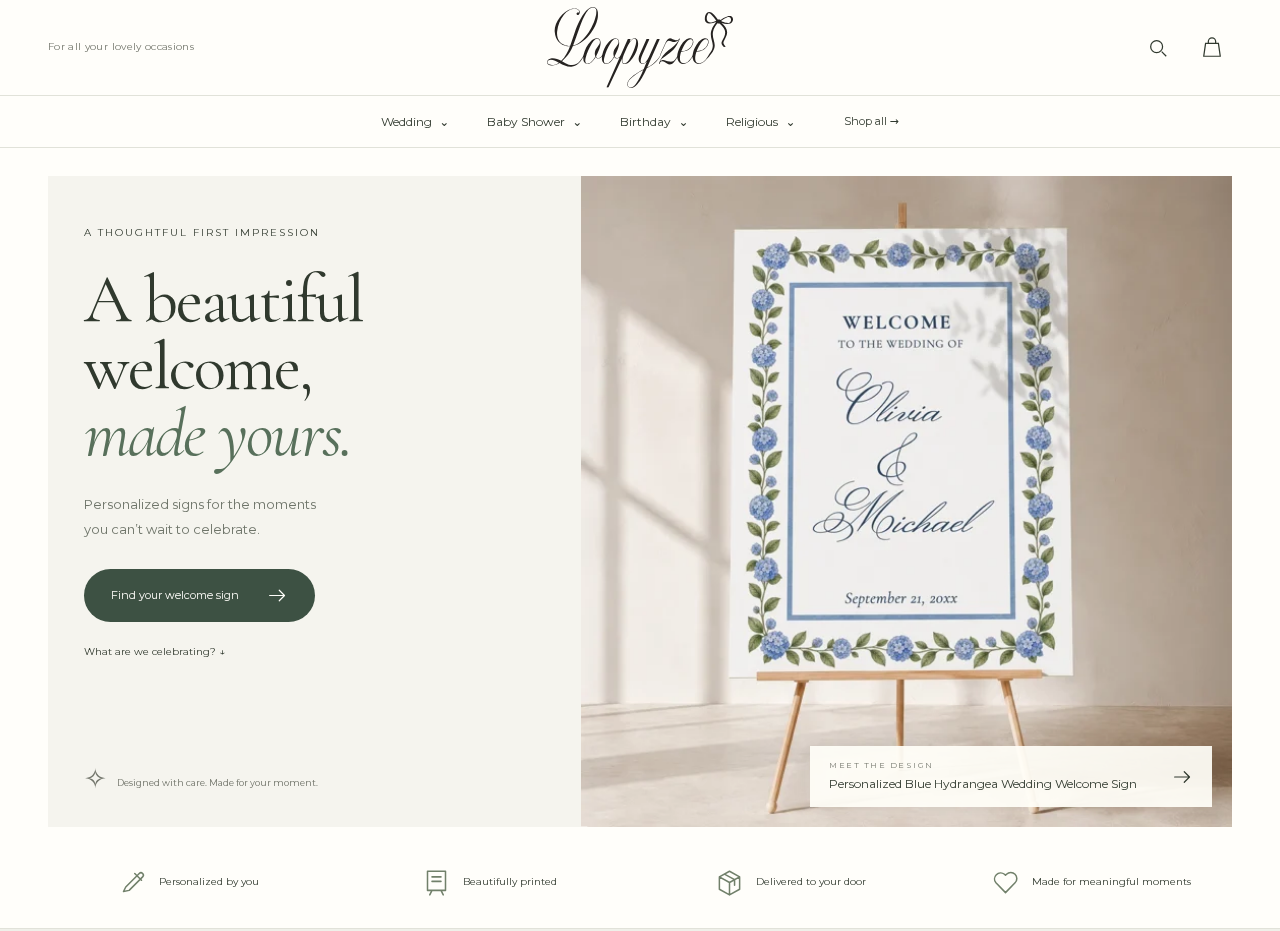
Yes, Loopyzee appears to be a legitimate small business, and nothing links it to Looius. It sells personalized printed welcome signs for weddings, baby showers, birthdays and baptisms.
Its Legal Notice names the operator as a sole trader established in Portugal. It lists a Portuguese tax number, a business address in Funchal, a phone number and support@loopyzee.com.
The page also links Portugal’s official electronic complaints book. That level of detail makes the seller easy to identify and contact.
Loopyzee.com was registered in September 2024. In March 2025 it showed a Portuguese “coming soon” page.
It now runs as a sign shop with free delivery in the contiguous United States.
Signs start at $49 and come in 16 × 20, 18 × 24 and 24 × 36 inch sizes.
Each sign is printed on 5 mm PVC foam board. Delivery takes an estimated 7 to 12 business days.
The shop asks customers to order at least three weeks before an event, and it says delivery dates are estimates, not guarantees.
Its policies are clear. Personalized signs can’t be returned for a change of mind.
Damaged or defective signs reported within 7 days of delivery get a reprint or a refund, and the customer can say which they prefer.
Loopyzee has no Trustpilot profile yet, which is normal for a young store. Order well before your event, and remember the shop prints exactly the wording you enter.
Nothing connects Loopyzee to Looius. It uses a different site platform, sells different products, publishes its own contact details and shows no Looius-style order-cap banner.
Our verdict: Loopyzee looks like a genuine small business. Check your names, dates and wording before you pay, because personalization mistakes you make yourself aren’t refundable.
Is Lovuso Legit?
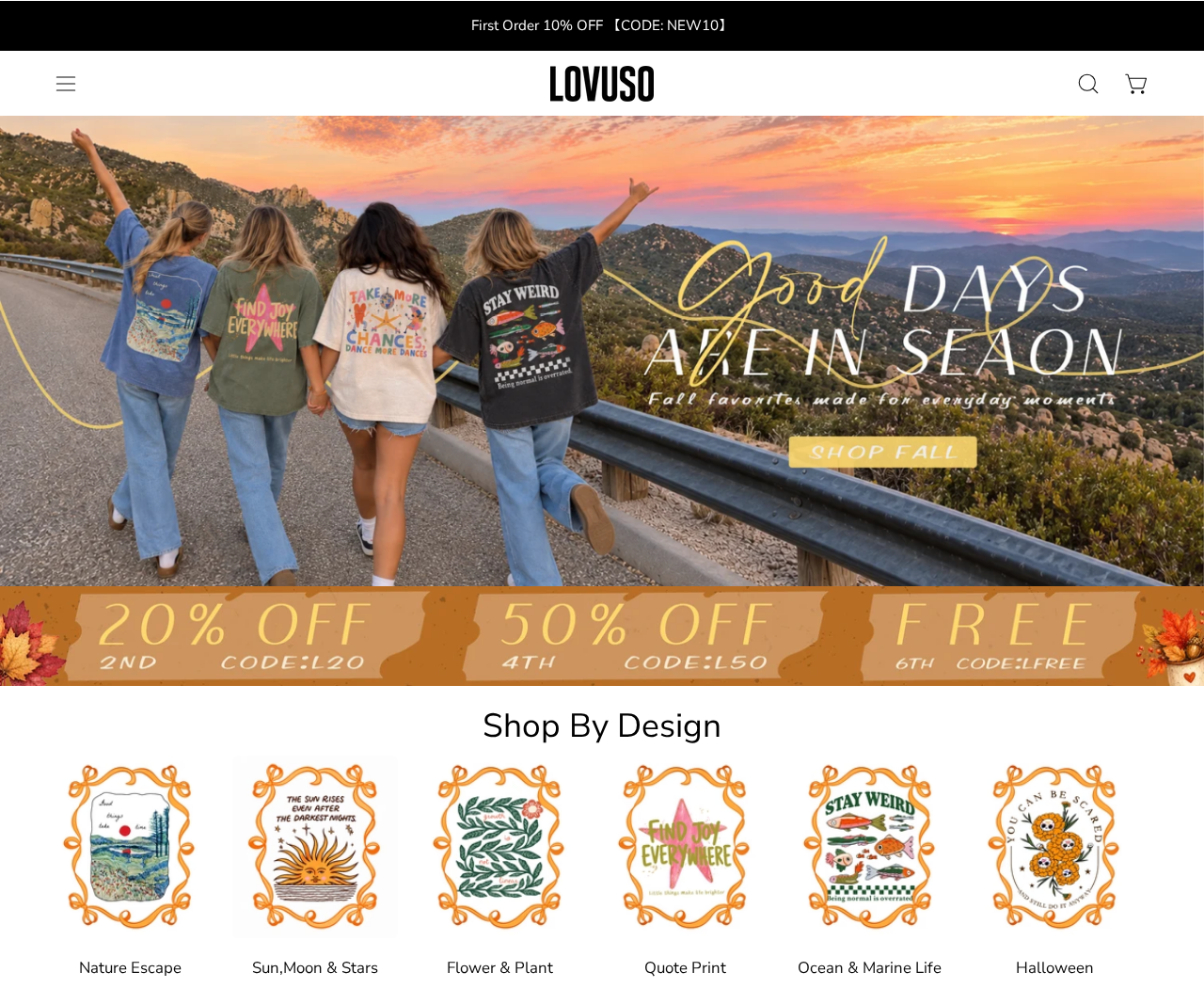
Lovuso appears to be a working print-on-demand clothing store with mostly positive reviews. It sells washed T-shirts and hoodies printed with nature, mushroom and slogan designs.
Trustpilot lists 34 reviews for Lovuso with a 4.1 TrustScore. Of those, 24 give five stars, three give four, two give three and five give one star.
The positive reviews praise the designs and quick fixes for order problems.
One one-star review says the print was far smaller than the website images and that Lovuso offered only a one-third refund. A four-star review mentions a wrong color.
Another one-star reviewer says their three-star product reviews vanished from the site and a sale timer kept restarting. Lovuso hasn’t replied to any of its five negative Trustpilot reviews.
Lovuso.com was registered on December 3, 2025, and its store runs on Shopify. Most T-shirts cost $29.95 and washed hoodies $52.95 to $58.95, with codes for multi-buy discounts.
Its refund policy accepts returns of unused, non-custom items within 30 business days of shipping. Buyers pay return shipping, and custom items can’t be returned.
The policy warns buyers not to send returns to the address printed on the package. Instead, email support@lovuso.com for the correct return address before shipping anything back.
Once a return is approved, the store says it issues the refund within 24 hours.
Banks may take 10 to 30 business days to post it, and the original shipping fee isn’t refunded.
The store accepts PayPal, embeds posts from its Instagram account, lovusoofficial, and claimed its Trustpilot profile in July 2026.
Nothing links Lovuso to Looius. It uses a different store platform, sells its own print designs, lists its own support email and shows no order-cap banner.
Our verdict: Lovuso looks like a genuine print-on-demand shop, though it is less than a year old.
Pay by card or PayPal, check the size chart and photograph anything that arrives wrong.
How Looius Compares With Other Fake Clothing Stores
Looius followed a pattern seen across many fake online shops. Our report on Comstylish.com covers another discount store that we flagged as a scam.
Some of these stores share a single address or template. Our investigation into 30 N Gould St, Sheridan, WY shows how one address can sit behind many unrelated store names.
If a store like Looius returns under a new name, look for the same order-cap banner and a real brand’s logo on an unrelated web address.
Not every small store is a scam, though. Our review of Lassloom shows a store that ships real clothing but makes returns hard.
How to Spot Fake Online Clothing Stores
Before you buy from an unfamiliar clothing site, check for warning signs like these:
- An order cap blamed on “tax regulations” or customs rules.
- A brand name on the page that doesn’t match the web address.
- No company name, address or phone number anywhere on the site.
- Prices that sit far below the usual cost of similar clothing.
- Reviews elsewhere that mention missing orders or blocked accounts.
- A store name you found by searching for a different, similar-sounding name.
- A checkout that suddenly charges more than the cart showed, including currency fees.
Fraudulent shopping websites often share common patterns that make them easier to detect once you know what to look for. Before entering personal information or making a payment, take a few minutes to check for these warning signs:
- Unrealistic prices and discounts
If a website offers products at prices far below trusted retailers, it’s often a red flag. Many of these sites advertise luxury or high-demand products at massive discounts to create a sense of urgency. A $300 product listed for $49.99 should immediately raise suspicion. - Recently registered or suspicious domain names
Many fraudulent websites operate on newly created domains that disappear after a few weeks. Look for signs like random characters in the URL, misspellings of well-known brands, or hyphenated domains.
You can check a site’s age with a WHOIS lookup, or run it through our free Scam URL Scanner. - Missing or vague company details
Legitimate businesses clearly display their company name, tax information, phone numbers, physical address, and return policies. Fraudulent sites often provide incomplete, fake, or no company details at all. A lack of verifiable contact information is a major warning sign. - No reliable customer service
Real businesses provide clear ways to contact support—email, phone, live chat, or physical return addresses. Fake stores often list nonfunctional contact forms, invalid phone numbers, or reply with generic automated messages. - Poor website quality and structure
Many fake stores are set up quickly with low-effort templates. Look for poor grammar, spelling errors, low-resolution product images, broken links, or missing legal pages (Terms of Service, Privacy Policy, Return Policy). A sloppy website often signals something isn’t right. - Copied product descriptions and images
Fraudulent sites often lift product listings directly from real retailers or marketplaces. If you reverse image search a product photo and find it on multiple unrelated websites, the listing is likely not original. - Lack of credible reviews or suspicious review patterns
A real store will usually have a mix of customer reviews across different platforms. Warning signs include no reviews at all, obviously fake five-star reviews, or multiple identical reviews posted on the same day. Searching “[website name] reviews” or “[website name] scam” on Google often reveals warnings from other consumers. - Unclear or unfair return and refund policies
Fake stores often use vague language around returns and refunds—or avoid the topic entirely. If you can’t easily find clear instructions for how to return an item or get a refund, proceed with caution. - Aggressive urgency and pressure tactics
Fraudulent websites commonly use fake scarcity (e.g., “Only 2 left in stock!”) or countdown timers (“Sale ends in 10 minutes!”) to push you to buy before you think it through. Legitimate stores don’t rely on fabricated urgency to make sales.
Quick Steps to Verify a Website’s Legitimacy
Before entering payment or personal details on a new shopping website, take a few simple precautions:
- Search for the store’s name along with words like “reviews” or “complaints” on Google and Trustpilot.
- Check the website’s domain registration using Whois.com.
- Use trusted tools to scan for malicious or fraudulent links:
- Malwarebytes ScamGuard – detect scams and unsafe links before they reach you on Android and iOS phone.
- Malwarebytes Browser Guard – block dangerous or fake websites on Windows and macOS browsers.
- Verify the business address on Google Maps to ensure it’s a legitimate location.
- Review the store’s accepted payment methods – credit cards and PayPal are traceable and safer than cryptocurrency or bank transfers.
- Trust your instincts; if something feels off, it’s better not to proceed.
How to Spot Similar Scams on Social Media
Many fraudulent shopping websites rely heavily on sponsored social media ads to draw in large numbers of potential buyers. These ads often promise extraordinary discounts—sometimes up to 90% off—and use emotionally charged language to push users into buying immediately.
They frequently appear on Facebook, Instagram, and TikTok, blending in with legitimate content. However, these ads follow predictable patterns that make them easier to identify once you know what to look for.
Spotting Fraudulent Facebook Ads
Facebook’s advertising platform is a favorite tool for fake online stores because of its massive reach. These ads often feature “unbelievable” offers designed to create urgency and bypass critical thinking. Warning signs include:
- Extreme, unrealistic discounts such as “90% OFF,” “Store Closing Sale,” or “Final Liquidation.” Real retailers rarely discount new products this aggressively.
- Poor grammar, awkward phrasing, or inconsistent language throughout the ad or website, indicating low-effort, mass-produced content.
- Generic stock photos or images with watermarks, suggesting the images were taken from legitimate brands or stolen from other sources.
- Recently created Facebook Pages, which is common for temporary fraudulent campaigns. Check the “Page Transparency” section to see when the page was created.
- Limited or no engagement from real customers. Authentic brands usually have reviews, comments, and visible user interaction.
If an ad raises doubts, search for reviews of the website or reverse image search the product photos to see if they’re copied from elsewhere. Never provide payment information until the site is verified.
Spotting Fraudulent Instagram Ads
Instagram is another major platform used to promote fake shopping sites through eye-catching visuals and short-lived “flash sale” captions. Warning signs to look for:
- New or disposable accounts with few posts and followers, often created just weeks or days before launching ads.
- Lack of tagged users in product posts. Legitimate stores often feature real customers, influencers, or product usage.
- Unsecured checkout pages. If the website linked in the bio does not use HTTPS, do not enter payment information.
- Fake or missing customer reviews. Fraudulent stores rarely have authentic purchase feedback.
- Unclear or restrictive return policies, often hidden or written vaguely to make refunds difficult.
When in doubt, search for independent reviews before buying, and only enter payment details on verified, secure websites.
Catching Fake TikTok Ads
TikTok is increasingly used to promote questionable shopping deals through short, persuasive videos. While many ads look polished, the same red flags apply:
- Links to unknown stores that don’t appear in search results or have no external reputation. Many of these sites are temporary and disappear after a short time.
- No verification badge on the TikTok account. While not every legitimate store is verified, the lack of a badge is one more indicator to check further.
- Aggressive countdown timers or “one-day only” promotions designed to rush decision-making.
- Lack of genuine customer reviews or real user content demonstrating the product in actual use.
- Comment sections filled with complaints or warnings from other users. This is often the first place victims speak up.
TikTok scams often rely on impulse buying. Take a moment to verify the website, read independent reviews, and use trusted browser protection before visiting external links.
What to Do If You Ordered From Looius
- Contact your card issuer or bank and dispute the charge as goods not received. Share the order date, amount, confirmation emails and any store replies.
- Card disputes often must be filed within about 120 days of the charge or expected delivery. Ask anyway if you’re past that, and note the call.
- PayPal disputes close 180 days after payment, so that window has passed for 2025 Looius orders. Your card issuer may still help if PayPal was funded by a card.
- If you paid with Apple Pay or Google Pay, raise the dispute with the bank that issued the linked card.
- UK credit card buyers: Section 75 covers single items priced over £100, and the £51 order cap kept Looius items below that, so ask for a chargeback instead.
- If you typed your card number into the site, ask your bank whether to cancel the card and issue a new number.
- Ignore anyone who offers to recover your money for a fee. Refund recovery offers are a common follow-up scam.
- US buyers can report the site to the FTC at ReportFraud.ftc.gov. UK buyers can use Report Fraud, the police service that replaced Action Fraud.
Frequently Asked Questions
Is Looius legit?
No. Looius.shop was a scam store. All 33 of its Trustpilot reviews give one star, 24 say nothing arrived, and the site has now disappeared.
Is the Looius website still open?
No. The looius.shop domain is no longer registered and doesn’t load. Trustpilot marks the store’s website as closed.
Is Loopyzee a legitimate website?
Loopyzee appears legitimate. It sells personalized welcome signs and publishes a Portuguese operator, tax number, address and phone. Nothing links it to Looius.
Is Lovuso legit?
Lovuso appears to be a real print-on-demand shirt store with a 4.1 Trustpilot score from 34 reviews. It has no link to Looius, though its return shipping is on you.
Can I get my money back from Looius?
Possibly, through your card issuer or bank. Dispute the charge as goods not received, and act quickly because dispute deadlines apply.
Was Looius the real Montirex store?
No. Montirex is a real sportswear brand from Liverpool, England. Looius.shop copied its name and logo, but genuine Montirex clothing is sold at montirex.com.
The Bottom Line
Don’t trust Looius.shop or any lookalike that reappears with its order-cap banner or a copied Montirex logo. Every Trustpilot reviewer gave it one star, and the store has vanished.
If you paid Looius, dispute the charge with your card issuer or bank now and ask about a replacement card.
Loopyzee and Lovuso are separate businesses with their own track records.
This article is for informational purposes only and should not be relied upon for financial or business decisions. We identify potential scams using research, user experiences, and expert analysis. However, all claims should be independently verified. Mistakes may occur, and legitimate products could be flagged. We strive for accuracy but make no warranties regarding the completeness or reliability of the information.

If you are the owner of the website or product in question and wish to offer clarifications regarding your business or website, please reach out to us via our Contact form.

Reviews & discussion
0 commentsShare a firsthand experience, or ask a question.
Community reviews
looius.shop
Moderated reader experiences, not an editorial verdict.
Start the conversation
Have a question or something useful to share? Add the first comment.