

Memo Matrix is being promoted online as a memory and brain-support supplement, often through dramatic advertising that touches on brain fog, cognitive decline, Alzheimer’s disease, and dementia. The presentation can look remarkably polished, with medical-style graphics, supposed expert commentary, scientific terminology, and stories designed to make the product feel like the result of an important new discovery.
The problem is that the marketing follows a pattern seen repeatedly in aggressive memory-supplement campaigns. Instead of offering straightforward information about a bottle, the sales process often relies on emotional storytelling, borrowed authority, long advertorials, affiliate promotions, urgency tactics, multi-bottle packages, and checkout flows that deserve much closer attention.
For consumers, that means the question is not simply whether Memo Matrix is worth buying. It is also important to understand who is actually selling it, what evidence exists behind the claims, how many bottles you are agreeing to purchase, and whether anything in the checkout could authorize additional shipments or future charges.
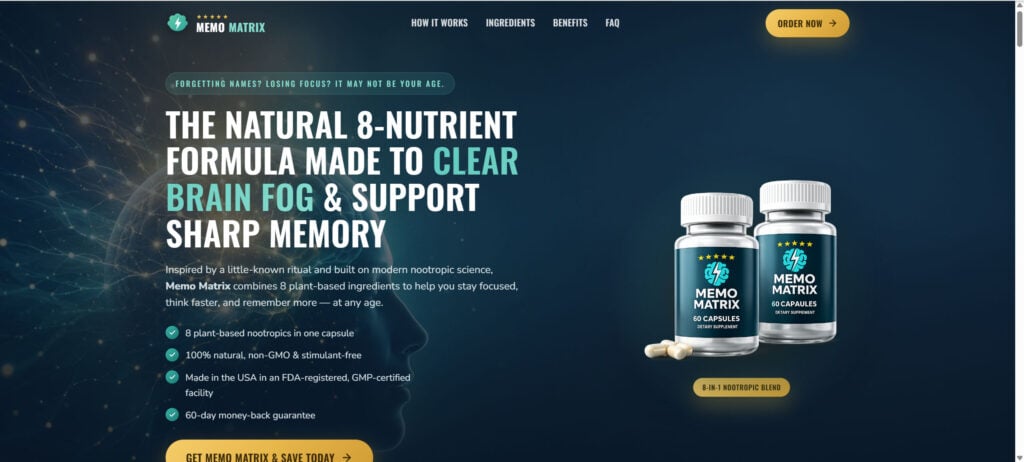
Memo Matrix Overview
Memo Matrix is generally presented as a natural supplement intended to support memory, focus, mental clarity, and age-related cognitive function. Some promotional campaigns, however, go much further and place the product inside stories involving serious conditions such as Alzheimer’s disease and dementia.
That distinction matters because there is a significant difference between selling a general wellness supplement and implying that a bottle can meaningfully address a complex neurological disease.
The strongest Memo Matrix advertisements do not simply say that the formula contains ingredients associated with brain health. Instead, they may introduce a supposedly overlooked cause of cognitive decline and then suggest that conventional medicine has failed to properly address it. By the time the product is introduced, the reader has already been guided through a carefully constructed story in which Memo Matrix appears to provide the missing piece.
This kind of marketing can be extremely persuasive because the product is not being sold in isolation. It is being sold as the conclusion to a narrative.+

The “Secret Memory Discovery” Is Designed to Get the Click
A common variation begins with some kind of extraordinary but inexpensive discovery: a honey recipe, bedtime ritual, rare plant, unusual ingredient, or supposed revelation connected to a prestigious doctor or university. The original Memo Matrix material references hooks such as a “$12 golden honey recipe,” a “Harvard doctor reveal,” and other supposedly simple solutions.
These claims work because they create a powerful curiosity gap. Someone worried about their memory is far more likely to click an advertisement promising a forgotten household remedy than one that simply says “buy our dietary supplement.”
Once the visitor arrives, however, the promised discovery can become increasingly difficult to separate from the sales pitch. What begins as the promise of a simple memory tip may turn into an extended advertorial or video explaining frightening theories about cognitive decline, followed by testimonials, scientific-sounding explanations, and finally a product offer. By the time Memo Matrix appears, the supposed free discovery has effectively become the mechanism used to sell the supplement.
That does not mean every promotional page is identical, but consumers should recognize the structure when they see it.
Memo Matrix Appears to Be Part of a Larger Affiliate Marketing Ecosystem
Another important issue is the way products like Memo Matrix can be distributed online.
A consumer may discover the supplement through an advertisement placed by an affiliate rather than through a conventional retailer. Affiliates make money by sending buyers to an offer, which means the website persuading you to purchase may not necessarily be the same company that manufactures the product, processes your credit card, ships the bottles, or handles refunds.
This can create an unusually fragmented customer experience.
One website might contain a glowing “review.” Another may resemble a medical news article. A third could feature a long video presentation. Although the pages look different, they can ultimately point visitors toward the same product offer.
The financial incentive is straightforward: affiliates earn commissions when visitors convert into buyers. That does not automatically make an affiliate offer illegitimate, but it does mean consumers should be cautious about treating every glowing article or testimonial as independent information.
A page calling itself a “Memo Matrix review” may still have a financial interest in convincing you to buy Memo Matrix.
That is particularly important when the article contains almost no criticism, aggressively promotes the largest package, and places purchasing links throughout the page.
Fake-Looking Authority Can Make Weak Evidence Feel Strong
The original Memo Matrix material highlights another familiar feature of these campaigns: what can be described as credibility theater. Pages may use news-style layouts, university references, white-coat imagery, medical formatting, recognizable logos, and other visual elements that make the presentation feel more authoritative than the underlying evidence warrants.
This technique works because consumers make rapid trust judgments based on appearance.
A clean page that resembles a major health publication naturally feels more credible than an ordinary advertisement. Add a photograph of a physician, a university name, an anatomical brain illustration, and some scientific terminology, and the page can begin to feel like independent medical reporting.
Consumers should separate those visual signals from actual proof.
If a page references Harvard University, for example, that does not establish that Harvard researchers tested Memo Matrix or endorsed the product. If a physician appears in a video, the relevant questions are who that person is, whether the credentials can be independently verified, and whether the individual has actually conducted research on the finished formula.
Likewise, displaying an “as seen on” logo does not establish genuine editorial coverage unless the claimed appearance can be found independently.
The best approach is to leave the sales funnel completely and verify major claims elsewhere. If a supposed study, endorsement, physician, or media report cannot be found outside websites selling the product, that should significantly reduce the weight you give it.
Alzheimer’s and Dementia Marketing Requires Extra Caution
Memory products occupy an unusually sensitive area of health marketing because the fear surrounding cognitive decline is profound.
People are afraid of losing independence, forgetting loved ones, or developing dementia. Families searching for help for an aging parent can also be particularly vulnerable to advertisements promising a simple breakthrough.
The source material itself recognizes that these campaigns may use fears surrounding dementia and Alzheimer’s disease to create urgency, including suggestions of rapid improvement, reversal, inexpensive fixes, or narratives suggesting doctors and pharmaceutical companies are overlooking the real answer.
This is where a consumer should become substantially more skeptical rather than less.
Alzheimer’s disease and other forms of dementia involve complicated biological processes that researchers have spent decades studying. A sales page can simplify that complexity into a few persuasive concepts, such as plaques, inflammation, toxins, blood flow, mitochondrial health, or insulin resistance in the brain. Some of these terms genuinely appear in scientific research, but their presence in an advertisement does not establish that Memo Matrix can meaningfully affect the disease being discussed.
The important question is whether strong independent evidence exists for the exact finished product and the specific result being claimed or implied.
A scientific explanation is not the same thing as clinical proof.

The Checkout Deserves as Much Scrutiny as the Health Claims
For many buyers, the biggest practical risk may appear only after they decide to order.
Direct-response supplement funnels are designed to maximize the value of each customer, which frequently means encouraging the buyer to purchase several bottles rather than one. A sales page may offer a single bottle at a relatively unattractive price while making the three- or six-bottle package look dramatically better.
The original Memo Matrix material specifically identifies unexpected upsells, larger bottle quantities, recurring billing, difficult support, and refund friction as common risks associated with this style of supplement funnel.
The key point is not that every Memo Matrix customer will necessarily encounter all of these issues. It is that consumers should actively look for them before entering payment information.
The Price You Notice May Not Be the Amount Charged
One common source of confusion involves per-bottle pricing.
A promotional page may prominently feature a low figure such as $39 or $49, but that number can represent the effective price of each bottle when purchasing a larger package. The amount actually charged to the card may therefore be three, four, five, or six times higher.
Before submitting an order, ignore the headline price and find the final transaction total.
Check how many bottles are included.
Check whether shipping is being added.
Check whether any optional products have been included.
Only the final order summary tells you what you are actually purchasing.
More Bottles Than Expected Can Turn a Small Purchase Into a Large One
Multi-bottle bundles are one of the central features of this type of sales model. The source material describes a familiar structure in which one bottle is priced high, three bottles are presented as recommended, and six bottles become the “best value.”
There is nothing inherently wrong with offering bulk discounts, but the design can make it surprisingly easy for consumers to focus on the discount rather than the total transaction.
The risk increases when the sales copy argues that several months of use are necessary. Someone who originally intended to experiment with one bottle can suddenly find themselves considering a six-month supply because the page presents anything less as an inferior choice.
Take the emotion out of the decision. If you only want one bottle, make sure one bottle is exactly what the confirmation page shows.
The Refill and Subscription Question Is Especially Important
Consumers should also examine whether the offer contains any form of recurring billing or automatic shipment arrangement.
The relevant language may not always be presented using the word “subscription.” Instead, terms such as autoship, continuity, automatic replenishment, membership, monthly supply, recurring shipment, refill program, or next delivery may appear somewhere in the checkout terms.
The original Memo Matrix material specifically warns about continuity programs and advises buyers to watch for autoship, membership, monthly, and “next shipment” language.
If you intend to make a one-time purchase, the order terms should make that clear.
Do not assume that every Memo Matrix promotional website uses exactly the same checkout arrangement either. Affiliate campaigns can direct customers through different landing pages or offers, which makes the specific terms shown during your purchase more important than what someone else may have encountered.
Take a screenshot before completing the transaction. That gives you a record of the quantity, price, and terms that were displayed when you paid.
How the Memo Matrix Sales Funnel Typically Works
The sales process becomes much easier to understand once the individual pieces are viewed together.
Step 1: An Emotional Advertisement Gets Your Attention
The first contact is often a paid advertisement on social media or another advertising network. Rather than leading with an ordinary bottle photograph, the ad may focus on fear of dementia, brain fog, aging, forgetfulness, or concern for an older family member.
Other variations use curiosity instead of fear, promising to reveal an ingredient or ritual that supposedly transformed someone’s memory.
Both approaches have the same purpose: create enough emotional interest to earn the click.
Step 2: The Advertisement Leads to an Advertorial
Instead of arriving at a normal online store, visitors may land on a page designed to resemble editorial content.
The page can contain an author byline, medical imagery, date stamps, navigation menus, news-style formatting, or video segments that resemble a broadcast. The original material explicitly describes these pages as advertorials designed to make visitors feel as though they are consuming reporting rather than advertising.
The distinction matters because people naturally approach editorial information with less skepticism than an obvious sales page.
Step 3: The Promised Secret Is Delayed While the Story Builds
The advertised “secret” is rarely delivered immediately.
Instead, the visitor is encouraged to continue reading or watching while the presentation expands on the supposed cause of cognitive decline. The source describes phrases such as “Watch this first,” “Doctors are stunned,” “The media won’t cover it,” and “Stay until the end” as examples of retention tactics.
This delay gives the marketer time to reshape the visitor’s understanding of the problem before presenting the product.
Step 4: Scientific Language Gives the Story More Weight
Once the visitor is emotionally invested, the presentation may introduce brain graphics, biological mechanisms, testimonials, and terminology that sounds clinical.
This can make the eventual product offer feel like the logical result of a scientific explanation rather than an ordinary commercial pitch.
Consumers should be particularly careful here because complex scientific language can sound persuasive even when the connection between the research being discussed and the specific supplement being sold is weak or nonexistent.
Step 5: Credibility Claims Reduce Skepticism
The funnel may then display phrases such as “clinically proven,” “doctor recommended,” “GMP certified,” “Made in the USA,” or similar statements. The source material notes that these types of badges and claims can appear without accompanying documentation or independent study links.
Each claim needs to be evaluated on its own.
A product manufactured in a compliant facility is not therefore clinically proven to improve dementia.
An ingredient that has been studied independently does not automatically prove that the finished Memo Matrix formula delivers the same outcome.
The distinction is easy to blur in advertising.
Step 6: Urgency Pushes the Visitor Toward a Decision
Once the sales presentation reaches the offer, countdown timers, limited-stock messages, temporary discounts, recent-purchase notifications, and visitor counters may appear.
These devices are designed to reduce hesitation.
For a health-related purchase, however, urgency should have the opposite effect. If an advertisement is pressuring you to buy before you have time to research the product, leave the page and investigate independently.
A legitimate product will still exist after you have had time to think.
Step 7: Bundle Pricing Increases the Order Value
The checkout generally offers several quantities, and the largest package is often positioned as the smartest financial decision.
This is standard direct-response pricing psychology. The small purchase is made to look inefficient, while the bigger transaction is framed as the obvious choice.
Consumers should decide how much product they actually want before evaluating the discount. Otherwise, the “savings” can become the reason they spend substantially more money than originally intended.
Step 8: Upsells Can Extend the Checkout
After the initial order, some funnels present additional products or upgrades.
The source specifically warns about upsells that can appear to be required steps, “free bottle” promotions that may change the total, and other checkout friction that increases billing confusion.
Read every screen carefully. If you have already made the purchase you wanted, you should not feel pressured to add another supplement simply because it appears immediately afterward.
Step 9: Customer Service Can Become the Difficult Part
Buying through an affiliate funnel can take minutes. Undoing the transaction may be considerably more complicated.
The source material notes potential problems including email-only support, slow responses, unclear return procedures, restrictive conditions, and delays in refund processing.
That is another reason to identify the actual merchant before purchasing. Save the support email, company name, return policy, and order number rather than relying on the affiliate page that originally referred you.
Why This Same Marketing Pattern Keeps Returning
Memo Matrix is only one product name.
The underlying marketing structure can be reused repeatedly. Domains can change, product names can be replaced, new ingredients can be emphasized, and a different “discovery” story can be inserted while most of the funnel remains essentially unchanged. The original source makes this point directly, describing a modular system in which operators can switch domains, rename products, change the recipe angle, and run a similar sales machine again.
That is why consumers are better protected by learning to recognize the pattern than by memorizing individual supplement names.
Whenever an advertisement combines frightening health claims, a hidden discovery, a fake-news-style landing page, questionable authority signals, dramatic testimonials, a lengthy sales video, limited-time pressure, and a complicated bottle bundle, it deserves serious scrutiny.
What to Do If You Already Bought Memo Matrix
If you already placed an order and now have concerns, the priority is not panic. It is documentation and control.
1. Check the Charge Against What You Intended to Buy
Open your bank or credit-card account and compare the amount charged with the order you believed you placed.
If you expected one bottle, confirm that you were charged for one bottle rather than a larger package.
Write down the merchant descriptor exactly as it appears on the statement because future charges may appear under the same name rather than “Memo Matrix.”
2. Read Your Order Confirmation Carefully
Look at the quantity, total price, shipping cost, and any wording referring to future shipments.
Search the email for terms such as autoship, recurring, membership, continuity, refill, monthly, and next shipment.
The source recommends treating any indication of recurring billing as something that should be addressed promptly.
3. Cancel Any Unwanted Recurring Arrangement in Writing
If the order confirmation suggests that you joined a refill or continuity program that you do not want, contact the seller and clearly request cancellation.
Include your name, email address, and order number, and state that you are canceling any subscription, autoship, membership, or recurring delivery associated with the purchase.
Ask for written confirmation and preserve the response. The original source specifically recommends using clear cancellation language and keeping evidence of the communication.
4. Save Evidence
Keep screenshots of the advertisement if possible, along with the landing page, checkout total, receipt, confirmation email, order number, and bank transaction.
The source recommends preserving this material in case a payment dispute becomes necessary.
5. Monitor Your Statements
Continue checking the card used for the purchase.
Watch for another charge around the same time the following month, unfamiliar merchant names, unexpected shipping fees, or amounts that resemble the original purchase. The source recommends monitoring statements for at least 60 days.
6. Contact Your Card Provider If Something Is Wrong
If you are charged for something you did not authorize, contact your card issuer and explain the situation.
Ask about disputing the transaction and preventing additional charges from the same merchant. If repeated transactions continue, your bank can advise whether replacing the card is appropriate.
7. Do Not Use Memo Matrix Advertising as Medical Guidance
Anyone experiencing meaningful or worsening memory problems should seek appropriate medical evaluation rather than relying on a supplement sales funnel.
The source also recommends speaking with a clinician or pharmacist before adding supplements when prescription medication is involved.
The Bottom Line
Memo Matrix is marketed through a style of supplement promotion that consumers should approach carefully. The combination of emotionally charged memory-loss stories, affiliate-driven advertising, medical-looking advertorials, borrowed authority, “breakthrough” narratives, urgency tactics, multi-bottle packages, upsells, and possible continuity billing creates plenty of opportunities for consumers to make a purchase before fully understanding what they are agreeing to.
None of this means that every Memo Matrix buyer will experience unexpected charges or that every website promoting the supplement operates identically. It does mean that the sales funnel deserves at least as much scrutiny as the ingredients themselves.
Before buying, identify the actual seller and read the checkout rather than relying on the affiliate page that brought you there. Confirm how many bottles are included, check the entire transaction amount rather than the advertised per-bottle price, and look carefully for any language that could authorize automatic refills or recurring deliveries.
Most importantly, separate marketing from medical evidence.
A news-style page is not automatically news. A white coat does not prove an endorsement. Scientific terminology does not establish that the finished product works, and a dramatic story about Alzheimer’s disease does not turn a dietary supplement into a proven treatment.
If the product is genuinely worth buying, it should survive a few minutes of independent research without a countdown timer telling you otherwise.
FAQ
Is Memo Matrix a scam?
Memo Matrix is promoted through marketing tactics that resemble aggressive direct-response supplement campaigns, including dramatic health narratives, advertorial-style pages, bundle pricing, urgency, and potentially confusing checkout structures. Rather than relying exclusively on the promotional story, consumers should investigate the exact seller, billing terms, evidence, ingredients, and refund policy.
Why are so many different websites promoting Memo Matrix?
Affiliate marketing can result in numerous independent websites promoting the same product. These affiliates may receive commissions when visitors purchase through their links, so consumers should not automatically assume that every “review” is independent.
Is a Memo Matrix review website necessarily the official website?
No. A website discussing or promoting Memo Matrix may simply be an affiliate landing page. The company identified during checkout and on the transaction terms is more important when determining who is actually responsible for the sale.
Could I accidentally order more Memo Matrix bottles than I wanted?
Bundle pricing can create that risk. Always check the selected quantity and final total before submitting payment, particularly when a low advertised price represents the cost per bottle inside a larger package.
Could Memo Matrix involve automatic refills?
The specific checkout terms need to be examined. Look for language such as autoship, continuity, membership, recurring shipment, automatic replenishment, or next delivery. If you intend to purchase once, make sure the transaction clearly reflects that.
What should I do if more bottles arrive than expected?
Compare the shipment with your order confirmation and credit-card charge. If the quantity is different from what you intended to purchase, contact the seller promptly and keep a written record of the communication.
What should I do if another charge appears later?
Check whether your original order contained recurring-billing terms. If you do not recognize or did not authorize the new transaction, contact the seller and your card issuer.
Why can the final Memo Matrix price be much higher than the advertised price?
Some supplement offers emphasize the cost per bottle rather than the total price of the package. A six-bottle bundle advertised at a low per-unit price will still result in the entire bundle being charged during checkout.
Are Memo Matrix testimonials proof that it works?
No. Testimonials are individual marketing claims and cannot substitute for high-quality clinical evidence on the exact finished product.
Does a doctor appearing in a Memo Matrix advertisement prove anything?
Not by itself. The person’s identity, qualifications, relationship with the advertiser, and actual evidence supporting the product should be independently verified.
Is Memo Matrix FDA approved?
Dietary supplements are not approved by the FDA in the same manner as prescription drugs. Marketing language that creates the impression of drug-style FDA approval should therefore be examined carefully.
Can Memo Matrix cure or reverse Alzheimer’s disease?
A dietary supplement advertisement should not be treated as evidence that a product can cure, reverse, or treat Alzheimer’s disease or dementia. Concerns about cognitive decline should be evaluated by a qualified healthcare professional.
What is the biggest red flag with Memo Matrix?
The broader marketing pattern is more important than any individual claim. If you encounter disease-related fear, a dramatic secret discovery, affiliate advertorials, questionable authority signals, countdown timers, multi-bottle pressure, upsells, and unclear recurring-payment terms within the same funnel, slow down and investigate before purchasing.








