

A caller says a new military debt forgiveness program could erase most of a servicemember's debt. The offer sounds exclusive, respectful, and timed for someone already struggling with payments.
Then the caller asks for an activation fee and says creditors should be paid through the program instead.
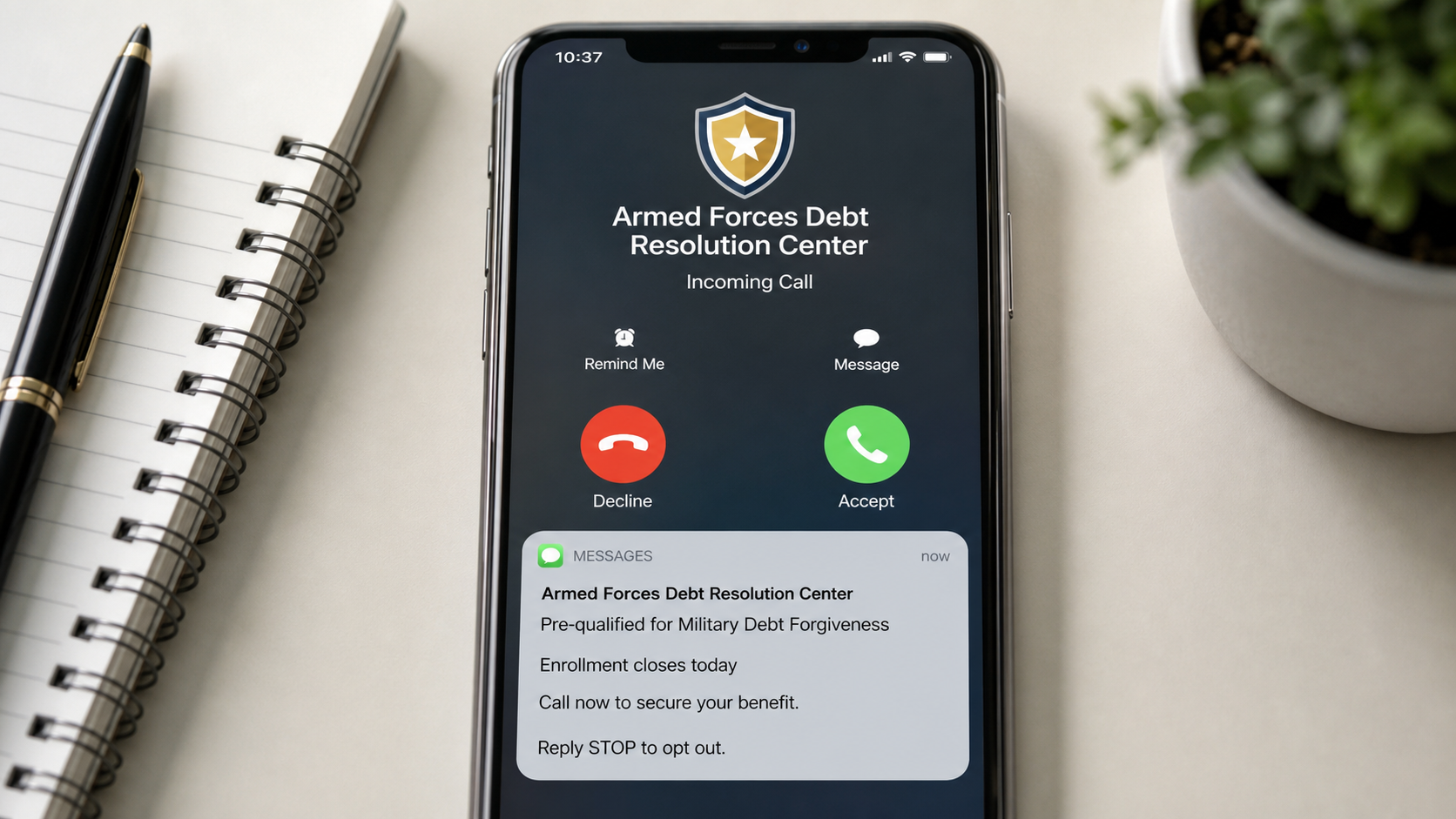
The FTC and Military Consumer warned in July 2026 about debt-relief callers using official-sounding language and supposed military connections. Some claimed ties to familiar military banks, credit unions, or credit bureaus.
The pitch may promise veteran debt forgiveness or an exclusive program after an upfront payment. The FTC says charging before settling debts or entering a consumer into a debt-management plan is illegal.
Worse, a victim may be told to stop paying real creditors. Missed payments can add interest and fees, damage credit, and create consequences for a servicemember's security clearance while the supposed program does nothing.
Overview
The promised relief begins by creating a new financial risk.
Military language disguises an ordinary debt-relief trap
A generic debt pitch becomes more persuasive when the caller mentions service, benefits, base resources, or a respected military financial institution. The affiliation may be entirely invented.
A real-sounding program name is not proof that Congress, the Department of Veterans Affairs, a military branch, or a lender authorized it.
The upfront fee is the clearest warning
Scammers promise a dramatic reduction, then demand enrollment, activation, legal, or processing money before any creditor agrees to anything. The fee may come from savings that should have paid real bills.
No caller can guarantee that every creditor will accept a settlement or that a special forgiveness program exists for the recipient's debts.
Stopping creditor payments can make the original problem worse
A debt company may tell the consumer to redirect monthly payments into its program. Meanwhile, creditors can report missed payments, add penalties, send accounts to collection, or file suit.
For military personnel, financial deterioration may also affect readiness or a security review. That makes independent counseling especially important before changing any payment plan.
- An unsolicited caller claims access to exclusive military debt forgiveness.
- The name resembles a military bank, credit union, agency, or credit bureau.
- Debt reduction is guaranteed before the caller reviews every account.
- An activation or enrollment fee is demanded upfront.
- The consumer is told to stop paying or speaking with creditors.
- Balances, penalties, and credit damage continue while promised settlements fail to appear.
- A portal shows projected savings that no creditor has approved.
- Automatic bank withdrawals begin before any documented negotiation result.
- Cancellation and refund conditions are hidden during the sales call.
- Another company later offers paid credit repair for the resulting damage.
- The representative cannot produce written authorization from any named military institution.
- Monthly deposits are described as payments even though creditors receive nothing.
- The promised settlement timeline keeps changing after each requested document.
- Account statements continue showing late fees, interest, and missed-payment reporting.
- The caller says independent verification will cancel the exclusive military benefit.
Why the Military Connection Makes the Pitch More Convincing
Servicemembers and veterans often navigate moves, deployments, transitions, benefit systems, and lenders that market specifically to the military community. A caller who speaks that language can sound familiar quickly.
Public records and breached marketing data may reveal branch, veteran status, address history, or lender relationships. Those facts can personalize a false affiliation without giving the caller any official access.
Debt itself creates urgency. Someone juggling cards, medical bills, or personal loans may welcome a single low payment and a confident promise that negotiation will begin immediately.
The sales script minimizes consequences. It may describe missed payments as a normal negotiation tactic without explaining collection calls, lawsuits, late fees, credit damage, or clearance concerns.
Real help begins with the lender, an on-base personal financial manager, a military legal-assistance office where appropriate, a reputable nonprofit counselor, or VA resources for veterans.
What the 2026 Military Consumer Warning Establishes
Military Consumer described unsolicited callers using official-sounding identities and implying links to USAA, Navy Federal, Equifax, Experian, TransUnion, or military programs. An implication is not an affiliation.
The warning identified upfront fees and guaranteed debt reduction as core danger signs. A company cannot honestly promise a settlement before creditors accept it.
The guidance also warned against paying the relief company instead of real creditors. The debt remains the consumer's responsibility unless an actual written agreement changes it.
Missed payments can increase debt through late charges and penalties. For a servicemember, damaged finances can also complicate a security clearance.
The FTC recommends contacting lenders directly and using military or VA financial counseling resources rather than trusting an unexpected sales call.
How the Military Debt Forgiveness Scam Works
Step 1: The caller identifies a military target
The approach may arrive by phone, text, social ad, or mail and references service or veteran status. The sender may know a real lender or approximate debt amount.
Those facts can come from marketing lists or breaches. They do not prove the caller represents the military, VA, lender, or credit bureau.
Step 2: An exclusive forgiveness program is introduced
The representative claims a new federal, veteran, or active-duty initiative can reduce principal rapidly. Enrollment supposedly closes soon.
The program name may not appear on any .gov page because it does not exist. The deadline prevents a call to the lender or financial counselor.
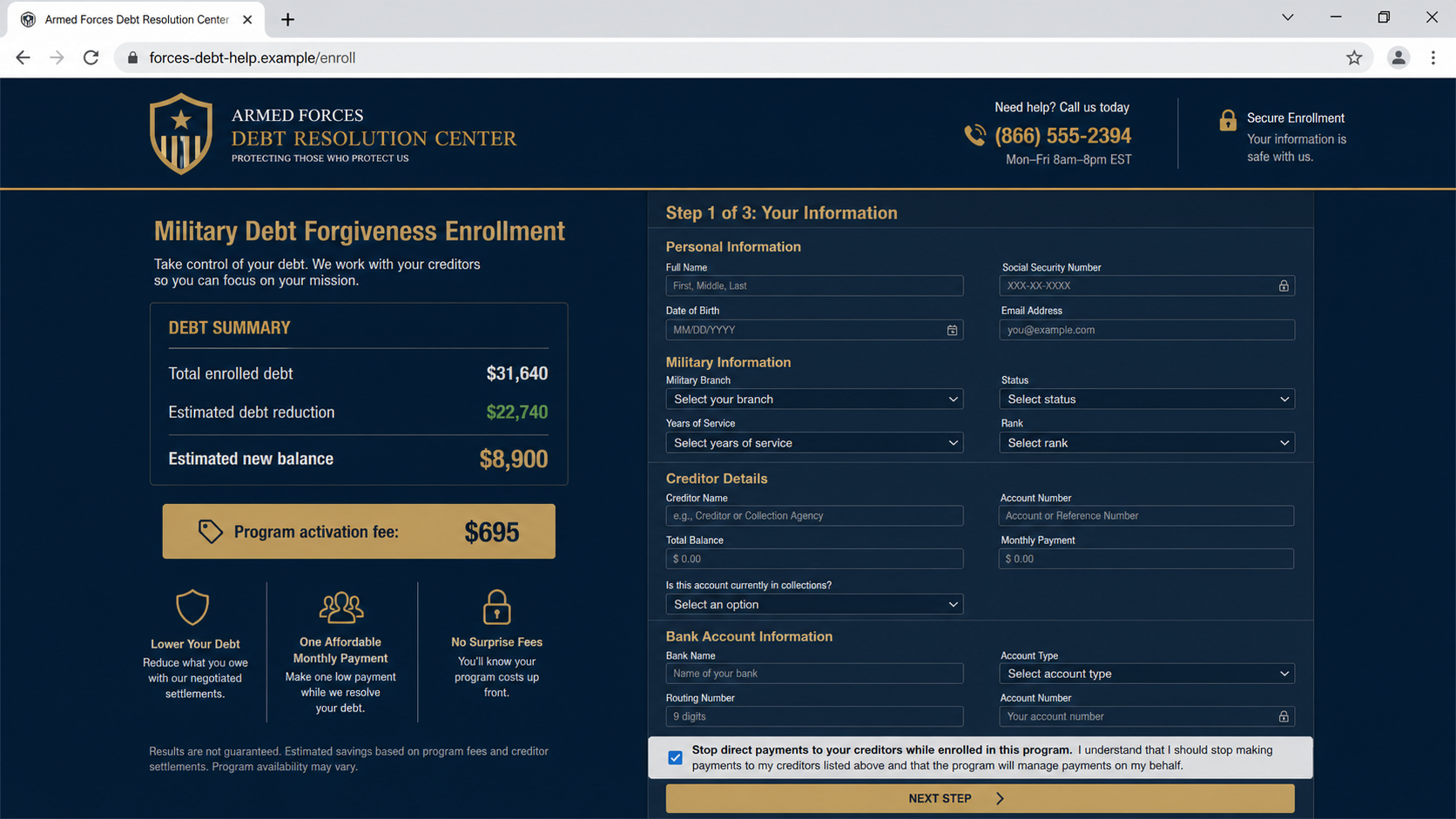
Step 3: A dramatic savings estimate appears
A portal may show a current balance and much lower projected balance before reviewing contracts or speaking with creditors. The estimate is presented like approval.
No debt is reduced by a graphic. Only a verified payment, lender agreement, discharge, or lawful program changes the obligation.
Step 4: Personal and financial records are collected
The form requests a Social Security number, military information, creditor accounts, bank details, pay information, and identity documents.
That record can support unauthorized debits, identity theft, targeted impersonation, or sale to other high-pressure marketers.
Step 5: An upfront activation fee is demanded
The caller says work cannot begin until an enrollment, legal, processing, or activation fee is paid. The fee may be taken by card, ACH debit, wire, or payment app.
The victim has paid before any independently verified result exists, which is precisely the point at which legitimate debt-relief rules provide protection.
Step 6: Real creditor payments are interrupted
The consumer is told to stop direct payments and avoid creditor calls. The relief operation may collect monthly deposits while accounts fall further behind.
Collectors, lawsuits, fees, and credit reporting continue because the creditors never agreed to the caller's promises.
Step 7: The company delays while the damage grows
Requests for updates produce scripts about negotiations, processing queues, or missing documents. Refund requests may trigger new conditions or an unreachable support line.
By the time the victim exits, upfront fees are gone and the original balances may be larger. Another company may then offer to repair the new damage for another fee.
Company, Address, and Fulfillment Checks
The patriotic brand is not proof of a military affiliation
Shield graphics, words such as armed forces, and references to benefits are easy to copy. Find the legal company in the contract and verify any claimed government or lender relationship independently.
Call the institution using its official app or statement. Do not ask the sales caller to transfer you to its supposed partner.
The listed address may be a mailbox or call center
Search the address and compare it with business and regulator records. A virtual suite, shared office, or lead-generation center is not evidence of a national forgiveness program.
A legitimate counselor should disclose where services are performed and which state rules apply.
Support often changes once the fee clears
Test whether the company provides written disclosures, a stable callback number, named counselor, cancellation route, and account-by-account plan before payment.
Generic agents who cannot explain creditor status or refund terms are not a substitute for documented negotiations.
Every payment and settlement must be traceable
Identify who receives the fee, where monthly deposits are held, and whether each creditor has accepted a written settlement. A dashboard estimate is not a creditor agreement.
Do not send money to a personal account, crypto wallet, gift card, or unrelated merchant. The payment trail must match the legal company and contract.
How to Check a Debt Relief Offer Before It Damages Your Credit
Contact every lender directly and ask about hardship, reduced-rate, payment-plan, or settlement options. Record the representative and terms.
Active-duty members can consult an on-base personal financial manager or counselor. Veterans can begin with VA and Military Consumer resources rather than an unsolicited caller.
Search the legal company with your state attorney general and financial regulators. Read the contract for fees, creditor communication, deposit custody, cancellation, and likely credit effects.
Never accept a guarantee. Creditor participation, tax consequences, lawsuits, and credit reporting vary, and honest counselors explain uncertainty.
Do not stop payments based on a phone promise. Change payment behavior only after understanding written agreements and consequences for each account.
Verify every claimed lender or credit-bureau connection through that institution's official app, statement, or public website. A logo and familiar name inside the sales portal do not establish a partnership.
Ask where monthly deposits will be held and whether the account remains under your control. Get the bank, custodian, withdrawal rules, and refund process in writing before authorizing any debit.
Review each debt separately because credit cards, personal loans, medical bills, and secured debts have different risks. A single projected savings figure hides those differences.
Request a complete fee schedule. Setup, monthly, settlement, legal, and percentage-based fees can erase the savings displayed in an advertisement even when a creditor eventually settles.
Ask what happens if a creditor refuses, sues, or continues reporting late payments. A responsible counselor explains these outcomes before enrollment instead of dismissing them as temporary pressure.
Servicemembers concerned about clearance reporting should seek guidance through appropriate command security, legal, and financial channels. A salesperson should never use clearance fears to force immediate payment.
Check whether cancellation stops future drafts and returns unearned funds. Send any cancellation in writing and keep delivery proof because a verbal request may be difficult to establish later.
Warning Signs to Watch For
- The call was unsolicited and already knows you served.
- The company implies ties to a military lender or credit bureau.
- A special forgiveness program cannot be found on a .gov site.
- Most debt is guaranteed to disappear.
- An upfront activation fee is required.
- Bank and Social Security details are requested immediately.
- You are told to stop paying creditors.
- The company refuses written account-by-account terms.
Debt relief should reduce uncertainty, not replace real creditor statements with a salesman's promise and a new automatic debit.
What to Do if You Have Fallen Victim to This Scam
- Stop new payments to the relief company. Revoke authorization in writing and request cancellation and a refund. Keep proof of delivery and do not rely on a phone promise.
- Contact your bank immediately. Report misleading or unauthorized debits, ask about ACH revocation, disputes, account monitoring, and replacement numbers if credentials were exposed.
- Call every real creditor. Explain what happened, confirm balances and status, ask about hardship options, and request written information about collections, fees, or legal deadlines.
- Get qualified military financial help. Active-duty members can contact an on-base personal financial manager. Veterans can use VA resources and independently vetted nonprofit counseling.
- Protect identity and credit records. Freeze credit if sensitive data was submitted, review reports, change reused passwords, and use IdentityTheft.gov if misuse appears.
- Scan devices used for enrollment. Remove remote-access tools or unknown downloads and run a full Malwarebytes scan to detect malicious software or browser additions.
- Reduce repeat scam exposure. AdGuard can block many known malicious ads and scam pages, but continue using official lender, VA, and government destinations for verification.
- Report the operation. File with ReportFraud.ftc.gov, your state attorney general, and relevant military consumer channels. Include contracts, ads, calls, payments, and claimed affiliations.
- Reject credit-repair and recovery follow-ups. Scammers may sell the victim's details to another company promising a refund or instant credit repair. Do not pay another upfront fee.
Frequently Asked Questions
Is there a universal military debt forgiveness program?
No universal program erases consumer debt simply because someone served. Verify any named benefit through official military, VA, or lender channels.
Can a debt relief company charge before helping?
FTC guidance says upfront debt-relief fees are a major warning, and charging before settlement or entry into a debt-management plan is illegal.
Why is stopping creditor payments dangerous?
Missed payments can add fees, damage credit, trigger collections or lawsuits, and potentially affect a servicemember's security clearance.
Does knowing my branch make the caller legitimate?
No. Military status can come from public, marketing, or breached data. Verify the company and affiliation independently.
Where can servicemembers get real help?
Start with the lender and an on-base personal financial manager or counselor. Veterans can also use VA resources.
Can the bank reverse an activation fee?
Possibly, depending on method and timing. Contact the bank promptly, explain the deceptive offer, and ask about disputes or ACH revocation.
The Bottom Line
The military debt forgiveness scam wraps an ordinary upfront-fee trap in patriotic language and borrowed institutional trust. A special-sounding program does not change what the consumer owes.
Never pay first, never accept a guaranteed reduction, and never stop creditor payments because an unsolicited caller says negotiation has begun.
If enrolled, contact the bank and creditors immediately, protect exposed data, and move the conversation to qualified military, VA, lender, and regulator channels.

Join the discussion
0 commentsShare your experience or ask a question about this article.
Discussion
Start the conversation
Have a question or something useful to share? Add the first comment.