

MindTrex promises a simple daily addition for people who feel distracted, forget names, or want to stay mentally sharp as the years pass.
It is an appealing idea, especially when memory worries already make everyday tasks feel harder. Before buying several months’ worth, look closely at the product being offered.
Overview
A brain supplement advertised through a Facebook referral
The supplied MindTrex Facebook page sends visitors through bestfitmart.com to getmindtrex.com. The destination sells packages of two, three, or six containers.
The page calls MindTrex a non-stimulant capsule product. Its actual label, however, gives instructions for mixing a scoop of powder with water.
That is not a subtle wording issue. Capsules and powder have different serving instructions, and shoppers should know which one they are paying to receive.
The label says more than the promotional description
The readable label specifies a 3g scoop, 30 servings per container, and a 2.4g proprietary blend. Individual ingredient amounts are not listed.
The blend names pea starch, baobab fiber, L-arabinose, konjac glucomannan, and spermidine. Those names describe the label, not proven improvements in human memory.
The main concerns are:
- Capsule wording does not match the powder instructions.
- The inspected purchase route gives a 60-day refund window.
- A separate MindTrex route advertises 180 days.
- Long evaluation suggestions can outlast the shorter guarantee.
- A Facebook medical category does not authenticate clinical credentials.
What the checkout actually showed
The six-container BuyGoods checkout displayed one $294 purchase. No visible subscription option appeared in that inspected checkout, so an automatic refill was not demonstrated.
The strongest reasons to avoid this offer are the product-format contradiction and inconsistent guarantee information. They stand on their own without inventing hidden billing.
Before ordering any memory supplement, the seller should clearly identify the formula, its evidence, the serving method, and the refund promise attached to your exact transaction.
The Capsule Claim Collides With the Powder Label
A product description may be reused carelessly, but customers are still entitled to an accurate description. Here, the label directs users to measure a scoop.
It then instructs mixing that scoop into 8 ounces of water. Nothing about those directions describes swallowing a capsule.
Someone shopping for pills could reasonably choose MindTrex because the sales page calls it capsules. Receiving powder would require a different routine and possibly different expectations.
The jar’s serving information also matters. Thirty servings at 3g explain the stated 90g net weight, but they do not reveal each botanical’s contribution.
A 2.4g blend is the combined amount of several ingredients. It should not be mistaken for 2.4g of spermidine or any other individual component.
That distinction prevents misleading comparisons with research. A study using a particular dose cannot substantiate this product when the equivalent dose is undisclosed.
Six jars nominally provide 180 daily servings at the label’s serving rate. That quantity is three times the length of the shorter 60-day guarantee.
You could therefore still have several unopened jars when refund eligibility ends. Calculate the deadline independently of how much product remains on your shelf.
The seller needs to fix the capsule description and explain the actual formula. Buyers should not have to reconstruct a basic product identity from scattered images.
How the MindTrex Purchase Funnel Works
Step 1: A medical-looking profile builds confidence
The Facebook page uses brain and memory language and selects Neurologist as its category. That category is a page setting, not a verified medical license.
No identified clinician on the supplied page establishes a professional consultation or prescription relationship. Treat the page as advertising rather than personalized neurological advice.
Its listed contact uses support@northsupplements.online, with +1 877-257-0710. Those details should be compared with the product’s actual support policy.
A reassuring category can make the referral feel authoritative. The proper question is who is recommending the finished formula and what evidence supports that recommendation.
Step 2: The referral selects a particular MindTrex offer
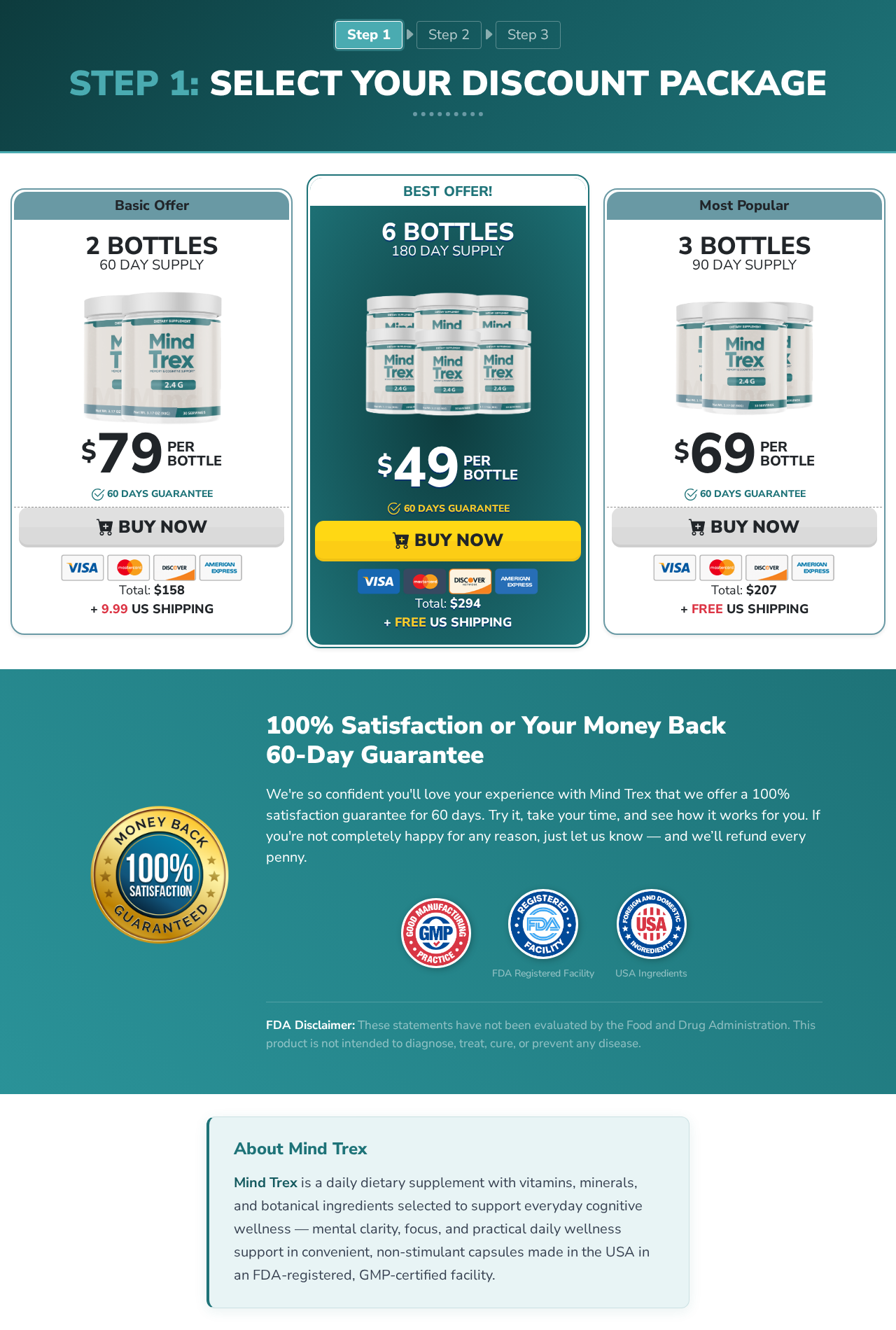
The bestfitmart.com link opens a BuyGoods-linked offer under getmindtrex.com/bg/Front/. This route displays a 60-day money-back guarantee.
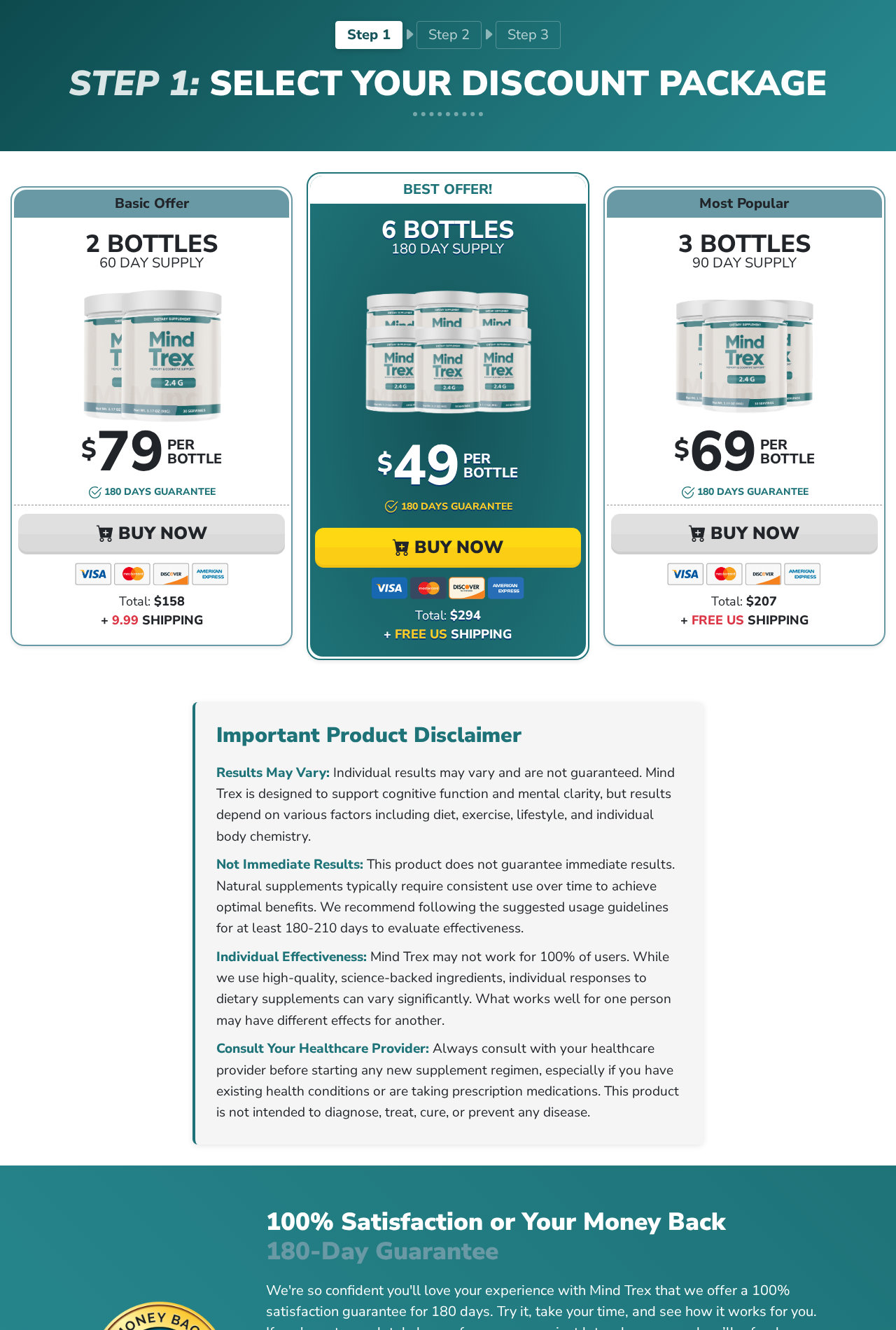
The same domain’s root page uses a different payment route and advertises a 180-day guarantee. The shared brand does not make those purchase conditions identical.
Save the page you actually used. A guarantee found later through a search engine may belong to a different channel, campaign, or transaction.
If the seller wants buyers to rely on 180 days everywhere, it should say so consistently and identify the orders that qualify.
Step 3: Bundle savings encourage a larger upfront payment
Six containers cost $294, or $49 apiece. Three cost $207, and two cost $158 before the displayed $9.99 US shipping charge.
Those prices reward buying more at once. They do not demonstrate that a six-month supply is medically appropriate for the person looking at the page.
The inspected six-container checkout confirmed the $294 total. It did not show an automatic monthly refill selection or establish an unauthorized change in quantity.
Read the package name before payment. A low per-container figure is only useful if you actually want, can safely use, and knowingly order that package.
Step 4: The guarantee starts from shipment
The BuyGoods-linked return information sets 60 days from the shipping date. Time spent waiting for delivery therefore reduces the period available to assess the product.
The policy calls for returning all containers, including empty and unopened ones. Throwing them away can complicate the request, even when you kept the receipt.
It describes five to ten business days for processing after the return arrives. Confirm authorization and the required materials before sending anything back.
The policy also describes assistance with qualifying return shipping. Ask whether your order qualifies instead of assuming a prepaid label is automatic.
Step 5: Long evaluation advice can create a timing problem
The root offer encourages evaluation over 180 to 210 days. That advice cannot safely be carried into a transaction whose guarantee ends after 60.
Even a 180-day guarantee does not automatically cover an assessment completed at 210 days. A recommended routine and a refund deadline are different clocks.
If support suggests waiting longer, request a written extension identifying your order and new deadline. A vague promise to give it more time is not enough.
Do not keep paying for hope while your practical remedy expires. Lack of improvement should prompt timely questions, not another large package by default.
MindTrex Distributor, Retailer, and Return Responsibilities
NorthSupp support and BuyGoods have different roles
The offer lists NorthSupp contact information. The payment page identifies BuyGoods as the retailer, meaning the checkout provider has its own transaction-support role.
These names should appear in your purchase records with enough clarity to direct a cancellation. Neither a retailer logo nor payment processing establishes clinical endorsement.
Check the bank descriptor before calling an unfamiliar number from an advertisement. The inspected checkout explains that the charge appears under BuyGoods.
If product support and retailer support give conflicting instructions, ask each to reference the same order number. Keep both responses rather than switching contacts without a record.
The Largo address is a return location, not a factory finding
The return policy lists Returns 66, 11870 62nd Street North, Largo, Florida 33773. That is an instruction for routing returned goods.
The same street address appears in SodaSlim return material. Shared parcel handling can explain that overlap without establishing that the products have the same manufacturer.
Do not interpret the depot address as proof of US ingredient production. A facility receiving returns can be separate from the plant that makes a supplement.
Use the address only after receiving authorization for your order. A return sent without the required details may be difficult to match to the transaction.
Support promises need an order-specific answer
The BuyGoods route publishes support@northsupplements.online and +1 877-257-0710. The root route instead lists support@cursoemail.online.
That variation is another reason to use your actual purchase channel. Do not assume the first email found in a search handles every MindTrex order.
Contacts were documented, not tested through calls or refund requests. The evidence does not establish systematic nonresponse or a disconnected phone.
What buyers need is practical clarity: applicable guarantee, deadline, return authorization, shipping arrangements, and confirmation that the requested cancellation or refund has been recorded.
A distributor statement does not disclose the entire supply chain
The label identifies MindTrex with Largo, Florida, and makes a US-manufacture claim using globally sourced ingredients. That remains the manufacturer’s presentation, not independent factory verification.
It does not provide ingredient-by-ingredient quantities within the proprietary blend. A consumer cannot calculate an individual active dose from the blend total.
A useful quality document would match the product’s lot, test identity and purity, and identify the responsible laboratory. Generic manufacturing badges do not provide those results.
No batch testing was performed here. The article’s recommendation rests on the inconsistent selling information, not an allegation that the powder is contaminated.
Memory Worries Deserve Better Evidence Than Testimonials
Occasional distraction and a worsening memory problem are not the same situation. An advertisement cannot determine which one a shopper is experiencing.
Stories about clearer thinking may sound convincing because the improvements are familiar. They do not show whether the product caused them or whether others benefit similarly.
Look for research on the finished MindTrex formula, at its marketed serving, in people comparable to the intended users. An ingredient bibliography is not that trial.
The powder-versus-capsule discrepancy makes this especially important. Evidence for a different dosage form or formulation cannot simply be attached to the same brand name.
For new, persistent, or worsening memory concerns, speak with an appropriate healthcare professional. Buying six jars should not become a reason to postpone that conversation.
Bring the readable label and a medication list. That is more useful than showing a screenshot of a Neurologist category or a glowing customer story.
What to Do If You Ordered MindTrex
-
Determine which offer took the payment. Find the retailer, order number, purchase URL, package size, and receipt total.
A BuyGoods-linked order should not be assigned the root page’s longer guarantee without confirmation. Preserve the promise shown when you purchased.
-
Check the product format before using it. Photograph the received container and read whether the directions specify a scoop or a capsule.
If powder arrived after capsule advertising influenced your order, explain that mismatch to support. Do not invent your own serving conversion between different forms.
-
Establish the correct deadline. The inspected BuyGoods policy measures its 60 days from shipment. Locate the dispatch email and calendar the date.
If a representative mentions 180 days, ask whether it applies to your exact transaction. Obtain that answer in writing rather than relying on a different webpage.
-
Request cancellation or return authorization promptly. Use the contact associated with your order and tell the retailer what outcome you want.
Keep every jar, including empties, while the request is assessed. Ask whether the return-shipping assistance described in the policy covers your case.
-
Document delivery of the return. Follow the authorized packing instructions and retain the tracking number and proof of receipt.
Use the policy’s processing estimate to schedule a follow-up. Ask for the refund reference if the seller says payment has already been sent.
-
Compare subsequent transactions with your authorization. No refill was established in the inspected checkout, but your own statements remain important.
If another charge appears unexpectedly, request the consent record and cancellation. Contact the payment provider about unresolved billing rather than assuming every charge is legitimate.
-
Escalate a substantiated disagreement. Send the retailer or card issuer the capsule claim, powder label, applicable guarantee, and your dated correspondence.
Explain the specific mismatch and requested remedy. Do not describe the product as laboratory-proven unsafe when your complaint concerns its description or return handling.
-
Get help for symptoms or memory changes. Consult a clinician or pharmacist about the actual powder and your medications.
If a reaction develops, discontinue use and seek advice. Keep the label and lot information available instead of discarding them during a refund dispute.
Frequently Asked Questions
Is MindTrex a capsule or powder?
The inspected sales text calls it capsules, but the actual label instructs using a 3g scoop mixed with water. That is a powder-format description.
What does the MindTrex label disclose?
It lists 30 servings and a 2.4g proprietary blend containing pea starch, baobab fiber, L-arabinose, konjac glucomannan, and spermidine, without separate ingredient amounts.
Does MindTrex have a 60-day or 180-day guarantee?
The inspected BuyGoods route says 60 days; the root offer says 180. Confirm the guarantee attached to your receipt rather than combining different channels’ promises.
Was a MindTrex refill subscription confirmed?
No. The inspected six-container checkout displayed a single $294 order without a visible subscription option. That finding does not replace checking your own purchase agreement.
Does the Facebook Neurologist category prove medical approval?
No. A social-page category does not identify a licensed clinician, create a treatment relationship, or substantiate a supplement’s ability to improve memory.
Should I buy a long supply to evaluate it properly?
Not through this inconsistent offer. Resolve the product description and evidence first, and never let long evaluation advice override the refund deadline covering your transaction.
The Bottom Line
Do not buy MindTrex through the inspected funnel. Capsule advertising, a powder label, and competing guarantee periods leave basic purchase expectations unresolved.
If you ordered, identify your retailer and refund clock now, preserve all containers, and request the appropriate cancellation or return before lengthy evaluation advice costs you time.








