


Someone offers to put your Bitcoin to work through a trading system you do not need to operate yourself. The software supposedly handles the difficult decisions.
Mirror Trading International built its pitch around that appealing division of responsibility. What happened to the money tells a very different story.
Overview
Bitcoin deposits behind a supposed forex trading bot
Mirror Trading International, usually shortened to MTI, solicited Bitcoin for a pooled trading operation. It claimed proprietary software would trade foreign currency on participants’ behalf.
The combination sounded sophisticated: cryptocurrency supplied the funds, a pooled account supplied scale, and a bot supposedly supplied expertise ordinary participants did not possess.
Investors therefore needed truthful answers about two separate matters: where their Bitcoin went and whether the advertised trading actually occurred.
Court findings established fraud rather than poor performance
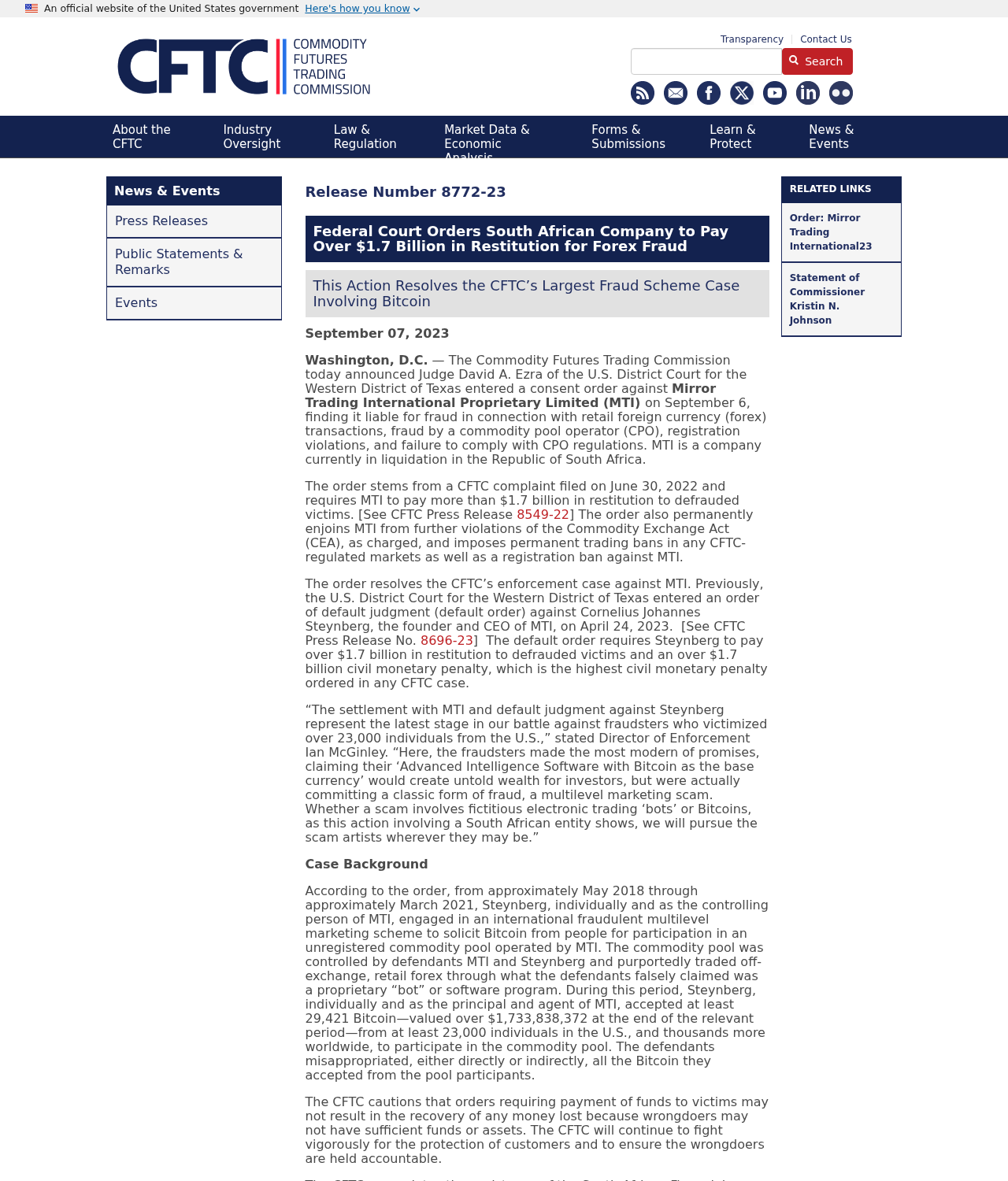
In September 2023, a federal court entered a consent order finding the company liable for fraud and other violations, according to the CFTC.
The CFTC’s case announcement says the defendants misappropriated all the Bitcoin accepted from pool participants, directly or indirectly. That is fundamentally different from unsuccessful legitimate trading.
- The operation sought Bitcoin through an international multilevel marketing network.
- Participants were told a proprietary bot would trade retail foreign currency.
- Civil court orders established fraud and imposed substantial financial obligations.
- Those orders do not establish that equivalent money is available for immediate repayment.
A large restitution order is not a personal payout notice
The company was ordered to pay more than $1.7 billion in restitution. Separate orders concerned founder Cornelius Johannes Steynberg, including restitution and a civil penalty.
The CFTC explicitly cautioned that payment orders might not result in recovery because sufficient assets may be unavailable. A legal obligation is not recovered cash.
MTI’s South African liquidation is a separate practical issue for claimants. Do not send money to someone claiming that the US order guarantees your payment.
Why Bitcoin and Forex Made the Pitch Sound Technical
A forex trading explanation can be difficult for an outsider to verify. Adding cryptocurrency makes the arrangement feel even further removed from an ordinary investment account.
That complexity creates room for a misleading shortcut: trust the person operating the software. The participant contributes funds while the operator controls the explanation.
However, a technical strategy still needs ordinary financial safeguards. Someone must hold the assets, execute the trades, maintain records, and account for withdrawals.
A bot does not remove those responsibilities. It also does not make the person asking for your money less accountable for truthful statements.
The most important distinction is between the funding asset and the supposed investment activity. Sending Bitcoin does not prove that foreign-currency positions were opened.
Likewise, seeing a Bitcoin transaction on a blockchain does not reveal what happened in a purported brokerage account. Those are different layers requiring different evidence.
MTI’s case shows why the impressive description should not become the answer. Investors needed independently verifiable custody and trading information, rather than confidence in proprietary software.
How the Mirror Trading International Scam Works
Step 1: Recruit participants through an international network
The CFTC described an international fraudulent multilevel marketing scheme operating from approximately May 2018 through March 2021. Bitcoin contributions came from the United States and elsewhere.
Recruitment can put an investment invitation inside an existing relationship. A person sharing the opportunity may seem more approachable than an unfamiliar financial business.
That familiarity can shift attention away from the operator. Instead of asking who holds the money, a prospective participant may ask whether their acquaintance has joined.
Knowing someone who joined does not tell you where your money will go. Their involvement cannot establish that the advertised trading system exists.
Nor does a large network settle the issue. Widespread participation can show successful promotion while leaving the same unanswered questions about custody and financial activity.
Step 2: Collect Bitcoin for a centrally controlled pool
Participants supplied Bitcoin to an unregistered commodity pool operated by MTI and controlled by Steynberg. The cryptocurrency was presented as funding for the trading operation.
The court findings cited by the CFTC covered at least 29,421 Bitcoin. That quantity was valued above $1.7 billion at the end of the relevant period.
Keep the valuation date attached to that figure. It is not a statement of today’s Bitcoin price, current recovered assets, or the amount payable to you.
Once funds enter another party’s control, the investor depends on more than the security of the blockchain. The operator’s conduct becomes central to the risk.
Using cryptocurrency does not turn a pooled investment into self-custody. If someone else controls the funds, your own wallet’s security cannot guarantee their proper use.
Step 3: Explain the expected returns with proprietary software
The advertised activity was off-exchange retail forex trading through a supposed proprietary bot. That explanation gave the operation an apparent source of investment earnings.
Proprietary can sound reassuring because it suggests a competitive advantage. It can also discourage basic questions by making ordinary transparency seem incompatible with protecting a secret.
There is no need to inspect every line of code to ask who holds assets or which independent records establish actual trading.
A business can protect technical intellectual property while still explaining material risks and providing truthful financial information. Secrecy does not resolve a missing custody trail.
The MTI findings are not a verdict on all automated trading. They concern false representations and misappropriation in this particular operation.
Step 4: Misappropriate the contributed cryptocurrency
The court findings described a much more serious problem than a bot choosing bad trades. All Bitcoin accepted from participants was misappropriated, directly or indirectly.
That conclusion breaks the advertised link between the investment explanation and the use of funds. The money was not handled as participants were led to believe.
For someone reconstructing the loss, the original transfer remains important even if the recipient later moved assets again. It anchors where your particular contribution entered.
Do not assume an unrelated address belongs to an operator simply because it appears near a transaction in an online discussion. Preserve the traceable facts you control.
Any deeper attribution needs reliable records and analysis. Guessing at wallet ownership can confuse a report and wrongly implicate an unrelated recipient.
Step 5: Replace the trading story with separate recovery proceedings
The company entered liquidation in South Africa, while US civil enforcement produced restitution obligations and market restrictions. These proceedings address different aspects of the aftermath.
They do not revive the bot, restore a trading account, or turn the original promotional promise into a reliable earnings history.
A claimant may need to establish transactions, identity, and existing filing status. The paperwork required depends on the actual administrator and proceeding involved.
That uncertainty can be exploited by someone offering a simple shortcut. A purported agent may promise immediate access to a large award in exchange for money.
Before responding, identify the authority behind the request. A genuine court order cannot authenticate a stranger’s payment instructions on its own.
The MTI Company, Its Founder, and the Liquidation
Match the full company identity to the case
The CFTC identifies Mirror Trading International Proprietary Limited as the company subject to its September 2023 consent order. Keep that legal identity with your records.
Abbreviations can make unrelated offers appear connected. A new website using MTI or a similar trading name needs its own identity checks.
A shared word, logo, or software description is insufficient to establish common ownership. Attach the confirmed findings to the actual company and conduct identified in court.
The company order and founder order are separate
The company consent order followed an April 2023 default judgment against Steynberg. The founder’s order included both restitution and a civil monetary penalty.
Both orders came from civil enforcement proceedings. They are not criminal convictions, and their amounts should not be combined into a single compensation fund.
Some obligations can concern overlapping losses, while a penalty serves a different purpose. A headline-sized total cannot tell an individual claimant what they will receive.
Liquidation figures describe administration at a particular time
Reporting continued in 2026 about claims in the South African liquidation. Such figures concern a dated stage of administration, not guaranteed amounts available to every participant.
A total submitted by claimants can differ from the total ultimately accepted. Money held can also differ from money distributable after the relevant process.
Use your own claim notices and authenticated administrator correspondence for personal decisions. A news report about aggregate claims does not establish your individual status.
A recovery contact must establish its authority
Ask which proceeding the person represents, the relevant case number, and where the court or regulator independently identifies that role.
Check that connection through the named institution before providing documents. Do not rely solely on a PDF or website supplied by the person seeking your cooperation.
If the claimed authority cannot be independently confirmed, do not proceed. No public recovery announcement requires you to surrender a wallet recovery phrase.
Three Different Numbers Investors Should Keep Separate
The amount contributed, the amount ordered repaid, and the amount actually recovered answer different questions. Confusing them can lead to another costly decision.
A contribution records what participants sent into the operation. The historical USD valuation helps describe scale, but does not automatically establish each person’s current claim.
A restitution order establishes a legal payment obligation. It does not prove assets have been located or that an administrator can immediately satisfy it.
A recovered asset belongs in another category. Its eventual treatment may depend on ownership disputes, administration, eligibility, and the orders governing the particular process.
The CFTC’s warning about possible non-recovery matters because it interrupts a dangerous assumption. A large court award is not a reason to pay a release fee.
For your own records, keep cryptocurrency amounts as cryptocurrency amounts and retain transfer dates. Record any USD equivalents with their source and valuation date.
That approach avoids quietly replacing the original transaction with a different number based on a later market price or an unsupported account statement.
What to Do if You Have Fallen Victim to This Scam
-
Document exactly what you transferred into MTI. Retrieve exchange exports, withdrawal confirmations, receiving addresses, transaction hashes, and messages explaining where you were instructed to send funds.
Make a dated list of contributions and any payments actually received. Place advertised earnings in a separate category rather than adding them to your deposits.
Keep original files with their dates and context. A cropped screenshot can omit information needed to connect a payment with the relevant account.
-
Identify the process behind existing claim correspondence. Locate your filing confirmation, claim number, administrator name, and the court or liquidation reference appearing on the notice.
Compare the legal identity with the CFTC case announcement. For liquidation correspondence, independently confirm the responsible administrator before sending updated documents.
Ask whether your claim is received, disputed, allowed, or awaiting information. Request the actual missing item instead of assuming a general recovery headline answers your case.
-
Check any fresh transfer with the provider immediately. If you recently paid a recovery demand, use support within your established exchange account or your bank’s published contact.
Give the transaction identifier and explain that it followed a claim about MTI funds. Ask whether intervention is possible and keep the case reference.
A provider may be unable to reverse a completed cryptocurrency transfer. That limitation does not make a stranger’s guaranteed reversal offer credible.
-
File a factual online-fraud report through the genuine FBI service. Open IC3.gov directly and choose File A Complaint.
Read the terms and select Accept if you agree. Complete the contact and loss details, adding known transaction hashes, recipients, and the representations you received.
Describe uncertain information as uncertain, and identify any earlier report. Review the completed account, add the digital signature, and select Submit Complaint.
Save the successful-submission page before navigating away. If the form identifies missing information, correct it before assuming your complaint has been submitted.
-
Separate reporting from filing a claim for money. IC3 collects reports; a police report does not itself establish eligibility in a liquidation or restitution process.
Ask the authenticated administrator what procedure applies to your existing position and whether any current deadline affects it. Obtain written instructions and retain the response.
No new filing window or guaranteed payout is established by the historical CFTC announcement. Do not pay someone who presents that announcement as your personal award.
-
Protect any information exposed during a recovery approach. Change a disclosed password through the genuine service, review account sessions, and secure the associated email account.
If you shared a wallet recovery phrase, seek urgent guidance through your wallet provider’s authenticated support materials about protecting remaining assets.
Never give that phrase to a case administrator or recovery agent. Ownership records and a wallet’s secret credentials are fundamentally different things.
Frequently Asked Questions
Was MTI simply a trading bot that lost money?
No, the civil findings established fraud and misappropriation of participant Bitcoin. That is different from genuine trading producing disappointing results within its disclosed risks.
Did investors keep control because they paid with Bitcoin?
Sending Bitcoin into an operator-controlled pool is not self-custody. The blockchain can record a transfer without ensuring the recipient uses the funds as promised.
Does the $1.7 billion order guarantee my refund?
No, a restitution obligation is not proof that enough assets have been recovered. The CFTC specifically warned that court orders might not produce repayment.
Can the company and founder awards be added together?
Do not treat separate restitution obligations and penalties as one available fund. Their legal purposes and relationship to the underlying losses require careful distinction.
What information matters most in a cryptocurrency report?
Preserve transaction hashes, dates, asset quantities, sending and receiving addresses, exchange records, and the messages directing payment. Label uncertain wallet ownership instead of guessing.
Should an administrator ask for my wallet recovery phrase?
No, that secret can give access to assets beyond the claim. Verify any request through the responsible institution and never provide recovery phrases to a stranger.
The Bottom Line
Do not fund a revived MTI bot offer or pay to release a supposed court award. The confirmed case concerns fraud, not merely unsuccessful trading.
If you contributed Bitcoin, preserve the actual transaction trail and verify your existing claim’s administrator. Treat any fresh payment demand as a separate decision requiring authentication.

Join the discussion
0 commentsShare your experience or ask a question about this article.
Community experiences
Did this happen to you?
Your experience could help someone recognize the same scam. Submit a private report for our team to review.
I experienced this tooReports are reviewed before publication. Sharing publicly is always your choice.
Discussion
Start the conversation
Have a question or something useful to share? Add the first comment.