


The email arrives as a final notice, not a celebration. It gives the impression that a file about you has been sitting on someone’s desk for years.
There are two amounts in the letter, and the smaller one is there for a reason. The sender has a story about the difference.
Overview
A prize that supposedly earned money while you waited
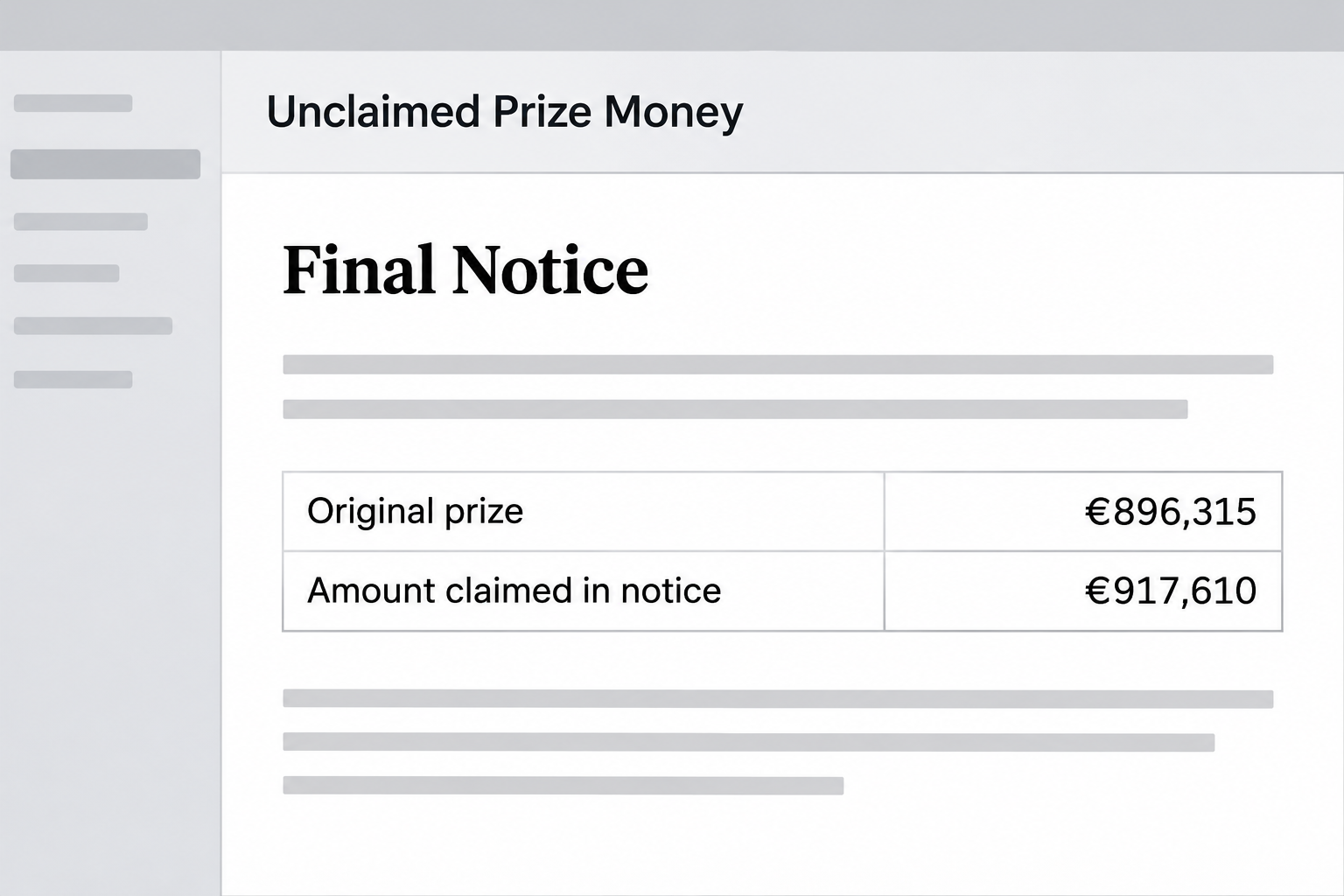
The Unclaimed Prize Money email claims that legal advisers in Spain are handling a lottery payout in your name. It presents €917,610 as the amount available now.
The letter says the prize grew from €896,315 after two years of being held and invested. The difference gives the story a financial history.
That is an unusual detail for a message that comes without warning. It makes an unexpected sum sound like a figure from a file rather than a number someone chose.
The reader is not given an independently verifiable record that links them to a winning entry. The requested first move instead involves supplying personal information to the sender.
A legal story explains why nobody contacted you earlier
The email claims an office responsible for unclaimed prize money appointed a law firm to handle the payment. It uses what looks like a file reference and a Madrid address.
It also claims the winnings will be invested for another period if not collected. That story explains away the long silence while giving the recipient a reason to react now.
The sender and reply addresses differed. That can happen legitimately, but it does not establish that either mailbox belongs to someone appointed to handle winnings.
The warning applies to the letter and its demands. A name or address printed in a fraud message is not evidence that the actual occupant sent it.
An identity check comes before any independent proof
The letter asked for a name, date of birth, occupation, address and contact details. It also asked whether the reader wanted to donate 20% of the supposed prize.
The donation question was part of the documented message. That does not mean anyone was observed being charged a donation, processing fee, or tax.
Before giving the sender more information, start with the things you can check without their help:
- Did you enter this particular promotion or buy a ticket that you still hold?
- Can you independently identify the organizer and check its official rules?
- Can the organizer confirm a matching prize without using the sender’s contacts?
- Has anyone asked you to pay or disclose personal details before establishing that you won?
If the first you have heard of the payout is an unsolicited email, the message does not establish a right to collect money.
How the Unclaimed Prize Money Email Scam Works
Step 1: The phrase “final notice” puts you behind before you start
Most people know where they bought a lottery ticket. This letter invites you to begin with a different assumption: that an old award somehow already belongs to you.
The text explains that earlier attempts to find a claimant did not succeed. That is a ready-made answer to the question of why you never heard about the prize.
Someone might open the message to see whether it contains a detail they have forgotten. The email uses that curiosity to turn a stranger’s demand into a personal matter.
Check your own records before giving the letter a chance to explain those records for you. An unexplained reference number cannot substitute for proof that you entered.
Step 2: The accounting story makes an invented balance sound settled
A single rounded figure could look like a fantasy. The two specific amounts, with an explanation about investment, look more like a reconciliation.
But the email does not prove there was an underlying prize, much less that a fund was invested on your behalf. The change in value is part of the claim.
Those figures can help identify this version. A message mentioning both €896,315 and €917,610 may be recycling the story under another subject.
If a forwarded copy changes the currency, focus on the claimed organizer and draw. A different amount will not make an unsolicited payout any easier to verify.
Step 3: The law-firm framing nudges you into a private exchange
The page of formal-looking text encourages the recipient to think of the sender as a professional handling confidential paperwork. A street address and file number add to that impression.
The only participant you can identify from that paper trail is the person asking you to reply. The email does not independently establish what office, if any, retained the sender.
You can check a lawyer’s identity through a reliable directory. Separately confirm whether the person sent the email and represents the organizer.
If all the suggested verification routes lead back to the message, you have not verified anything outside the message. Do not make the reply your first test.
Step 4: The “claim” turns into a request for personal information
Asking for an identity check is plausible when money changes hands. The question is whether you have established who is collecting the information and why they are entitled to it.
A date of birth alongside a home address and phone number is more useful than any one of those facts alone. That combination makes later impersonation more persuasive.
Even limited information can make a second message or call feel more personal. The risk does not begin only when someone asks for a passport scan.
The documented message does not establish that anyone sent those details. It shows an attempt to collect them and suggests what recipients should look for in follow-up messages.
Step 5: A donation or fee can become the next demand
The email raises the idea of donating part of the award. A genuine choice about donating money would not prove that an unrelated sender can release that money.
Follow-up demands in prize scams often have different names. The FTC’s guidance on fake prize notices warns that taxes, handling charges, and processing fees can all be used as pretexts.
The record does not show how this sender would have followed up. Treat any later request to cover a deposit, donation, or release fee as a new reason to stop.
Do not send a small test payment while keeping the rest back. Neither a receipt nor a promise of reimbursement will verify the existence of the award.
What to Do if You Have Fallen Victim to This Scam
-
Stop the conversation and keep the original message. Save the subject, date, displayed sender, reply address, and the wording of any follow-up without reopening an unsafe link.
Do not send a final reply explaining why you think it is false. Ending the exchange avoids confirming more about you.
-
If you replied with basic details, list exactly what you sent. An email address or general inquiry is different from a birth date, full address, ID scan, or bank details.
Watch for contacts that reuse your name, city, or the alleged file reference. These may sound more informed because they are drawing on what you already sent.
Warn anyone whose contact information you provided. They should know why a stranger might mention the prize before they decide how to respond.
-
If you shared an identity document or national identifier, act on that exposure. Contact the issuing authority or local identity-fraud support for guidance appropriate to that document.
U.S. readers can start with IdentityTheft.gov for a recovery plan. Other countries have different systems for fraud reports, credit alerts and document replacement.
Save dates and details of the disclosures for your report. Keep scans of your identity documents out of ordinary emails or messages to unverified people.
-
If you disclosed card details or paid, call your provider. Use the number on your card or your existing banking app, not contact information on the alleged prize letter.
Tell your bank or payment provider what happened and ask whether the transaction can be stopped, disputed, or traced. The available options depend on how you paid.
Hold onto gift-card receipts, wire records, or app confirmations if relevant. Do not send an additional payment to someone who says it will make the first one refundable.
-
Report the attempted fraud through a channel you already trust. Use the email provider’s phishing control and a local fraud-reporting service appropriate to where you live.
A report does not require you to keep talking to the sender. A copy of what already arrived can be more useful than a longer conversation arranged to gather evidence.
-
Look out for a second offer to recover your money. Do not assume a new contact is official because they know the amount, the file number, or the earlier story.
Verify any official-sounding contact through an independently found number. A genuine organization should not need an up-front payment from you to prove that a prior message was fraudulent.
What a Real Prize Verification Looks Like
Start with your own record of entry rather than the letter. A purchase record, an original ticket, or an account with the organizer gives you an independent starting point.
The Spanish state lottery’s prize help page directs online entrants to the status in their own account. It says those records take precedence over outside notifications.
The existence of an official lottery does not connect this email to it. Check the draw, rules, and identity of the organizer making the claim.
A valid procedure may require identity checks at an appropriate stage. That is different from sending a detailed identity profile to a reply address supplied by an unknown correspondent.
Ask someone you trust to review the notice with you before sending anything. A second reader can check which parts came from the email and which came from outside it.
A real notification is not the only record of a win
The Spanish lottery says it may notify online winners directly. That is why the useful rule is not “legitimate lotteries never email,” but “verify the outcome outside the email.”
For example, open your existing account independently and look for the corresponding entry. The money promised in a message is not a replacement for that record.
If you purchased a paper ticket, use the organizer’s official instructions. Do not give an unknown person a picture or serial number to check it for you.
A notification occasionally matches a promotion you recognize by coincidence. Confirm which ticket or entry belongs to that draw before treating the message as connected.
Do not mistake a delayed payout story for a verified obligation
The letter invokes both safekeeping and a deadline. Those details are worth recognizing because they allow the same message to say there is plenty of money but little time.
A claim that funds will be invested again leaves room for later contact. Another notice can reuse that story even after you ignored the first one.
The two amounts also help reporting teams connect messages with different subjects. Include them in a report if present, but leave out your own ticket or account details.
Do not use the sender’s explanation of Spanish law to check the sender’s own authority. If the claim genuinely concerns a draw you entered, consult that organizer or independent advice.
If nothing ties you to the named draw, you do not need to sign a waiver or take steps to decline the winnings. Keep or report the message without replying.
Frequently Asked Questions
Is the €917,610 Unclaimed Prize Money email real?
The documented email uses a false payout story to solicit personal details. Its stated balance is a detail to recognize, not a debt anyone has proven they owe you.
Can unclaimed lottery funds really earn interest for the winner?
That depends on the organizer and the applicable rules. The email provides no reliable proof that any money was held or invested for this recipient, regardless of its arithmetic.
If the Madrid address exists, is the message safer?
An address may be real while the email is false. Use independent information about the organizer and confirm the appointment rather than relying on a location printed in a letter.
Is the 20% donation request proof that money was stolen?
It shows the letter introduced a donation decision. The available evidence does not show a payment or what the sender would have asked for after receiving a reply.
What if I gave only my name and phone number?
Anticipate tailored calls or messages and do not confirm other details. Contact your bank or identity-fraud service if you also sent a sensitive identifier or financial information.
Does an unopened email mean my device is infected?
There is no documented installation in this particular email case. The observed hook was the reply and identity request, not evidence that an unopened message compromised a device.
The Bottom Line
Do not send information or money in response to the €917,610 notice. A supposed file number and an explanation for the extra money are not proof that you won.
If you already replied, assess what you disclosed and protect that information first. If you paid, contact the payment provider now rather than waiting for the promised prize.

Join the discussion
0 commentsShare your experience or ask a question about this article.
Community experiences
Did this happen to you?
Your experience could help someone recognize the same scam. Submit a private report for our team to review.
I experienced this tooReports are reviewed before publication. Sharing publicly is always your choice.
Discussion
Start the conversation
Have a question or something useful to share? Add the first comment.