

The voicemail is already talking when you pick the phone up. A first name you do not know sits next to a department that sounds like it has a badge. You have been pre-approved, there is a number to call back, and if you wait the approval might not hold.
People who look that name up land on two different things. One is a robocall that keeps using National Advisory Center and National Advisory Center Approval Department. The other is a live student-loan site that calls itself National Advisory and National Advisory Group. The names sit close enough that a tired person can treat them as the same office.
If you already called back, keep the recording. The rest of this is about the $45,000 pre-approval, the paid-help pitch for free federal forms, and why a real Laguna Hills office with a similar name is not the same file as the Sarah voicemail.
Overview
The trap is a Sarah-style voicemail that says you are already pre-approved for $45,000. The recording wants a callback. Once you dial, the desk treats the approval as a file and asks for a Social Security number, a bank account, or a fee before anyone has a loan or a student-aid form in front of them. That callback is the sale.
A separate Laguna Hills company with a similar name sells paid paperwork for federal student-loan forms the government already offers free. Those are two files. National Advisory Group Inc is a real BBB-listed shop with an owner, a street, and a 2018 start date. The Sarah voicemail is not proven to be that office. Do not collapse them into one scam.
The $45,000 voicemail
On 800notes reports for 844-600-0110, people in March, April, and May 2024 described the same script. A caller named Sarah said she was with National Advisory Center, or National Advisory Center Approval Department, and that they were pre-approved for a $45,000 loan. The number to call back was 844-600-0110. Several posts used the same dollar figure and the same first name.
That is a recorded voice offering a pre-approval you never applied for, plus a callback that is not the number on your caller ID. You did not fill out a form. The recording still uses your silence as a pending file. If you wait, the approval might not hold. That clock is theirs, not the Department of Education’s.
The Federal Trade Commission later described the same family of calls in a September 2025 consumer alert: a voicemail about a $52,000 loan you did not apply for, a request for a Social Security number or a bank account, and a line about taking you off the list if you call back. YouMail’s public robocall write-ups show how common the template is. One campaign uses National Financial Hardship Loan Center and $36,000. Another uses Relief Advisory Approval Department and a $48,000 pre-approval. Those are not proof that the same people run every name. They are proof that official-sounding advisory and hardship titles plus a round cash figure are a working script.
Paid help for free forms
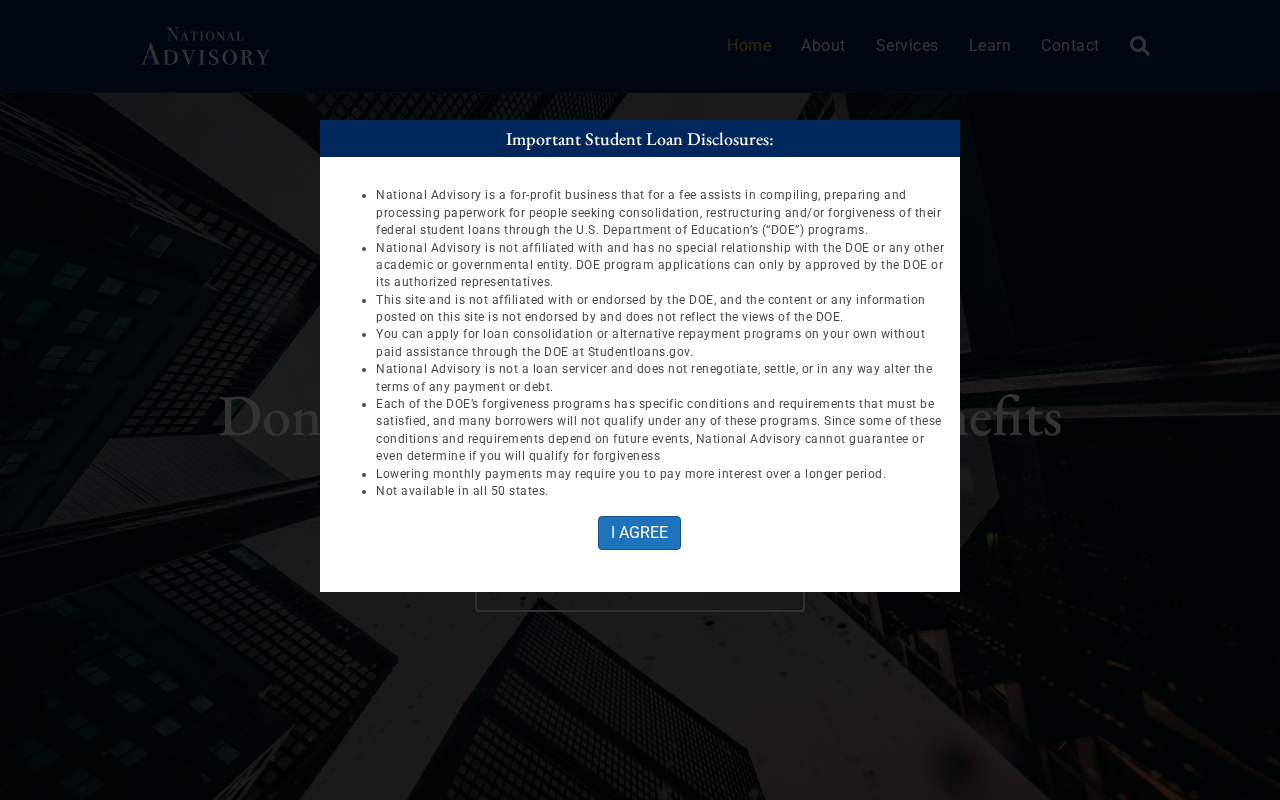
The other pitch that shares this kind of name is not a mystery loan. It is a fee for paperwork the government already offers free. The live site at nationaladvisory.org says so in its own disclosure modal. National Advisory is a for-profit business that charges to compile, prepare, and process paperwork for federal student loan consolidation, restructuring, and forgiveness. It is not affiliated with the U.S. Department of Education. You can apply for those programs on your own at Studentloans.gov. It is not a loan servicer. It cannot guarantee or even determine whether you will qualify for forgiveness.
That is the company telling you the thing you are about to pay for is optional paperwork for a free government form. The homepage still shouts “Don’t Miss Out on Available Benefits” and “Call us today.” The three products are Financial Analysis, Documentation Preparation, and Yearly Certification. The About page grades itself Honesty 100%, Integrity 100%, Diligence 100%, Results 100%. Those bars are a graphic, not a license.
The Federal Trade Commission is blunter. In Paying for School and Avoiding Scams, it says there is nothing a student loan debt relief company can do for you that you cannot do yourself for free, and that it is illegal for companies to charge you before they help you. The Department of Education’s Office of Inspector General says the same thing in one sentence: never pay for help with student loan debt relief, loan forgiveness, or loan consolidation.
An older Solution page on that same site, still live in August 2026, sells a harder version of the same pitch. It promises approval of lower payments, a 60-day rescue from default, garnishments suspended in 60 days, a credit lift, and a tax refund back, plus a 100% money back guarantee with no form and no window next to the slogan. The disclosure modal on the same property says the company cannot guarantee forgiveness and cannot change the terms of a debt. Those two promises do not fit together. The leftover page is useful because it shows the sale, not because it is a shopfront tour.
The callback is the sale
The recording does not need you to stay on the first call. It needs you to dial the toll-free number it repeated twice. That is how 844-600-0110 shows up in a row of 800notes posts with the same $45,000 figure. Once you call, you are no longer screening a robocall. You are on a live desk that already has a script for a person who believes a loan is waiting.
From there the questions get personal: Social Security number, bank routing, date of birth, and a processing fee to release funds. The FTC’s advance-fee loan page says that fee is the tell. There is no loan and no lender. If you pay, the voice and the money are gone. On student-loan versions, the fee can be an enrollment charge or a monthly draft for document preparation. The words change. The ask does not.
The Telemarketing Sales Rule is the line under the first version. A promised loan plus an upfront fee is not a gray area. The student-loan version has its own line: the FTC says it is illegal for those companies to charge you before they help you, and Federal Student Aid says the application itself is free.
The Sarah callback is not the number on the Laguna Hills file. Consumer reports attach 844-600-0110 to National Advisory Center. Indexed reports on 855-400-0180 talk about a Susan voicemail from National Advisory Group and a $50,000 alternative debt hardship program. A nearby script uses National Assistance Center and a different 877 line. Those are the same family of sentence, not a published switchboard. None of those robocall callbacks appear on nationaladvisory.org. If you press 1 to opt out, you have just told them the number is live.
A real office with the same kind of name
Laguna Hills National Advisory Group Inc is a real shop. Treat it as a real shop. The Better Business Bureau lists it under Financial Services. The BBB profile for National Advisory is not accredited. It names National Advisory Group Inc as an alternate and lists owner Gerrit Preston. The street on that file is 23282 Mill Creek Dr Ste 105, Laguna Hills, CA 92653-1689, and it prints 877-625-2517. The file opened December 17, 2019. BBB says the business started and incorporated on April 18, 2018. The profile also lists a failure to respond to 1 complaint.
The Sarah voicemail is not proven to be that office. BBB reviews still show people who got a scam call under this name, then reached the Laguna Hills office and were told it was not the same company. That reply is part of the record. The name is doing work in both places, and a person in debt is not in a good position to split those files at 9 p.m. Keep them split anyway. Paid help for free federal forms is one problem. A $45,000 pre-approval you never applied for is another.
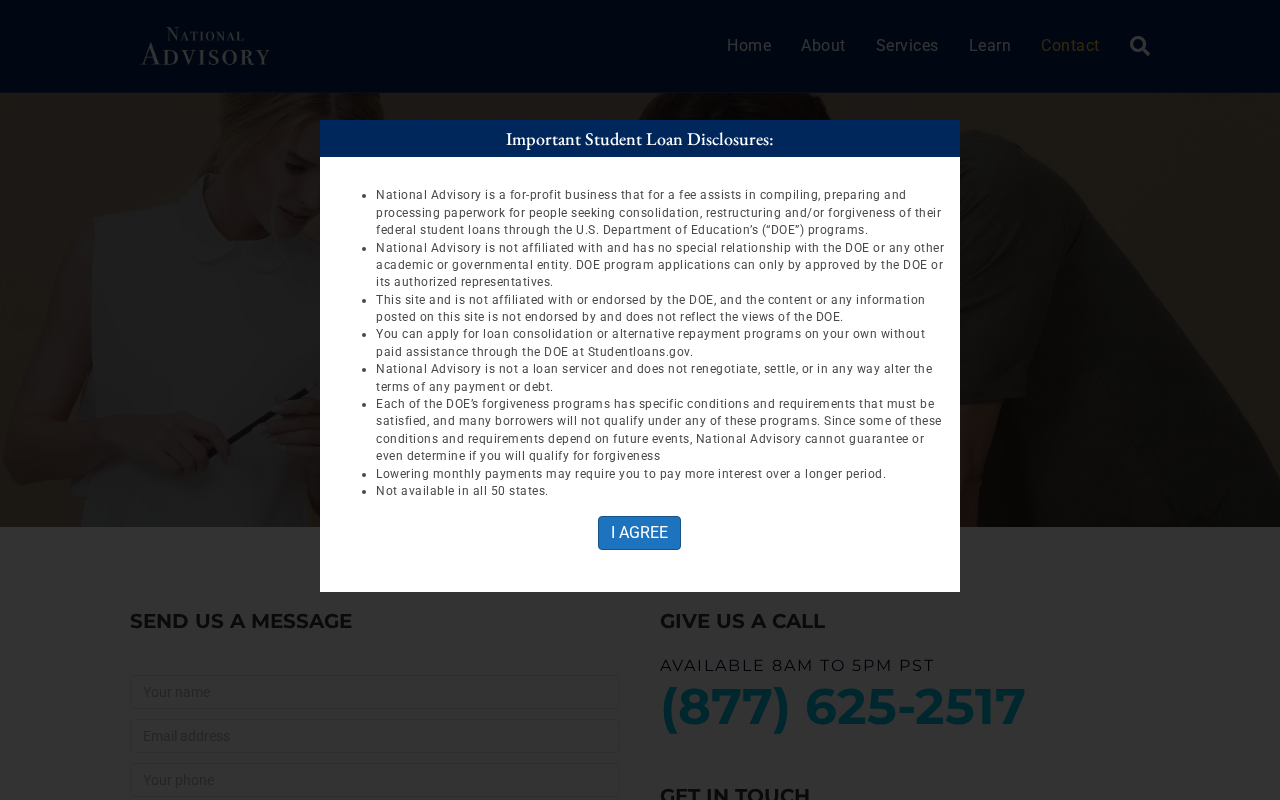
The live site does not publish a standalone refund process next to the 100% money back line. Privacy and terms are dated June 27, 2019, and point people to support@nationaladvisory.org. A BBB reviewer wrote that they paid monthly installments for over 2 years and could not get anyone on the line once student loan payments started again. The business reply said the loans had been forgiven. That reply is the company’s claim, not a document you can audit from the outside. If a draft already left, the next step is the bank and a written cancel, not another voicemail.
For credit card and other unsecured debt, the CFPB’s debt relief explainer says to avoid a company that charges fees before it settles, touts a new government program for personal credit card debt, or guarantees pennies on the dollar. A hardship loan that appears on a voicemail with no application is that warning in audio form. For tax, the FTC’s January 2026 alert is just as flat: the first IRS contact comes by mail, not by a cold call from a resolution department.
How The Voicemail And The Paid Help Pitch Differ
The call and the website are not the same machine. They use a similar name. They are not proven to be the same office. The Sarah voicemail is one file. The Laguna Hills paperwork shop is another. Do not read the sequence below as one company running both.
1. A voicemail that already decided you qualify
You did not fill out a form. You did not request a callback. The recording still uses your silence as a pending file. Callers named Sarah, Susan, Barb, or Mary say they are with National Advisory Center, National Advisory Center Approval Department, or National Advisory Group. You are pre-approved for $45,000, $50,000, or, in the FTC’s own example, $52,000. The approval is about to expire. That is the hook.
The FTC says these calls often arrive in bursts, from different numbers, several times a day. Caller ID can look local. The number in the message is a different line. If you press 1 to opt out, you have just told them the number is live.
2. The callback is the real door
The recording does not need you to stay on the first call. It needs you to dial the toll-free number it repeated twice. That is how 844-600-0110 shows up in a row of 800notes posts with the same $45,000 figure. Once you call, you are no longer screening a robocall. You are on a live desk that already has a script for a person who believes a loan is waiting.
From there the questions get personal: Social Security number, bank routing, date of birth, and a processing fee to release funds. The FTC’s advance-fee page says that fee is the tell. There is no loan and no lender. If you pay, the voice and the money are gone.
3. The fee is dressed up as paperwork
The words change to processing, insurance, application, or transfer deposit. On student loan versions, it can be an enrollment fee or a monthly draft for document preparation. On tax versions, it is a resolution fee for a program the IRS did not pre-approve.
The payment method is often a wire, a prepaid card, a gift card, or crypto, because those are hard to reverse. A bank draft for a monthly student-loan service is slower and looks more like a real office. Both can empty an account.
The Telemarketing Sales Rule is the line under the first version. A promised loan plus an upfront fee is not a gray area. The student-loan version has its own line: the FTC says it is illegal for those companies to charge you before they help you, and Federal Student Aid says the application itself is free.
4. A live Laguna Hills site is a different file
If you search before you call back, nationaladvisory.org is sitting there with a skyline, a disclosure modal, and a Laguna Hills BBB file. That is a live business with its own disclosures. It is not proof that the Sarah voicemail came from that office. Paid help for free federal forms is one file. A $45,000 pre-approval you never applied for is another.
The site sells paid help for free federal forms, keeps an old Solution page that promises 60-day default rescue and a tax refund back, and does not publish a refund process next to the 100% money back line.
The Laguna Hills company and the Sarah voicemail are not proven to be the same operators. The BBB review in which the office said a scam call was not them is part of that record. The name is doing work in both places, and a person in debt is not in a good position to split those files at 9 p.m.
5. Similar names show up on hardship, credit, and tax scripts
Consumer reports under this name talk about hardship loans, debt consolidation, and credit matching. The 800notes file is a $45,000 assistant loan. Indexed reports on 855-400-0180 talk about alternative debt hardship programs.
The same paid-help pitch also swaps in credit repair and getting a tax refund back. The FTC’s 2026 tax alerts describe official-sounding resolution departments that want a Social Security number or an illegal upfront fee.
The product on the voicemail is not a specific loan you applied for. Consumer reports under similar names talk about hardship loans, debt consolidation, and credit matching. That is the family of sentence, not a published switchboard that ties every name to the Laguna Hills office.
6. Support goes quiet after the draft starts
On the live site, the public refund story is a 2019 guarantee with no instructions. On BBB, a person who paid for more than 2 years said the line went dead when repayment restarted. The company said the loans were forgiven. There is no public case number attached to that reply. If your own draft is still leaving the account, the next step is not another voicemail. It is the bank and a written cancel.
7. Recovery calls arrive after the first loss
Once a number is known to pick up, a second voice can offer to get the fee back for a new fee. That is a second scam. The FTC, CFPB, and TIGTA do not call you from a fresh mobile number to recover a hardship loan. Anyone who does is reading the same voicemail list you are already on.
What To Do If You Already Paid
If you already called back, paid, or read a Social Security number out loud, do this in order. Do not wait for the desk to feel helpful.
- Stop talking to the number that called you. Do not call 844-600-0110, 855-400-0180, or any other callback from the voicemail. Do not press buttons to opt out. Block the inbound IDs and the callback. Save the recording if you still have it.
- Write down what left the house. Names used on the call. The callback. The caller ID. The amount they asked for. The method. The last four of any card or account. The date. If you paid nationaladvisory.org or 877-625-2517, keep the confirmation, the draft date, and any contract PDF.
- Call the bank or card issuer the same day. Ask them to reverse the draft if you can, block the merchant, and watch for a second charge under a different name. If you sent a wire, a prepaid card, a gift card, or crypto, say so. Those are slower to recover. Speed still matters.
- If you gave a Social Security number or a bank login, lock the file. Place a fraud alert or a credit freeze at Equifax, Experian, and TransUnion. Change the bank password from a device you trust. If an FSA ID was shared, recover that account at StudentAid.gov and call the Federal Student Aid Information Center from the number on that site, not from a voicemail.
- If the pitch was a student loan, go to the real servicer. Log in at StudentAid.gov. See who actually holds the loan. Ask whether anyone else has been given permission to talk about the account. Cancel any authorization you did not mean to give. Income-driven repayment and forgiveness applications are free there.
- If the pitch was tax, use IRS numbers only. The IRS says the first contact is by mail. Payments go to the United States Treasury through the methods on IRS.gov, not to a prepaid card a caller dictated. Report an IRS impersonation to TIGTA at 800-366-4484 or through the TIGTA reporting page.
- If you paid the live site and want a refund, put it in writing once. Email support@nationaladvisory.org from the address on the order. Ask for a refund of the specific amount to the original payment method and for every future draft to stop. The Solution page’s 100% money back line is the sentence to quote. Save the sent mail. If the reply is silence, or a claim that work already started, send that thread to the bank with the I AGREE disclosure that says the programs are free at Studentloans.gov.
- File the reports. Use the FTC fraud report form and include both the caller ID and the callback. Add your state attorney general. If a student loan was touched, file with Federal Student Aid and the CFPB. Register the phone on the National Do Not Call Registry. That list will not stop a scammer, but it makes the next illegal call easier to describe.
- Ignore the recovery follow-up. Nobody legitimate will charge you a second fee to get the first fee back. If a new voice has your case number from the first call, that is the same list, not a government office.
If a relative forwarded the voicemail, send them this page instead of the callback. These names move through family group chats the same way they move through a dialer.
The Bottom Line
National Advisory Center, on the phone, is a pre-approval you never filed. The 800notes file for 844-600-0110 is the same $45,000 script over and over. The FTC has already described that call. You do not need to dial it to finish the story.
The live site at nationaladvisory.org is a for-profit paperwork shop for federal student loans. Its own modal says the programs are free at Studentloans.gov and that it cannot guarantee forgiveness. The harder version of that pitch still promises a 100% refund, 60-day default rescue, a credit lift, and a tax refund back, with no refund process next to the guarantee.
BBB has it as National Advisory Group Inc in Laguna Hills, not accredited, with reviews that mix a two-year monthly draft and scam calls using the same name. Those are still two files. The Laguna Hills company is a real shop that sells paid help for free federal forms. That is not the same as calling that shop the Sarah voicemail, and it is not a license to call that shop a scam.
If the phone is still in your hand, hang up. If a draft already left, keep the recording, write the cancel, and call the bank. The Department of Education and the IRS do not leave a Sarah voicemail about $45,000.

Reviews & discussion
0 commentsShare a firsthand experience, or ask a question.
Community reviews
National Advisory Center
Moderated reader experiences, not an editorial verdict.
Start the conversation
Have a question or something useful to share? Add the first comment.