

NeuroPrime XT is marketed as a natural brain supplement that can restore memory, sharpen focus and “detoxify” the pineal gland. Its advertising goes much further, suggesting that the drops can remove fluoride from the brain, restore melatonin production and even reverse memory loss.
These are extraordinary medical claims. Yet the NeuroPrime website provides no credible clinical trial showing that the finished product can accomplish any of them.
Our investigation also uncovered a recycled affiliate funnel in which consumers who click advertisements for an entirely different supplement—Apex Neuro Elite—are eventually redirected to a checkout selling NeuroPrime drops.
NeuroPrime may be a real product that ships to buyers, but its sales tactics, scientific claims and contradictory refund terms raise serious red flags.
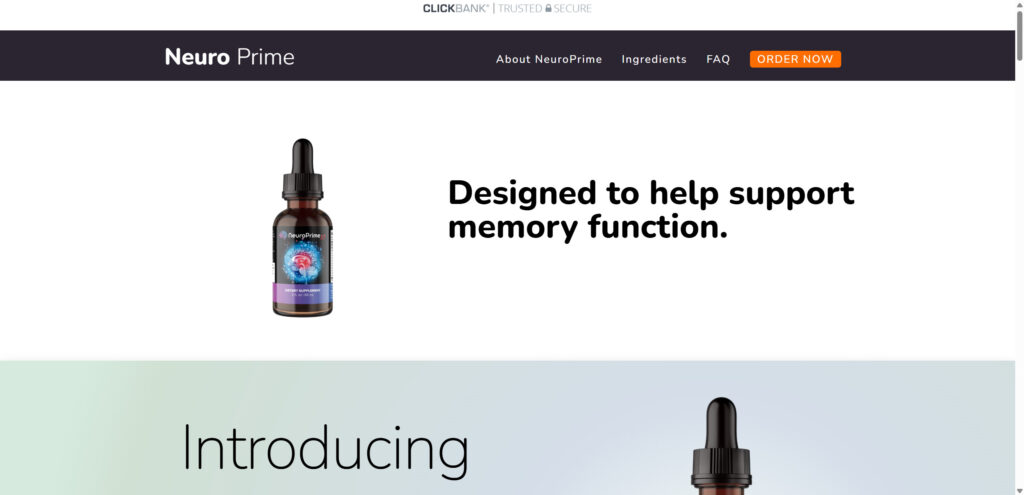
What Is NeuroPrime?
NeuroPrime is a liquid dietary supplement promoted primarily to older adults concerned about memory loss and cognitive decline.
The official website lists ingredients including:
- Moringa
- Pine bark extract
- Ginkgo biloba
- Tamarind
- Lion’s mane mushroom
- Chlorella
- Bacopa monnieri
- Spirulina
- Neem
The site recommends taking one dropper daily. However, a list of recognizable plant ingredients does not establish that this particular mixture improves memory—or that the amounts in each serving are effective or safe.
The prices advertised during our review were:
| Package | Advertised price | Price per bottle |
|---|---|---|
| One bottle | $69 | $69 |
| Three bottles | $177 | $59 |
| Six bottles | $294 | $49 |
The website heavily pushes the six-bottle package, even claiming that “97% of customers” select it. No source or sales data is provided to substantiate that statistic.
Red Flag #1: An Apex Neuro Elite Ad Leads to NeuroPrime
One of the clearest warning signs is how NeuroPrime appears inside other supplement funnels.
A website promoting Apex Neuro Elite describes that product as a capsule-based brain supplement. Its ordering buttons, however, pass through affiliate tracking links before redirecting shoppers to a ClickBank checkout for NeuroPrime XT drops.
In other words:
- The visitor sees an advertisement for Apex Neuro Elite.
- The sales page promotes Apex Neuro Elite capsules.
- The ordering link passes through an affiliate tracker.
- The final checkout sells NeuroPrime liquid drops.
That is not a minor branding discrepancy. The product name, form and presentation all change before payment.
This creates a genuine risk that buyers may not realize what they are ordering—especially if they move quickly through a long-form video or advertorial funnel.
Red Flag #2: Fake Celebrity and Alzheimer’s-Themed Advertising
The wider funnel has been promoted through sensational ads involving supposed memory breakthroughs, breakfast tricks and fabricated connections to public figures such as Bill Gates and Dr. Oz.
These ads are designed to resemble news reports, health investigations or urgent medical announcements. Some contain fake comments, questionable testimonials and artificial viewer counters intended to create the impression that thousands of people are watching simultaneously.
There is no credible evidence that Bill Gates, Dr. Oz or a recognized Alzheimer’s organization has endorsed NeuroPrime.
The important distinction is that an individual NeuroPrime landing page may not display every one of these claims. Affiliate marketers can rotate product names, videos and pre-sale pages while sending visitors to the same checkout.
Red Flag #3: The “Pineal Gland Detox” Story Is Not Proven
A more aggressive NeuroPrime sales presentation describes the product as a “military-grade formula” that supposedly:
- Detoxifies and decalcifies the pineal gland
- Flushes fluoride from the gland
- Restores natural melatonin production
- Reverses memory loss
- Protects against Alzheimer’s and Parkinson’s disease
- “Bulletproofs” brain health
Research has examined pineal calcification and its possible associations with aging, melatonin and certain medical conditions. That does not prove that NeuroPrime removes fluoride, reverses calcification or restores memory.
Most importantly, we found no published human clinical trial demonstrating that the finished NeuroPrime formula produces these results.
The National Institute on Aging states that no vitamin or supplement has been proven to prevent Alzheimer’s disease. Advertising a supplement as a way to reverse memory loss should therefore be treated with extreme skepticism.
Sudden or worsening memory problems also deserve medical evaluation. They can be associated with medication effects, sleep disorders, depression, vitamin deficiencies and neurological diseases. Relying on online drops could delay proper diagnosis.
Red Flag #4: Ingredient Studies Are Presented as Product Evidence
The NeuroPrime site includes a scientific-reference section, but these references do not amount to a clinical trial of NeuroPrime.
Some discuss sleep, melatonin or individual plant ingredients. At least one reference involves laboratory or animal research on tamarind rather than humans taking the marketed formula.
This is a common supplement-marketing trick:
Find a study involving one ingredient, then imply that the study proves the entire commercial product works.
It does not.
An ingredient can behave differently depending on its dose, preparation, purity, combination with other substances and the person taking it. Without transparent quantities and controlled testing of the complete formula, the claimed benefits remain unproven.
One citation shown on the website also uses the DOI 10.1234/jad.2023.006. The 10.1234 prefix has the appearance of placeholder data rather than a reliable, traceable citation, which raises further questions about how carefully the reference list was assembled.
Red Flag #5: The Refund Promises Contradict Each Other
The main NeuroPrime website advertises an “iron-clad” 365-day guarantee. It tells customers to try the product and says they can return what they have not used for a complete refund.
However, the separate shipping and return policy says returned items must be unused and unopened, in their original packaging.
Those are materially different promises.
A consumer who opens a bottle to try the drops may reasonably believe that the advertised guarantee still applies. The written return policy could then be interpreted as excluding that opened bottle.
Before ordering, consumers should obtain written confirmation covering:
- Whether opened bottles are refundable
- Whether empty bottles must be returned
- Who pays return shipping
- Whether original shipping costs are refunded
- Whether all bottles in a multi-bottle order must be returned
- Whether any restocking or processing charge applies
Save screenshots of the guarantee displayed on the day of purchase.
Red Flag #6: Aggressive Pressure to Buy Six Bottles
The funnel strongly encourages buyers to purchase three or six bottles rather than testing one bottle first.
At checkout, the six-bottle NeuroPrime package was displayed at $294, accompanied by a claimed regular price of $594, a 50% discount and an optional shipping-protection charge.
This creates several risks:
- The buyer may accidentally select a larger package than intended.
- Order bumps may be added during checkout.
- Additional offers may appear immediately after payment.
- The customer may mistake an upsell confirmation for a routine “continue” button.
- Returning six bottles may be more complicated and expensive than expected.
Review the product name, bottle count, total charge and every checkbox before submitting payment.
Does NeuroPrime Enroll Buyers in a Subscription?
The ClickBank checkout we examined described the six-bottle package as a one-time purchase. We did not see a disclosed automatic monthly subscription on that particular checkout.
Therefore, we cannot say that every NeuroPrime purchase automatically creates a subscription.
Nevertheless, unwanted recurring charges remain something buyers should watch for because supplement funnels frequently use separate upsells, continuity offers or follow-up promotions. The terms can also vary between landing pages and affiliate campaigns.
After purchasing:
- Save the checkout page and receipt.
- Confirm the order quantity immediately.
- Decline unfamiliar post-purchase offers.
- Look for words such as “monthly,” “recurring,” “membership” or “autoship.”
- Monitor card statements for at least several months.
- Expect a NeuroPrime order to appear with a ClickBank-related descriptor.
Do not assume that closing a sales page cancels an order or recurring plan.
Red Flag #7: Generic and Recycled Policy Pages
NeuroPrime’s legal pages provide limited transparency about the business operating the brand.
The privacy policy contains language referring to products such as “eBooks” and “software,” even though the site sells a liquid supplement. It also references the UK Data Protection Act 1998, suggesting that portions may have been copied from an older generic template.
The NeuroPrime disclaimer acknowledges that product claims have not been clinically proven or evaluated by the FDA. That disclaimer sits uneasily beside sales material suggesting the drops can reverse memory loss and protect against serious neurological diseases.
The FDA explains that dietary supplements are not approved for safety and effectiveness before being marketed. A supplement website displaying badges such as “certified,” “natural” or “non-GMO” should not be confused with FDA approval or proof of medical effectiveness.
Red Flag #8: The NeuroPrime Name Is Used for Different Products
Search results contain several unrelated products using “Neuro Prime” or “NeuroPrime,” including:
- NeuroPrime liquid drops
- An Amazon capsule product under the OVICIA brand
- An eBay product attributed to OTR Labs with a different ingredient list
- An unrelated capsule supplement sold by ATP Lab
These products do not appear to share the same formula.
The repeated name does not prove that every listing is counterfeit or controlled by the same seller. It does mean consumers must be extremely careful when comparing reviews, ingredient lists and return policies. A positive review of one “Neuro Prime” product may have nothing to do with the drops sold at theneuroprime.com.
Red Flag #9: Search Results Are Flooded With Questionable “Review” Pages
Searching for NeuroPrime produces numerous supposed reviews hosted as PDFs on unrelated organizational, government, educational and nonprofit domains.
Many appear inside temporary upload or form-submission directories. Their presence on a trusted-looking domain does not mean the organization reviewed or endorsed NeuroPrime.
Similar promotional articles also appear through press-release distribution services. These pages may look like independent health journalism, but they often repeat seller claims and ordering links without independently testing the product.
Consumers should give more weight to identifiable medical institutions, peer-reviewed clinical trials and transparent consumer-protection reporting—not anonymous “2026 review” PDFs designed primarily to rank in Google.
Is NeuroPrime a Scam?
NeuroPrime appears to be a real supplement sold through a real ClickBank checkout. That does not make its marketing trustworthy.
The most accurate conclusion is:
- A physical product may be delivered.
- The advertised memory and pineal-detox benefits are not supported by credible clinical evidence.
- Some affiliate funnels advertise a different product before redirecting buyers to NeuroPrime.
- The sales presentation makes extreme disease-related claims.
- The refund language is inconsistent.
- The funnel aggressively pressures customers to order multiple bottles.
- A recurring subscription was not disclosed in the checkout we examined, but buyers should still watch for separate upsells and unauthorized repeat charges.
Based on these red flags, we recommend avoiding NeuroPrime—particularly if the purchase is being driven by a celebrity-themed ad, an Alzheimer’s “breakthrough” story or a supposed secret cure being suppressed by doctors.
What To Do If You Already Ordered NeuroPrime
Act quickly if the order quantity or charge is not what you expected.
- Save the receipt, checkout screenshots and original advertisement.
- Contact NeuroPrime support and ClickBank in writing.
- State clearly whether you are canceling an order, an upsell or any recurring authorization.
- Request a return authorization and the complete return instructions.
- Use tracked shipping for any returned bottles.
- Keep photographs of the package and its contents.
- Check your statements for further ClickBank or NeuroPrime charges.
- If the seller refuses to resolve an unauthorized or misrepresented charge, contact your card issuer and provide your documentation.
Anyone experiencing memory problems should speak with a licensed healthcare professional rather than relying on a supplement promoted through anonymous ads.
Final Verdict
NeuroPrime’s marketing combines a familiar formula: frightening claims about dementia, a supposedly hidden cause, a secret natural solution, questionable scientific references, dramatic discounts and pressure to buy six bottles at once.
The confirmed redirect from Apex Neuro Elite advertising to a NeuroPrime checkout is especially troubling. Consumers should always receive the exact product advertised to them—not discover a different name and formula only after reaching the payment page.
NeuroPrime has not demonstrated that its drops decalcify the pineal gland, remove fluoride, reverse memory loss or treat Alzheimer’s disease. Until credible human clinical evidence and consistent consumer terms are provided, its promises should be regarded as marketing—not medical fact.








