


Two tubs share a name, a shelf, and nearly the same label. Which one did the store mean when it promised NSF supplement certification?
Turn the tubs around before you decide. A few words beside the mark, and sometimes a string of characters on the base, can change what you look up.
Overview
Listen for the noun that follows “certified”
Picture three shelf cards beside the same powder. One describes the factory, another describes the formula, and the third mentions screening for substances banned in sport.
Which card would you want to see backed up before buying? You might care about the ingredients, while a teammate needs to know about testing for banned substances.
Those are different questions, even if the seller puts them under one heading. Underlining the subject of the claim usually gets you further than enlarging the artwork.
Give similar packages their own identities
A family name helps you find the right shelf. Once you’re there, the small print that separates the neighbors becomes much more useful than the bold name they share.
- Take the full name from the selected package, including words that distinguish it from the original version.
- Read the strength alongside its units and the quantity it describes, such as one tablet or a serving of two.
- Note the market designation, form, flavor, and net weight wherever they distinguish one version from another.
- For a lot comparison, copy the printed batch code exactly and keep the original container within reach.
Know what a useful answer sounds like
A good result is specific enough for somebody else to repeat your comparison. They should be able to pick out the same package without relying on its color.
Suppose your note says only that you found the manufacturer’s name. A friend could bring you two entirely different bottles and satisfy everything you wrote down.
Give that friend a product name, form, and strength instead. If both bottles still fit, look for the next field that actually separates them.
How to check NSF supplement certification against your package
Step 1: Decide whether the claim concerns a site or a product
Look for the sentence containing the manufacturer’s claim, not just the line of large type above it. On a shopping page, check which package is currently selected.
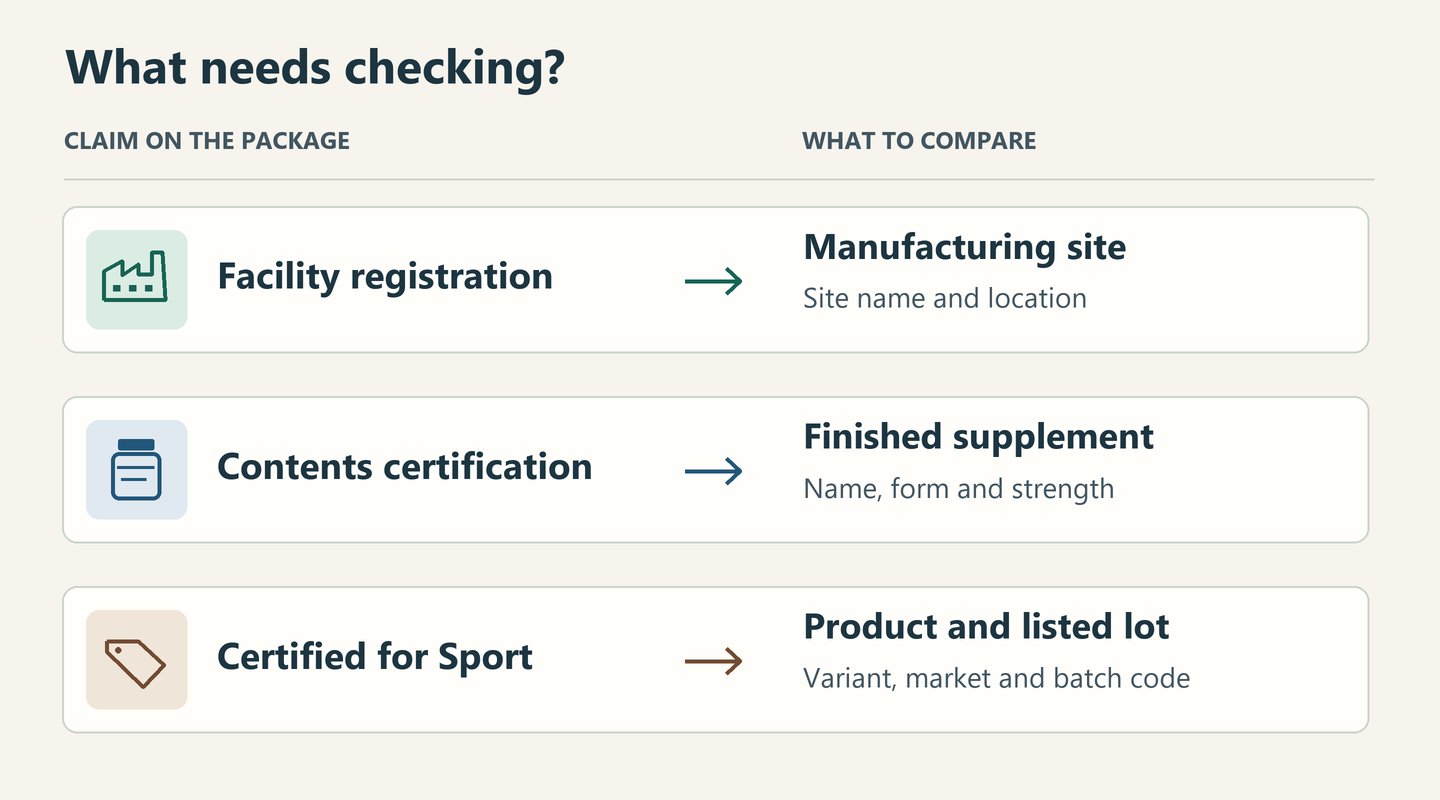
NSF’s guide to supplement labels distinguishes facility registration from product certification. Its good manufacturing practices audit concerns the site; the auditor doesn’t test individual product samples during that audit.
A shelf card in our fictional example promises powder made in a registered facility. Finding that facility would answer the card’s claim, even if you never found the powder.
Now imagine a second card promising certification of the finished powder. The very same facility record would leave that promise unanswered. Look for the name of the powder itself.
A third card adds a claim about banned substances. Don’t erase that extra condition when taking your notes, especially if it was the reason you picked up the tub.
NSF identifies three relevant standards: NSF/ANSI 455 concerns manufacturing practices; NSF/ANSI 173 evaluates a finished supplement, including its contents and specified contaminants; NSF 306 adds sport-specific banned-substance screening.
For a supplement, the Sport program builds on 173, not the other way around. A contents listing alone leaves the additional sports question open.
Step 2: Find the right directory and read across one row
The NSF dietary supplement directory has fields for certification type, product, manufacturer, facility location, and product type. Product and manufacturer searches ask for at least three letters.
Start with a distinctive part of the printed name. If the store has added a slogan or abbreviated the name on its receipt, leave those words out.
Next, look for a finished product under the manufacturer heading. Read horizontally from that product name, keeping the form and other fields attached to the same row.
Consider the Standard 173 vitamin D listing. Under Captek, vitamin D3 softgels appear at 25, 50, and 125 micrograms. The shared form doesn’t distinguish those entries; the strength does.
On the same page, a US facility has a Nutrilite vitamin D entry specifically designated for Canada. The facility’s country and the product’s intended market answer different questions.
Notice where “All” appears: under Product ID for a particular row. Read it with that row’s product name, not as a statement covering the manufacturer’s whole catalog.
If your bottle shows a different market, don’t translate its name and assume equivalence. Look for that version, or leave the market match open until someone can identify it.
Step 3: Compare like quantities before ruling a product in or out
In this fictional example, the front of a bottle says 40 micrograms per serving. Your comparison note describes 20 micrograms per tablet. Could both descriptions fit the same bottle?
Turn to the serving information before deciding. If a serving is two tablets, each containing 20 micrograms, the quantities agree. If a serving is one tablet, they don’t.
Agreement clears up the arithmetic, not the identity of the entire product. A different form or extra ingredient can still send you back to a different entry.
Consider a second bottle with the same front-panel number but with a second vitamin added to its name. Dropping the extra ingredient would make two distinct descriptions look identical.
Retain both ingredient names when you compare the label with the entry. You’re identifying a formula here, not choosing a dose or deciding whether to take either bottle.
Step 4: For Sport, use the specific product and lot
Go to the NSF Certified for Sport product directory. Its product search accepts a lot number, among other identifiers. Use the product search, not the general site search above it.
Two real entries show why this matters. NSF lists 10X Health Amino Blend Fruit Punch as a 222 g powder for US sale, with lot 25C1457011.
The Tropical Orange entry gives Orange as its flavor, 228 g as its package size, and 24BP18846 as its lot. Both records name the same brand.
Open them side by side and cover the brand names. Enough information remains to tell the entries apart without looking at either product photo.
Now cover the lot numbers as well. You can still distinguish two varieties, but you can no longer answer a question about a particular production batch.
The missing detail changes the conclusion, not the product. Someone shopping online may know which flavor they ordered before knowing which lot the seller will actually ship.
Step 5: Settle only the question the comparison answers
Imagine your running club requests a sport-specific product and batch match. You find a contents entry for your powder, but can’t establish the Sport match before training.
Leave that powder at home for this session. You have useful information about the contents claim, but nothing that meets the club’s stated condition for this batch.
That is different from saying the batch contains a banned substance. A missing match isn’t a laboratory result, and looking up the product isn’t testing what’s inside your tub.
If Sport coverage matters for participation, ask your team or governing organization what it accepts. Don’t promise a negative drug test on the strength of a directory entry.
Try the comparison with two lookalike pouches
Here is a fictional exercise, not an NSF listing. Imagine that the only record available describes a US peach powder, 180 g, with the batch code P41.
The seller lets you choose peach or pear on the same page. Its headline stays put when you switch flavors, so judge each selection by the details below.
| Package in hand | Package details | Decision on that record |
|---|---|---|
| Peach pouch | US peach powder, 180 g, batch P41 | The details supplied in this exercise match. |
| Pear pouch | US pear powder, 186 g, batch R17 | The record describes a different flavor and batch. |
| Another peach pouch | US peach powder, 180 g, unreadable batch | The variety fits, but the batch remains unknown. |
The pear pouch isn’t a failed version of the peach one. It needs its own evidence, and a record for pear could settle that question without changing the peach result.
The second peach pouch presents a different problem. Searching for more flavors won’t restore the missing characters; what you need now is a legible code from that package.
Which detail would you ask for if the seller can send just one more photo? For the pear pouch, request its complete identifying label to locate the appropriate record.
For the peach pouch with blurred printing, ask for the batch area on the specific unit instead. A pristine stock image of the front answers neither question.
What if the carton and the pouch carry different codes?
Write down both codes and where each appears. Ask which code identifies the finished supplement and how the two relate; don’t choose whichever one produces a match.
If that link cannot be explained, keep the lot comparison open. A different carton code alone doesn’t tell you what the pouch contains.
When the listing, the shelf tag, and the package disagree
Start with the source of each statement. The issuer describes what it lists, the label identifies the item you have, and the shelf tag tells you what the store promised.
Imagine a retailer advertising a certified citrus powder. Its product page opens on citrus, but the package on your doorstep is an unflavored refill bag.
The issuer’s citrus record may be perfectly accurate. The first problem to solve is which item you bought, not whether somebody ought to remove citrus from the directory.
Compare the confirmation with the delivered bag. If both say unflavored, ask for that product’s record. If the confirmation says citrus, raise the substitution with the seller instead.
A screenshot can preserve the seller’s wording even after its page changes. Save the selected option with the claim; a cropped headline without the selection can’t show what was promised.
A store might shorten a name to “berry,” while the full package reads “mixed berry” and all identifying fields agree with one listing.
In that situation, the abbreviated shelf tag needn’t outweigh the specific match. A contradiction in strength or form deserves more attention than a missing adjective on a price sticker.
Bundle and refill warning
A genuine listing doesn’t authenticate a store or its offer. Before paying, compare the selected quantity and full order total with the price advertised for one bottle.
Check whether you’re choosing a single delivery or agreeing to refills, including their cost and cancellation terms. A product record doesn’t tell you whether any particular purchase renews.
What to Do If You Already Bought the Supplement
-
Keep the original packaging until you’ve sorted out any discrepancy. Photograph the product name, strength, and stamped code before separating the outer carton from its contents.
When several household members use similar supplements, keep each picture beside its own receipt. Otherwise you may resolve a perfectly good match for somebody else’s bottle.
-
Save the issuer’s direct product link with the date and the particular field you matched. A link to the search homepage forces you to reconstruct your decision later.
If you buy the same product again, your old note tells you where to start. Compare the new container before reusing a conclusion that depended on its lot.
-
For an unclear product designation, give the manufacturer or NSF the full label name and ask which entry covers that version. Include the market or lot when it matters.
Describe the single unresolved detail in the question. A reply that merely repeats the brand’s general commitment to testing hasn’t explained the discrepancy you asked about.
-
Take an order mismatch to the merchant with your confirmation and package photo. Ask about return conditions before opening an item you may wish to send back.
Keep the seller’s answer with the receipt. If you also want to stop future deliveries, request that separately and keep the written confirmation for your records.
-
For a personal health decision, bring the actual supplement label and your medication list to your pharmacist or clinician. Explain why you were considering taking it.
The NIH Office of Dietary Supplements notes that quality seals don’t guarantee safety or effectiveness. A product can match its description without being suitable for you.
Frequently Asked Questions
What if the product name appears under more than one manufacturer?
Use a company identifier from the label if available, and compare the entire designation. When both entries still fit, request the direct record for your version instead of guessing.
Can the expiration date stand in for a smeared lot number?
Don’t substitute a date merely because it’s legible. Unless you can establish how it identifies this batch, you’ve answered when the package expires, not which batch it belongs to.
Does a larger value pack need another lookup?
First distinguish a carton holding several identical units from a single larger container. Compare each inner unit when available; a larger individual package may need its own size match.
Should I accept a lab report instead of certification?
A report may describe what someone tested, but your question was whether NSF lists the product under a particular program. Request that record if certification matters to your decision.
Is a different label design a reason to reject my bottle?
Start with the fields that identify the formula and market. A color change alone settles little; a changed strength or added ingredient gives you something specific to resolve.
What if I can only find a saved copy of the listing?
Use the copy to recover the exact name and identifiers, then return to the issuer. If the current record is unavailable, describe your evidence as historical, not current confirmation.
The Bottom Line
Rely on NSF supplement certification only for the program and product you can actually match. If a Sport lot is essential and remains unresolved, don’t rely on that batch.
If you’ve already bought the supplement, keep the package and receipt. Ask the issuer about an unclear certification claim, or the merchant about an item that differs from your order.

Join the discussion
0 commentsShare your experience or ask a question about this article.
Community experiences
Did this happen to you?
Your experience could help someone recognize the same scam. Submit a private report for our team to review.
I experienced this tooReports are reviewed before publication. Sharing publicly is always your choice.
Discussion
Start the conversation
Have a question or something useful to share? Add the first comment.