

Nutrivora oil of oregano promises a fresh start for people tired of bloating, low energy, and recurring discomfort. The offer makes a daily capsule sound reassuringly simple.
Before choosing a package, it helps to follow the offer beyond its bright green promises. Several details deserve a closer look.
Overview
A supplement presented as an answer to infections
Nutrivora sells oregano oil and black seed oil softgels. Its reviewed sales page goes beyond everyday wellness, promising action against Candida, parasites, bacteria, and viruses.
That is the central concern. A supplement advertisement cannot establish that someone has an infection, or that this finished product can safely treat it.
Our October 9, 2026 review found strong medical marketing, a preselected subscription option, and refund restrictions that conflict with the prominent satisfaction promise.
Those findings justify caution about this offer. They do not establish that every customer experiences an unauthorized charge or that the capsules contain undisclosed substances.
The buying choices matter as much as the bottle
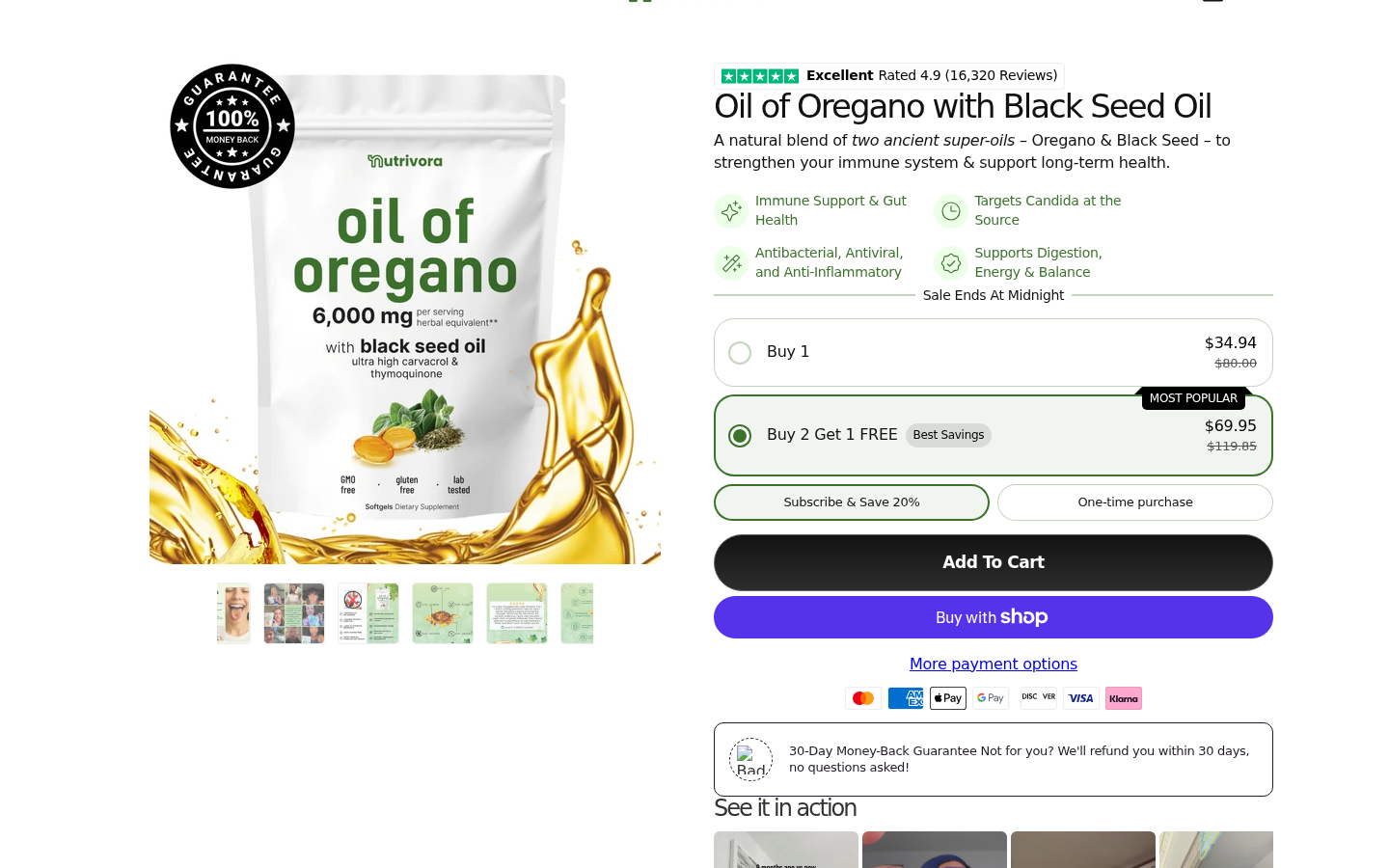
The captured product page initially selected a three-pack deal and Subscribe & Save. A separate one-time purchase button was available alongside it.
The displayed package price was $69.95. Another choice offered one product for $34.94. These were observed page prices, not completed transactions.
Someone expecting a single trial purchase could overlook those choices while concentrating on the promised health benefits. The recurring interval needs checking before payment.
- The highlighted package contained three products, not one.
- The subscription option advertised 20% savings.
- The sales page promised a 30-day satisfaction refund.
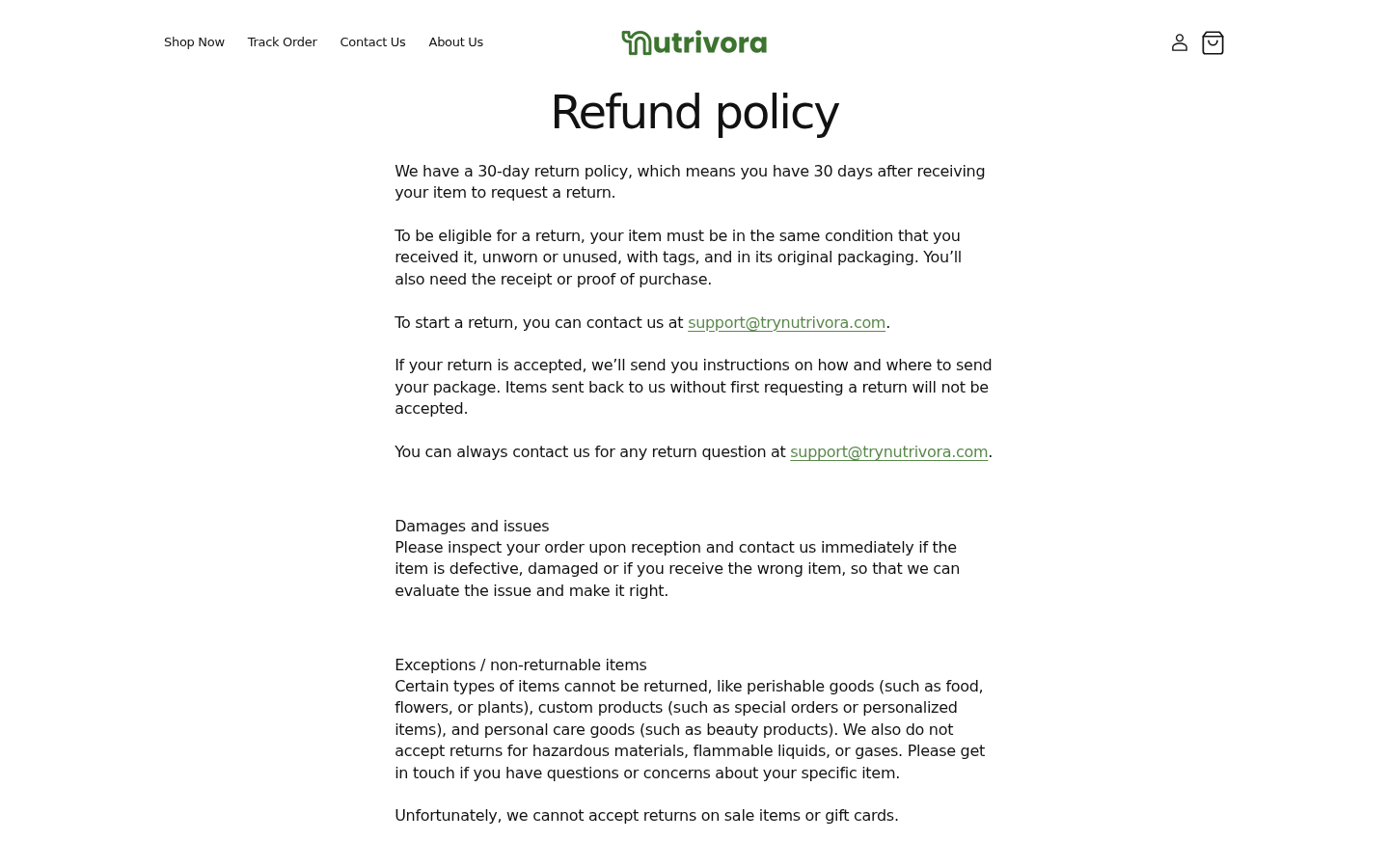
- The separate policy required unused goods and excluded sale items.
Our assessment of the offer
We would not rely on Nutrivora to diagnose or treat Candida or a suspected parasite infection. Its sales copy does not supply the necessary clinical assurance.
We would also avoid ordering until the seller explains, in writing, how its trial-style guarantee applies to opened supplements, discounted packages, and subscription orders.
This investigation concerns the specific offer at trynutrivora.com. Similar ingredients, green packaging, or oregano branding do not prove that other sellers share its operator.
Why the Candida and Parasite Claims Deserve Scrutiny
The pitch starts with symptoms many people recognize. Fatigue, digestive discomfort, and bloating can make a promise of restored balance feel personally relevant.
The page then introduces hidden organisms as the explanation. That leap turns an ordinary shopping decision into something that resembles a treatment decision.
A symptom list is not a diagnostic test. It cannot determine whether an infection exists, identify its cause, or establish which treatment would be appropriate.
The CDC explains that Candida normally lives in several areas of the body. Its presence alone does not mean someone needs a supplement cleanse.
When Candida causes an infection, location and severity matter. A mouth infection, vaginal infection, and invasive infection are not interchangeable conditions.
CDC treatment guidance describes antifungal medication, with treatment decisions depending on the infection and the person’s health.
Nutrivora’s page instead promotes a broad course for gut balance, including an initial period followed by maintenance. We did not verify a clinical trial supporting that branded protocol.
Research about an ingredient’s activity against an organism does not automatically establish that swallowing this particular mixture produces the same effect in people.
The useful questions concern the finished formula: who was studied, what condition they had, what amount they received, and how outcomes compared with a control group.
The offer’s testimonials and customer survey figures cannot answer those questions. A person reporting less bloating does not demonstrate that parasites were present or eliminated.
The FDA distinguishes dietary supplements from products intended to treat disease. A wellness label does not validate disease-treatment advertising.
We did not establish an FDA enforcement action against this exact seller. The concern here comes from the claims we directly observed, not an invented regulatory finding.
How the Nutrivora Sales Funnel Works
Step 1: Familiar discomfort becomes a compelling explanation
The landing page links everyday digestive complaints with Candida, parasites, and other hidden threats. Readers are offered one appealing explanation for several frustrating experiences.
This is persuasive because a named cause feels more useful than uncertainty. It also makes a purchase seem like the next practical step.
But the page has not examined the reader. Its explanation remains a sales claim, regardless of how closely the symptoms resemble someone’s experience.
Step 2: Numbers and testimonials build confidence
The top of the offer displayed a 4.9 rating associated with 16,320 reviews. Another area described a 4.8 score and more than 2,320 reviews.
Those different totals may refer to different datasets. The reviewed page did not make their relationship clear enough to treat them as one independently verified customer record.
Elsewhere, the seller attributed improvement figures of 93%, 95%, and 97% to customer feedback. The presentation supplies confidence without a published controlled comparison.
Testimonials describe relief from fungal complaints and other symptoms. They are seller-presented accounts, not proof of diagnosis, independent medical assessment, or typical outcomes.
Readers should look for the survey method, number invited, number responding, and exact questions. Without that context, an impressive percentage has limited explanatory value.
Step 3: The selected package increases the commitment
Our screenshot shows the three-product offer highlighted before we made a purchase selection. That matters when someone arrives intending to try one package.
The prominent savings language encourages comparison by value per item. The immediate financial decision, however, is the total charged for the selected package.
Check the quantity and complete price together. A lower unit cost is not a smaller purchase, and an extra package is not useful if the product is unsuitable.
The available one-product option means buyers are not necessarily forced into a bundle. It does not remove the need to notice which choice is already active.
Step 4: A discount can include recurring deliveries
Subscribe & Save was selected in the captured offer. One-time purchase was visible as a different choice, making this a decision the buyer must actively understand.
The capture does not show a clear recurring shipment interval beside those buttons. We did not complete checkout or verify the final authorization screen.
Before paying, confirm the next billing date, renewal amount, shipment quantity, cancellation method, and any deadline before processing. Save the answers with the order confirmation.
A subscription can be legitimate when terms are clear and consent is informed. Its presence alone does not prove concealed billing or an unauthorized transaction.
The practical risk is an unwanted commitment made while focusing on the discount. Returning a shipment and stopping later renewals may require separate requests.
Step 5: The refund promise meets narrower conditions
The product page promises a refund within 30 days if the product is not suitable. Its wording invites the expectation of a meaningful satisfaction guarantee.
The refund policy adds conditions: unused merchandise, original packaging, proof of purchase, and approval before sending anything back.
It also excludes sale items. That is especially important when the offer itself emphasizes a sale and discounted packages.
These terms leave an obvious question: how can a customer evaluate capsules while keeping the product unused? The seller needs to explain that conflict before purchase.
Seller Identity, Shipping, and Product Traceability
The trading name does not establish the legal seller
The reviewed terms use Official Nutrivora as the business name. The contact section directs questions to support@trynutrivora.com.
We did not establish a separately identified legal company and registration number from those pages. That leaves buyers with a trading identity rather than a verified corporate match.
Before ordering, request the full entity name that will appear on the receipt. Compare it with the payment descriptor if a charge subsequently appears.
A different descriptor can have an ordinary payment-processing explanation. Ask for that explanation rather than assuming either fraud or authorization from the name alone.
A New York address does not locate the factory
The footer lists 47 W 13th St, New York, NY 10011. We did not verify that address as Nutrivora’s manufacturing site or authorized return destination.
The shipping policy expressly allows fulfillment from an international warehouse. It does not identify a country for every order.
Accordingly, the evidence does not establish that these capsules are manufactured in China. It also does not establish that the New York address is fake.
Ask where your package will ship from and where an approved return must go. Those answers affect delivery expectations and the cost of resolving a problem.
The contact route needs a usable cancellation process
The seller publishes weekday support hours and an email address. We inspected these details but did not call, send a message, or test its response time.
An email address on a footer does not explain the subscription workflow. Buyers need to know whether cancellation happens through an account, a link, or a written request.
Obtain a confirmation that identifies the subscription and its effective end date. A general acknowledgment of a support ticket is not the same thing.
Keep order cancellation, recurring cancellation, and refund requests distinct. Combining everything into one vague message can leave uncertainty about what the seller actually processed.
The label must explain what the strength figures mean
The pictured pouch describes 6,000 mg as an herbal equivalent per serving. That wording should not be read as 6,000 mg of extracted oil inside each capsule.
Other page sections emphasize 80% carvacrol and mention 165 mg. Those figures require a clear serving definition and complete label to be interpreted properly.
Ask for the Supplement Facts panel, actual extract quantity, serving size, other ingredients, manufacturer, and lot identification. A front-label strength claim cannot replace those details.
The page also advertises third-party testing. A useful supporting report should identify the tested batch, laboratory, test date, and results relevant to the product’s composition.
Delivery Details That Need Clarification
The shipping page lists standard US delivery at five to seven business days, while its expedited US estimate is five to twelve business days.
That does not explain what a buyer gains by choosing the faster-sounding option. Clarify the actual service and expected arrival before paying an upgrade fee.
Processing is described separately, generally taking one to three business days, with longer allowances during busy periods. Do not mistake a transit estimate for total waiting time.
Orders containing international-warehouse items may travel internationally as a whole. The stated estimate for that situation is seven to fourteen business days.
These are the seller’s published estimates, not delivery times we tested. Save the version shown when ordering if timing is important to your decision.
What to Do If You Ordered Nutrivora
-
Check the confirmation before opening the product. Find the number of packages, total payment, purchase type, and any future shipment details.
If you expected one item, compare that expectation with the actual order. Record the discrepancy accurately rather than assuming the checkout changed it afterward.
-
Cancel unwanted renewals separately. Use the order’s management link or the seller’s published support address. State clearly that future recurring charges are not wanted.
Include the order number and request a dated confirmation. Avoid sending a full card number, password, or unnecessary identity documents through email.
-
Raise the guarantee conflict promptly. Attach the satisfaction promise and ask how it applies to your exact package, especially if discounted or already opened.
The policy counts its return-request window from receipt. Do not spend that period waiting for health benefits while an unresolved return deadline approaches.
-
Wait for return instructions before shipping. Request the authorized address, approval reference, postage responsibility, and expected refund amount.
Retain tracking and photographs of the package. Sending it to an address found in a footer may not satisfy the seller’s return process.
-
Contact your payment provider about unresolved charges. Explain whether the issue concerns unauthorized billing, unwanted renewal, missing goods, or a disputed refund.
Provide the relevant records and ask about applicable deadlines and recurring-payment controls. A dispute outcome depends on the transaction and the provider’s rules.
-
Keep health decisions separate from the purchase dispute. Persistent symptoms deserve qualified assessment. Tell your clinician what you took and bring the package or label.
If an adverse reaction develops, stop using the product and seek appropriate medical advice. Do not replace prescribed treatment with the seller’s advertised gut protocol.
-
Preserve a clear record if reporting the offer. Save the dated page, receipt, correspondence, tracking, and relevant statement entries.
Describe what you personally experienced. Separate the seller’s advertised claims from your symptoms, assumptions, or comments posted by other buyers.
Frequently Asked Questions
Is Nutrivora oil of oregano a proven Candida treatment?
We did not verify clinical evidence establishing this finished product as a Candida treatment. The seller’s ingredient explanations and testimonials do not provide that proof.
Does every Nutrivora order create a subscription?
No such conclusion is supported. Our capture showed Subscribe & Save selected, but a separate one-time option existed. Check your own confirmation and recurring terms.
Why might someone receive three packages instead of one?
The reviewed page preselected a three-product deal. That can explain a bundle order, but it does not prove that quantities were changed after payment.
Can opened Nutrivora capsules be returned?
The satisfaction promise suggests a broad refund, while the policy requires unused items and excludes sale goods. Obtain a written answer for your specific order.
Is Nutrivora manufactured in China?
We did not establish its manufacturing country. International fulfillment is mentioned, but a warehouse location and a manufacturing origin are different facts.
Will canceling a delivery automatically refund an earlier charge?
Not necessarily. Request confirmation for each action: stopping renewals, canceling unshipped goods, approving returns, and refunding payments already taken.
The Bottom Line
Nutrivora oil of oregano pairs substantial health promises with a selected subscription offer and a restrictive refund policy. Those details deserve attention before any payment.
Our recommendation is to hold off until the seller resolves the billing and guarantee questions. Seek medical guidance for suspected infections rather than treating the sales page as a diagnosis.








