

Resilia turns two familiar botanical ingredients into a broad daily-wellness story. The page promises support for digestion, immunity, energy, inflammation, metabolism, and the heart.
There is another detail beside those promises: the highlighted offer is a subscription. We examined the formula, claims, refill terms, company, and refund process.
Overview
A Real Supplement with Expansive Marketing
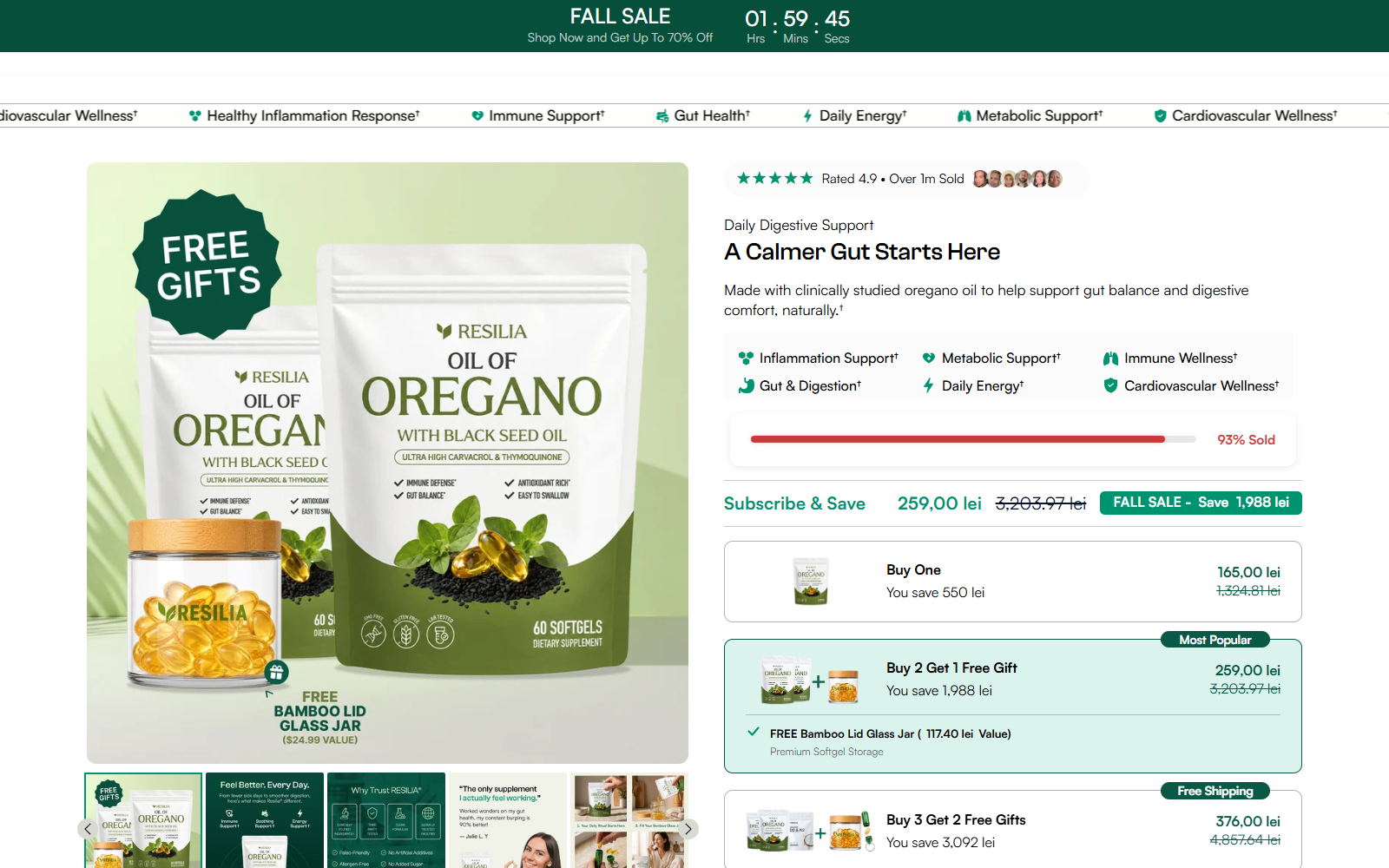
Resilia Oil of Oregano is presented as a dietary supplement containing oregano extract and black seed oil. The seller provides serving information and a conventional softgel format.
The marketing connects that simple formula with a remarkable range of possible benefits. Those benefit statements use supplement disclaimers and should not be read as disease treatment.
A product can physically exist while its advertising still exceeds what a careful shopper should believe. Delivery and clinical effectiveness are separate questions.
The Default Offer Deserves Special Attention
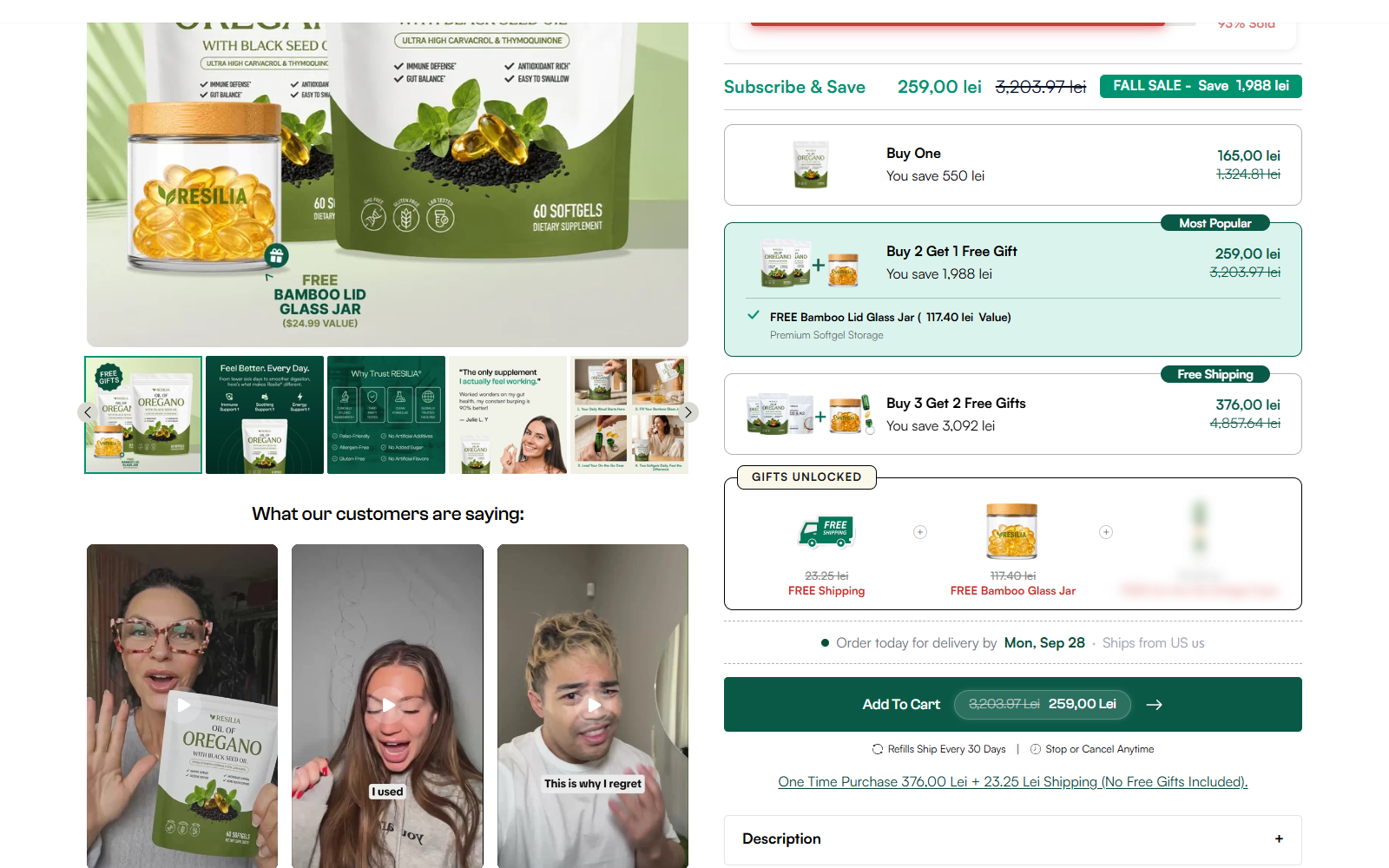
The examined product page prominently selects “Subscribe & Save.” It states that refills ship every 30 days and that the subscription continues until canceled.
A one-time purchase is available, but it is less visually prominent and excludes some gifts or shipping incentives. That design can make recurring billing feel like the normal choice.
Buyers must verify the purchase type before submitting payment. A lower first price can become expensive when another shipment and charge arrive each month.
Our Assessment
Resilia is not accurately described as a nonexistent-product scam. It identifies an operating company, sells through mainstream channels, and discloses automatic renewal in its written terms.
However, the broad health narrative, urgency, enormous sales claims, bundle pressure, and subscription-first design create a serious risk of misunderstanding.
We classify this as a high-pressure supplement offer with a refill trap risk. That is especially important for shoppers arriving from short social videos.
- The product is a supplement, not approved disease treatment.
- The highlighted plan renews every month.
- Cancellation must occur before the next billing date.
- Results and testimonials are not guaranteed.
- The refund window is limited to 30 days after delivery.
What Resilia Claims and What It Means
The product page lists immune, digestive, metabolic, cardiovascular, inflammatory, antioxidant, energy, and mental-clarity support. Few simple supplements are marketed across so many wellness concerns.
“Support” is legally and scientifically different from treating, preventing, or curing a disease. The page itself includes the standard statement that claims were not evaluated by the FDA.
Traditional use can justify research interest. It does not prove that a branded softgel will produce the advertised experience for a particular person.
The 6,000mg Figure Needs Interpretation
Resilia describes a 20:1 oregano extract as delivering the equivalent of 6,000mg of fresh oregano. That is not necessarily 6,000mg of material inside each serving.
Extract-equivalent numbers can look dramatic. Buyers should compare actual serving weight, standardization, active compounds, testing, and dosing rather than one large headline number.
Research on Ingredients Is Not a Product Trial
The page cites a body of research involving black seed oil. Studies on an ingredient do not automatically validate every formula, dose, manufacturing process, or combined claim.
Ask whether evidence evaluates the exact finished product at the exact dose for the exact promised outcome. Broad references cannot answer that question.
Supplement Safety Still Matters
Botanical does not mean harmless. Oregano oil and black seed products may cause digestive discomfort, allergy, or interactions depending on health conditions and medication.
Consult a qualified healthcare professional before use during pregnancy, nursing, surgery preparation, chronic illness, or treatment involving blood sugar, blood pressure, or clotting.
How the Resilia Refill Offer Works
Step 1: A Social Video Presents a Simple Wellness Discovery
The ad may frame oregano and black seed oil as overlooked ancient ingredients that modern routines forgot. This story sounds reassuring because the ingredients are familiar and natural.
AI presenters, dramatic personal accounts, or medical-looking imagery can make the message feel independently reported. The seller’s landing page remains the commercial destination.
Step 2: The Landing Page Expands the Benefit List
Once visitors arrive, one daily softgel appears connected with gut comfort, immunity, energy, inflammation, metabolism, and cardiovascular wellness.
Someone concerned about several symptoms may see the product as an unusually efficient solution. That emotional value can overshadow the limited meaning of “support” claims.
Step 3: Urgency and Popularity Reduce Deliberation
A countdown, seasonal sale, percentage-sold indicator, large order claim, and thousands of positive reviews all suggest that buyers should act immediately.
These elements originate on the seller’s page. They do not independently verify demand, stock scarcity, customer outcomes, or the duration of the promotion.
Step 4: Subscribe and Save Is Preeminent
The prominent price sits under a subscription label. Nearby text says refills ship every 30 days and cancellation is available.
The one-time option costs differently and may exclude advertised gifts. A hurried buyer can interpret the visible amount as a normal single purchase.
Step 5: Bundles Raise the Initial Commitment
Multi-bottle packages include bigger savings and free accessories. The bundle can feel rational when the page suggests consistent use is required for noticeable results.
Buying several units before testing tolerance creates avoidable risk. Supplements may not suit the user, and return eligibility can be narrower than the headline guarantee implies.
Step 6: Monthly Billing Continues Until Cancellation
Resilia’s terms say subscription charges recur monthly on the calendar date corresponding to the initial purchase. Renewal continues until the customer cancels.
The terms require cancellation at least 24 hours before the next scheduled billing date. A request after billing applies to the following subscription period.
Step 7: The Refund Window Runs from Delivery
Written terms limit refund requests to 30 days from confirmed delivery. Shipping and handling are nonrefundable, and returned products are not accepted.
That process may be convenient when honored, but it leaves little room for waiting months to judge broad wellness outcomes before requesting money back.
The Subscription Is the Central Buyer Risk
A disclosed subscription is not inherently fraudulent. Many legitimate merchants offer recurring delivery, and Resilia puts recurring language on its page and in detailed terms.
The problem is comprehension. Design, gifts, strike-through prices, and urgency can draw attention away from the difference between one bottle and indefinite monthly billing.
Consumers often remember the first advertised total, not the renewal date. The safest approach is to take a screenshot of the selected plan immediately before payment.
How to Confirm What You Selected
- Look for “Subscribe,” “Auto-renew,” or “Refills” beside the price.
- Check frequency, quantity, shipping, tax, and renewal amount.
- Read the cancellation deadline before entering card details.
- Inspect the confirmation email for recurring language.
- Add the next billing date to your calendar.
Why a Card Replacement May Not End Renewals
Some payment networks offer account-updater services that provide merchants with updated card details. Resilia’s terms mention receiving refreshed card information from payment providers.
Cancel with the merchant and keep proof. Replacing a card alone is not a reliable subscription-management strategy.
Testimonials and Popularity Claims
The page displays a 4.9 rating, a claim of more than one million units sold, and stories describing rapid changes in digestion, energy, and seasonal wellness.
Testimonials describe personal experiences selected for a sales page. They do not establish typical outcomes, and the seller’s disclaimer says individual results may vary.
Some testimonial language approaches experiences that consumers may interpret as disease prevention. That impression should be weighed against the explicit FDA disclaimer.
Questions the Sales Page Does Not Resolve
A careful buyer should want recent certificates of analysis, contaminant testing, lot traceability, manufacturing standards, and evidence supporting the stated active-compound amounts.
“Manufactured in an FDA-registered facility” does not mean the FDA approved the supplement or verified its effectiveness. Registration and product approval are entirely different concepts.
Company, Address, and Fulfillment Checks
The Company Behind Resilia
The terms identify Sack Consulting Inc. doing business as Resilia. A trademark filing also associates the Resilia Oil of Oregano name with that company.
This disclosure is materially stronger than a funnel that never names its operator. It does not independently substantiate health outcomes or customer-service quality.
The Legal Notice Address
Resilia’s terms provide 8255 NW 66th Street, Miami, Florida for formal notices and arbitration opt-outs. That location should not automatically be treated as a return warehouse.
The refund terms say physical product returns are neither required nor accepted. Follow the seller’s current written instructions rather than mailing a parcel there.
Phone and Email Support
The site lists support@resilia.shop and 203-516-7743 for assistance. Use email for cancellation because it creates a timestamped record.
If you call or text, follow up by email with the date, representative, requested action, and confirmation number. Keep screenshots of every account status change.
Fulfillment and Billing
The product page states that orders ship from the United States. Buyers should still verify the carrier, tracking origin, package count, and billing descriptor.
A fulfillment center may ship bottles without being the brand headquarters or manufacturer. The label should disclose the responsible party and supplement facts for the received lot.

What to Do if You Were Enrolled in Resilia Refills
- Review the confirmation email. Identify whether the order says subscription, membership, auto-renewal, refill, or one-time purchase. Save the complete message and receipt.
- Cancel through the account immediately. Complete every confirmation screen. Screenshot the canceled status, date, next shipment, and any cancellation number.
- Send a written cancellation notice. Email support with the order number and a direct instruction to end all recurring shipments and charges.
- Request eligible refunds promptly. Quote the delivery date and current 30-day policy. Identify each disputed charge and explain why reimbursement is requested.
- Monitor the payment method. Watch for pending and posted renewals. Keep monitoring after cancellation because processing can begin before a visible shipment notice.
- Dispute unauthorized renewals. Give the issuer the ad, checkout, confirmation, cancellation evidence, merchant response, and later charge. Ask about stopping recurring merchant payments.
- Report adverse reactions. Stop taking the supplement, retain the bottle and lot information, and contact a healthcare professional when symptoms are concerning.
- Protect your browser. Use Malwarebytes after suspicious redirects or downloads. AdGuard can reduce deceptive ads, trackers, and repeated supplement funnels.
How to Avoid Similar Supplement Refill Traps
Search the checkout for recurring language before focusing on the discount. Subscription disclosures may be close to the button while still losing the visual competition.
Choose a one-time purchase when evaluating an unfamiliar supplement. A slightly higher initial price can be cheaper than managing unwanted monthly deliveries.
Photograph or screenshot the final selection, not merely the advertisement. The checkout state is the clearest evidence of what you intended to authorize.
Use a card that sends instant transaction alerts. Fast notice gives you time to contact the merchant before another shipment moves into fulfillment.
Do not let “natural” replace medical judgment. Persistent symptoms require proper evaluation, especially when an advertisement promises help across several body systems.
Calculate the Real Subscription Cost
Write down the first charge, renewal price, shipping, taxes, and monthly quantity. Promotional gifts can distract from the amount that repeats after the initial order.
Multiply the complete renewal total by twelve. The annual figure provides a clearer comparison with one-time alternatives and exposes the cost of forgetting to cancel.
Check whether bundle quantity changes the refill quantity. Some plans renew the original package rather than sending only one replacement bottle.
Confirm that cancellation stops both billing and fulfillment. A shipment already processing may remain chargeable even after the account shows no future renewal.
Keep the cancellation email permanently with the receipt. If another charge appears months later, that simple timestamp can become the strongest dispute evidence.
Review statements under every descriptor connected with the order. A processor name may look unrelated to Resilia, causing recurring charges to escape notice.
Frequently Asked Questions
Is Resilia Oil of Oregano a real product?
Yes, the evidence indicates a physical dietary supplement is sold. Product existence does not prove every advertised benefit or eliminate subscription and refund concerns.
Does Resilia automatically renew?
The Subscribe and Save option renews monthly until canceled. A separate one-time purchase option exists, so buyers must confirm which plan is selected.
How do I cancel Resilia refills?
Use the customer account before the next billing deadline and send a written notice to support. Save confirmation showing the subscription is inactive.
Is Resilia approved by the FDA?
Dietary supplements are not approved like prescription drugs before sale. Facility registration or disclaimer language must not be mistaken for product approval or proven effectiveness.
Can oregano oil treat infections or chronic disease?
Do not use this supplement as a substitute for diagnosis or prescribed treatment. Marketing support claims do not establish that it cures or prevents disease.
What should I do about an unexpected renewal?
Cancel immediately, request a refund in writing, preserve proof, and contact the payment provider when the charge was not knowingly authorized or remains unresolved.
The Bottom Line
Resilia sells a recognizable supplement, but the offer surrounds two botanical ingredients with unusually broad wellness claims, aggressive social proof, and constant urgency.
The most concrete risk is recurring billing. The highlighted Subscribe and Save plan ships refills every 30 days and continues until canceled under the seller’s terms.
Read the final checkout carefully, prefer one bottle for a first trial, discuss safety with a professional, and act quickly if a subscription or charge differs from your intent.








