

Sabel presents Ethiopian black seed oil as a simple daily answer to problems that can feel stubborn, personal, and difficult to explain.
The bottle is real enough to picture, but the health promises and recurring order choice deserve far more attention than the advertisement gives them.
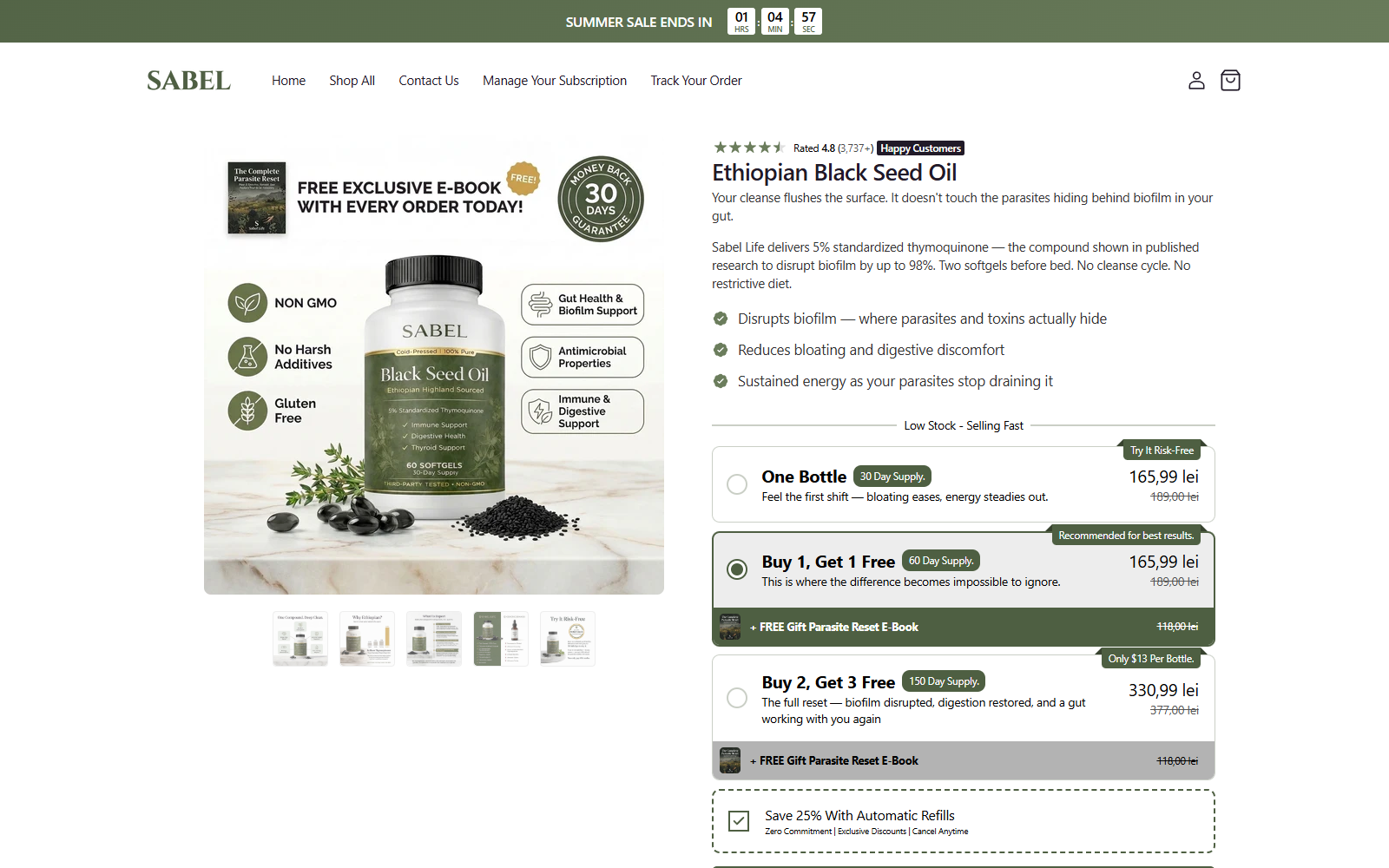
Overview
What Sabel is offering
Sabel sells an Ethiopian black seed oil supplement in liquid form. The page connects it with digestion, energy, bloating, biofilms, and unwanted organisms.
Black seed oil comes from Nigella sativa seeds. It is a genuine traditional ingredient, but that fact does not validate every condition named in advertising.
The product is sold as a one-time order or through automatic refills. During our review, the refill option appeared selected on the product page.
What makes the offer concerning
The strongest concern is the distance between the product’s broad narrative and the evidence shown for this exact formula.
The page uses parasite and biofilm language that can make ordinary symptoms sound like signs of a hidden infestation.
It also places recurring billing beside the promised savings. A shopper focused on relief may not appreciate that the lower price changes the transaction.
Our assessment
Sabel’s written subscription policy is clearer than many refill offers. It promises reminders, online cancellation, and a 30-day refund without requiring a return.
Those favorable terms should be acknowledged. They do not establish that the advertised health outcomes are clinically proven for Sabel’s finished product.
We would not use this supplement to diagnose or treat parasites. Buyers should understand the renewal schedule and discuss persistent symptoms with a qualified clinician.
- Automatic refills appeared selected during our review.
- The subscription policy states a default 28-day interval.
- The same quantity and product can renew at that interval.
- The seller promises a reminder before each charge.
- The policy says cancellation is available through the account.
- The page makes sweeping parasite and biofilm claims.
- Displayed media logos do not prove endorsement or coverage.
Black Seed Oil Is Real, but the Marketing Leap Is Large
A familiar ingredient can make a sales story feel medically grounded. Black seed oil has a long history of traditional use and has attracted scientific research.
Research on an ingredient is not automatically evidence for a branded bottle, its concentration, its purity, or every outcome described on a landing page.
Different studies use different preparations, doses, populations, durations, and endpoints. Results cannot be transferred casually to an online product.
Sabel emphasizes thymoquinone, a naturally occurring compound in Nigella sativa. A concentration figure still does not prove that the product removes parasites or dismantles biofilms.
Those are specific medical propositions. They require product-specific evidence, reliable diagnosis, meaningful outcomes, safety monitoring, and transparent publication.
The sales page does not replace that standard. Testimonials and simplified diagrams can be persuasive without answering basic clinical questions.
A person with fatigue, bloating, digestive discomfort, or brain fog has many possible explanations. Assuming parasites may delay appropriate testing and treatment.
Black seed oil can also cause side effects or interact with medicines. Natural origin does not guarantee suitability for every person.
Pregnancy, surgery, chronic illness, and medicines affecting blood pressure, glucose, or clotting deserve professional guidance before supplementation.
The Parasite Story Turns Uncertainty Into Urgency
Direct-response health pages often begin with common complaints. Low energy, poor digestion, cravings, and restless sleep are broad enough to fit millions of readers.
The advertisement then offers one hidden explanation. In this case, parasite and biofilm language turns nonspecific symptoms into a compelling threat.
Once a visitor accepts that explanation, the supplement appears to solve several problems at once. That is a powerful sales structure, not a diagnosis.
Real parasitic infections require proper medical evaluation. The correct test and treatment depend on the organism, exposure, symptoms, and individual health history.
A supplement page cannot determine whether a visitor has an infection. It also cannot show that one oil safely treats every organism implied by the narrative.
Watch for phrases that sound precise without being testable. “Supports cleansing” can imply a strong result while avoiding a measurable treatment claim.
Similarly, “helps break the shield” creates an image of biofilm removal but does not tell readers what was measured in human users.
How the Sabel Refill Funnel Works
Step 1: Common symptoms become one hidden problem
The visitor is invited to connect ordinary discomfort with parasites or biofilms. This reframes uncertainty as an urgent reason to act.
The story is emotionally efficient. People who have not found an easy explanation may feel they finally understand what is happening.
That feeling can arrive before any medical testing or careful review of alternative causes.
Step 2: Scientific language gives the story authority
Thymoquinone concentration figures, ingredient descriptions, and biological terms create an impression of precision. Readers may interpret specificity as proof.
However, a chemical name or concentration does not establish a claimed outcome. The missing link is reliable evidence for the finished product.
Ask whether the exact formula was tested against a clear endpoint in humans. Ingredient references alone are not the same answer.
Step 3: Familiar media names create borrowed trust
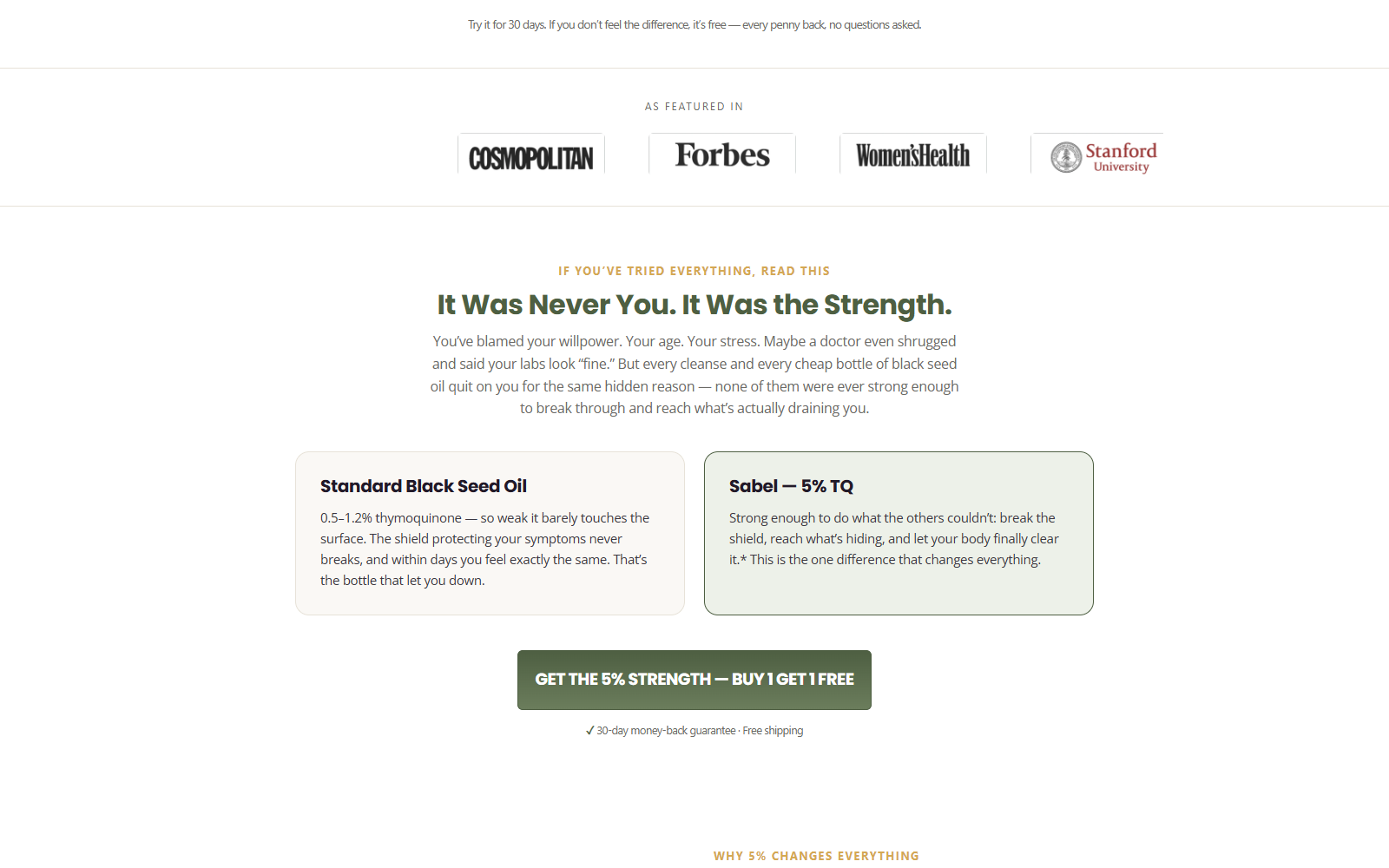
The page displayed recognizable publication and institutional logos beneath an “as featured in” message.
A logo does not show what was published, whether the product was reviewed, or whether an organization endorsed the claims.
Look for a direct article, identifiable author, publication date, and language supporting the exact representation. Without that trail, the logos are decorative evidence.
Step 4: The discounted choice starts automatic refills
The product page pairs a lower price with recurring delivery. During our review, the automatic-refill choice appeared active.
That means a shopper may be enrolling in repeat charges rather than buying one bottle. The distinction should be understood before checkout.
Read the label beside the selected option. Do not rely on the larger savings figure or button text.
Step 5: The interval can outpace actual use
Sabel’s policy states a default renewal every 28 days, regardless of the initial bundle quantity.
That detail is important. Someone ordering multiple bottles could receive another identical bundle before using the first supply.
Calculate the daily serving, servings per bottle, bottles ordered, and next billing date. The schedule should match consumption, not merely the merchant’s default.
Step 6: Cancellation depends on using the promised tools
The written policy says customers can manage or cancel through an account and will receive a reminder before renewal.
Those provisions are positive if they work as described. Buyers should create the account immediately and confirm the next order date.
Do not wait for a reminder. Calendar the renewal and cancel several days early if the product is unwanted.
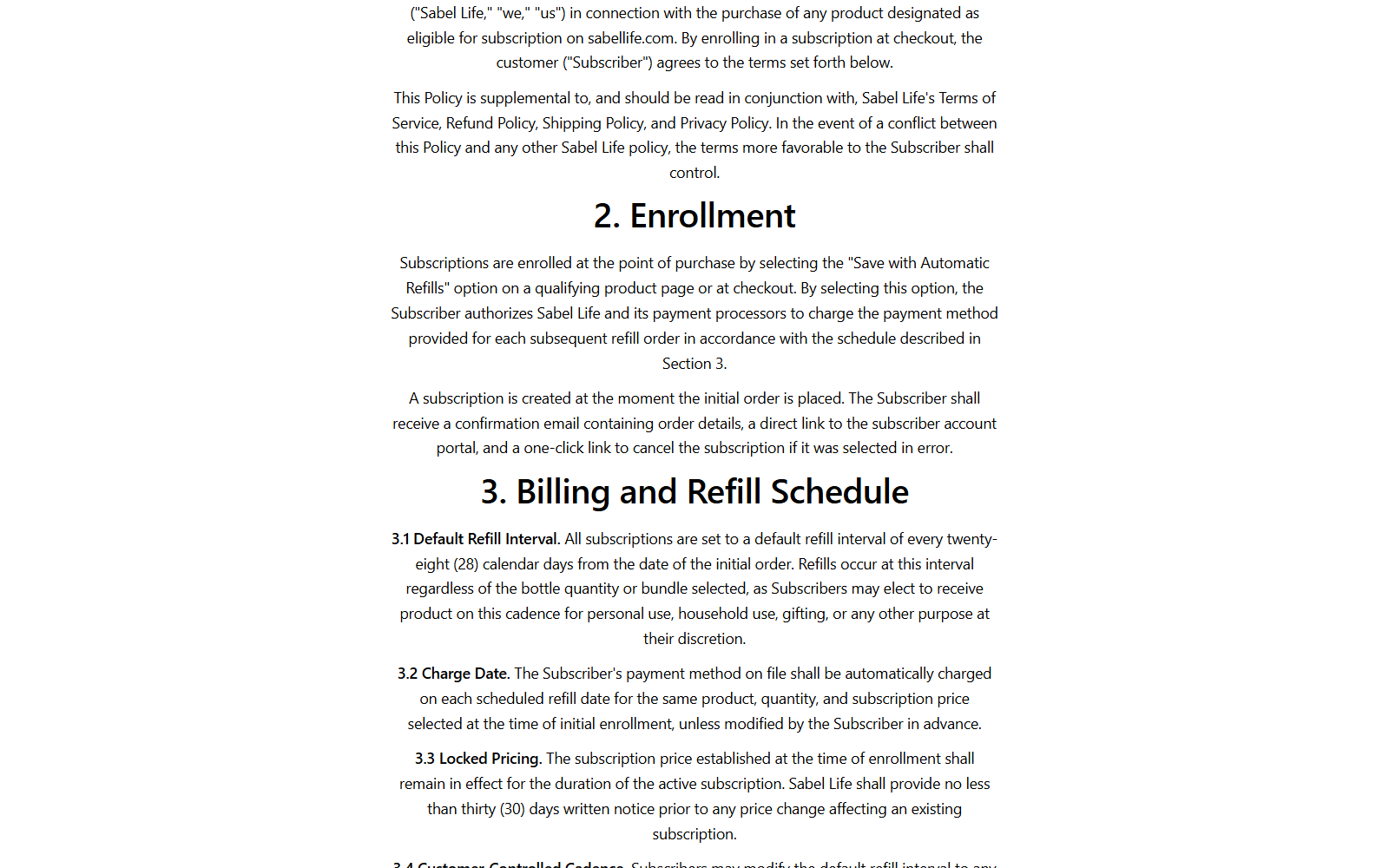
Understanding the 28-Day Refill Detail
Recurring delivery is not inherently deceptive. Many people intentionally subscribe to products they use consistently.
The risk appears when the order quantity and renewal interval do not match. A multi-bottle purchase can create a much larger recurring shipment than expected.
Suppose a customer chooses several bottles because the bundle offers a better unit price. A 28-day refill could renew that entire quantity.
The policy states that the same product, quantity, and subscription price will be charged unless the customer changes the plan.
That sentence deserves more attention than the savings badge. It defines the financial commitment after the first order.
Take a screenshot of the selected option, checkout summary, and subscription terms. Save the confirmation email showing quantity and next renewal.
Log in after ordering. Verify that the account actually provides cancellation and that the button produces written confirmation.
If the account does not work, contact support immediately. Keep the message and timestamp before the renewal date.
The policy also promises an email reminder. Search spam and promotional folders, but never make cancellation depend entirely on receiving it.
What the Refund Promise Does and Does Not Prove
Sabel’s subscription policy says dissatisfied customers may request a refund within 30 days and need not return the product.
That is more consumer-friendly than policies demanding several empty bottles, return postage, or a complicated authorization process.
Still, a written guarantee is only as useful as its implementation. Response speed, eligibility interpretation, and refund processing determine the real experience.
Submit any request through the documented channel and retain a copy. Include the order number, charge date, amount, and clear requested resolution.
Do not confuse a refund guarantee with proof of efficacy. A merchant can offer refunds while making claims that remain unsupported.
Likewise, a successful cancellation does not show that the parasite narrative is medically sound. Billing fairness and health evidence are separate questions.
Read the Received Label, Not Only the Landing Page
The bottle in a parcel is the product someone will consume. Its label should match the ingredient amounts and serving directions shown before payment.
Compare the supplement panel, other ingredients, bottle volume, country information, and warnings with the archived listing.
Check whether the label states a thymoquinone concentration and whether that statement applies to the oil, a seed extract, or another measurement.
Look for a legible lot number and expiration date. These details help connect a safety concern or quality complaint with a specific production run.
Do not use a bottle with a broken seal, leaking cap, unusual sediment, rancid odor, or unexplained label differences.
Photograph any discrepancy before contacting support. A clear side-by-side record is more useful than a general statement that the product looks wrong.
Company, Address, and Fulfillment Checks
Identify the contracting seller
Start with the legal entity named in the terms, receipt, and card statement. A brand name is not always the company responsible for the transaction.
All three records should lead to one explainable business. Unrelated descriptors or changing identities make a future dispute harder.
Ask support for the exact legal seller before ordering if the answer is not prominent.
Verify the support route
Test customer service with a precise subscription question. Ask whether a three-bottle first order renews as three bottles after 28 days.
A useful answer should state the quantity, billing amount, next date, cancellation method, and refund procedure without evasive language.
Save the reply. It may clarify the contract if the checkout presentation was ambiguous.
Separate headquarters from fulfillment
A returns facility may only process parcels. It does not necessarily manufacture the oil, formulate it, or employ the support team.
Ask where the finished product is manufactured, bottled, tested, and dispatched. Those are different questions from where returns are mailed.
Look for lot identification, expiration details, tamper evidence, ingredient amounts, warnings, and manufacturer information on the received label.
Demand evidence that matches the bottle
General black seed research cannot verify Sabel’s identity, purity, concentration, contaminants, or stability.
A useful certificate should identify the product, batch, laboratory, testing date, and methods. A generic badge is not equivalent.
Parasite treatment claims require more than purity testing. They need credible clinical evidence for the exact product and intended use.
What to Do if You Have Fallen Victim to This Scam
- Determine whether you subscribed. Review the checkout receipt and confirmation for automatic refill, subscribe, recurring, or 28-day language.
- Open the customer account now. Confirm the next charge date, shipment quantity, renewal price, and available cancellation control.
- Cancel early if you do not want refills. Use the account and send a written request. Save the confirmation page and email.
- Request a refund within the stated window. Cite the 30-day policy, provide the order details, and state the exact charge requiring reversal.
- Speak with a clinician about symptoms. Do not rely on an advertisement to diagnose parasites, digestive disease, fatigue, or medication interactions.
- Monitor the payment method. Check for another authorization near the 28-day date. Contact the seller and card issuer promptly about an unwanted renewal.
- Check your device if redirects appeared. Run Malwarebytes if you downloaded unknown files or encountered suspicious prompts during the purchase path.
- Limit risky advertising exposure. AdGuard can filter many aggressive ads and tracking links, but it cannot evaluate a supplement’s medical claims.
Frequently Asked Questions
Is Sabel Black Seed Oil a confirmed scam?
We found concerning health marketing and an active refill choice, but the written policy includes meaningful cancellation and refund protections. That requires a nuanced assessment.
Does Sabel automatically renew orders?
The subscription option renews. Its policy describes a default 28-day interval and says the same product and quantity are charged unless changed.
Can black seed oil remove parasites?
The sales page does not establish that Sabel’s finished product safely diagnoses or treats human parasitic infections. Suspected infections need appropriate medical evaluation.
Do the displayed media logos prove endorsement?
No. A logo alone does not show an article, review, approval, or endorsement. Look for a direct, verifiable publication supporting the exact claim.
Can I cancel a Sabel subscription online?
The published policy says account holders can manage or cancel online. Save the final confirmation and verify that no pending renewal remains.
What should I check on the bottle?
Check the seal, lot, expiration, ingredient panel, serving size, warnings, manufacturer details, and consistency with the listing. Report material differences immediately.
The Bottom Line
Sabel combines a real botanical ingredient with a much larger parasite and biofilm story. The page does not provide enough evidence to accept that story as diagnosis.
The refill terms are equally important. A selected subscription can renew the same bundle every 28 days, potentially creating more product than expected.
Read the order as a health decision and a recurring contract. Verify both carefully, and seek medical advice for symptoms rather than following advertising alone.

Join the discussion
0 commentsShare your experience or ask a question about this article.
Discussion
Start the conversation
Have a question or something useful to share? Add the first comment.