

A crypto advertisement can borrow the colors, vocabulary, and executive imagery of a respected financial company in seconds. The hard part for a viewer is noticing what the advertisement cannot borrow: a real relationship with that company.
That difference sits at the center of the QUFC Exchange campaign now appearing on social media. The promotion looks corporate, the platform looks busy, and the pitch arrives with the kind of authority that makes a new investment feel pre-approved.
This report looks past that presentation and follows the path from the first sponsored post to the moment a supposed investment becomes money that cannot be withdrawn.
Overview
What people are being shown
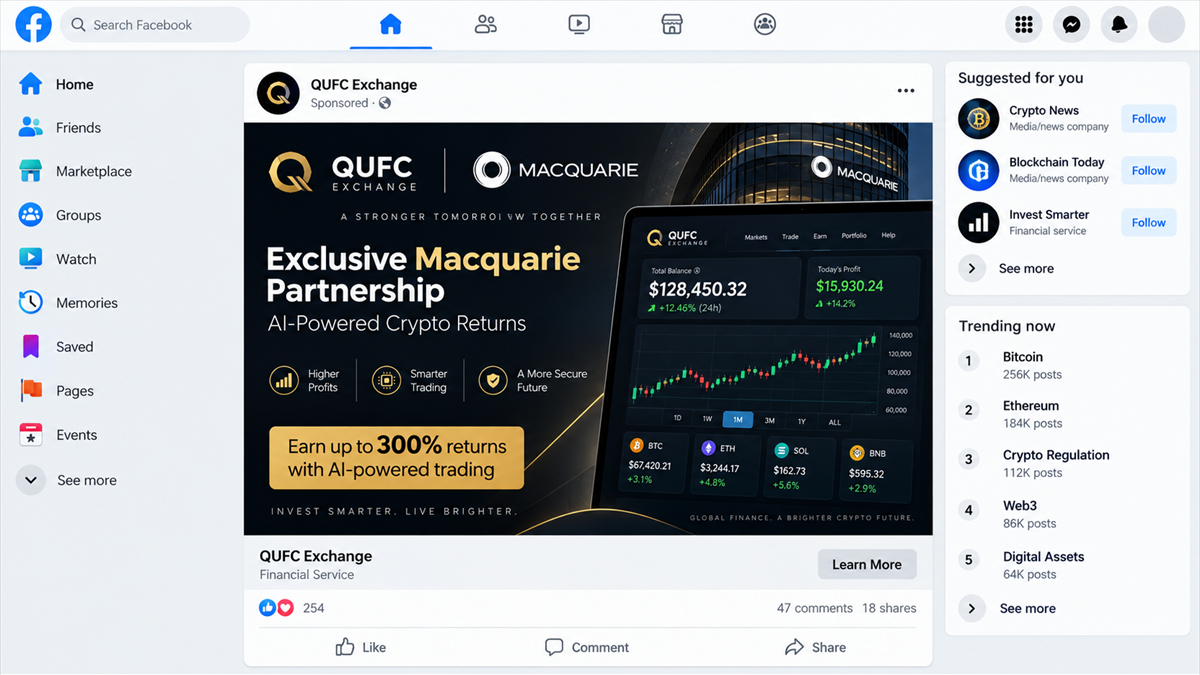
Social media users are seeing promotions for a cryptocurrency platform called QUFC Exchange. The advertisements claim that the platform is connected to Macquarie Group and may use Macquarie branding, the names and images of senior executives, and AI-generated video to make that relationship look real.
The offer is framed as access to a polished trading platform rather than a direct request to send money to a stranger. That distinction matters because the professional interface can make the transaction feel like an ordinary account deposit.
What Macquarie has confirmed
Macquarie issued a September 2026 alert stating that QUFC Exchange is a fake crypto investment platform being promoted on social media. The company said it is not affiliated with QUFC Exchange in any way and would not use social media to ask people to invest in a new crypto platform.
This is not a case where reviewers simply dislike a legitimate product or where an investor is disappointed by normal market losses. The company whose identity is being used has publicly rejected the claimed partnership.
The shortest safe answer
Do not deposit money, connect a wallet, upload identity documents, or continue a conversation with anyone promoting QUFC Exchange. If you encountered the name through a social media ad, treat the claimed Macquarie connection as false.
- Macquarie says it has no affiliation with QUFC Exchange.
- The campaign uses Macquarie branding and executive likenesses without authorization.
- AI-generated video can make an invented endorsement appear personal and current.
- A convincing account balance does not prove that deposited money is recoverable.
- Requests for a tax, verification fee, or release payment are additional scam stages.
Why the Macquarie Name Changes the Pitch
Most people know that cryptocurrency promotions can be risky. The campaign tries to quiet that concern before it appears. Instead of asking the viewer to trust an unknown exchange on its own merits, the advertisement presents the platform as something connected to an established financial group.
That borrowed reputation makes the platform appear regulated and suggests that professionals have already examined it. It also gives the viewer a familiar name to search.
If the scam page repeats that name often enough, a quick search may return a confusing mix of genuine Macquarie pages and promotional material created by the scammers.
AI-generated executive videos add another layer. A person who would ignore a banner ad may pause when a recognizable business leader appears to explain the opportunity. Lip movement, voice, office backgrounds, subtitles, and news-style graphics can all be manufactured. Video is evidence that a file exists, not evidence that the person shown approved its message.
The official Macquarie scam alert is unambiguous: QUFC Exchange is not a Macquarie partner. That direct denial should outweigh every logo, testimonial, document, or video placed inside the promotion.
How the QUFC Exchange Scam Works
Step 1: A sponsored post manufactures authority
The campaign begins where people already discover financial news and products: social networks, video feeds, and advertising placements. The ad may present a limited launch, an AI trading system, an exclusive partnership, or a chance to join before general access opens.
The creative is built to answer objections. Macquarie branding supplies trust. Executive imagery supplies a human endorsement. A moving chart supplies the feeling of live market activity. A time limit supplies urgency.
Step 2: The click opens a controlled sales path
The destination may be a landing page, registration form, messaging conversation, or fake news article. Each version moves the viewer away from the original platform and into an environment the operator controls.
The first form often asks for ordinary lead information such as a name, email address, and phone number. That can feel less dangerous than a payment request, but it identifies a responsive target and gives the sales team several ways to continue the pressure.
Step 3: A supposed account manager takes over
After registration, a caller or chat contact may introduce themselves as a broker, analyst, onboarding specialist, or account manager. The conversation is designed to feel attentive. The representative may ask about investing experience, goals, and available funds before suggesting a manageable opening deposit.
This personal contact is not independent financial guidance. It is part of the same funnel. The caller’s job is to convert interest into a transfer and keep the victim engaged after the first payment.
Step 4: The dashboard turns deposits into theater
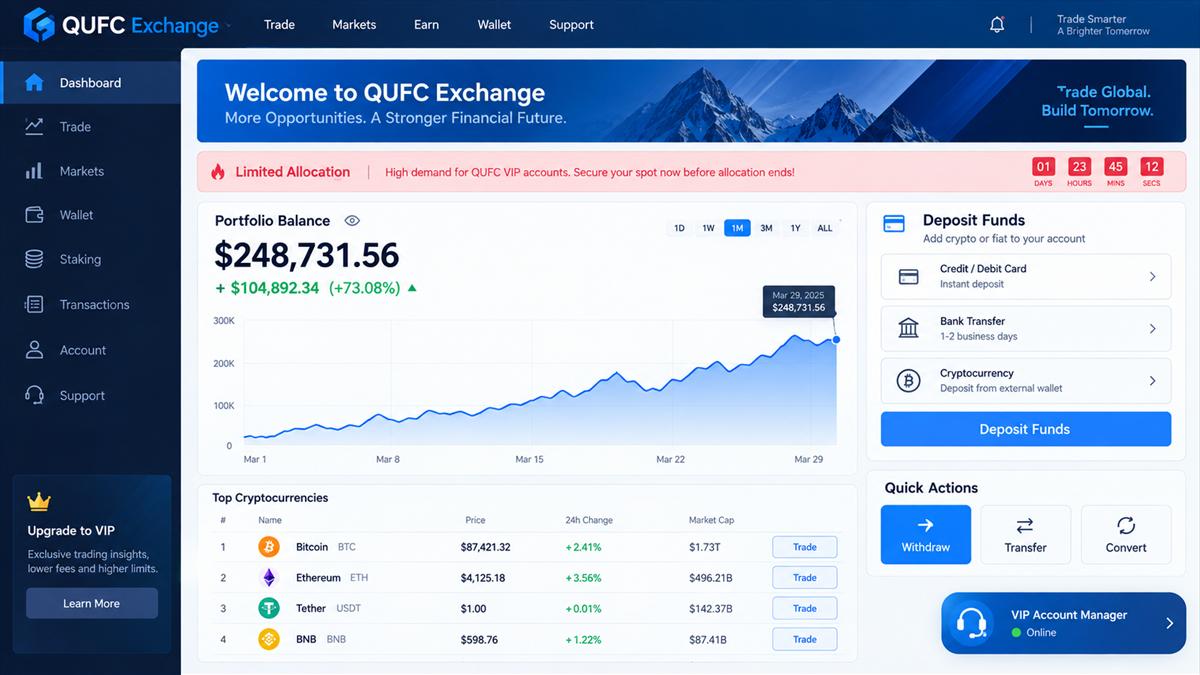
Once money is sent, the platform can display almost any result. A balance may rise within hours. Profitable trades may appear to open and close at perfect moments. Charts, account tiers, bonus credits, and performance percentages make the numbers feel connected to a real market.
The victim sees a figure on a screen, but there may be no brokerage account and no assets held in the victim’s name. The operator controls both the deposits and the display. Changing a number in a database is not the same as generating an investment return.
Step 5: Small success is used to request more money
Some investment scams allow a small early withdrawal or provide a token payment. That payment is not proof that the platform is legitimate. It can be a calculated expense used to unlock a much larger deposit.
The account manager may then recommend a higher tier, a time-sensitive trade, a matching bonus, or a minimum balance required for access to premium returns. Apparent profits make the victim feel that declining would mean walking away from a system that is already working.
Step 6: Withdrawal creates a new bill
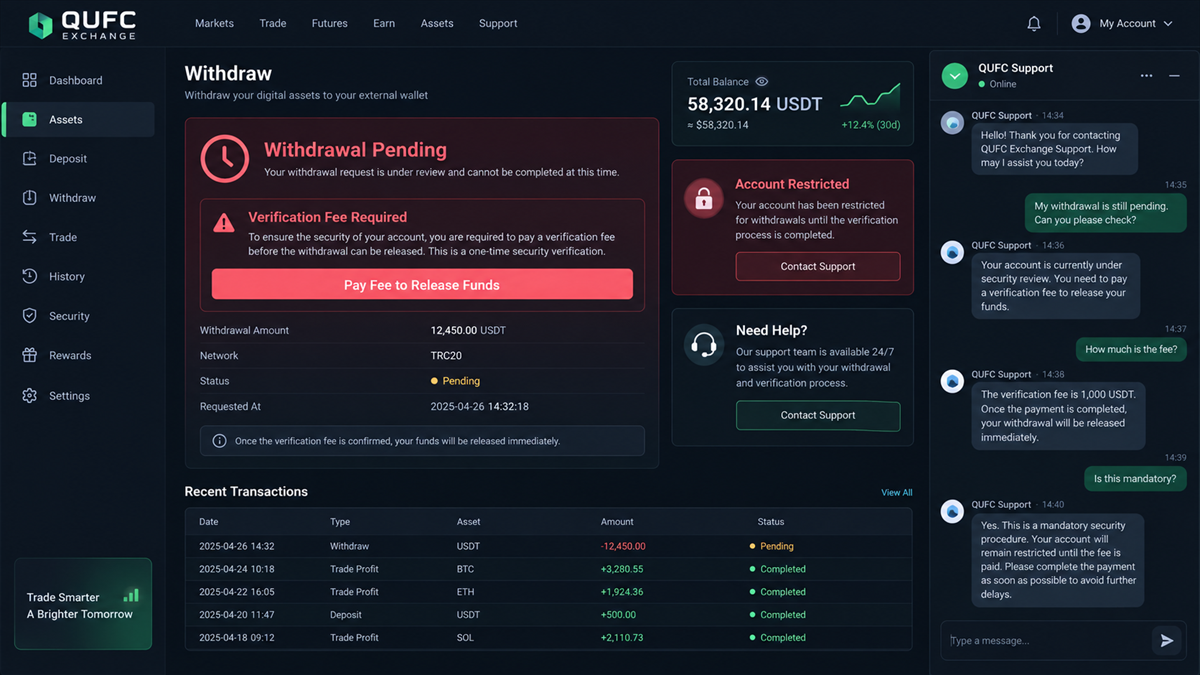
The truth usually becomes visible when the victim tries to take money out. The request may remain pending, fail a compliance review, or trigger a notice demanding tax, insurance, wallet activation, anti-money-laundering verification, or a release fee.
Paying that charge does not release the balance. It tells the operator that the victim can still be persuaded. Another obstacle can appear immediately, followed by another payment demand. Real taxes and compliance checks are not settled by sending extra money to an unverified platform so it can unlock fictional profits.
The Account Balance Is Not Proof of an Investment
A fake trading portal is persuasive because it copies the language of real finance. It can show order histories, asset allocations, identity checks, market feeds, and support tickets. None of those elements require the operator to have bought a single asset.
Ask a more basic question: where is the money held, which legal entity received it, and which regulator licenses that entity to provide the advertised service? A brand logo in the header does not answer any of those questions.
The same caution applies to documents. A PDF can contain company registration numbers, executive signatures, and compliance seals copied from unrelated sources. Verify claims with the named organization and regulator using contact details you found independently.
MalwareTips has documented the same visual trick in other fake crypto trading platform scams: the dashboard is designed to keep a person depositing, not to provide a transparent record of assets they control.
Red Flags in QUFC Exchange Promotions
No single design choice proves fraud, but this campaign comes with a decisive fact: Macquarie denies the claimed relationship. Any promoter who continues using that relationship after the denial is not offering a harmless marketing exaggeration.
- An advertisement says Macquarie is a partner, backer, or sponsor of QUFC Exchange.
- A video shows an executive endorsing a platform that the executive’s company disavows.
- The ad leads to a registration page before explaining the legal entity and license.
- A caller promises unusually steady returns or describes losses as impossible.
- The representative insists that the opportunity is limited or must be funded today.
- Deposits must be sent in cryptocurrency, to changing bank accounts, or to an unrelated recipient.
- The account manager discourages independent checks or tells you not to contact Macquarie.
- A withdrawal requires a new deposit, tax payment, verification fee, or insurance charge.
Company and Checkout Checks
Verify the claimed partnership at the source
Go directly to the named company’s official website and search its security alerts, news releases, and product pages. Do not use a contact number or verification link supplied by the advertiser. In this case, Macquarie has already said the partnership does not exist.
Identify the legal entity receiving money
A platform name is not enough. Look for the full company name, physical address, registration jurisdiction, license number, and regulator. Then verify each item in the regulator’s own database. Similar names and copied registration documents are common.
Check the deposit route
The recipient should match the verified legal entity. Personal accounts, unrelated companies, crypto wallet addresses, and instructions that change during the conversation are serious warnings. A polished checkout page cannot repair a mismatched recipient.
Test the withdrawal claim without paying more
If a platform says another payment is required to withdraw, stop. Do not send a small fee as an experiment. Save the notice and transaction history, then contact your bank, card issuer, or exchange through official channels.
What to Do if You Have Fallen Victim to This Scam
- Stop every payment. Do not pay a release fee, tax, verification charge, recovery deposit, or account-closing fee.
- Contact the payment provider immediately. Tell your bank, card issuer, payment app, or cryptocurrency exchange that the transaction is connected to an impersonation investment scam. Ask what recall, dispute, freeze, or tracing options remain.
- Preserve the full record. Save advertisements, profile names, web addresses, emails, chat exports, phone numbers, wallet addresses, bank recipients, receipts, and screenshots of the dashboard.
- Secure the accounts you used. Change reused passwords from a clean device, enable multi-factor authentication, revoke unknown sessions, and check whether the scammer added recovery details.
- Scan any device used for remote access. If the representative asked you to install software or share your screen, disconnect the device and run a full security scan. Malwarebytes can help check for remote-access tools and related malware.
- Protect your identity. If you uploaded a passport, driver’s license, selfie, bank statement, or proof of address, contact the relevant issuing organizations and follow local identity-theft guidance.
- Report the advertisement and platform. Report it to the social network, your national fraud-reporting service, financial regulator, and Macquarie at the address listed in its official alert.
- Ignore recovery offers. Anyone promising guaranteed recovery for an upfront fee may be using the original victim list for a second scam.
After the urgent steps, an ad and tracker blocker such as AdGuard can reduce exposure to malicious advertising and tracking-heavy redirect chains. It is an extra barrier, not a substitute for verifying the company and recipient before sending money.
How to Judge the Next Crypto Advertisement
Begin with the endorsement, because that is often the cheapest part of the ad to fake. Search the official site of the named bank, celebrity, television program, or executive. If the claimed partner does not confirm the product, stop there.
Then separate the platform from its screen. Verify who owns it, where it is licensed, who receives deposits, and whether the regulator recognizes the exact entity and domain. Do not accept a screenshot of a license as verification.
Finally, remember that urgency is a sales tool, not an investment feature. A legitimate opportunity does not become safer because a timer is running, a caller is waiting, or a supposed allocation is about to close.
Frequently Asked Questions
Is QUFC Exchange partnered with Macquarie?
No. Macquarie states that it is not affiliated with QUFC Exchange in any way. Promotions claiming a partnership are using a false association.
Are the Macquarie executive videos real?
Macquarie says the campaign has used names, images, and AI-generated videos of senior executives. A realistic face and voice do not establish that the person made or approved the statement.
Does a profitable QUFC dashboard mean the money is there?
No. The operator can control every number displayed on an unverified platform. Proof requires independently verifiable custody, transactions, licensing, and a withdrawal that does not demand more money.
Can I pay the fee and withdraw afterward?
Do not pay. Extra tax, verification, insurance, and release demands are common ways investment scammers continue collecting money after a victim asks to withdraw.
What if I only gave QUFC my phone number?
Expect follow-up calls, messages, and possibly new offers under different platform names. Block the contacts, watch for targeted phishing, and do not confirm additional personal or financial details.
Can a recovery company get my crypto back?
Be extremely cautious. Cryptocurrency transfers can be difficult to reverse, and scammers target victims with guaranteed recovery offers. Work through your exchange, bank, law enforcement, and recognized reporting channels without paying an unsolicited recovery agent.
The Bottom Line
QUFC Exchange is not a Macquarie investment product. Macquarie has publicly identified the platform promotion as a scam and rejected the partnership shown in its social media advertising.
The safest response is to leave the funnel before registration. If money or documents have already been sent, stop paying, preserve the evidence, secure your accounts, and contact the payment provider immediately.

Join the discussion
0 commentsShare your experience or ask a question about this article.
Discussion
Start the conversation
Have a question or something useful to share? Add the first comment.