

The Nuzzy Pen is sold as a simple at-home fix for a problem people hate dealing with.
Skin tags. Dark spots. “Blemishes.” Little imperfections you want gone, fast, without paying clinic prices or waiting weeks for an appointment.
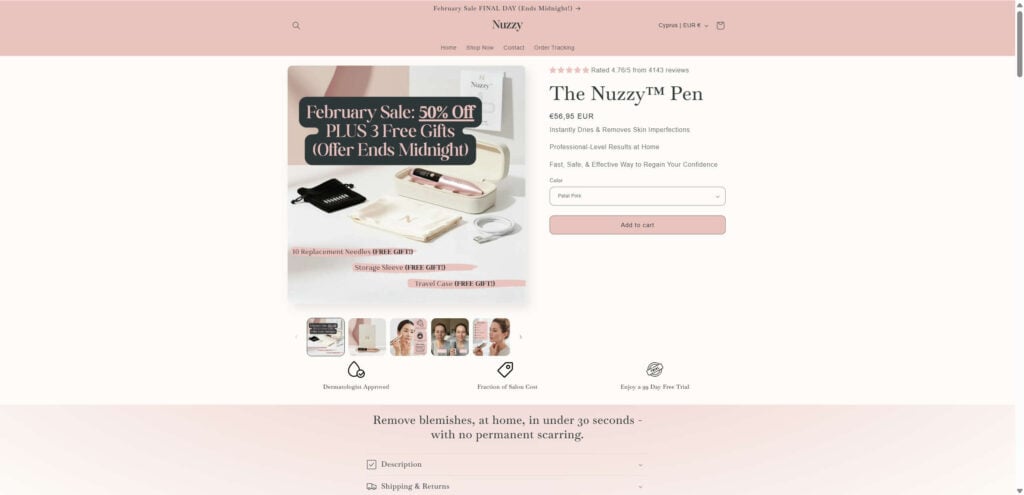
The pitch is seductive: a quick zap, the spot dries out, a small scab forms, and the area clears in days. The site frames it as professional-level results at home, backed by a long trial and a big discount that supposedly ends soon.
But when you look at how the product is marketed, what details are missing, and what this type of “micro-spark” pen actually is, the decision gets a lot less exciting and a lot more practical.
This review breaks down what the Nuzzy Pen claims, what’s realistic, and what the sales funnel signals about the operation behind it.
Overview
What the Nuzzy Pen claims to do
The Nuzzy Pen is marketed as an electric skin care pen that uses a “precise micro-spark” to dry out skin tags, dark spots, and other surface imperfections.
The general promise looks like this:
- Target a small area with a controlled spark
- The treated spot dries and darkens
- A small scab forms
- Over the next few days, the scab flakes off naturally
- The skin underneath looks clearer, with no visible scarring
The store also leans heavily into clinic-comparison language, implying you can get “pro-level” results without expensive treatments.
On top of that, there are strong persuasion layers:
- Ongoing “limited-time” sales and urgency messaging
- Big discounts (commonly framed around 50% off) plus free gifts
- Bold effectiveness statements (such as a 93% effectiveness rate)
- A long “risk-free” trial period (shown as 99 days)
- A large social proof claim (“Trusted by over 38,000 women”)
None of these elements prove the product is fake.
But they do tell you the page is optimized to convert quickly, not to educate carefully.
What this product category usually is
A “skin tag and mole removal pen” sold online is typically a low-cost electric cautery-style device.
In simple terms, it creates heat at the tip to burn or cauterize superficial tissue. Many listings call this a spark, plasma, or micro-spark, but the practical effect is the same: localized thermal damage.
That matters because the risks are also the same:
- Burns and blistering
- Infection
- Scarring or discoloration
- Poor wound healing, especially on face or sensitive areas
- Treating the wrong thing because it “looks harmless”
This last point is the biggest one.
A skin tag is not the same thing as a mole.
A dark spot is not the same thing as a harmless blemish.
And any marketing that blurs those categories is asking you to take a risk you may not fully understand.
The “mole” issue: why this is not a casual DIY problem
If a website markets the pen for moles, that should immediately slow you down.
At-home removal can destroy the visible surface of a mole, but it does not tell you what the lesion was. If something is suspicious, removal at home can delay diagnosis and prevent proper evaluation.
That is why responsible medical guidance typically warns against self-removing moles and unknown lesions.
If you are considering this product for anything you would describe as a mole, especially a changing, irregular, or dark lesion, the safest move is to get a professional evaluation.
“Dermatologist Approved” without proof is a major red flag
One of the most common persuasion tricks in this category is the phrase “Dermatologist Approved.”
It sounds authoritative, and it calms a buyer’s fear around safety.
But when the page does not provide:
- A dermatologist name
- Credentials
- A clinic or practice affiliation
- A published statement
- Any verifiable testing or documentation
Then “Dermatologist Approved” is just a marketing label.
A professional brand that truly has medical endorsement typically uses specifics, because specifics are valuable.
When a site uses medical authority language with no names and no proof, it’s a sign the claim exists mainly to reduce hesitation.
Limited technical specs and missing certifications matter here
For many consumer products, vague specs are annoying but not dangerous.
For a device that intentionally burns skin, lack of safety details is a real concern.
A responsible product listing would typically clarify, at minimum:
- What safety standards it meets (if any)
- Any relevant certification claims and documentation
- Clear contraindications and warnings
- Guidance about what not to treat (moles, certain lesions, sensitive areas)
- Sterility and hygiene considerations
- Aftercare guidance that does not encourage unsafe behavior
When the sales experience focuses on discounts, testimonials, and before-and-after images, but stays thin on safety and certification details, that imbalance is the story.
The before-and-after problem: “dramatic” often means misleading
The Nuzzy marketing relies heavily on dramatic transformations.
That is not surprising. Before-and-after images sell.
The problem is that in this niche, images are frequently:
- Filtered or edited
- Taken under different lighting
- Shot at different angles and distances
- Cropped to hide irritation
- Presented without time context
- Paired with testimonials that cannot be verified
If the site also uses lifestyle photos that look synthetic or overly perfect, it raises an additional credibility issue. Some stores use AI-generated “customer” images because they can build a polished review wall quickly, even when real customer proof is limited.
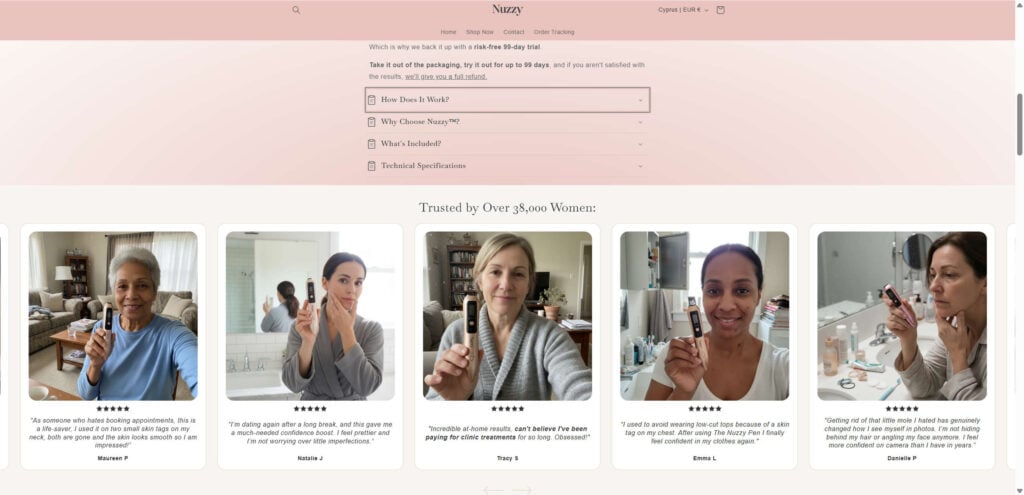
When you see a review section that looks too clean, too consistent, and too optimized, treat it as marketing until proven otherwise.
The “Trusted by 38,000 women” claim: what to look for
Big social proof numbers are common in dropshipping-style stores.
The question is not whether the number is true.
The question is whether it is verifiable.
If a store claims tens of thousands of buyers, you would normally expect to see at least some footprint outside the site:
- Reviews on established platforms
- Discussions in forums
- Independent video reviews
- Retail listings with consistent feedback
If the main proof is only the store’s own review carousel and on-page testimonials, the claim remains unverified.
The 99-day risk-free trial: good promise, but the process matters
A “risk-free 99-day trial” sounds generous.
But refunds are not about the headline. They’re about execution.
A reliable refund process typically includes:
- Clear instructions
- A real support channel with consistent response
- Transparent return shipping terms
- A straightforward timeline for refund processing
- A policy that is not full of vague exclusions
In many conversion-focused operations, “risk-free” becomes a negotiation.
Some buyers get partial refunds. Some are asked to ship internationally at their own expense. Some face delays that push them past dispute windows.
So the right way to read a long trial promise is: it’s meaningful only if the support and return infrastructure is real and responsive.
Contact details and identity signals: small details that add up
One of the most useful credibility checks for any online store is consistency in business identity.
In the screenshots provided, the site’s contact information references a trade name (for example, “Dusk Thermals”) and emails that do not consistently match the brand name.
This kind of mismatch is common in template-based operations:
- The “brand” is the storefront name used in ads
- The legal or trade name is something else entirely
- The support email may be a generic inbox, sometimes even a free email provider
- The store can be rebranded quickly if needed
This does not automatically mean fraud.
But it does lower confidence, especially when combined with heavy urgency marketing and thin technical transparency.
Shipping claims: broad warehouse coverage is a common template
Many stores in this niche claim shipping from multiple warehouse regions (such as the USA, Europe, and Hong Kong) with delivery estimates like 5 to 7 days.
Sometimes that is accurate.
Other times it is a broad claim designed to reduce hesitation, even when fulfillment originates overseas.
If you are considering buying, the most practical approach is to treat shipping speed claims as estimates, not guarantees, and to prioritize payment methods that protect you if delivery drags out or the product does not match the offer.
The pricing reality: this is usually a low-cost generic device
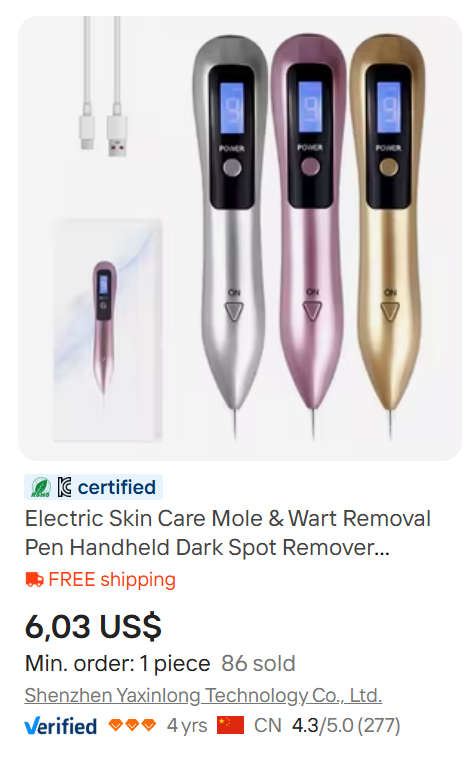
Wholesale marketplace listings show very similar “mole and wart removal pens” sold for around $6 and up, often with free shipping and high seller volume.
That does not mean a branded store cannot charge more.
It does mean you should be clear about what you are paying for:
- Marketing
- Packaging
- The storefront experience
- Support and return handling, if it exists
If support and returns are weak, then you are paying premium pricing for a commodity device.
So should you buy it?
Based on the pattern, the Nuzzy Pen is not positioned like a medical-grade device with robust safety documentation and verifiable clinical backing.
It is positioned like a high-conversion consumer gadget:
- Constant sale pressure
- Authority claims without proof
- Thin safety and certification details
- Dramatic imagery that is hard to verify
- A broad promise that invites risky self-treatment
If your goal is to remove or treat anything you would reasonably worry about, or anything that resembles a mole, this is not the type of product you should trust for that job.
If you are considering it for minor cosmetic issues, the safest framing is this: it is a low-cost cautery pen sold through aggressive marketing, with the usual risks that come with burning skin at home.
How The Operation Works
Step 1: Hook the buyer with a high-frustration, high-shame problem
Skin tags and visible spots are perfect for impulse marketing.
They are annoying, sometimes embarrassing, and they feel like a simple fix should exist.
The funnel starts by making you feel:
- This problem is common
- You are wasting money on clinics
- You can fix it yourself quickly
That emotional setup is what makes the next steps land.
Step 2: Offer a mechanism that sounds precise and professional
“Micro-spark.”
“Precise.”
“Targets only the surface.”
These phrases do two jobs at once:
- They make the product sound engineered and safe
- They reduce the buyer’s fear of burns and scarring
But precision claims require documentation.
Without real technical and safety details, “precision” is just a word that makes a cautery pen feel like a salon device.
Step 3: Show a simple 3 or 4-step process to remove complexity
The product is presented as a clean, predictable routine:
- Tap the spot
- The spot dries out
- A scab forms
- It flakes off naturally
This is a conversion tactic.
It turns a medically sensitive topic into a simple household task.
The buyer stops thinking about:
- Infection risk
- Skin type differences
- Location sensitivity
- Lesion identification
- Scarring probability
And starts thinking: “This seems easy.”
Step 4: Use “clinic comparison” to justify the price
The funnel pushes the idea that you are saving money compared to a dermatologist.
That is a powerful frame because it makes almost any price feel reasonable.
But it also creates a dangerous incentive: it nudges buyers away from professional evaluation, including cases where evaluation is exactly what they need.
Step 5: Add authority claims to suppress safety objections
“Dermatologist Approved” is a classic example.
The point is not accuracy.
The point is emotional permission.
When no names, credentials, or proof are provided, the claim is functioning as a sales tool, not medical reassurance.
Step 6: Fill the page with social proof and large numbers
“Trusted by over 38,000 women” is a prime example of a number designed to eliminate doubt.
The visual layout helps too:
- Rows of smiling “customers”
- Consistent review formatting
- Short quotes that sound like ad copy
- Star ratings placed where your eyes naturally scan
If the imagery looks unusually polished or synthetic, that is another sign it is built primarily to convert.
Step 7: Trigger urgency with never-ending sales
This category lives on “final day” banners and countdown timers.
The goal is simple: prevent you from leaving the page.
If you leave, you might:
- Compare alternatives
- Read independent reviews
- Question safety
- Decide you do not need it
So the funnel applies pressure:
- “Final day”
- “Ends at midnight”
- “Limited-time”
- Discounts plus free gifts
The psychology is straightforward: buy now, think later.
Step 8: Keep specifications vague to avoid creating friction
Detailed specs can create questions.
Questions slow sales.
So many stores keep the product description high-level, focusing on outcomes rather than constraints.
This is especially common when the underlying device is generic and sourced from the same suppliers used by many other storefronts.
Step 9: Run the store on a template-based ecommerce platform
The site appears to operate as a Shopify storefront.
That is not inherently suspicious. Shopify powers many legitimate stores.
But in this niche, it often correlates with:
- Rapid store launches
- Heavy reliance on ads
- Short product cycles
- Brand names that come and go
The operational model is frequently marketing-first.
The product is replaceable.
Step 10: Fulfillment tends to follow a commodity product pipeline
The same pen appears widely in wholesale listings under generic titles like “Electric Skin Care Mole & Wart Removal Pen.”
That typically means the seller is not a manufacturer.
They are a marketer and storefront operator.
In practice, that can lead to:
- Variable quality control across batches
- Packaging that does not match premium branding
- Support that is primarily email-based
- Returns that depend on how motivated the seller is to honor them
Step 11: Returns are the real stress test
This is where “risk-free” becomes either meaningful or meaningless.
A buyer-friendly operation makes refunds smooth.
A conversion-focused operation often makes refunds slow, unclear, or conditional.
If a store is truly confident in the product and its claims, support and returns are usually easy to find, easy to use, and fast.
If support feels hard to reach, policies feel vague, or contact details feel inconsistent, that is when a long trial promise starts looking like a marketing lever rather than a customer protection.
What To Do If You Have Bought This
- Stop and identify what you planned to treat
If you intended to treat a mole or an unknown lesion, pause. Do not self-treat. Consider getting it evaluated by a licensed professional. - Do not use it on suspicious, changing, or irregular spots
If something has changed in color, shape, size, or texture, or bleeds easily, treat that as a medical evaluation case, not a DIY case. - Read the return policy and save it
Screenshot the refund policy, shipping policy, and the claims on the product page. Save your order confirmation email and any tracking details. - Document the condition of the product when it arrives
Take photos of the packaging, the device, and any included accessories. If something is missing or looks different than advertised, you want evidence. - Avoid high-risk areas and be conservative
Anything near eyes, lips, or sensitive facial areas carries higher risk. If you are unsure, do not experiment. - If you want a refund, request it early and in writing
Keep your email short and direct: order number, request for a full refund, request for return instructions, and request for written confirmation. - Use your payment protections if support stalls
If support is slow or unresponsive, contact your payment provider early. Do not wait until you are outside the dispute window. - Monitor your statements for the merchant name
Write down how the charge appears on your statement. Storefront brand names and merchant descriptors often differ. - If you have any adverse reaction, get medical advice promptly
Burns, infection, significant irritation, or abnormal healing should be evaluated by a professional. Do not keep re-treating the area. - Leave an honest review where it helps other buyers
If your experience does not match the marketing, sharing facts about shipping time, product quality, and refund handling helps other people avoid the same trap.
The Bottom Line
The Nuzzy Pen is marketed as a fast, professional, at-home solution for skin imperfections, backed by big discounts, bold effectiveness claims, and persuasive before-and-after visuals.
The problem is the gap between marketing confidence and technical transparency.
You have:
- Constant urgency sales tactics
- “Dermatologist Approved” language with no verifiable proof
- Limited safety and certification specifics for a device that burns skin
- Dramatic imagery that is hard to verify and may be heavily edited
- A product category that is widely sold as a low-cost generic device under many brand names
If you are considering this for anything you would call a mole, or anything you are unsure about, the responsible recommendation is: do not buy, and do not self-treat.
If you already bought it, protect yourself by being conservative, documenting everything, and acting quickly if you need a refund.









“Unfortunately, we do not have a US return address at this time.” Jimmy NuzzyPen, online response.
To return my unopened product, well within the 99-day trial period, I received an address in China.
The fees to return will cost more than it was to purchase, DO NOT BUY
Hi, thank you for sharing this. A “trial period” is not very meaningful if the only return option is an expensive address in China. That is a common refund-blocking tactic, especially when the return cost is higher than the product itself.
Hi, thank you for sharing this.
A “99-day trial” is not very useful if the only return option is an expensive address in China. That is a common refund-blocking tactic, especially when the return shipping costs more than the product itself.
Lots of information but no review of the actual product. This is more a review of the website.
What I want to know is this… if I spend the money on this , am I actually 1) receiving something 2) is the the thing I receive the actual item advertised 3) does the product work
Hi Tammy, fair question. In many of these investigations, the main issue is the overall buying experience: whether buyers receive the item, whether it matches the ad, and whether refunds work. Based on the complaints, the concern is that people may receive a cheap product that does not match expectations, and returns may be difficult or expensive. That is why we advise caution.
I have one. So you will get it. It has a USB charger, several needles (2sizes), and instructions. I have been using it for approx a month. It emits a spark when applied to the area, and may require more than one session.
Thank you for describing what actually arrives – that is more informative than the sales page. But I want to be straightforward with you, because what you are describing worries me more than the money does.
A battery device that emits a spark, supplied with needles of two sizes, is being sold as a home version of electrocautery or plasma treatment – a procedure that in a clinic is done with sterile single-use tips, local anaesthetic, controlled power and someone trained to recognise what should not be treated. The unregulated versions carry real risks: burns deeper than intended, permanent scarring and pigment changes, infection from needles that are not sterile, and no way to know the actual power output. Needing several sessions is not a sign it is working slowly; it is a sign the power is uncontrolled, and repeated injury to the same spot is how scarring happens.
The part that concerns me most is what these are usually bought for. If you are treating a mole, a skin tag that has changed, or any lesion that has altered in size, colour or shape, please have it looked at by a doctor before doing anything else. Destroying a lesion at home removes the thing a dermatologist would need to examine, and a small number of those turn out to be skin cancers – that is the one outcome that genuinely matters here. Skin tags and warts on the other hand are trivial to remove properly, often in a single appointment.
If you have already used it and any area is red, hot, weeping or spreading, that needs seeing this week. Adverse effects from a device like this can also be reported to the FDA at fda.gov/medwatch.