


A collector offers a discount on an old debt from a store card you remember. You find your final statement, and the balance is different.
Then you notice the years on the paperwork. One looks recent enough to be about an entirely different account. Which date would you use to ask about the difference?
Overview
Start with the account you actually recognize
This example concerns an old debt on an ordinary American consumer credit card. You remember the store, the purchases and the move that interrupted your mail.
Recognizing the card gives you a place to start looking. It says little about who calculated today’s figure or what happened in the months after your last statement.
Find the question behind each date
You may wonder whether someone can still sue, which amount to dispute, or how long a collection can appear on your credit report. Those questions call for different evidence.
If you are opening a stack of envelopes, look for the one that could need an answer today. Start with any court papers already served.
Notice who put the date there
- On the letter, find the words beside the bold date. A discount available until Friday tells you when the sender wants a decision about that price.
- On your statement, separate the day the issuer prepared it from the period its entries cover. A June statement can describe money received in May.
- On the credit report, keep the name of the company above the entry. You will need that name to ask what its date represents.
Why would an old debt come up again?
An old balance can generate a genuine collection letter. In many states, a voluntary payment request remains possible after the time for suing expires, according to the CFPB.
A collector covered by Regulation F cannot sue or threaten to sue over a time-barred consumer debt. That means the applicable period for bringing legal action has expired.
Consider what the letter in your hand actually says. A price good through Friday and an explicit threat to file suit Friday would deserve different conversations with a lawyer.
Keep the sentence before and after any mention of court. A photograph that cuts off the word “unless” might leave you with quite a different account of what was said.
In some states a payment or acknowledgment may restart the time to sue. Check the governing law before agreeing, especially if you moved or the contract names another state.
Find the agreement for this particular card if you have it. A current offer from the same store might name a different lender than the one on your statements.
Give a lawyer the place and approximate time you opened the account, where you lived afterward and what records you kept. The envelope may give only a mail service’s address.
What explains the difference between $720 and $870?
Elena finds the statement she kept after her last purchase. Its closing balance came to $720. A collector now wants $870 and offers to hold a discount for $10.
She checks the original issuer and the account ending on both papers. The store had once offered her a second card, which makes the account ending worth checking.
The $150 difference measures the size of Elena’s question. The arithmetic cannot establish who made a mistake or whether any particular fee was permitted.
The collector’s itemization date can be the last statement date or the charge-off date. Find the figure beside it before comparing your statement with the current demand.
Suppose the breakdown starts months after Elena’s statement, at $800. That leaves $80 to explain before that date and $70 afterward.
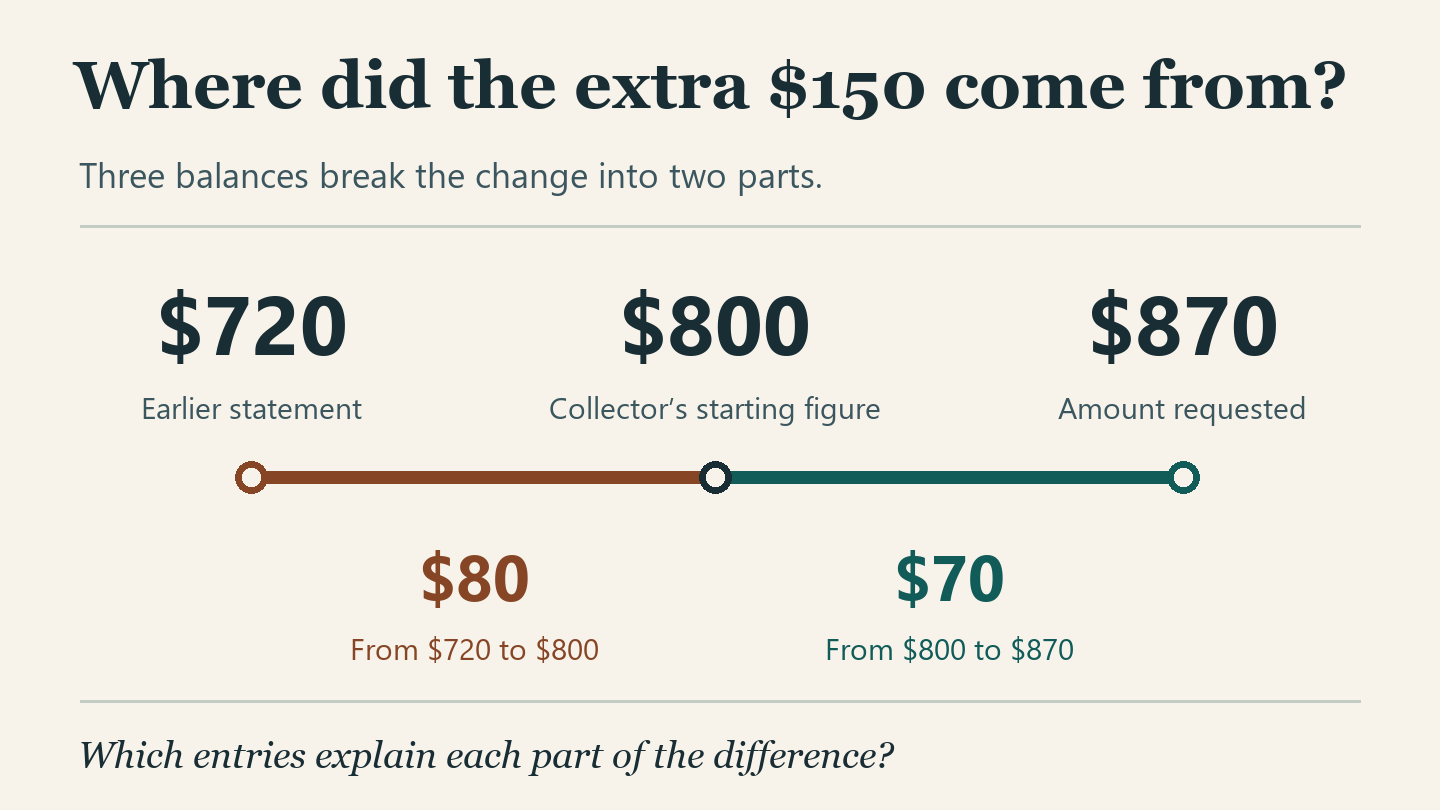
That suggests two useful questions for the person reviewing the account. Which entries raised the earlier $720 to $800, and which entries explain the last $70?
Now suppose Elena finds an old $50 credit slip. Before subtracting it again, she looks down the $720 statement for a matching credit from the same store.
If it already appears there, subtracting another $50 would count one return twice. If the slip is dated later, she needs the next statement to see where it landed.
A slip printed at the register establishes the date the store processed a return. Look for the later description on the card statement before deciding the credit never arrived.
Even a receipt with the right amount might belong to the other card. The date, account ending and description together make a better match than the store logo alone.
Elena can ask about the $150 without asserting that the exact remaining balance is due. Her old statement captures one point in the account’s history.
Under federal law, a timely written dispute pauses a covered collector’s efforts on the disputed portion until it mails verification or a copy of a judgment.
The validation notice shows the end of the thirty-day dispute period. Elena can circle that date and underline the separate Friday cutoff on the offer to hold the discount.
In her own notes Elena records what she actually questioned. A reply explaining the $70 would still leave a question about the $80 between the two starting figures.
Which missed payment belongs to this credit report?
Two friends remember making payments during a difficult year. Both have a bank record showing money left their checking accounts. Their monthly card statements tell different stories.
Mara’s January bill shows she fell behind. By March her account was current. She missed September’s payment, and the account stayed overdue through collection.
Inez still has her bank receipt from March. She owed arrears from January through collection, including after her March payment. Its amount matches the entry on her statement.
These histories point to September for Mara and January for Inez. You can see why by covering up the amounts and reading what each March statement says about arrears.
For an ordinary covered collection or charge-off, the seven-year reporting period begins after 180 days from the start of the delinquency immediately preceding collection or charge-off, under federal law.
That outside limit has exceptions and does not promise an exact removal day. Ask which month the company used before guessing when its entry will disappear.
Reassignment leaves the original delinquency date intact. Both accounts reached another company last summer. Their letters could bear identical dates despite the different histories.
Read what the field is called before alleging a reporting error. A heading recording when the company obtained the account would be consistent with the transfer letter in Inez’s file.
The more revealing comparison is between two fields that claim to describe the same event. Put the field name and the company’s explanation alongside the relevant monthly statements.
Without the March statement, look for a later bill that lists activity near the top of the page. A copy of April’s bill might include March’s closing figures.
A bank debit is helpful evidence that money left the account. It cannot tell you how the issuer allocated that payment between past charges and the current bill.
What changes when the governing state law is known?
These examples concern two separate borrowers. For each borrower, assume a qualified adviser has established which statute applies and confirmed the relevant period already expired.
New York’s consumer-credit provision generally gives three years for a covered action against a purchaser, borrower or debtor, subject to its listed exceptions.
Once that applicable period has expired, a subsequent payment, affirmation or other activity does not extend or revive it. The order of those events matters to the answer.
Suppose a payment request arrives today and a bank record shows money sent last winter. Nothing on the two pages alone establishes whether last winter fell before or after expiration.
There is a practical difference between remembering a transfer and knowing who received it. A receipt naming only a payment processor may leave the account and recipient unidentified.
Someone reviewing that history would need to know what event the first date represents. A family member’s recollection that the account was “about three years old” leaves that question unanswered.
Assume a buyer under Texas Finance Code section 392.307 and an already barred claim. The buyer cannot start suit or arbitration, and later payment or reaffirmation cannot revive it.
If reporting remains permissible, the first written notices differ. Both notices say the buyer will not sue. Buyers reporting this debt also disclose possible continued reporting as unpaid.
Once the reporting period has expired, the required notice says the buyer will neither sue nor report. Look for the part of the paragraph that addresses reporting specifically.
Imagine two relatives comparing letters at a kitchen table. One letter mentions possible reporting as unpaid. The second paragraph on the other letter ends a sentence sooner.
The relative with the shorter letter wants to know what a prospective landlord might see. To check her own file, she needs the report, not her cousin’s longer letter.
A company collecting on behalf of someone else might sign the letter. If ownership is unclear, note both names separately before asking which organization actually bought this account.
When court papers arrive alongside the collector’s reply
Suppose Elena receives two envelopes on the same afternoon. One answers her question about the $70. The other contains court papers concerning the same store card.
Both envelopes name the same company and amount. Elena’s collection reference appears on the business letter. The papers from the case also identify a court and a case number.
The CFPB’s court guidance says to follow the court papers’ instructions and response deadline. Ignoring a served case risks a default judgment even on an apparently old claim.
Mailing a dispute to the collector does not answer the lawsuit. Elena’s receipt names the collection agency and identifies its mailroom as the destination of her earlier letter.
If the instructions are unclear, a legal aid lawyer may help. Bring the papers themselves, including any sheets that looked like routine instructions.
For that conversation, Elena can show the specific $80 gap still unexplained. Someone seeing only her first question might assume she still needed an explanation for all $150.
Elena can flag the first page that shows the $800 balance. Include the heading so someone reading the number can tell how the collector described it.
A useful note for the appointment says when each envelope arrived and what was inside. That lets the adviser see which dates come from paperwork and which come from memory.
Which paper are you trying to understand?
My file contains an old card statement.
Look at the opening balance and the closing balance on the same page. Which one did you copy into your notes, and which one appears on the following month’s bill?
If the figures do not carry forward as expected, check the dates. Two apparently successive bills might have a whole billing cycle missing between them.
The collector enclosed a breakdown of the amount.
First check which account each figure covers. A heading might describe the amount on a single account, while a cover sheet gives a household total across two different cards.
Check the sign on a credit carefully. Adding a $25 refund when you meant to subtract it puts your result $50 away from the intended figure.
I have a printed credit report.
Keep the page above the entry if it contains the field definitions. A cropped photograph might show the year clearly while leaving out the words that explain its meaning.
The papers name a court and a case.
Read every page that shares the case number. Check whether a sheet printed on both sides contains a continuation of the instructions you saw on the front.
What to Do With the Papers You Already Have
- Pair each figure with its source and its date. Start with the oldest statement that actually matches the account, then add the collector’s breakdown beside it.
- Mark the particular entries that explain the difference. Leave room for an unresolved amount instead of balancing the numbers by inserting a fee you have never seen documented.
- Put each outstanding response on its own calendar line with the recipient named. Save what you sent beside any reply, so an answer about one question cannot close another accidentally.
- If you already made a payment, keep its receipt, the offer you accepted and any later statement. Tell your adviser exactly what happened before drawing conclusions about its legal effect.
Frequently Asked Questions
Which balance should I use if the statement is incomplete?
Identify the amount as the last figure you can document. Ask for the missing period between that statement and the next figure you can verify from your records.
Does missing the collector’s dispute period prove I owe everything?
Federal law prevents a court from treating failure to dispute during that period as an admission of liability. An unanswered letter cannot explain the $150 difference in Elena’s records.
What if a relative remembers paying the store for me?
Ask which card or purchase the relative meant and whether they kept a receipt. A gift toward a different purchase could explain their memory without changing this account.
What if the account disappears from my credit report?
An absent entry supplies no evidence of a settlement. If you reached an agreement, find its terms and check your records for the payments the agreement actually called for.
What if I moved after opening the account?
Tell a lawyer about the move and bring the agreement. Write down the dates and places you know, leaving gaps wherever the records cannot support a more specific answer.
What if a reply encloses a statement I already have?
Compare the pages before setting them aside. A duplicate of the front page might arrive with a new reverse side that identifies an adjustment missing from your earlier copy.
The Bottom Line
Decide what your next old debt letter needs to explain. The offer on Elena’s desk cannot explain a missing credit, establish an account’s history or answer a court case.
If money already changed hands, match the receipt to the next statement. Keep any unexplained balance beside the supporting figures, so the next conversation starts with the actual discrepancy.

Join the discussion
0 commentsShare your experience or ask a question about this article.
Community experiences
Did this happen to you?
Your experience could help someone recognize the same scam. Submit a private report for our team to review.
I experienced this tooReports are reviewed before publication. Sharing publicly is always your choice.
Discussion
Start the conversation
Have a question or something useful to share? Add the first comment.