


After a relative dies, a credit card statement can arrive for an account nobody in the family remembers. Before anyone pays, find out when the account was opened.
A surviving spouse or estate representative can protect the person’s credit file while investigating the bill. Each request goes to a different organization and requires its own evidence.

Overview
Confirm who is handling financial records
Begin with the person authorized to act. A daughter who found a letter in the mailbox can preserve it for the executor without having to obtain her father’s credit report.
When a spouse or legally authorized representative reports a death, Equifax’s instructions distinguish proof of the death from documentation identifying the person making the request.
Decide what you want the recipient to do
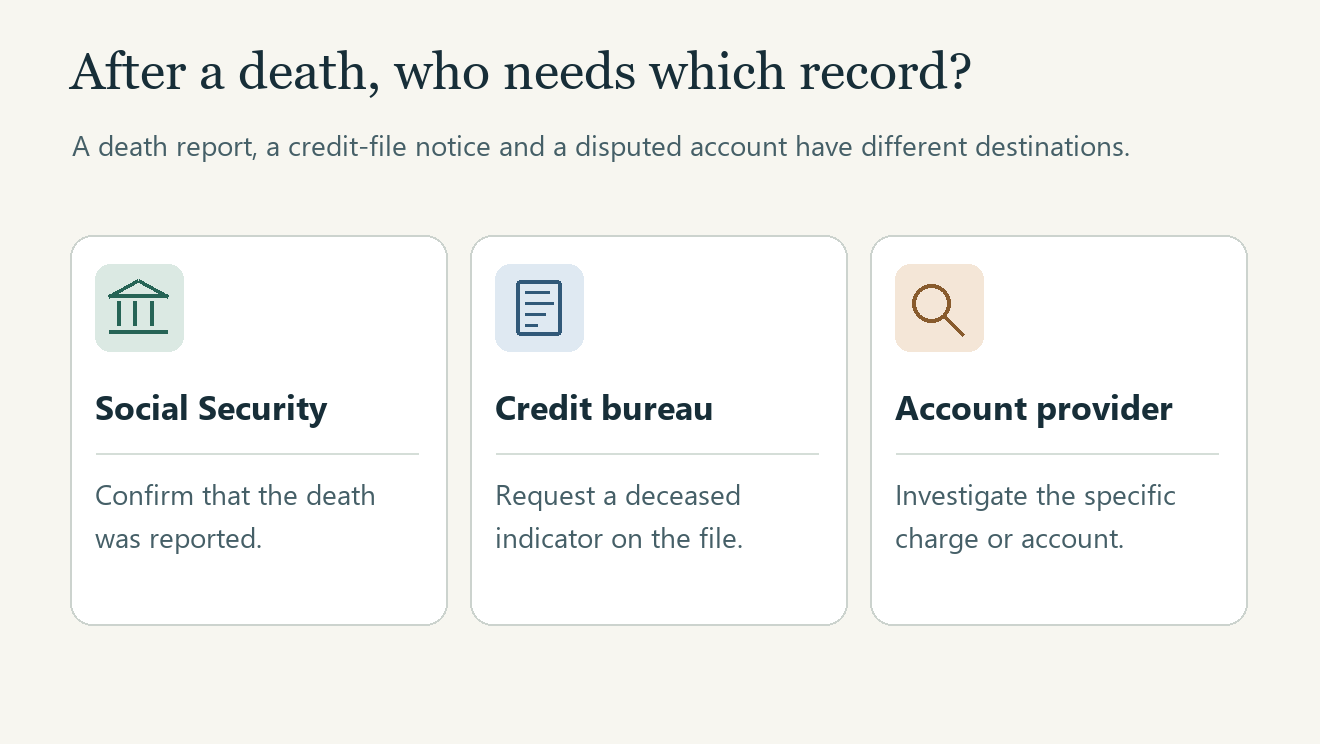
A funeral home usually tells Social Security about a death. The Social Security Administration’s instructions explain what to do when a funeral home did not make that report.
A credit bureau can mark an individual’s file. The lender that opened an unfamiliar account has a different job, investigating who applied and what happened on that account.
Keep the initial questions small and specific
- Ask whether the funeral home reported the death before arranging another call about the same record.
- Identify which bureau received the request to add a deceased notice and where its written confirmation should arrive.
- For a suspicious bill, separate the date on the envelope from the purchase date, opening date and account holder’s name.
Establish your authority before requesting private records
Imagine three siblings cleaning out their mother’s home. One has the death certificate, one paid the funeral bill, and one has court papers appointing her executor.
The first two can tell the executor what they found. Finding a Social Security card or being the person who organized the funeral does not establish authority over credit records.
Experian’s guidance for surviving relatives identifies a surviving spouse or legally authorized representative, such as an executor. It calls for court documentation when the requester is not the spouse.
If several relatives are helping, choose one contact address for the authorized person. That makes it easier to recognize a reply and spot an outstanding request.
Equifax’s death-notification instructions ask for the deceased person’s legal name, Social Security number, birth date and death date, plus the requester’s identification and return address.
Equifax also asks a requester who is not the spouse for court documents showing their authority. The bureau lists its current mailing destination on the same instructions page.
A death certificate establishes that a death occurred. It does not tell the recipient which sibling, business partner or friend may see the person’s private borrowing history.
Someone who handled banking during life may still have a signed power of attorney in a drawer. Obtain confirmation of estate authority before relying on that document after death.
If the institution wants proof you have not yet obtained, ask exactly which document is missing. Leaving the request with the estate representative beats signing under the wrong role.
For example, a surviving spouse may want an adult child to organize envelopes. The child can index the correspondence while the spouse handles the bureau’s identity and relationship requirements.
Report the death to the organization maintaining each record
Confirm whether Social Security has been told
Social Security says to call if no funeral home was involved or the funeral home did not report the death. Have the deceased person’s identifying details available.
The agency specifies the name, Social Security number, birth date and death date. If you live abroad, use its separate instructions for people outside the United States.
Ask the funeral director a narrow question about this particular death. A statement that the home usually makes reports is less informative than an answer identifying your relative.
Record the answer and when you received it. You can then explain to another family member why you are calling Social Security or why that step was already handled.
A Social Security report does not supply your family with a copy of anyone’s credit report. Keep a question about a department-store account for the issuer or credit bureau.
Ask a credit bureau to mark the individual’s file
Equifax says that once one nationwide bureau adds a deceased notice, it notifies the other two. The authorized person can start the notification with one bureau.
Experian instructs the requester to obtain a certified copy of the death certificate and retain the original. Follow the chosen bureau’s requirements when preparing its packet.
TransUnion’s death-reporting guide describes a confirmation letter after it processes the request. Keep that response with the notification you sent and note which bureau issued it.
Use the spelling on the records and check the return address before sealing the envelope. A missing apartment number can complicate receipt of an otherwise properly addressed confirmation.
If you have no confirmation, ask the bureau that received the request what it still needs. A carrier’s delivery record documents arrival, without establishing acceptance of the request.
Understand what a deceased indicator changes
TransUnion’s guidance on deceased credit files says a lender requesting the file sees the death information. TransUnion does not offer a freeze or fraud alert on that file.
The indicator gives a creditor reason to question a new application. It cannot tell you whether an older card was used or whether a disputed transaction was refunded.
Suppose a credit bureau confirms it added the notice on Friday. That letter cannot answer whether a lender approved an application on Wednesday, before the notice was recorded.
Contact that lender separately if you have evidence of such an application. Filing another death notification does not explain the outstanding account or initiate the lender’s fraud investigation.
Request the reports you actually need
Equifax’s credit report instructions direct the spouse or executor to request each bureau’s report individually. One death notification does not deliver three reports.
Its report request includes the last known address, identifying details and documentation of death or testamentary authority. An executor must also show documentation of the executor’s role.
TransUnion asks a spouse seeking its report to identify their relationship and provide a mailing address. Its instructions for an executor or other representative require additional documentation.
Follow the specific provider’s current page for the action you need. A mailing address for one company’s notices should not be assumed to accept another company’s report requests.
Keep a list of which reports have arrived. If only one company has replied, label the file with that company’s name instead of treating it as the entire record.
Read the account section with old statements nearby. Look for the issuer’s name, identifying account digits and any available opening date before chasing an unfamiliar retail brand.
A familiar store name on a receipt can appear differently on a statement. Ask the named institution to confirm a connection rather than relying on a resemblance between two names.
Two reports can also describe what appears to be the same account. Match the issuer and account details before recording two separate suspected losses in the estate’s notes.
Match the date to the question
| Date in hand | What it can help establish |
|---|---|
| The statement was issued after the death | When the lender prepared that statement, irrespective of when a purchase occurred. |
| The purchase took place before the death | Whether an earlier receipt or household record explains the charge. |
| The application was dated after the death | Which event to ask the lender to verify as possible identity misuse. |
| Death notice confirmed by a bureau | When that bureau acknowledged its own action on the file. |
Three situations that look alike in the mailbox
The bill is new but the purchase predates the death
Lena receives a furniture store statement on August 18. Her spouse died on August 5, but the line she recognizes is a July 29 purchase.
She finds a dated delivery receipt for the same amount. That supports an earlier purchase even though the first monthly statement arrived after the funeral.
Lena checks whether the statement lists anything else. Matching one charge does not explain a second line or establish that Lena personally owes the balance.
The CFPB’s explanation of debt after death says debts are generally paid from the estate. Co-signing, joint responsibility and some state-law exceptions can change a survivor’s obligations.
She gives the statement and receipt to the person handling estate bills. She can still report a separate unexplained purchase without describing the entire account as fraudulent.
A welcome letter names a newly opened account
Another family finds a card issuer’s welcome letter addressed to their father. The printed date falls after his death and there is no familiar account number.
The executor obtains the bank’s contact information independently and asks what the date represents. A replacement card on an older account is a different event from a new application.
If the issuer confirms an application dated after the death, the executor can give its fraud department the date of death, the disputed opening and proof of authority.
The California attorney general’s guidance recommends putting suspected fraudulent opening or use in writing to the affected creditor or collector. Identify the account or activity as specifically as possible.
Ask what the institution will investigate, how the representative can supply documentation securely and where written findings will go. Keep the reference separate from the bureau’s death-notification reference.
If the lender confirms an unauthorized new account, request written confirmation of its disposition and any correction it sends to reporting companies. Review the affected file for that specific change.
The surviving borrower recognizes a joint account
Marcus and his late wife borrowed together. The latest statement still shows both names and includes a payment they arranged before her death.
Marcus asks the lender to confirm how its records describe his role, how payments should continue and which documents it needs to update the account.
A joint credit card holder and an authorized user have different legal positions. The CFPB also identifies co-signers and certain state-law obligations as exceptions to the general estate rule.
A card bearing Marcus’s name would show he received a card. It would not, on its own, establish the terms under which he used it.
He saves the agreement, the lender’s answer and the payment history. A blanket request to close everything could interfere with an account he still needs to manage.
What to Do If You Find an Account You Cannot Explain
- Preserve the notice and write down the precise event in question. Identify the account’s opening, a later purchase or a reported balance instead of alleging that everything is fraudulent.
- Have the authorized person contact the creditor through an independently verified channel. Ask for its fraud or estate department and explain why the dates or ownership appear inconsistent.
- Ask the creditor which documents it needs to review that event. Keep originals secure, retain copies of the request and use the recipient’s designated method for sensitive documents.
- If the entry appears on a credit report, dispute it with the bureau displaying it. Identify the source company and the particular record or transaction you are challenging.
- Keep the creditor’s findings and the bureau’s reply separately. Check whether each response addresses the item you reported and whether the correct person’s file reflects the outcome.
For a TransUnion dispute, give the deceased person’s legal name, the reporting company, the partial account number shown, the reason and supporting documentation, including the requested death and authority evidence.
A response that says the person was marked deceased addresses the flag. If the unfamiliar account still appears, ask for a response to the account dispute itself.
The FTC’s debt collection guidance for families explains that collectors can contact certain people about estate debts. A relative’s ability to take a message does not make them personally liable.
If a caller pressures someone for payment, record the claimed creditor and reference. The representative can verify the obligation without disclosing family records to that caller.
Frequently Asked Questions
Can an adult child request a parent’s report just because they have the death certificate?
Being an adult child does not establish estate authority. Identify the surviving spouse or legally authorized representative and follow the chosen bureau’s documentation requirements before requesting a report.
Do all three credit bureaus need separate death notices?
Experian says the bureau receiving the notification informs the other two. Keep the first bureau’s confirmation and seek the individual reports you need to verify particular entries.
What if a bill lists only a statement date?
Ask the issuer for the date the account was opened and the date of the disputed activity. Until then, the statement alone cannot establish an unauthorized event after death.
Will a deceased notice automatically close a jointly held card?
The bureau’s notice updates the individual credit file. Ask the lender about the joint account’s status, the surviving holder’s obligations and the next payment under its agreement.
Should the family use a deceased relative’s online account to pull reports?
Use the bureau’s route for a spouse or representative. A saved password does not demonstrate your authority, and the official request supplies a separate record of who asked.
What if the bureau replies but the creditor does not?
Keep the bureau’s dated response and follow up with the creditor using its reference. Ask what remains under investigation and how the authorized representative can obtain its written findings.
The Bottom Line
Report the death through the appropriate channels, then review unfamiliar accounts by their opening and transaction dates. Keep the bureau’s death confirmation separate from any decision about disputed activity.
When a particular account still looks wrong, the authorized representative should approach its creditor and the bureau showing the entry. Verify the resulting correction on the relevant record.

Join the discussion
0 commentsShare your experience or ask a question about this article.
Community experiences
Did this happen to you?
Your experience could help someone recognize the same scam. Submit a private report for our team to review.
I experienced this tooReports are reviewed before publication. Sharing publicly is always your choice.
Discussion
Start the conversation
Have a question or something useful to share? Add the first comment.