


The leasing office says a housing court case turned up on your tenant screening report. You recognize the county, but the address looks unfamiliar.
Before explaining anything to the landlord, get the entry in front of you. A street name, a date and a few missing words can change which question you need answered.
Overview
Start with the version the landlord saw
Ask which screening company supplied the report and when the landlord received it. Save the version showing the disputed entry, including the page that explains its headings.
Identify the court behind the entry
Copy the court name and the entire case number onto one line. Leave a blank wherever the company has omitted a detail that you need to check.
Decide which part of the entry you question
- If the address looks wrong, start by comparing the property and parties with your own rental history.
- If you recognize the dispute, find the document that says how the court resolved it.
- If the report lists several cases, group the rows by court and full case number before counting them.
Get the report behind the rental decision
A leasing agent might say that a background check is the reason you need a cosigner, even though the apartment is still available. Write down exactly what the agent said.
The Consumer Financial Protection Bureau’s rental guidance explains that report-based adverse action can include a denial, a larger deposit, a higher rent or a cosigner requirement.
The landlord must give an adverse-action notice when information in the report contributed to the decision. The notice may be oral, written or electronic.
Use the screening company’s name, address and phone number from the notice to request your copy. If the landlord told you by phone, ask for the details in writing.
The federal free-disclosure provision gives you a free copy from the reporting company if you request it within 60 days after you receive the adverse-action notice.
Save the email or note the day of the call. That date belongs next to the report request, while a hearing date belongs on your court calendar.
Ask the leasing office which line raised the concern. If its answer is simply “housing records,” request the page or item number so you can investigate the same information.
The office may have seen an earlier version than the one you receive. Keep both dates visible if the company’s copy already shows a change the landlord hasn’t seen.
Check whether the case involves the right renter
Imagine that Sam receives a report about an apartment on Lake Avenue. Sam rented on Lake Street for the same two years and has never lived on Lake Avenue.
A parcel map showing two different streets can help Sam read the addresses, but it cannot establish who signed either lease. His own lease identifies his building and unit.
Sam writes down the property on the report, the property on his lease and the dates each document covers. He keeps the original spelling, including the street suffix.
The report has abbreviated the defendant’s first name to an initial. Sam asks which court supplied that item and which details the screening company used to match him.
Another person’s information can appear in a tenant background check. A shared name is a reason to check the match carefully before claiming somebody used your identity.
Look at the role beside the name. When several people appear on a case, an entry mentioning your building or former roommate may still concern a different person.
Suppose the mailing address on an old letter belongs to a forwarding service. Mark it as a mailing address instead of treating it as the rental property in dispute.
A lease with a different address is especially useful when it covers the exact month questioned. A lease signed years later tells the reviewer considerably less about that month.
Sam can say which address he occupied and attach the relevant lease page. He cannot tell the company who lived on the other street or whether that person owed rent.
Read what happened after the filing
A filing records a request for the court to act. The Government Accountability Office’s eviction research explains why a filing or judgment alone cannot establish that someone physically moved out.
Ask what the report’s date represents. A landlord can refer to the date a case began while a renter is looking at the date the judge signed the final order.
Picture a report with a February filing, an April hearing and a May order. All three lines name the same court, case and rental property.
The May order in this example says the landlord’s case was dismissed. The February entry is accurate as history, yet it leaves the reader with an incomplete picture by itself.
The CFPB’s guide to checking rental background reports tells renters to look for the disposition, meaning the status or outcome, and to flag a missing dismissal.
In a case involving two tenants, check whether the order names both people or just one.
If the available entry says only that a hearing was scheduled, keep the result open. A calendar listing gives you a date to search without telling you what happened there.
Suppose your copy contains a proposal signed only by one party. Ask for the document the court actually entered before describing the proposed terms as the court’s decision.
The figure beside the claim needs a label. Compare the amount the landlord requested with any amount the judge actually awarded before calling it a money judgment.
Even when the order awards money, look for separate language about possession. A number beside someone’s name cannot answer the specific question of who occupied the apartment afterward.
Count cases by court and number
Two collections of paper can produce the same three dates for entirely different reasons. Spread the pages out and copy the identifiers before arranging anything by date.
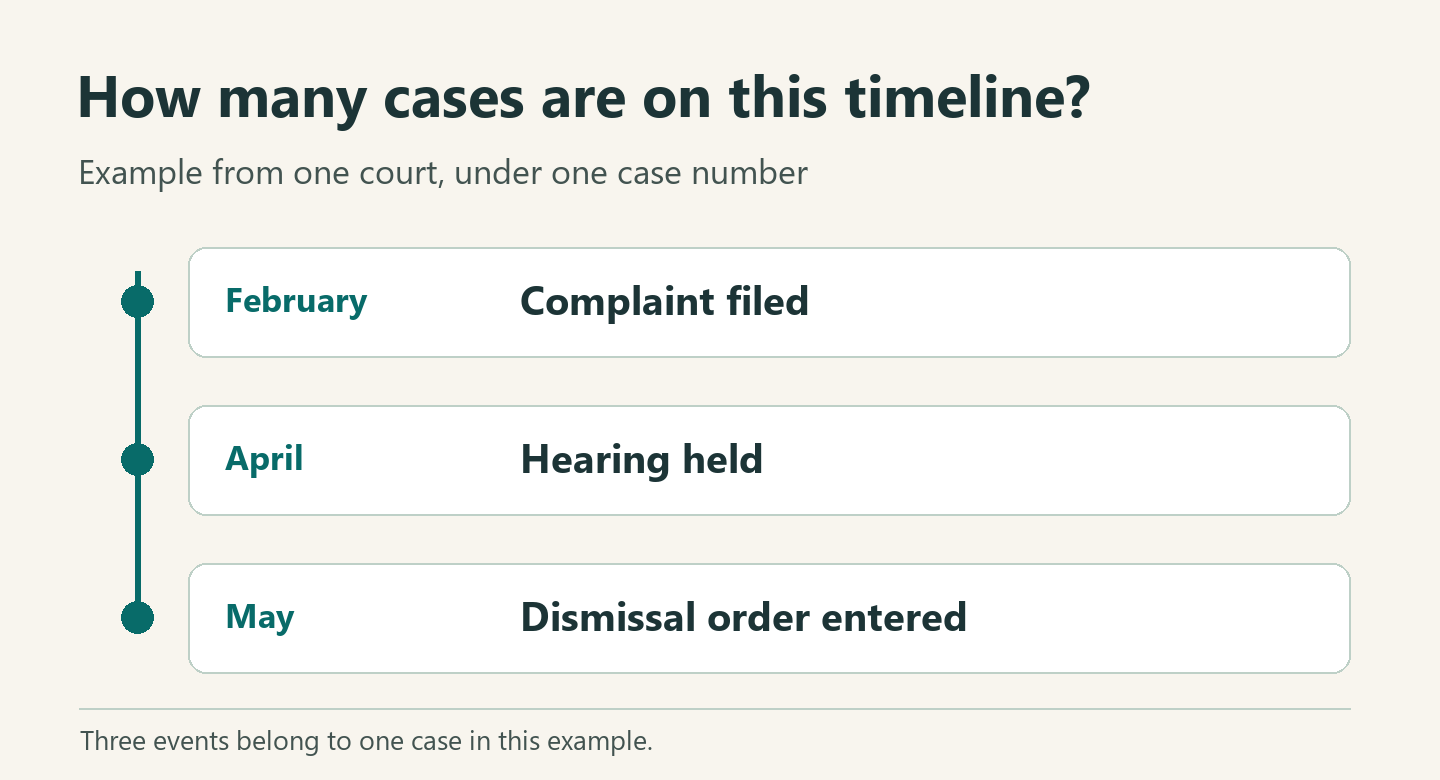
Different stages of one proceeding can appear as multiple evictions. In the February example, the three matching identifiers give you a way to test the report’s count.
Write the three events on one sheet and put the May order beneath them. Then compare the number of distinct case identifiers with the summary shown to the landlord.
Now change one fact in the example. The April row comes from a different county, even though the short number printed beside it looks identical.
Keep that row separate until you have the complete reference from each court. A year prefix or a group of letters may have disappeared when someone shortened a number.
Conversely, a second row may quote the first case inside the description of another proceeding. Ask which case the row itself describes before treating a referenced number as another filing.
Two dates alone may leave the comparison unresolved. If the vendor omitted both court names and case references, ask for the source of each row.
Use a court record that answers your question
A case register, sometimes called a docket, is a starting point for locating the document you need. A register records events and may omit the documents themselves.
Use the court named in the report to find its official records office. Ask how to obtain the particular order, using the court name, case reference and approximate entry date.
Try a specific question when the register is hard to read. For the February example, ask how to get the order associated with the May entry in that case.
Keep the date of your search with your notes. A report prepared in April and an order entered in May describe records from different moments, even when both are accurate.
When an Oregon court has already sealed the case
The Oregon Judicial Department’s court records guide distinguishes basic case information from copies of the case documents.
Oregon’s eviction set-aside guidance explains how to request a copy of an existing sealing order if a private background check still shows the case.
A missing public search result alone does not confirm sealing. Check which court handled the matter and whether you searched under the name used in the case.
For someone who already holds the order, the useful comparison is between the court and number on that order and the entry still visible on the private report.
Ask the screening company to correct the entry on the strength of the order. Check how to provide the necessary proof without circulating the contents of a sealed file.
This Oregon example begins after the court has acted. If you want to change access to an existing case, ask the court that handled it about local options.
What if the court search returns several possible matches?
Start with your own papers and work outward. An old notice with the full number can separate two entries that have the same surname and filing month.
If you still cannot choose between the results, tell the screening company that. Ask for the reference behind its entry before ordering somebody else’s case documents.
What to Do About an Error on Your Tenant Screening Report
The federal reporting law lets you dispute an item’s accuracy or completeness with the company that maintains your file.
Describe each disputed item on its own.
| What you found | Evidence to compare | What to ask for |
|---|---|---|
| The rental address points to another person. | Compare the property and dates with your own lease. | Ask the screener to investigate the match to your file. |
| The report ends at the original filing. | Compare the final order with the report’s stated outcome. | Ask the screener to add the missing case disposition. |
| Several rows appear under a single case number. | Check whether court, parties and events match throughout. | Ask how many distinct cases the summary actually counts. |
| A private entry survives an Oregon sealing order. | Compare the exact court and number on both documents. | Ask for correction using proof of the existing order. |
For a mistaken match, name the disputed address or party role and explain how it differs from your records. Give the reviewer a page they can check.
For the missing May order, put the court reference and the report item in the same sentence. State what the order says and identify its date.
Send the screening company copies of the records supporting the dispute. Choose the pages that identify the case and establish the point, including enough context to read the order accurately.
If the court’s own record contains the discrepancy, ask that court or its self-help office how to correct it. Describe the conflict between the register and your copy.
Disagreeing with a judge’s decision raises another question. Seek local legal help about challenging the decision itself and check any deadline on your court papers while the screening dispute proceeds.
Follow the row into the next report
- Save your marked comparison beside an untouched copy of the screening report, so you can reconstruct exactly what you challenged.
- When an answer arrives, locate the disputed address, case count or outcome in the revised document and read the full line again.
- Give the landlord an updated report or ask the screening company to send it. Confirm which version the leasing office will consider.
A reply that the source has been verified still leaves room for a concrete question. Did the reviewer check the identity match, the existence of the filing or the outcome?
For example, verifying that a February case exists leaves the missing May dismissal unanswered. Point back to the exact field and document that your first request identified.
Frequently Asked Questions
What if I recognize the landlord but never rented that unit?
A property manager may appear on paperwork for more than one building. Compare the address, apartment number and dates on the specific case with the lease you actually signed.
Does a dismissed filing mean the court sealed the case?
Dismissal and sealing answer separate questions about outcome and access. Look for a sealing order before describing the case as sealed.
What if the order has the right number but a different name?
Check the caption and each named party before drawing a conclusion. A familiar number without the right court and person leaves the connection to your application unresolved.
Can a receipt for rent prove the case was dismissed?
A receipt links a payment to a date and amount. Read the court’s order to find out how the case ended, even if the receipt covers everything the landlord requested.
What if I have a hearing while the report is disputed?
Keep the hearing on your calendar and follow the court’s instructions. Ask the court or local legal aid about the deadline yourself if anything on your papers is unclear.
Will the landlord hold the apartment while I check?
Ask the leasing office whether it will keep your application open and how to submit an update. Save the answer alongside the date the office expects to make its decision.
The Bottom Line
Match the line on your tenant screening report to the court, case and person. A dated order gives you something concrete to say about the outcome.
Ask for the change your documents support and check the next version yourself. Send the corrected information to the landlord and keep any separate court dates on your calendar.

Join the discussion
0 commentsShare your experience or ask a question about this article.
Community experiences
Did this happen to you?
Your experience could help someone recognize the same scam. Submit a private report for our team to review.
I experienced this tooReports are reviewed before publication. Sharing publicly is always your choice.
Discussion
Start the conversation
Have a question or something useful to share? Add the first comment.