


Your brokerage asks for a trusted contact, while your daughter offers to take the bills off your hands. Both sound like practical ideas for a busy month.
Before anyone adds a name to an account, it helps to picture what that person would actually do on an ordinary Tuesday.

Overview
The task your helper can take home
Start with the last piece of financial paperwork you put aside. Perhaps the print was hard to read, a charge looked unfamiliar, or a check needed your signature.
Would larger print or a reminder earlier in the week solve the problem? Try the simplest adjustment with that bill in front of you.
The call your brokerage might make
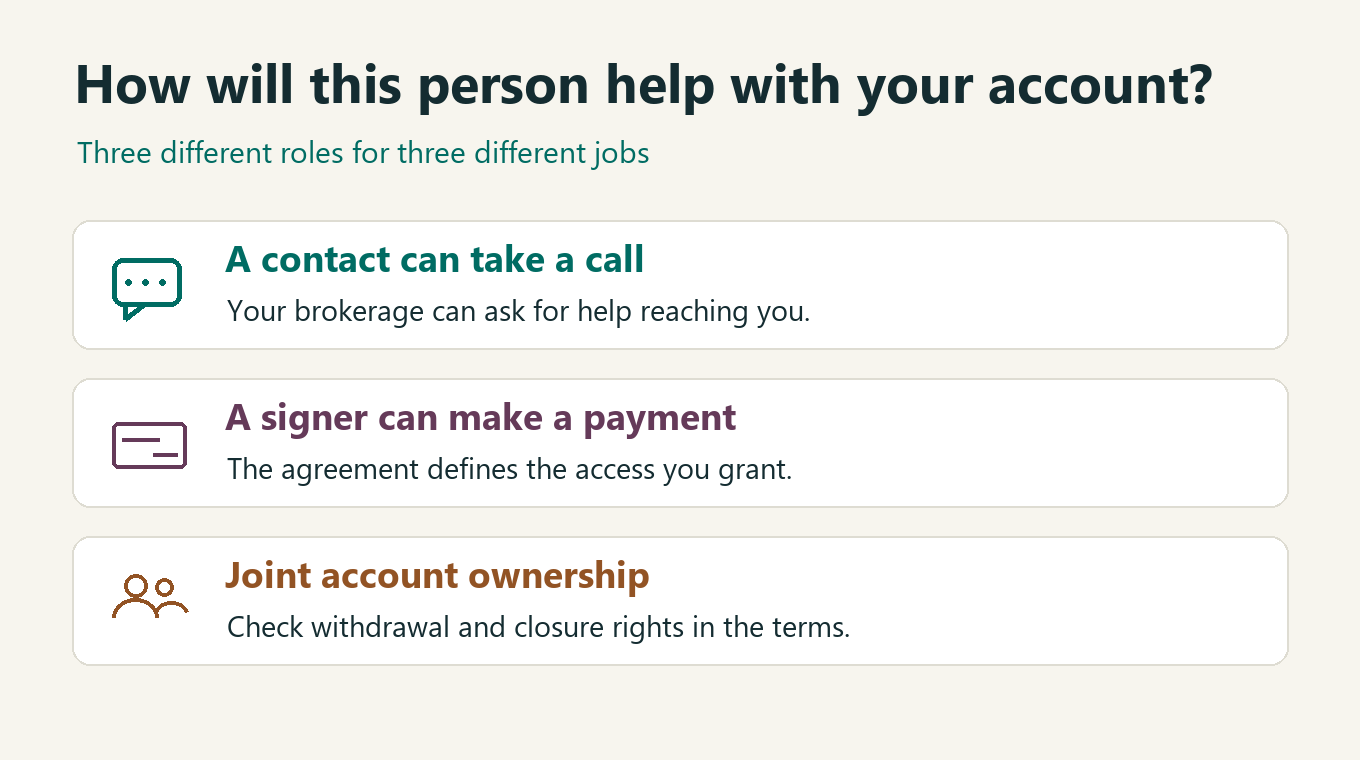
A trusted contact gives your U.S. retail brokerage someone to approach in limited situations, including a concern about financial exploitation or trouble reaching you.
The contact can help the firm reconnect with you. The designation alone gives them no power to place trades, demand your balance, or decide what happens to your investments.
The words that can change a checking account
Before you speak to the bank, write down the errand you have in mind. Bring a recent bill if seeing the payee and amount would help explain it.
Before a conversation with either institution, jot down which of these requests sounds most like your own.
- I want another pair of eyes on the two electric bills that arrived together.
- I want my broker to have another way to find me if my usual number stops working.
- A contractor needs payment during my recovery, and the due date falls before my next appointment.
- I intend to share ownership and want to understand what that means for both of us.
When the brokerage cannot reach you
Imagine that Lorraine goes to stay with her sister for the summer. Her new phone works, but her broker still has the landline number for her empty apartment.
Lorraine has named her neighbor Ben as a trusted contact. If the firm calls him, he can pass along a request for Lorraine to contact her broker.
If Lorraine’s sister answers the phone, Ben can simply ask her to pass along a message. Lorraine can decide where to make the return call in private.
If Ben last saw Lorraine a month ago, that is all he can reliably say. Someone else can speak to her whereabouts more accurately.
Under FINRA Rule 4512, firms must make reasonable efforts to obtain an adult contact for eligible accounts. A retail customer may decline and still open or maintain the account.
The firm provides written disclosure about when it can share account information with the contact. Permitted purposes include checking current contact details or identifying an existing legal representative.
The joint investor bulletin on trusted contacts explains how to add or update someone through your firm. You can choose an adult outside your family or name multiple people.
Think about who can reach you if your phone goes missing. A relative who knows only that same number may be less helpful than the neighbor who sees you weekly.
A good candidate also understands when to keep quiet. If Ben would tell everyone at the next block meeting, Lorraine may prefer a friend who lives further away.
Talk about how a genuine call might unfold. Ben can take the caller’s name, then use the number on the firm’s own website to reach the office independently.
A request to send cash, read back a sign-in code, or approve a sale gives Ben a concrete reason to end the conversation and alert Lorraine directly.
The designation provides no promise that somebody will call ahead of every withdrawal. If Lorraine suspects a transfer is already underway, she should contact the brokerage immediately herself.
Sharing the work while you keep the pen
At breakfast on Sunday, your son finds two envelopes from the water company. You remember paying one bill, and the amounts are close enough that either could be it.
He can put the service dates side by side and find the matching entry on the statement you show him. You decide whether a balance remains due.
In the CFPB’s guide to family banking help, the helper sorts bills while the account owner signs checks.
Choose what goes into that Sunday pile. Someone who checks the water and electric bills doesn’t need to see a brokerage statement tucked into the same envelope holder.
You might keep three ordinary folders for bills awaiting your attention, payments you have approved, and charges you want to question. Put the payment date on your own copy.
When a company sends a reminder, your helper can find the dated copy before placing the reminder in the unpaid pile. That simple habit can prevent a duplicate payment.
If you prefer online banking, let the helper organize the paperwork beside you while you enter your own sign-in information and confirm the amount on your screen.
Ask whether the arrangement still works when one of you is away. Perhaps a different afternoon solves the problem, or perhaps a payment genuinely needs somebody else’s signature.
Consider those possibilities before making a permanent change for a temporary scheduling conflict. Missing a bus to the bank presents a different problem from needing someone to manage ongoing payments.
When someone else really needs to pay
Suppose Ellis is recovering from hand surgery and wants his niece Maya to pay his household bills during recovery. He expects to make spending decisions throughout.
Sorting the envelopes won’t cover the week the heating contractor needs payment. Ellis could bring the invoice to the bank and point out the due date.
A convenience or agency account can let a helper deposit or withdraw funds and write checks while the original owner keeps ownership.
This arrangement alone gives Maya no right to keep the money when Ellis dies. Ask whether the bank offers it.
Ellis may be comfortable with Maya writing a check to the contractor but uneasy about her making a cash withdrawal. He should ask whether the bank can enforce that distinction.
If Ellis has a spending limit in mind, he should write it down before the meeting. Ask the representative where that limit appears in the proposed terms.
Give the representative an imaginary bill for $380. Who could sign today, what proof would the bank require, and where would Ellis see the payment afterward?
Then change just one detail in the example. If the payee were Maya herself, would the bank see or handle that transaction any differently under the proposed arrangement?
Ellis can match the invoice amount to the statement and note when the check cleared. A check image, if available, lets him compare the named payee with the invoice.
If the payee looks unfamiliar or the statement gives only a check number, Ellis can ask the bank to help identify the entry.
To make oversight manageable, Ellis could look at every payment from the recovery period alongside the original bills. An unexplained check deserves attention even if the monthly total looks right.
What changes when the helper becomes a joint owner
The words on the bank’s paperwork matter more than what a family calls its arrangement. Ask the representative to identify the section naming the owners before anyone signs.
The CFPB’s explanation of joint checking says that in most circumstances either owner can withdraw the money and close the account. Your agreement and state law matter.
Picture a joint checking account with $4,200 set aside for rent and groceries. A relative offers to help by adding their name and settling one overdue electric bill.
If the agreement allows either owner to withdraw the entire balance, the amount of that electric bill sets no ceiling on the other owner’s access.
Ask what would happen to next month’s rent payment if one owner closed the account today. It is easier to plan while the payment is still weeks away.
A family might genuinely intend to share ownership. Each person should understand what happens during their lifetime and ask how the account handles funds after an owner’s death.
If someone’s goal involves inheritance, put that question to a qualified local lawyer before signing. A casual assurance that the family will sort it out later settles very little.
Choosing an agent for a defined job
A financial power of attorney lets an agent act for you within the authority the document grants. A short assignment and planning for possible future incapacity call for different conversations.
Durable authority generally continues if you lose capacity. Ask a qualified lawyer about scope, timing, safeguards, and how your state’s law applies to your situation.
Consider two families facing very different errands. One person needs a roof repair paid during a trip, while another wants help managing multiple accounts over an extended period.
Bring the actual bill or a short list of accounts to the conversation. It helps the lawyer hear what you want accomplished and which decisions you intend to keep.
The CFPB’s overview of powers of attorney discusses requiring an agent to report transactions to another person. Think about whom you would trust to read those reports.
Suppose the agent records a single $600 expense for repairs. A dated invoice, payee name, and payment confirmation give the reviewer enough information to ask about an unfamiliar contractor.
It also helps to agree how the reviewer can reach you privately. If all questions pass through the person making the payments, a disputed charge becomes harder to discuss.
Keep the bank involved in the practical details. Ask how it will identify the agent, what it needs to see, and how the agent should sign when acting for you.
A lawyer can explain how to change or revoke the document. Ask each institution how it records a change and how you can confirm it received the proper notice.
Compare the choices against a real errand
Pick the row that resembles the job you have in mind. Take its question to the person or institution that can answer for your circumstances.
| Your goal | Arrangement to discuss | A question worth asking |
|---|---|---|
| Sorting household mail | Informal help while you sign | Which papers do we need for today’s bills? |
| Another contact for my broker | Brokerage trusted contact | Could this person reach me another way? |
| Checking-account payment assistance | Bank convenience or agency arrangement | Exactly which withdrawals could my helper make? |
| Appoint someone for specified financial affairs | Financial power of attorney | Which decisions would this document give my agent? |
| Shared account ownership | Joint ownership | Could either owner withdraw everything or close it? |
What if the same person has two roles?
It is possible to describe someone’s role differently at different institutions. Write the account and the actual appointment side by side to avoid giving the wrong answer in a hurry.
If your sister has two roles, keep each institution’s paperwork with its own statements. Which folder contains the authority relevant to today’s question?
If the broker calls about reaching you, her checking-account paperwork doesn’t explain what she may do at the brokerage. Direct questions about additional authority to the firm holding that account.
What to Do Before Signing or After Granting Too Much Access
- Describe one actual job for the helper and one decision you want to keep. Bring both examples to the appointment so the representative can address the difference.
- Request a copy of the proposed terms and locate the words identifying the owner, signer, contact, or agent. Ask about any description that conflicts with your intentions.
- Find out how you would see activity afterward. Choose who will receive statements and how you will check the first payment against the bill.
- If you already signed something broader than intended, obtain the current agreement and ask the institution what changes are possible and whose consent it requires.
An unfamiliar withdrawal makes this more urgent. Use the institution’s independently verified contact information to report the transaction, note the amount and date, and ask what it can do now.
Preserve relevant statements, messages and signed papers. Follow the institution’s instructions for disputing the transaction and get case-specific legal advice if ownership or the agent’s authority is in dispute.
Frequently Asked Questions
Can my brokerage insist that I pick a relative?
The trusted contact can be another adult you trust. Think about privacy and availability as well as whether the person is comfortable hearing from a financial firm.
Can a trusted contact check my balance for me?
The designation gives someone no independent right to balance information. Ask the brokerage about an appropriate separate arrangement if reviewing statements together no longer meets your needs.
Does my bank have the same trusted contact rule?
Ask which account you are discussing, especially if banking and investment accounts carry the same brand. The retail brokerage rule concerns the brokerage relationship.
What if I have nobody nearby to sort bills?
Ask your local Area Agency on Aging about money management programs and whether a recommended provider is insured or bonded.
Who should attend my conversation with the bank?
You can bring someone who helps you remember details and still ask for time alone with the representative. Use that time to explain your own wishes without interruption.
How do I tell a former helper their job has ended?
Say exactly which tasks have stopped, then collect household paperwork and verify current permissions with each institution. A conversation at home cannot tell you what the bank’s records show.
The Bottom Line
Choose a trusted contact when your brokerage needs another person to reach. Keep signing for yourself when help with paperwork is enough, and grant only the payment authority you understand.
If a helper already has more access than you intended, get the signed arrangement from the institution today. Report any questionable movement of money promptly through its verified channel.

Join the discussion
0 commentsShare your experience or ask a question about this article.
Community experiences
Did this happen to you?
Your experience could help someone recognize the same scam. Submit a private report for our team to review.
I experienced this tooReports are reviewed before publication. Sharing publicly is always your choice.
Discussion
Start the conversation
Have a question or something useful to share? Add the first comment.