


An email says your address came up in a drawing for $450,000. You don’t remember entering, but the message presents the result as official.
Before contacting the person named in the notice, ask who ran the drawing. A real promotion should have an answer that doesn’t depend on replying to the email.
Overview
The prize is presented as a government-backed result
The Online Promotional Sweepstakes email scam says the recipient was randomly selected to receive $450,000. It presents the amount as a first prize that is ready for verification.
The sender links the claim to government work and names a person described as a validating officer. The requested contact is a consumer email account, not a verified agency channel.
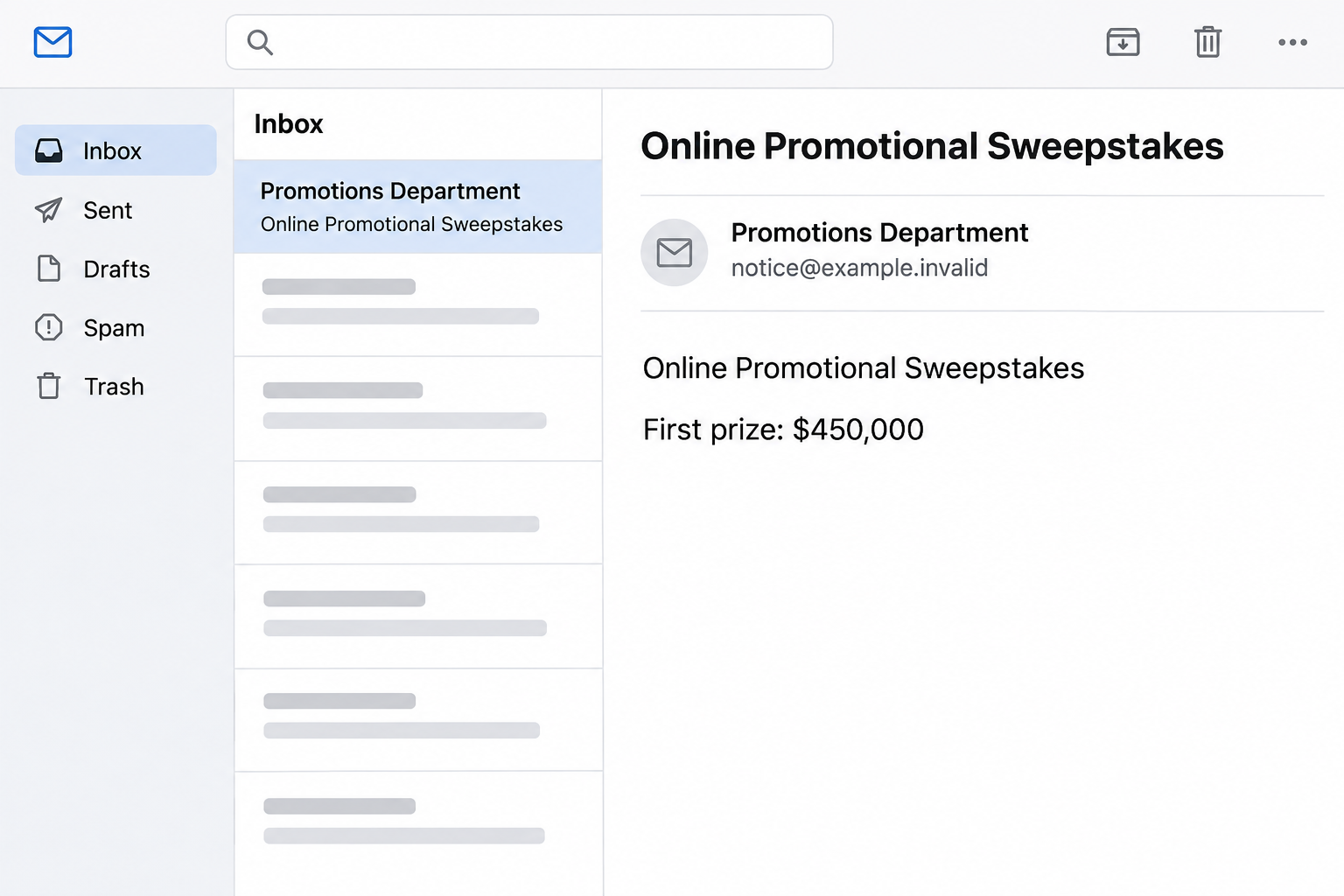
The image above recreates the offer and amount without the reply details. It doesn’t show an authentic agency message or a prize that was paid.
There’s no independently identifiable sweepstakes tied to the email. The names are meant to lend authority to a claim the reader is asked to accept first.
The message combines institutions with different responsibilities
The notice invokes a workers’ compensation appeals body and a health department as if they belong together in a federal sweepstakes operation.
The California Workers’ Compensation Appeals Board handles workers’ compensation adjudication. That purpose doesn’t match the email’s story about an online promotional drawing.
The U.S. Department of Health and Human Services has a real Inspector General. Its alert about fake grant offers explains that scammers misuse federal authority to request information or money.
That warning describes a related tactic, not an announcement of this prize. Recognizing an agency name isn’t enough to identify who sent the message.
It asks for personal contact information before giving proof
The recorded message tells the reader to provide a full name and contact details to begin verification. It does not demand a specific fee in the opening email.
Later requests could ask for documents or money. Do not treat those possibilities as events confirmed for everyone who received this sample.
Before considering any response, look for information you can verify elsewhere:
- A promotion you knowingly entered or a legitimate sponsor with a public record of the drawing.
- Published rules, dates and eligibility that apply to this exact prize.
- A verified organization that can confirm the result without using details provided by the email.
- A clear reason why a government appeals board or health agency would be involved at all.
How the Online Promotional Sweepstakes Scam Works
Step 1: It explains why you don’t remember entering
The message says an email address came up in a random drawing. That explanation makes it possible to believe you won without recalling any entry.
You aren’t being asked to figure out whether you bought a ticket. You’re asked to believe the selection already happened and only the paperwork remains.
An unsolicited claim can feel unusually plausible if you remember entering some promotion recently. Identify the promotion you actually entered before linking it to the email.
A real sponsor should be identifiable outside the message. Don’t let the sender supply both the award and the only way to verify it.
Step 2: Official-sounding names substitute for an identifiable sponsor
The email uses agency language rather than naming a company most people can look up as a sweepstakes operator.
A name associated with public administration can make verification, permission or documentation sound routine. It can also take attention away from the fact that the roles don’t fit.
One body named in the story resembles a state appeals board. The federal health name doesn’t explain why you would be selected for a promotional cash award.
Check the institutional role, not just whether the abbreviation looks familiar. Finding the name of a real agency is not evidence that the agency created the campaign.
Step 3: A first-prize amount makes questions feel like delays
The $450,000 figure is large enough to make a reader consider what they could do with it. That makes the next request feel small by comparison.
The email states the amount as a result rather than an estimate. It still doesn’t tie the number to a drawing record or a sponsor you can confirm.
No real deadline needs to be established for this pressure to work. The worry can be as simple as not wanting to miss the chance.
If you feel that pressure, wait. Check whether you can find the same prize, rules and sponsor without using the supposed validating officer.
Step 4: The first reply can move the conversation into private channels
The opening instruction is to contact the named person and provide basic identifying information. That can sound less serious than giving card or banking details.
A reply can tell the sender that someone is reading and interested. If they follow up, a continuing thread can feel more official simply because it now includes your name.
Don’t assume that an address with a person’s name identifies a real agency employee. That isn’t enough to verify authority.
If someone later calls or messages claiming to handle the prize, don’t supply more details to see which institution they know. Verify the organization yourself.
Step 5: A later request could exploit the money you expect to receive
Advance-fee schemes can ask for money described as a processing expense, tax or other release requirement. These are common possibilities, not demands shown in this recorded first email.
A later contact could also ask for identity documents or banking details. That can matter even if you never send money.
Do not pay or buy anything to find out whether the award is real. If there’s a genuine sponsor, contact it through a verified route.
If you already paid or shared information, you don’t need to prove where the pitch ends. Contact the appropriate institution based on the exposure you can describe.
How to Verify a Claimed Prize Without Replying
Use the promotion you actually remember entering
Find the entry confirmation, published rules or account you already used. Compare the sponsor, dates and prize description with the new message.
If you didn’t enter any promotion and cannot identify a real public drawing, don’t send your contact details just to learn what the notice supposedly means.
Sometimes a real promotion uses an outside administrator. Its authority should still be verifiable through the official sponsor, not just through information supplied by the alleged officer.
If someone says the rules are available only after you reply, stop. A name and an exact amount aren’t a substitute for identifying the program.
You also don’t need to confirm your age, address or eligibility with the sender before seeing the rules. Verify the program before handing anyone identification.
If the program is real but its details differ, tell the actual sponsor about the impersonation. Don’t try to reconcile the two offers with the address supplied in the email.
Check the role of any government agency named in the notice
Open the institution’s actual website independently. Look for what it does and whether a genuine program matches the claim.
A benefits program, public grant and commercial sweepstakes are different things. The email’s use of those ideas together doesn’t establish a route to your winnings.
If a real workers’ compensation case is pending, check it through the appropriate state process. Don’t connect an independent case to a prize email just because it mentions compensation.
For a genuine health benefit or grant inquiry, contact the office you already use or ask official support to direct you. Don’t share case records with the named correspondent.
Watch for requests unrelated to proving the award
An unexpected link, private conversation or demand for a release payment can introduce a new risk even if the first note did not request money.
A photo of an award letter, check or supposed tax document doesn’t verify that anything was deposited. Your actual bank can tell you what it sees on the account.
Don’t cash an unfamiliar check and send money onward at the sender’s direction. Ask your bank for advice before spending or transferring such funds.
If you help a family member with the notice, let them explain what happened without embarrassment. The most important detail is what, if anything, they already shared.
Distinguish an official report from a refund offer
A report prepared for an authority can identify the sender, date, amount and actual request. It doesn’t require you to give the supposed officer another chance to explain the prize.
If you receive a follow-up offering to retrieve a fee, check who contacted you. A person who knows about the award or payment is not necessarily an investigator.
Use the agency’s established reporting portal or telephone contact independently. Keep sensitive evidence out of public warning posts.
If you want to warn somebody else, describe what made the notice questionable: the government names, the large prize and the request to reply with personal information.
Don’t put the alleged officer’s reply address in a public post. Someone seeing the warning might mistake it for an official contact and use it.
If your email provider asks for the original, use its reporting feature. This lets the provider see what was sent without turning a warning into another copy of the pitch.
When there is a payment to report, save the record before deleting the mail. The date, method and reference are often more useful than the sender’s explanation.
What to Do If You Fell Victim
-
Don’t reply to ask for proof.
Save the subject, date and claim if you need them for a report. Report the message as spam or phishing rather than contacting the named person.
If this came through work, give your organization the original through its reporting process. Don’t forward it with a note inviting colleagues to try the address.
Check the genuine promotion or agency independently only if there is a real question left to resolve.
-
If you replied with basic contact details, stop the exchange.
Be alert for follow-ups that use the same information to sound familiar. Don’t give a second correspondent more details to prove that they know your case.
A reply does not automatically mean someone entered your mailbox. If you gave out a password or approved access separately, tell the affected provider.
Keep the identifying information you shared in mind so you can explain it without repeating sensitive values in a public report.
-
If you shared identification or banking information, act on that exposure.
Contact your bank through its normal app or a verified number if financial information was involved. Say which details went to the sender.
If you disclosed a sensitive identifier or ID document, use IdentityTheft.gov in the U.S. or appropriate guidance in your own jurisdiction.
Tell the bank about any code or authorization you supplied. A verification claim in an email does not make an unrelated banking action safe.
-
If you sent money, contact the payment provider now.
Ask whether the payment can be stopped, recalled or disputed. Options depend on how the money moved and when you report it.
Give it your transaction reference, timing and any other confirmed details through its secure process. Don’t send extra money to satisfy a new requirement.
If you received a check or an apparent deposit, ask your bank what to do. Avoid forwarding money while it investigates.
-
Keep the evidence and report through real channels.
Use the FTC’s fraud reporting site in the U.S. or your local reporting authority. Note the government names used and what the message actually asked for.
Keep a record of any subsequent call, payment or request separately. Label what was claimed and what you verified so a later report isn’t confused with the original story.
If someone contacts you about the report itself, confirm the case with the authority. Don’t treat a new email as a reliable way to recover a loss.
Frequently Asked Questions
Is the $450,000 Online Promotional Sweepstakes prize real?
The documented notice provides no verifiable award or sponsor. It borrows government names and asks for personal information. Don’t reply to claim it.
Does the Workers’ Compensation Appeals Board run this drawing?
The real California board performs workers’ compensation adjudication. Its name in an email does not establish any connection to a sweepstakes.
Why did the email use a regular email account for the officer?
It routes replies away from a verified agency. A display name and consumer email address don’t prove that the person has authority to validate a prize.
Was there already a fee in the original message?
No specific fee appears in the documented opening. The request was for contact information. Treat a later payment demand as a separate warning.
What if I only gave the sender my name and phone number?
End the conversation and expect possible follow-ups using those details. Contact financial institutions promptly if you gave out banking information, a code or money.
Can I recover money I sent to claim it?
Ask the payment provider immediately what is possible. No one can promise recovery, and you shouldn’t pay another fee to obtain it.
The Bottom Line
Don’t contact the purported officer to claim the $450,000. The message borrows authority but provides no independently verifiable award.
If you already responded, stop the exchange. If you sent a payment or sensitive information, contact the relevant provider or reporting service based on what you shared.

Join the discussion
0 commentsShare your experience or ask a question about this article.
Community experiences
Did this happen to you?
Your experience could help someone recognize the same scam. Submit a private report for our team to review.
I experienced this tooReports are reviewed before publication. Sharing publicly is always your choice.
Discussion
Start the conversation
Have a question or something useful to share? Add the first comment.