

A small wall-mounted box promises to cool an entire room without a hose, drain, window kit, or installer. During a heat wave, that sounds almost perfect.
Orvyla packages that promise inside a polished storefront filled with confident specifications and glowing reviews. The details become stranger when examined together.
Overview
The page describes a real compressor air conditioner
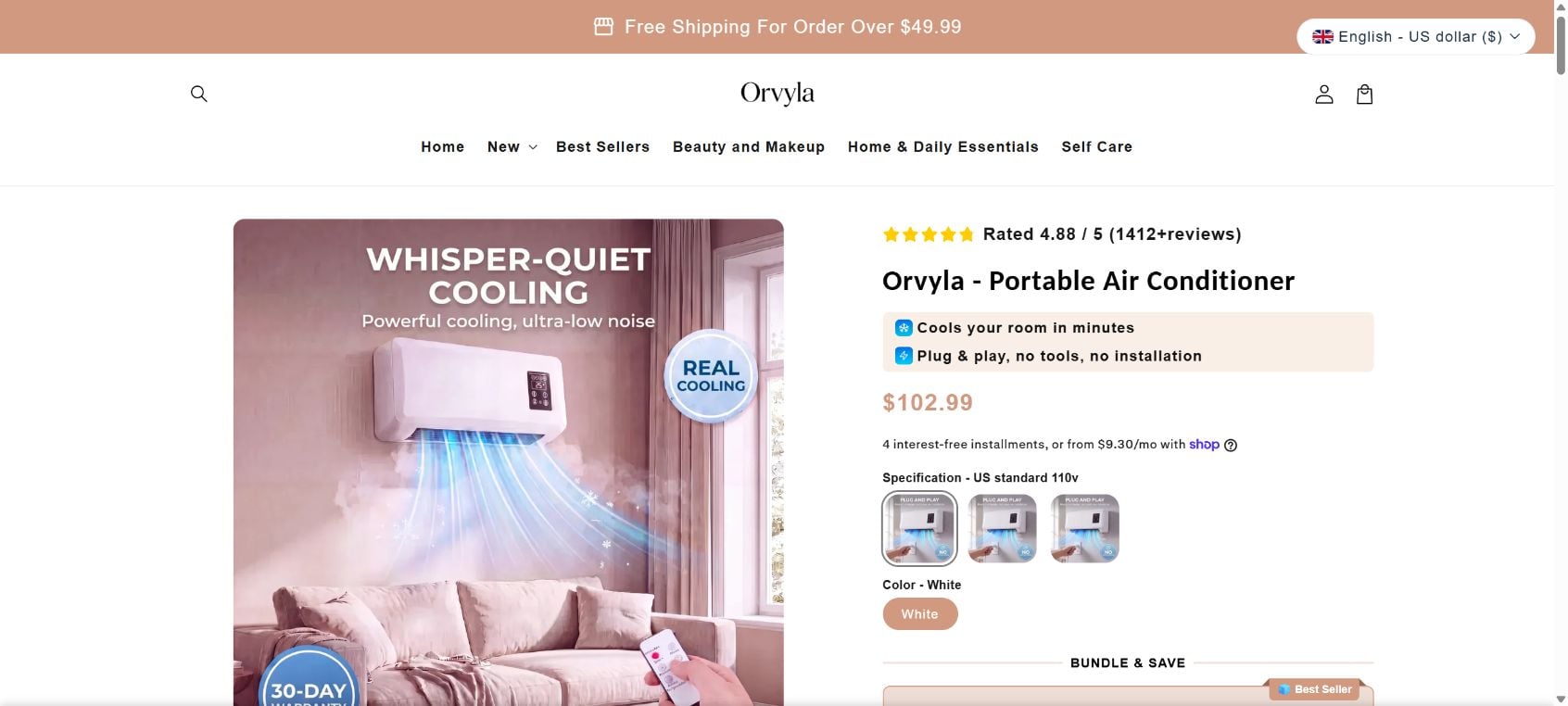
Orvyla sells its Portable Air Conditioner for $102.99 before bundle pricing. The device is pictured as a compact wall-mounted unit with remote control.
The listing says it is “real refrigeration, not a fan.” It also advertises 12,000 BTU efficiency, whole-room cooling, heating, drying, and low energy use.
Those are specifications buyers associate with a conventional room air conditioner. Yet the page says installation requires no hose, drain, window kit, drilling, or technician.
The sales claims conflict with basic heat removal
Air conditioning does not destroy heat. A refrigeration system absorbs heat indoors and must release that heat somewhere else, normally through an outdoor coil or exhaust.
A sealed appliance operating entirely inside one room cannot provide sustained net cooling without sending heat outside. Its electrical consumption eventually adds more heat indoors.
The product photographs do not show an outdoor unit, exhaust hose, window vent, or wall penetration. The description never explains where a claimed compressor rejects heat.
- The seller claims 12,000 BTU performance from a compact $102.99 device.
- The page promises real refrigeration without an exhaust path.
- Room coverage is described vaguely while advertisements imply whole-room cooling.
- The same device supposedly cools, heats, dries, and remains whisper-quiet.
- The store’s legal terms discuss magnetic eyelashes instead of air conditioners.
The evidence does not support the advertised machine
We did not purchase and disassemble an Orvyla unit. Therefore, we cannot state exactly what hardware a customer receives.
We can say the public description omits the heat-rejection system required for the advertised cooling. That is a central technical detail, not a minor specification.
The price creates another credibility gap. Genuine 12,000 BTU portable or window units are heavy appliances with compressors, refrigerant circuits, safety certifications, and substantial shipping costs.
The Orvyla Portable Air Conditioner scam warning is therefore justified. Consumers should not rely on the page’s “real AC” language without independent hardware evidence.
What the Orvyla Portable Air Conditioner Claims
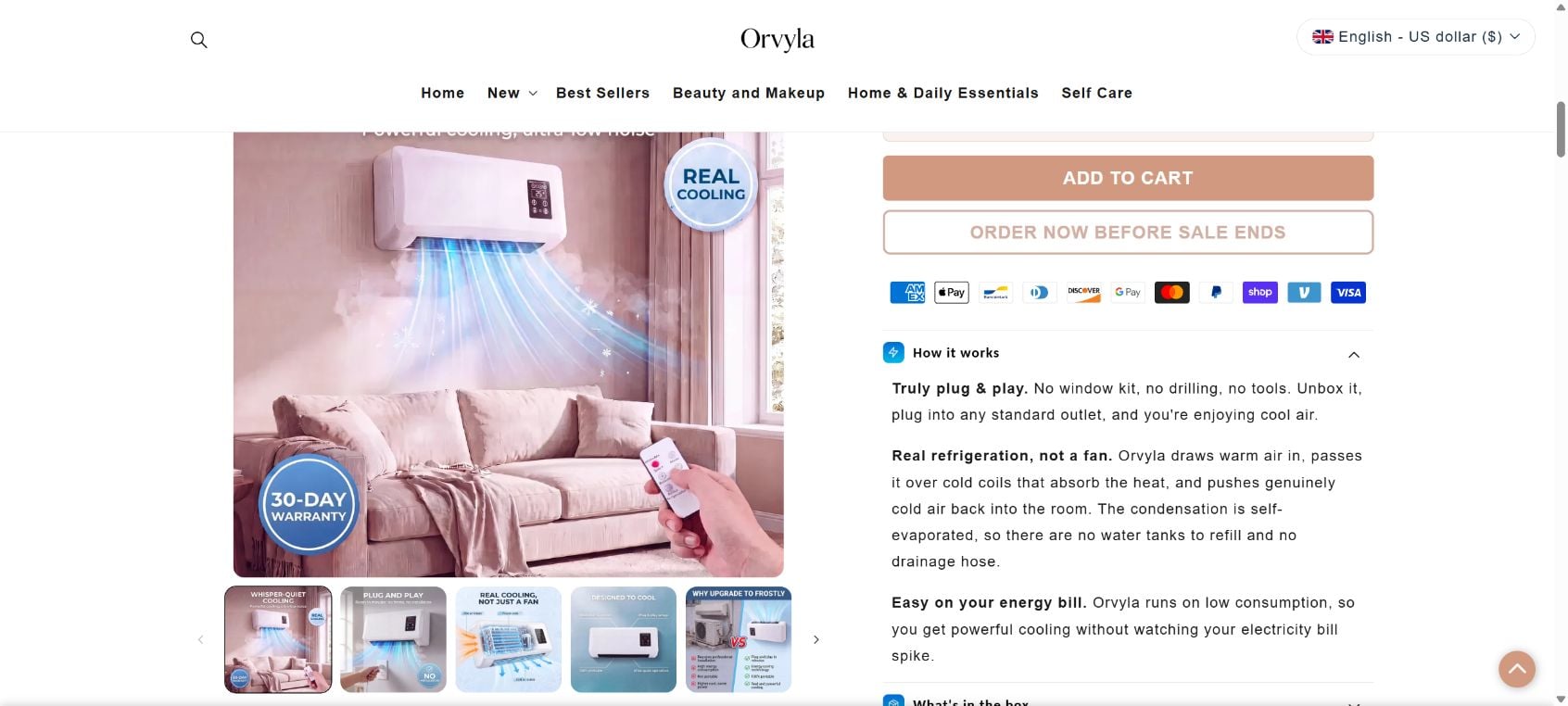
The page says buyers can remove the unit from its box, plug it into any standard outlet, choose a temperature, and feel refrigerated air within minutes.
It specifically distinguishes Orvyla from evaporative coolers and ordinary fans. The copy describes cold coils absorbing heat from incoming room air.
Condensation supposedly self-evaporates, removing the need for a water tank or drainage hose. The description then promises low consumption and lower electricity bills.
Other sections add heating and drying functions. The device is said to circulate gentle warm air and remove indoor moisture from rooms, clothing, and cabinets.
A comparison table lists “12,000 BTU efficiency” for Orvyla. It also marks plug-and-play setup, portability, energy savings, and quiet operation as advantages.
The page reports that 91% of users felt a cooler room within ten minutes. It says 10,000 customers love the product and shows numerous testimonials.
None of those numbers comes with a study method, participant list, independent tester, or verifiable report. They function as advertising claims controlled by the seller.
The page does not provide dimensions, weight, amperage, wattage, refrigerant type, compressor model, certification number, or sound measurement.
The Missing Exhaust Is the Central Problem
Cooling requires moving heat out of the room
A compressor system circulates refrigerant between a cold evaporator and a hot condenser. The evaporator absorbs indoor heat, while the condenser releases it elsewhere.
Window units place the hot side outdoors. Split systems connect indoor and outdoor components. Portable units normally send hot air through a hose.
Orvyla’s page promises the benefits of that system while removing every visible route for the heat to leave. No technical diagram resolves the contradiction.
Cold airflow near the outlet is not whole-room cooling
A small evaporative cooler can make outgoing air feel cooler as water evaporates. Its effect depends strongly on humidity and does not equal compressor refrigeration.
A thermoelectric plate may also create one cold side. Its opposite side becomes hot, and the total room effect remains unfavorable without outside heat rejection.
Holding a thermometer directly beside an outlet proves little. A valid test measures room temperature over time, humidity, power use, and heat discharged outdoors.
The page avoids the measurements that matter
BTU capacity should be tied to standardized conditions and identifiable hardware. “12,000 BTU efficiency” is not a useful engineering specification by itself.
The listing says “ideal for personal spaces” in one place, while other copy promises to refresh an entire room. Those descriptions create different consumer expectations.
Power consumption is called low, but no wattage appears. Quietness is praised, but no decibel rating or testing distance is stated.
How the Orvyla Portable Air Conditioner Scam Works
Step 1: Heat-wave advertising creates an urgent problem
The campaign reaches people when bedrooms are uncomfortable and energy bills feel threatening. A small, cheap alternative to traditional AC immediately earns attention.
Visuals show blue air, snowflakes, and a comfortable room. Those graphics communicate powerful refrigeration before the viewer reads a single specification.
The ad removes every familiar drawback: no installer, no window obstruction, no hose, no noise, and supposedly no expensive electricity.
Step 2: The landing page borrows the language of real HVAC equipment
Terms like compressor, cold coils, refrigeration, 12,000 BTU, temperature control, and dehumidification make the device sound technically credible.
The page repeats “real cooling, not a fan” until that distinction feels proven. Repetition, however, is not a laboratory measurement.
Missing specifications remain hidden beneath broad benefit statements. The buyer sees an engineering vocabulary without the data needed to verify the engineering.
Step 3: Rendered images make the product seem larger and stronger
The main images place a compact white box high on a wall, sending bright blue airflow across a furnished room.
Several scenes look digitally composed. Scale, mounting, airflow, and remote-control details can be created without photographing a functioning appliance.
Rendered advertising is common. It becomes risky when no ordinary photographs show the back, label, vents, cord, mounting hardware, compressor, or exhaust arrangement.
Step 4: Ratings and countdowns suppress technical questions
The store displays a 4.88 rating from more than 1,400 reviews. It also uses sale timers, bundle labels, and “order now” language.
A shopper who feels the offer may expire is less likely to compare weight, wattage, certification, manufacturer identity, or independent performance tests.
On-site testimonials repeatedly praise speed, quietness, and energy savings. The site does not explain how reviewers or outcomes were independently verified.
Step 5: The buyer chooses a discounted package
The page offers single and multi-unit bundles. It presents reference prices and savings that make purchasing several units feel financially rational.
Buying multiples magnifies risk because the return policy generally limits refunds to two items. Unused extras may not produce a complete refund.
Shipping and restocking costs can also reduce recovery. The apparent deal should be compared with the maximum amount actually recoverable.
Step 6: The delivered item may not match the implied performance
A buyer may receive a fan, evaporative cooler, compact heater, or another low-power appliance. Without testing, we cannot identify the delivered Orvyla hardware.
Whatever arrives must be judged against the written promises. Photograph the box, model label, power rating, accessories, instructions, and every opening before use.
If no compressor or heat exhaust exists, the item cannot perform like the room air conditioner advertised. That mismatch should be documented immediately.
Step 7: Complicated returns protect the seller’s margin
Orvyla says returns must begin within 30 days and require prior approval. The customer generally pays return shipping and may face a 15% restocking fee.
The store says orders cannot be canceled after placement. Its policy also limits the number of refundable items, which matters after a bundle purchase.
A low-cost imported parcel can become expensive to return. Delays in obtaining an address may consume valuable card-dispute or return time.
Company, Address, and Fulfillment Red Flags
The store identity changes inside its own terms
Orvyla’s terms welcome customers to Orvyla.com, then say items are sold through Meylora, including magnetic lashes and beauty accessories.
Another section describes the company’s mission as providing innovative beauty solutions. That does not fit a 12,000 BTU cooling appliance.
This looks like a policy copied from another storefront or campaign. It leaves buyers uncertain about which business is legally responsible.

The address does not resemble an appliance operation
The site lists 987 Tulip Tree Lane, West Des Moines, Iowa. Public real-estate records describe a single-family residence at that address.
A residential address can be used for registration or remote administration. It does not show where air conditioners are manufactured, certified, stored, or returned.
No separate factory, appliance warehouse, repair center, or corporate office is disclosed. The consumer cannot trace the product’s physical path.
The phone and email should be tested before purchase
Orvyla provides support contact details, but availability claims on a page are not the same as responsive problem resolution.
Call before ordering and ask for the unit’s manufacturer, model number, weight, wattage, refrigerant, certification, exhaust method, and domestic return address.
If the representative cannot answer basic appliance questions, do not expect better technical support after the payment clears.
The manufacturer and safety certifications are missing
The listing does not name the company that builds the unit. It shows no verifiable UL, ETL, CSA, or equivalent certification number.
We found no reliable evidence proving a particular country of manufacture. The responsible conclusion is that the supply chain is undisclosed.
An unknown electrical appliance that combines cooling, heating, and drying deserves more scrutiny, not less. Counterfeit safety marks and unsuitable wiring can create fire risks.
Never assume a familiar plug image proves voltage compatibility or electrical certification. Verify the physical label when the parcel arrives.
How to Test a Portable AC Claim Safely
Start without modifying walls or discarding packaging. Record an uninterrupted unpacking video that captures the shipping label, seals, accessories, and model plate.
Weigh the unit. Compressor equipment capable of 12,000 BTU usually contains substantial metal components, heat exchangers, motors, and refrigerant tubing.
Find the hot side. If the device genuinely cools air through refrigeration, another area must become warm and that heat must leave the room.
Measure room temperature several feet away, not directly at the outlet. Keep windows, sunlight, occupancy, and starting temperature consistent.
Use an outlet power meter only if it is correctly rated. Compare measured consumption with the label and the advertised capacity.
Stop immediately if the plug overheats, insulation smells, liquid leaks, wiring is exposed, or the unit trips a breaker.
Do not open a claimed refrigerant appliance. Pressurized systems and mains voltage require qualified service technicians.
Warning Signs Before Buying a “No-Hose” Air Conditioner
- The page promises compressor cooling but shows no outdoor heat path.
- A 12,000 BTU claim appears without power, weight, or certification data.
- Images show blue airflow instead of real installation details.
- The same tiny device allegedly cools, heats, dries, and saves substantial energy.
- Room size is vague or changes between page sections.
- Thousands of reviews appear without transparent verification.
- Countdowns and bundle savings dominate the page.
- Legal terms refer to a different brand or product category.
- The manufacturer and model number are absent.
- Returns require overseas shipping, approval, or a restocking fee.
A real appliance listing should become clearer under scrutiny. It should not require buyers to infer engineering from animations and marketing adjectives.
If the seller cannot explain where the heat goes, the claimed cooling system has not been explained at all.
Choose a recognized model with searchable certification, a complete manual, realistic installation requirements, and a return channel you can verify before payment.
What to Do if You Have Fallen Victim to This Scam
- Preserve the advertisement. Save the product page, BTU claim, no-hose promise, order summary, guarantee, and confirmation email.
- Record the delivered item. Photograph the box, label, cord, vents, accessories, instructions, damage, and any different brand name.
- Do not create a safety hazard. Unplug the unit if it overheats, smells unusual, leaks, sparks, or lacks credible electrical markings.
- Request a refund in writing. Explain the specific mismatch and demand the approved return address before sending anything.
- Track every deadline. Note the delivery date, 30-day return window, seller responses, and your payment provider’s dispute limit.
- Challenge unsupported charges. Contact the card issuer if the seller refuses a valid return or delivered merchandise differs materially.
- Check for recurring billing. Review the receipt and account for subscriptions, warranties, memberships, or duplicate bundle charges.
- Report unsafe products. U.S. consumers can notify the Consumer Product Safety Commission and the FTC with photographs and documentation.
- Scan suspicious devices. If the advertisement installed software or triggered dangerous redirects, run Malwarebytes and remove unknown extensions.
- Block future malicious ads. AdGuard can reduce scam advertisements and redirects, but it cannot repair hardware or reverse a transaction.
Frequently Asked Questions
Is the Orvyla Portable Air Conditioner a real AC?
The page claims compressor refrigeration, but it does not explain an outdoor heat-rejection path. We found insufficient evidence to verify 12,000 BTU performance.
Can an air conditioner cool a room without a hose?
Some window and split systems have no indoor hose because their hot components are outdoors. A fully indoor compressor unit still needs outside heat rejection.
Is Orvyla only a fan or evaporative cooler?
We did not inspect a purchased unit, so we cannot identify its hardware. The advertised specifications should not be accepted without independent testing.
Does Orvyla offer a refund?
The site states a 30-day policy, but approval, packaging, shipping costs, item limits, and a possible 15% restocking fee can apply.
Who manufactures the Orvyla unit?
The reviewed listing did not identify a manufacturer, factory, or verifiable certification holder. Ask for those details before buying.
What should I buy instead?
Choose a model from an identifiable appliance manufacturer with published capacity tests, certification records, installation guidance, and local warranty support.
The Bottom Line
Orvyla sells the dream of powerful refrigeration with every inconvenient part removed. The page never solves the physical problem hidden inside that dream.
A $102.99 box cannot be judged by snowflake graphics, ratings, or repeated “real AC” language. Its heat path, hardware, and certification must be verifiable.
Until independent evidence appears, avoid the offer. A heat wave is uncomfortable, but a weak, unsafe, or difficult-to-return appliance will not make it better.

Join the discussion
0 commentsShare your experience or ask a question about this article.
Discussion
Start the conversation
Have a question or something useful to share? Add the first comment.