

Hair thinning and hair loss affect millions of people worldwide, and the beauty industry is quick to jump on solutions that promise quick results. Recently, Ovela Hair Growth Serum has flooded online ads, promising to stop thinning, revive shine, and regrow baby hairs in just weeks. The sleek roll-on bottle, “clinically proven” ingredients, and before-and-after photos make it look like the miracle we’ve all been waiting for.
But the question is: does Ovela actually work, or is it another cleverly marketed product designed to empty your wallet?
This in-depth review goes beyond the glossy claims. We’ll break down what Ovela is, how it claims to work, the red flags that appear on its website, what to do if you’ve already bought it, and finally, whether it’s worth your time and money.
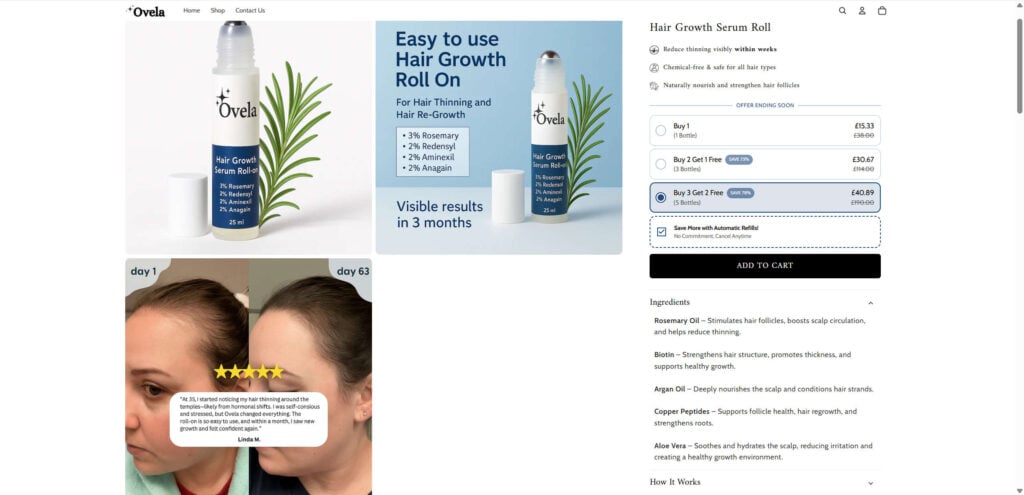
Overview of Ovela Hair Growth Serum
When you first land on the Ovela website, it feels professional and polished. The product is presented in a minimalist design with a rollerball applicator, which is marketed as an “easy-to-use hair growth roll-on”. According to the site, it targets thinning hair, supports follicle health, and provides visible results in as little as three months.
Here’s a detailed look at how Ovela presents itself:
Claimed Key Ingredients
The serum’s promotional material lists a mix of natural extracts and scientific-sounding compounds:
- Rosemary Oil (3%) – Supposed to stimulate hair follicles, increase circulation, and reduce thinning. Rosemary has indeed been studied for its ability to support scalp health, but clinical results are mixed and usually require long-term use.
- Redensyl (2%) – A relatively new hair cosmetic ingredient promoted as a DHT blocker. DHT (dihydrotestosterone) is often linked to pattern baldness. While some lab studies show promise, human trials are limited.
- Aminexil (2%) – A patented molecule claimed to counteract the hardening of collagen around hair roots, which can suffocate follicles. It’s often used in L’Oréal’s anti-hair loss formulas.
- Anagain (2%) – An extract from pea sprouts that is said to extend the hair’s growth phase. Again, some studies exist, but results vary widely.
Additional Listed Ingredients
- Biotin – A popular supplement for hair strength, though deficiencies are rare.
- Argan Oil – Known to condition and nourish the scalp.
- Copper Peptides – Believed to support follicle health and stimulate new growth.
- Aloe Vera – Soothes irritation and hydrates the scalp.
On paper, this mix sounds like a “dream team” of hair growth boosters. But as with many beauty products, ingredients listed do not guarantee results. Concentrations, formulations, and consistency of use all play a role.
The Bold Promises
Ovela’s marketing makes several strong claims:
- Visible results in 3 months.
- Reduces hair thinning within weeks.
- Safe for all hair types, chemical-free, and non-greasy.
- Buy more, save more deals with up to 78% off.
While some of these promises sound reasonable, others set off alarms. For example, legitimate hair regrowth treatments like minoxidil usually take 4–6 months to show visible results, and even then, regrowth is not guaranteed for everyone.
The Website’s Red Flags
When investigating Ovela’s official website, several suspicious details come up:
- The site was only registered on August 19, 2025. Yet, there are reviews on the product page dated months earlier. That’s impossible, suggesting fake or preloaded testimonials.
- All reviews are overly positive. Every single review praises Ovela as a miracle worker, which is unusual. Real customer feedback is normally mixed.
- No third-party presence. Trusted review platforms like Trustpilot have no mention of Ovela. If a product was truly selling in large volumes, independent reviews would exist.
- Urgency tactics. The website displays heavy discounts (like £38 down to £15.33) and claims offers are “ending soon.” These countdown-style promotions are common on scammy or low-trust websites.
The Visual Proof
The site features dramatic before-and-after photos showing women with receding hairlines that appear thicker after 63 days. But there’s no verification that these results are genuine or linked to the product. Stock images and doctored photos are frequently used in online scams.
Overall First Impression
At first glance, Ovela presents itself as a cutting-edge, natural solution to hair loss. But with closer inspection, the website inconsistencies, lack of external reviews, and urgency-based sales tactics raise concerns.
If you’re considering buying, you’ll need to understand exactly how the serum is supposed to work. Let’s dig into that.
How Ovela Hair Growth Serum Claims to Work
The Ovela Hair Growth Serum is sold as a roll-on applicator designed for direct scalp use. The company’s description outlines a clear process, though much of it resembles marketing copy rather than verified science. Let’s break it down step by step.
Step 1: Application
Users are instructed to roll the serum directly onto thinning areas of the scalp, particularly near the temples, crown, or hairline. The rollerball is meant to deliver “targeted nutrients” without mess.
Potential Issue: Roll-on applicators can limit how much product actually reaches the scalp. Hair strands may absorb much of the serum before it penetrates the follicles.
Step 2: Stimulation of Circulation
The formula claims to boost scalp circulation, largely through rosemary oil and massage during application. Increased blood flow is said to deliver more nutrients and oxygen to follicles, supporting healthier growth.
The Science: While scalp massage and oils may improve circulation, there’s limited clinical proof that this directly leads to regrowth in cases of genetic hair loss.
Step 3: DHT Blocking
Compounds like Redensyl and Aminexil are marketed as blockers of DHT, the hormone strongly linked to male and female pattern baldness. By reducing DHT activity, Ovela claims to prevent follicle shrinkage.
The Science: DHT-blocking ingredients like finasteride are proven, but cosmetic-grade ingredients like Redensyl have far weaker evidence.
Step 4: Root Strengthening
The inclusion of copper peptides and biotin is said to thicken hair shafts and strengthen roots, reducing breakage.
The Science: These ingredients may improve hair quality, but strengthening existing strands is different from regrowing lost hair.
Step 5: Extending the Growth Phase
The ingredient Anagain (pea sprout extract) is claimed to extend the anagen phase of hair growth, allowing follicles to produce longer, thicker hair before shedding.
The Science: Some studies suggest pea sprout extract may promote density, but large-scale clinical trials are lacking.
Step 6: Visible Results in Weeks to Months
Ovela promises that within weeks, users will see less shedding, and within three months, visible regrowth will occur.
The Science: Legitimate regrowth products like minoxidil usually take 4–6 months, and even then, results vary. Promises of quick fixes are a red flag.
Bottom Line on How It Works
The product’s marketing steps sound logical but are not strongly supported by large-scale scientific studies. The biggest issue is that Ovela presents its formula as if it is a guaranteed solution, when in reality, hair growth science is complex and outcomes are unpredictable.
What to Do If You Bought Ovela Hair Growth Serum
If you’ve already purchased Ovela and are now questioning whether it was a good decision, here are some steps you should consider:
1. Review the Refund Policy
Check the Ovela website’s terms of service or contact page for refund details. Many of these sites claim to offer a “money-back guarantee,” but the reality can be different.
- Look for email addresses or phone numbers listed.
- Take screenshots of your order confirmation and product listing.
- Submit a refund request as soon as possible.
2. Contact Your Bank or Credit Card Company
If you suspect the website may not honor refunds:
- Contact your bank to report the transaction.
- Request a chargeback if the product has not been delivered or if you believe the advertising was misleading.
- Mention the suspicious signs like fake reviews and urgency tactics.
3. Monitor Your Account
If you entered credit card details, keep an eye on future statements. Some websites sign customers up for automatic refills without clear consent.
- Cancel any recurring charges immediately.
- Use a virtual card or one-time payment card in the future for similar purchases.
4. Research Safer Alternatives
If you’re genuinely struggling with hair thinning, consider evidence-backed solutions:
- Minoxidil (Rogaine): FDA-approved topical solution proven to stimulate regrowth.
- Finasteride (Propecia): A prescription pill for male pattern baldness.
- Low-level laser therapy: Devices designed to stimulate follicles.
- PRP (Platelet-rich plasma) therapy: A clinical option gaining popularity.
5. Report the Website if Necessary
If you feel the website may be operating deceptively:
- File a complaint with consumer protection agencies.
- Report the site to platforms like Trustpilot or social media channels to warn others.
The Bottom Line: Should You Buy Ovela Hair Growth Serum?
Ovela Hair Growth Serum presents itself as a miracle solution to hair thinning, but the evidence doesn’t match the claims.
While the listed ingredients like rosemary oil, biotin, and copper peptides are known to support hair health, the promises of rapid regrowth and dramatic results within weeks are not realistic. The suspicious website details, fake-looking reviews, and urgency-driven discounts further weaken its credibility.
If you’re struggling with hair loss, it’s better to rely on proven treatments and professional guidance rather than gamble on a product with unclear backing.
Final Verdict: Approach Ovela with caution. For now, it’s safer to avoid it and choose treatments with real, verifiable results.

Reviews & discussion
0 commentsShare a firsthand experience, or ask a question.
Community reviews
Ovela Hair Growth Serum
Moderated reader experiences, not an editorial verdict.
Start the conversation
Have a question or something useful to share? Add the first comment.