

An unsolicited voicemail from Premier Tax Council says your tax file was reviewed and appears eligible for a major reduction, penalty relief or an IRS settlement. The agent warns that the opportunity is time-sensitive and asks you to call before a final review or enrollment period closes.
The cold-call campaign described here is a scam. It creates a tax problem without showing a notice, then sells a guaranteed solution before reviewing transcripts or finances. The name and professional vocabulary do not prove that a licensed tax firm or IRS program is involved.
Premier Tax Council Scam Overview
The caller invents access to a tax file
Premier Tax Council scam calls usually begin as a robocall or voicemail saying a file has unresolved returns, penalties or a balance that qualifies for relief. The message may refer to a Fresh Start initiative, hardship program or final compliance review. It sounds as though an eligibility decision already happened, even though the caller has not confirmed a tax year, notice or assessed balance.
The operation may know a name, telephone number, address or an estimate of tax debt from marketing lists, public records or earlier inquiries. Those details make the call feel targeted but do not demonstrate access to IRS records. The caller often learns the most useful facts by asking broad questions after the recipient calls back.
Guaranteed relief becomes an upfront-fee sale
A live agent promises to reduce the balance, stop collection or settle for a tiny fraction of what is owed. Before a transcript review or written analysis, the recipient is asked to pay for enrollment, investigation, protection or filing. Some operations collect sensitive documents and then perform little or no meaningful work. Others disappear or create additional fees.
- The claim: a private review already found a tax problem or relief opportunity.
- The authority: IRS terminology, compliance language and a professional-sounding organization name.
- The promise: guaranteed reduction, penalty removal or rapid Offer in Compromise approval.
- The demand: an upfront fee and taxpayer identity documents before independent verification.
- The harm: lost money, exposed tax records and genuine deadlines left unattended.
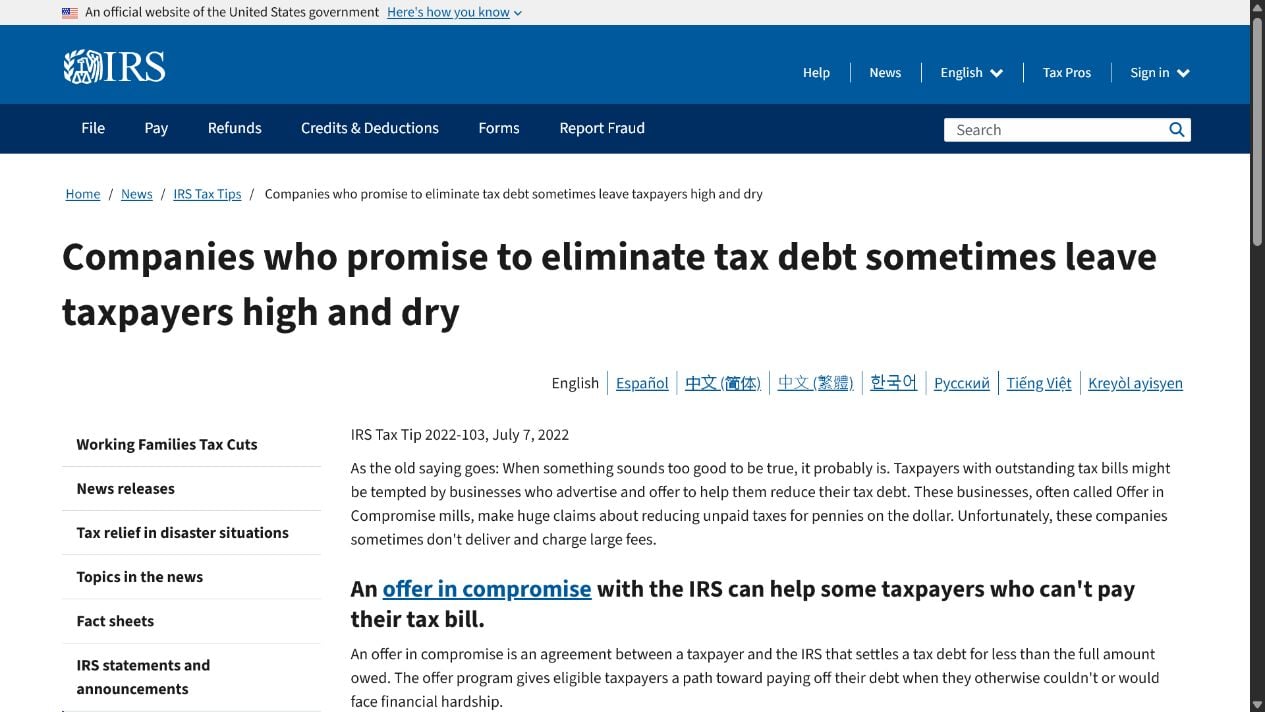
The IRS warns that dishonest Offer in Compromise mills make huge claims about reducing tax debt, charge large fees and sometimes file applications for people who do not qualify. An Offer in Compromise is a real program, but the IRS evaluates ability to pay, income, expenses and asset equity. A cold caller cannot guarantee the outcome from a telephone number alone.
Warning Signs of a Premier Tax Council Call
The caller promises a result before establishing the facts
A legitimate tax professional should explain who they are, what work is proposed, who will perform it and what the written fee agreement covers. The recommendation should follow a review, not precede it.
The campaign reverses that order. It begins with the dramatic result, then collects information and money needed to make the sales story feel personalized.
Red Flags at a Glance
- The call says your file was reviewed without permission. No transcript authorization or prior engagement exists.
- Relief is described as guaranteed. No caller can promise IRS acceptance before a financial review.
- A deadline exists only in the voicemail. The urgency does not match a mailed IRS notice.
- A large fee is required immediately. Enrollment comes before a written scope or credential check.
- The agent will not identify the licensed professional. There is no verifiable attorney, CPA or enrolled agent assigned.
- Sensitive records are requested through an unknown portal. Tax returns and identity documents can enable serious fraud.
- The caller discourages contact with the IRS. Independent verification would expose the invented review.
Premier Tax Council and the Offer in Compromise Sales Pitch
A real IRS program is used as bait
An Offer in Compromise can settle eligible tax debt for less than the full amount when paying in full is not realistic or would create hardship. It is not a secret program and does not require a cold caller. Taxpayers can review eligibility information and an official pre-qualifier through the IRS.
The existence of the program makes the scam more persuasive. The agent can describe real tax terms while hiding the fact that eligibility depends on a detailed financial picture. Quoting a dramatic savings amount before reviewing income, expenses and assets is a sales tactic, not an IRS decision.
Not every tax-relief company is fraudulent
Attorneys, CPAs and enrolled agents can legitimately represent taxpayers. The problem is the unsolicited Premier Tax Council campaign that invents a review, guarantees relief or demands money and documents before the recipient can verify who is responsible for the work.
A legitimate firm should provide its legal business name, physical address, professional credentials, written engagement, fee structure and a clear explanation of alternatives. Verification should use state licensing records and the IRS directory, not telephone numbers or links supplied by the salesperson.
Large retainers can leave the real tax problem untouched
A victim may believe the fee itself protects against IRS collection. It does not. Until a valid authorization and appropriate filing are submitted, IRS deadlines continue. A scammer can consume the money that would have supported a payment plan while failing to address the account.
Before paying anyone, obtain transcripts or review the IRS Online Account, identify the exact years and balances involved, and compare all available options. The least dramatic option may be a payment plan or direct resolution rather than an expensive settlement application.
How the Premier Tax Council Scam Works
Step 1: A robocall announces a file review
The recipient hears that Premier Tax Council or a similar tax group reviewed a case and found unresolved filings, penalties or special relief eligibility.
No evidence of access to IRS records is provided because the call is a lead-generation and fraud script.
Step 2: Urgency creates a reason to call back
The message says a settlement window, final review or enrollment period is closing. A callback is framed as the last chance to prevent growing penalties or collection.
The pressure keeps the recipient focused on timing rather than authentication.
Step 3: The agent builds a tax profile from answers
The live caller asks about balance size, unfiled years, income, employment, assets and prior notices. The questions make the consultation feel official.
The victim is supplying the facts that the supposed advance review should already contain.
Step 4: A dramatic reduction is presented
The agent claims the taxpayer can remove penalties, stop enforcement or settle for a fraction of the balance. Approval is described as likely or guaranteed.
Alternative options and disqualifying facts receive little attention because the goal is enrollment.
Step 5: An upfront fee and documents are collected
The operation requests a large card payment, wire or payment-app transfer for investigation or representation. It may also collect tax returns, Social Security numbers and bank statements.
The financial and identity loss can begin before any legitimate tax work is demonstrated.
Step 6: Little work or an unsuitable filing follows
Some victims receive generic paperwork, while others discover that no authorization or application was filed. An OIC may be submitted despite obvious ineligibility simply to create the appearance of service.
Meanwhile, real notices and payment deadlines continue.
Step 7: Additional fees or recovery offers appear
The caller may demand more money for appeals, lien removal, compliance certificates or expedited approval. If the victim complains, a second operation may offer a refund for another fee.
Each new payment is detached from a verifiable IRS action or written result.
How To Verify a Tax Relief Company Safely
Verify the tax problem and the professional separately
First, confirm the balance through the IRS Online Account, transcripts or a mailed notice reached independently. Do not let the salesperson become the only interpreter of your tax record.
Then verify the individual who will perform or supervise the work. Search state bar or accountancy records, the IRS directory of credentialed preparers and the business registration. Ask for a written engagement before providing documents or payment.
A Safer Verification Sequence
- Confirm the exact tax years and balances. Compare the caller story with IRS records.
- Identify the named professional. Verify attorney, CPA or enrolled-agent credentials independently.
- Read the written engagement. It should define work, fees, refunds and who handles the case.
- Ask why the proposed option fits. A professional should explain alternatives and eligibility risks.
- Use the IRS OIC information directly. Check whether the program appears suitable before paying a marketer.
- Refuse guaranteed outcomes. The IRS, not a salesperson, decides whether an offer is accepted.
- Protect the transcript authorization. Understand every Form 2848 or Form 8821 before signing.
What To Do If You Paid Premier Tax Council
Find out what was actually filed before paying anyone else
Stop additional payments and collect the contract, invoices, recordings, emails, portal messages and names used by the operation. Ask in writing for an itemized description of work completed and copies of every document allegedly submitted.
Check the IRS Online Account and contact the agency through irs.gov to review balances, notices and authorizations. A verified tax professional can help determine whether an OIC, power of attorney or other filing exists and whether any deadline needs immediate attention.
If the payment was unauthorized or obtained through material misrepresentation, contact the bank or card issuer promptly. If identity documents were uploaded, secure email and financial accounts and consider a credit freeze.
Recovery Checklist
- Cancel future payments and notify the bank or card issuer about suspected fraud.
- Request copies of contracts, transcripts, authorizations and filings from the operation.
- Review IRS records for unfamiliar representatives, addresses or submissions.
- Revoke an authorization you did not understand or approve through the proper IRS process.
- Ask a separately verified professional to assess the real balance and missed deadlines.
- Change exposed passwords and freeze credit if identity documents were provided.
- Report fraudulent tax promotion activity to the IRS, FTC and appropriate state regulator.
- Reject anyone promising a guaranteed refund of the fee for another payment.
Resume the real tax case through verified channels
Do not ignore genuine IRS notices because the caller was fraudulent. Determine which returns, balances or deadlines actually exist and choose an affordable, documented response.
Monitor tax and credit records after the incident. Stolen returns and identity documents can support refund fraud, account access and convincing follow-up calls long after the original payment.
Frequently Asked Questions
Is the Premier Tax Council cold-call campaign legitimate?
The campaign described here is fraudulent when it invents a file review, guarantees IRS relief or demands upfront money and documents before independent verification.
Is an Offer in Compromise a real IRS program?
Yes. It can help eligible taxpayers settle for less, but acceptance depends on financial facts. A cold caller cannot guarantee qualification or approval.
How do I verify a tax professional?
Identify the actual person handling the matter and check attorney, CPA or enrolled-agent credentials through independent professional and IRS records. A company name alone is insufficient.
What if I really owe the IRS?
Resolve the genuine balance through the IRS or a separately verified professional. Owing tax does not prove that the unsolicited caller has authority or an appropriate solution.
The Bottom Line
The Premier Tax Council scam sells certainty before facts. It invents a review, promises a dramatic reduction and places the upfront fee ahead of transcripts, eligibility and credentials.
Verify the IRS account first and the professional second. A legitimate solution can be explained in writing and withstand independent checks; a scam depends on preventing them.








