

A device that promises to measure your blood sugar, heart rate, and oxygen levels without a single drop of blood sounds like something out of a sci-fi movie. Enter the Remifa 𝐍𝐨𝐧-𝐈𝐧𝐯𝐚𝐬𝐢𝐯𝐞 𝐁𝐥𝐨𝐨𝐝 𝐆𝐥𝐮𝐜𝐨𝐬𝐞 𝐌𝐨𝐧𝐢𝐭𝐨𝐫. Marketed as a revolutionary, non-invasive health tool, it has captured attention across social media and e-commerce platforms. But here’s the truth: it may not just be ineffective – it could be a full-blown scam.
In this article, we’ll uncover exactly how the Remifa glucose monitor scam works, the red flags you need to watch for, and what steps to take if you’ve already fallen for it.
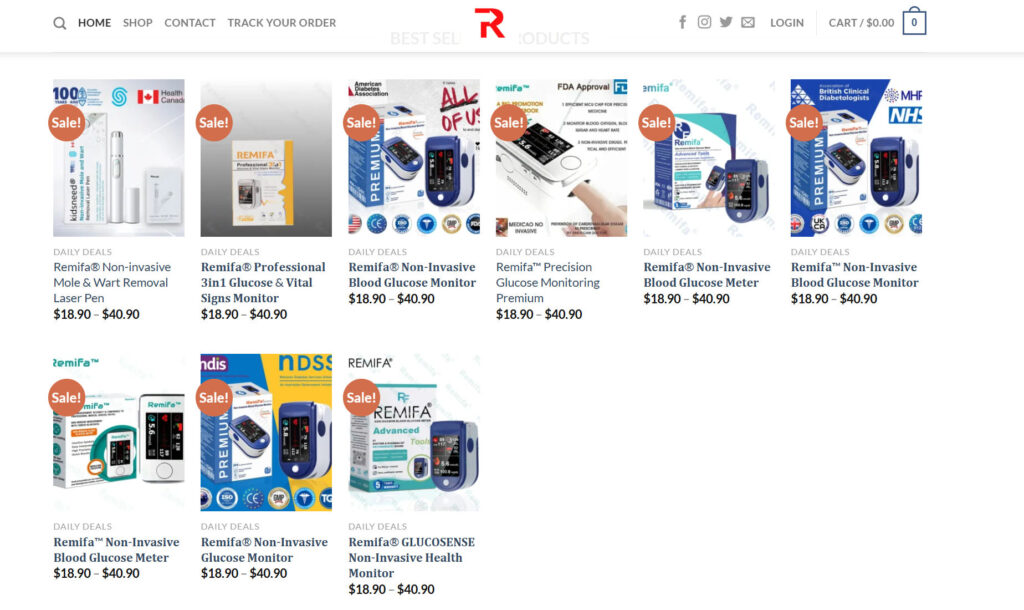
Scam Overview: The Remifa Glucose Monitor Under the Microscope
At first glance, the Remifa Glucose Monitor looks like a game-changer. It claims to provide accurate, non-invasive readings of blood sugar levels, a feature that would be life-altering for diabetics tired of daily finger pricks. But a closer look quickly reveals that this device is not what it seems.
The Big Claims
Remifa promotes its monitor with bold statements:
- “99.9% accurate”
- “No finger pricks required”
- “FDA certified”
- “Endorsed by healthcare professionals”
- “Used by over 80,000 Americans”
These claims are prominently displayed alongside glowing testimonials and trust badges to give an illusion of credibility. The promise of pain-free testing is highly appealing, especially to individuals with chronic conditions like diabetes.
The Medical Reality
Currently, no widely available device exists that can accurately and reliably measure blood glucose without drawing blood. Technologies like continuous glucose monitors (CGMs) from trusted companies like Dexcom and Abbott still require subcutaneous sensors. Any claim of a completely non-invasive glucose monitor should be met with extreme skepticism.
Misuse of Medical Language
Remifa’s marketing materials falsely refer to their device as “FDA certified.” This is a red flag in itself, as the FDA does not certify medical devices. Instead, it either approves them through a premarket approval (PMA) process or clears them through a 510(k) notification. Remifa provides no public documentation of either.
Recycled Hardware, Different Label
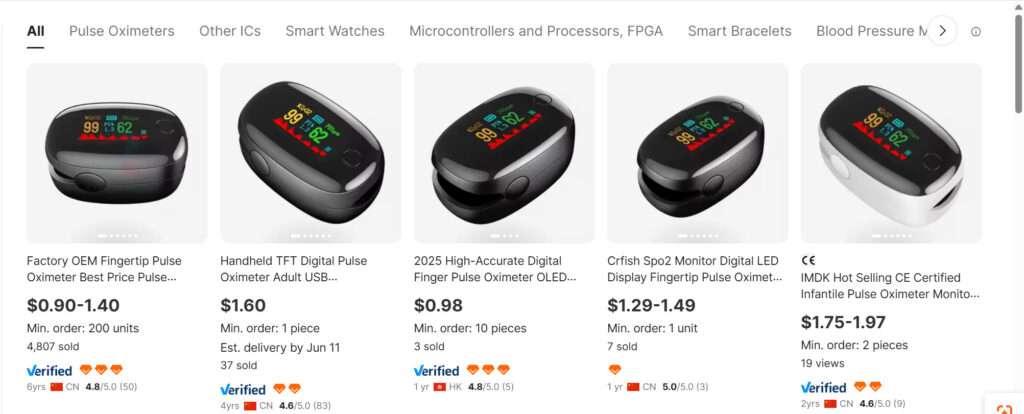
The product design is suspiciously similar to inexpensive pulse oximeters widely available on platforms like Alibaba for under $2. These devices are designed to measure heart rate and oxygen saturation—not blood glucose. Remifa appears to be repackaging a standard pulse oximeter, slapping on new branding, and making unverified medical claims.
Fake Testimonials and Review Manipulation
The Remifa website features overly polished, suspiciously generic reviews with profile pictures likely pulled from stock image libraries. Claims of “19,000+ satisfied users” are unsubstantiated. Searches for genuine reviews on independent platforms return little to no results.
Price Inflation and Artificial Scarcity
Selling at a “discounted” rate of $18.22 to $36.34, Remifa creates a false sense of urgency by listing a 51% discount and encouraging bulk purchases. This marketing trick plays on the fear of missing out (FOMO), compelling users to buy before researching.
How the Scam Works
This scam is particularly insidious because it exploits a medical need. Here’s how the operation typically unfolds:
1. Slick Ads and Emotional Hooking
Scam ads pop up on Facebook, YouTube, Instagram, and Google, often targeting diabetes-related interests. The language is emotional and urgent: “Tired of finger pricks? Join 80,000+ people who made the switch!”
2. Fake Authority and Endorsements
To gain trust, the site lists fake certifications, endorsements from made-up doctors, and fabricated health organization partnerships. Logos and fake badges (“FDA Certified,” “Expert Approved”) are designed to mislead.
3. Rebranding Generic Products
Scammers take cheap pulse oximeters (costing around $1 on wholesale sites), repackage them with new branding, and claim they offer blood glucose readings. The device is identical to pulse oximeters on Alibaba and similar platforms.
4. Misleading Product Pages
Product descriptions are long and filled with medical-sounding jargon to appear trustworthy. They mix real health advice with unproven claims to confuse consumers who may not know the difference.
5. Fake Reviews and Testimonials
Testimonials are fabricated or copied from unrelated sources. High review numbers (like “19,000+ customers”) are posted with no verified third-party proof. This inflates perceived trustworthiness.
6. False Scarcity Tactics
Pop-ups and countdown timers imply the deal is ending soon or that stock is running out. These are standard high-pressure sales tactics used to trigger impulse purchases.
7. Checkout and Payment Traps
Buyers are lured into making purchases through slick checkout systems that may lack proper encryption or third-party security audits. In some cases, customers are enrolled in auto-renewal subscriptions without consent.
8. No Real Customer Service
After purchase, many users find it nearly impossible to reach customer service. Email addresses bounce back, phone numbers are disconnected, and refund policies are ignored.
9. Lack of Delivery or Poor Product Quality
Some buyers report never receiving a product. Others receive a basic pulse oximeter that has no glucose monitoring capability at all.
10. Disappearing Act
Many of these scam operations vanish after a few months, only to reappear under a different name and website URL.
What to Do If You Have Fallen Victim to the Remifa Scam
If you have purchased a Remifa Glucose Monitor, here are steps to take immediately:
1. Stop Using the Device Immediately
- Do not rely on it for blood glucose readings.
- Using inaccurate devices can lead to dangerous health outcomes.
2. Request a Refund
- Contact the seller through the website (if it’s still active).
- Document all communication attempts (email, screenshots, etc.).
3. File a Chargeback With Your Bank or Credit Card Company
- Explain that the product was falsely advertised.
- Most credit card companies allow disputes within 60-90 days of purchase.
4. Report the Scam
- FTC (Federal Trade Commission): https://reportfraud.ftc.gov/
- FDA: Report unsafe or fraudulent devices to https://www.accessdata.fda.gov/scripts/medwatch/
- Better Business Bureau (BBB): File a complaint at https://www.bbb.org/
5. Leave an Honest Review
- Share your experience on consumer sites like Trustpilot, Reddit, and BBB.
- Help warn others by describing what happened to you.
6. Watch Your Financial Statements
- Monitor your bank and credit card for unauthorized charges.
- Cancel the card if recurring charges appear.
7. Warn Others
- Post on social media to alert your community.
- If you found the product via an ad, report that ad to the platform.
Frequently Asked Questions About the Remifa Glucose Monitor Scam
What is the Remifa Glucose Monitor?
The Remifa Glucose Monitor is a device marketed as a non-invasive tool that measures blood glucose, heart rate, and oxygen levels without drawing blood. It claims to offer accurate results in seconds and is sold online with promises of FDA certification and expert endorsements.
Is the Remifa Glucose Monitor FDA approved?
No, the device is not FDA approved. The FDA does not certify devices—it either clears or approves them based on clinical evidence. There is no record of the Remifa being listed in the FDA’s medical device database.
Can a non-invasive device really measure blood sugar accurately?
Currently, no non-invasive consumer device has been proven to measure blood glucose with clinical accuracy. Technologies for truly non-invasive glucose monitoring are still under development and not approved for home use.
Why is the Remifa device considered a scam?
The device is considered a scam due to multiple red flags:
- False medical claims
- Fake FDA certification
- Rebranded $1 pulse oximeters from wholesale sites
- No clinical proof of glucose accuracy
- Fabricated testimonials
- Aggressive marketing tactics and misleading urgency
What happens if I rely on this device for blood sugar monitoring?
Relying on an inaccurate device can lead to serious health risks. Inaccurate readings may cause users to take the wrong medication dosage, skip necessary treatments, or fail to recognize dangerous blood sugar levels.
What should I do if I already bought the Remifa monitor?
Stop using the device immediately. Contact your bank or card provider to request a chargeback. Report the seller to the FTC, FDA, and BBB. Document all communications and share your experience to help warn others.
Are there any real reviews from actual users?
Very few, if any, verified reviews exist outside of Remifa’s own website. Most testimonials appear to be fake, overly generic, or copied from unrelated sources.
Can a pulse oximeter read blood sugar?
No. Pulse oximeters measure oxygen saturation and pulse rate through light absorption in the finger. They cannot detect blood glucose levels. Any claim suggesting otherwise is scientifically inaccurate.
How can I identify similar scams in the future?
Look out for:
- Over-the-top claims (like 99.9% accuracy)
- Lack of independent clinical data
- Fake reviews and made-up expert endorsements
- Copy-pasted or stock images in testimonials
- Sites that pressure you to “buy now” or use countdown timers
The Bottom Line
The Remifa SugarSense Glucose Monitoring Device is not just misleading—it’s potentially dangerous. No device currently exists that can non-invasively and accurately monitor blood sugar levels at home. What Remifa is selling appears to be a standard pulse oximeter dressed up with false promises and deceptive marketing.
Consumers must stay informed and vigilant. Always research before buying health-related products, especially those that seem too good to be true. Accuracy and safety in medical devices are non-negotiable. If a company refuses to provide transparent proof, clinical studies, or FDA clearance, walk away.
Don’t let shiny marketing blind you. When it comes to your health, trust the science, not the scam.

Join the discussion
0 commentsShare your experience or ask a question about this article.
Discussion
Start the conversation
Have a question or something useful to share? Add the first comment.