

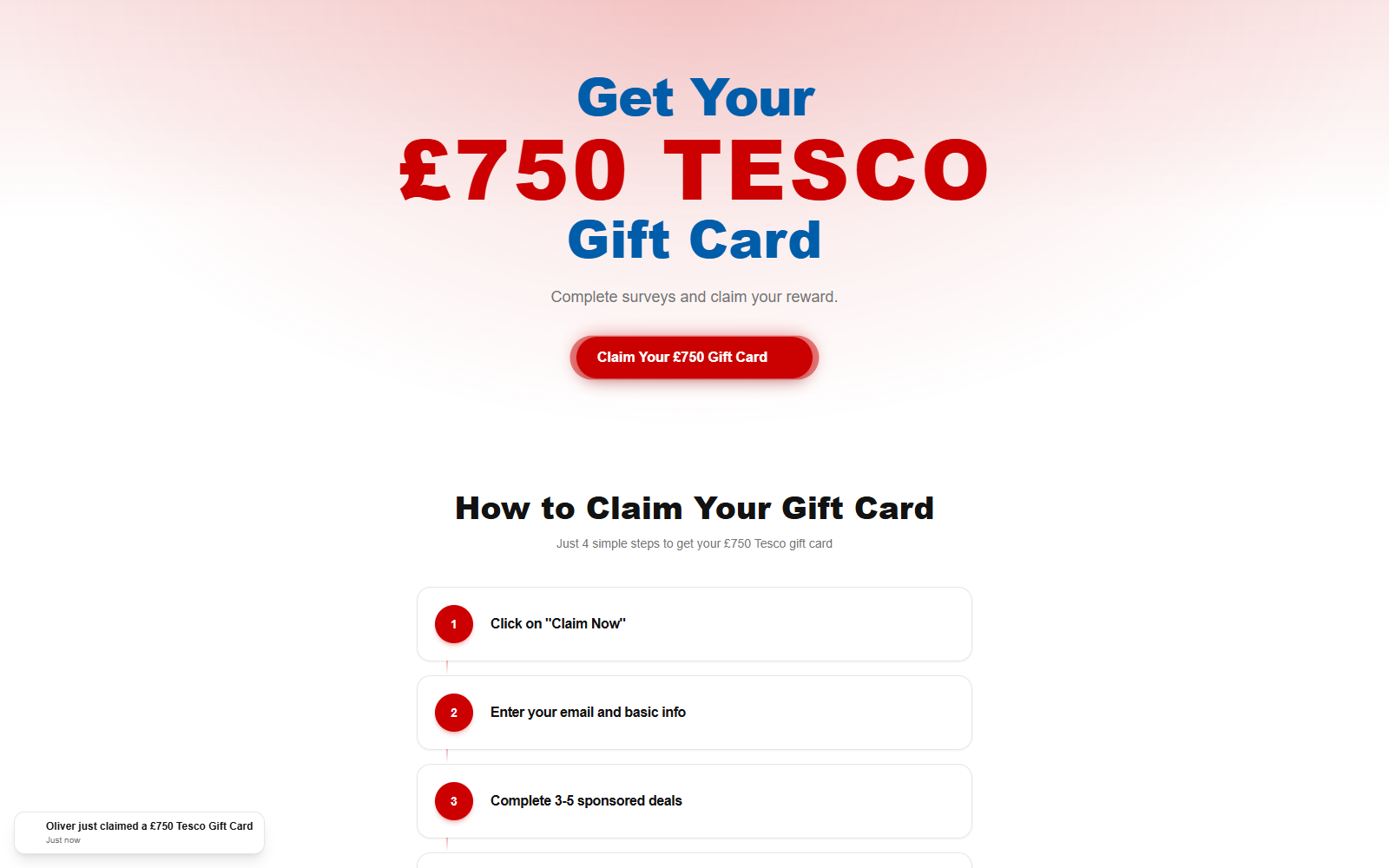
RewardBasket greets visitors with an enormous £750 Tesco gift card and a four-step route to claim it. The page feels more like a celebration than a contract.
That cheerful presentation deserves a slower reading. The identity behind the reward, the destination of each button, and the true commitment are not equally prominent.
Overview
RewardBasket is not a Tesco website
The offer appears on RewardBasket.online, not Tesco.com. We found no evidence that Tesco operates, approves, or guarantees this particular reward page.
The red-and-blue presentation borrows instant familiarity from the supermarket’s name. Branding cues cannot establish a commercial relationship that the page never documents.
Both buttons leave the advertised domain
“Claim Your £750 Gift Card” and “Start Your Survey Now” point to the same trksy.org affiliate link. The parameters identify an offer, publisher, and traffic source.
Consequently, RewardBasket is a traffic bridge. The next business controls the form, sponsored deals, qualification rules, data processing, and any eventual reward decision.
The four easy steps hide the difficult part
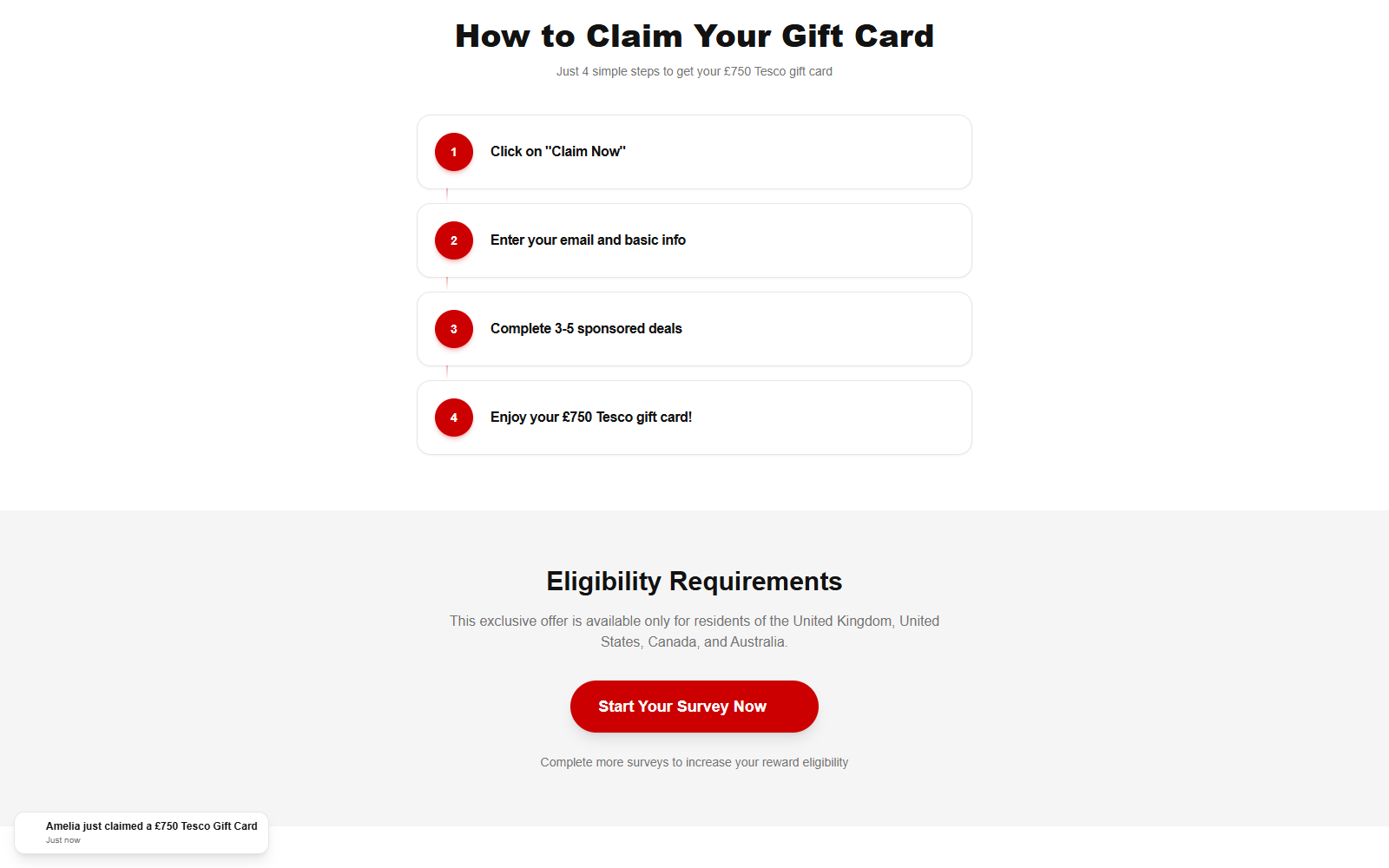
The page says applicants enter basic details, complete three to five sponsored deals, then enjoy the card. It does not display the full deal program before redirecting.
Important concerns visible during our review include:
- No named legal promoter on the landing page
- No direct Tesco confirmation of this offer
- An affiliate destination unrelated to Tesco’s domain
- No complete reward rules presented before the click
- A very recently created domain with hidden ownership
- A simulated notice claiming someone just received a card
The £750 figure may be theoretically associated with a later reward program. That does not make the first page complete, transparent, or safe enough to trust blindly.
What the Landing Page Leaves Unanswered
RewardBasket shows eligibility for residents of the United Kingdom, United States, Canada, and Australia. Tesco’s retail presence and gift-card rules differ across those markets.
The page does not explain which country’s Tesco card is offered, where it can be redeemed, or whether people outside Britain receive an equivalent reward.
It also does not name the company adjudicating claims. Without that name, visitors cannot inspect its reputation, complaints, privacy record, or program rules beforehand.
The expression “three to five sponsored deals” sounds manageable. Yet one displayed number cannot explain categories, levels, minimum spending, subscription periods, or verification deadlines.
The FAQ headings appear on the page, but their answers were not available in the captured text. A reward worth £750 requires clearer information than collapsed questions.
A lower-corner notification said “Oliver” had just claimed a card. No evidence, claim identifier, date, location, or verifiable account supports that message.
Such activity pop-ups create urgency and social proof. They should be treated as website interface elements, not independent customer testimony.
The domain was registered recently and its public ownership details are hidden. Neither fact proves misconduct, but both weaken the history available for a high-value offer.
How the RewardBasket £750 Tesco Gift Card Scam Works
Step 1: A supermarket name supplies borrowed confidence
Food prices make a £750 Tesco card emotionally powerful. It promises meaningful household relief, not merely an entertaining prize or minor discount.
That practical value encourages fast action. People may overlook the unfamiliar web address because the retailer’s name feels safer than the actual promoter.
Step 2: The page converts uncertainty into four tidy instructions
A short numbered sequence creates the expectation of predictable progress. Visitors see a beginning, a limited amount of work, and an attractive finish.
Missing conditions remain invisible until after the click. A clean layout can therefore make a complicated arrangement seem almost frictionless.
Step 3: The visitor enters an outside reward system
Both main buttons route through an affiliate tracker. That system records which publisher delivered the visitor and can credit successful actions to that source.
The browser may then pass through several addresses before reaching a registration form. Each domain can have different privacy policies and commercial partners.
Step 4: Surveys build a detailed marketing profile
Reward questionnaires can ask about age, household size, employment, insurance, debt, shopping, utilities, or preferred products. The questions are commercially useful.
Answering does not necessarily advance a Tesco claim. It may instead qualify the person for advertisements, sales calls, lead generation, or additional offers.
Step 5: Sponsored offers replace the word “free”
Some tasks may cost nothing, while others require purchases or trial enrollments. A small initial price can renew into a much larger recurring charge.
Participants must also satisfy tracking and eligibility rules. Using a different device, blocking cookies, repeating an offer, or missing documentation can invalidate credit.
Step 6: Claiming becomes a separate endurance test
After completing offers, applicants may face identity checks, receipts, waiting periods, deadlines, or customer-support exchanges. The simple landing page mentions none of that detail.
Many people abandon the process after spending time or money. The affiliate ecosystem can still profit from their completed actions even when no reward is delivered.
Why “Complete Three to Five Deals” Is Not Enough Information
Deal quantity is only one variable. The real burden depends on which deals qualify, how much they cost, and whether they create continuing commitments.
A transparent advertisement would disclose the representative cost range, time required, essential exclusions, and the legal entity responsible for resolving tracking failures.
It would also explain whether free offers alone can reach £750. Without that clarification, shoppers may discover that higher reward levels require paid participation.
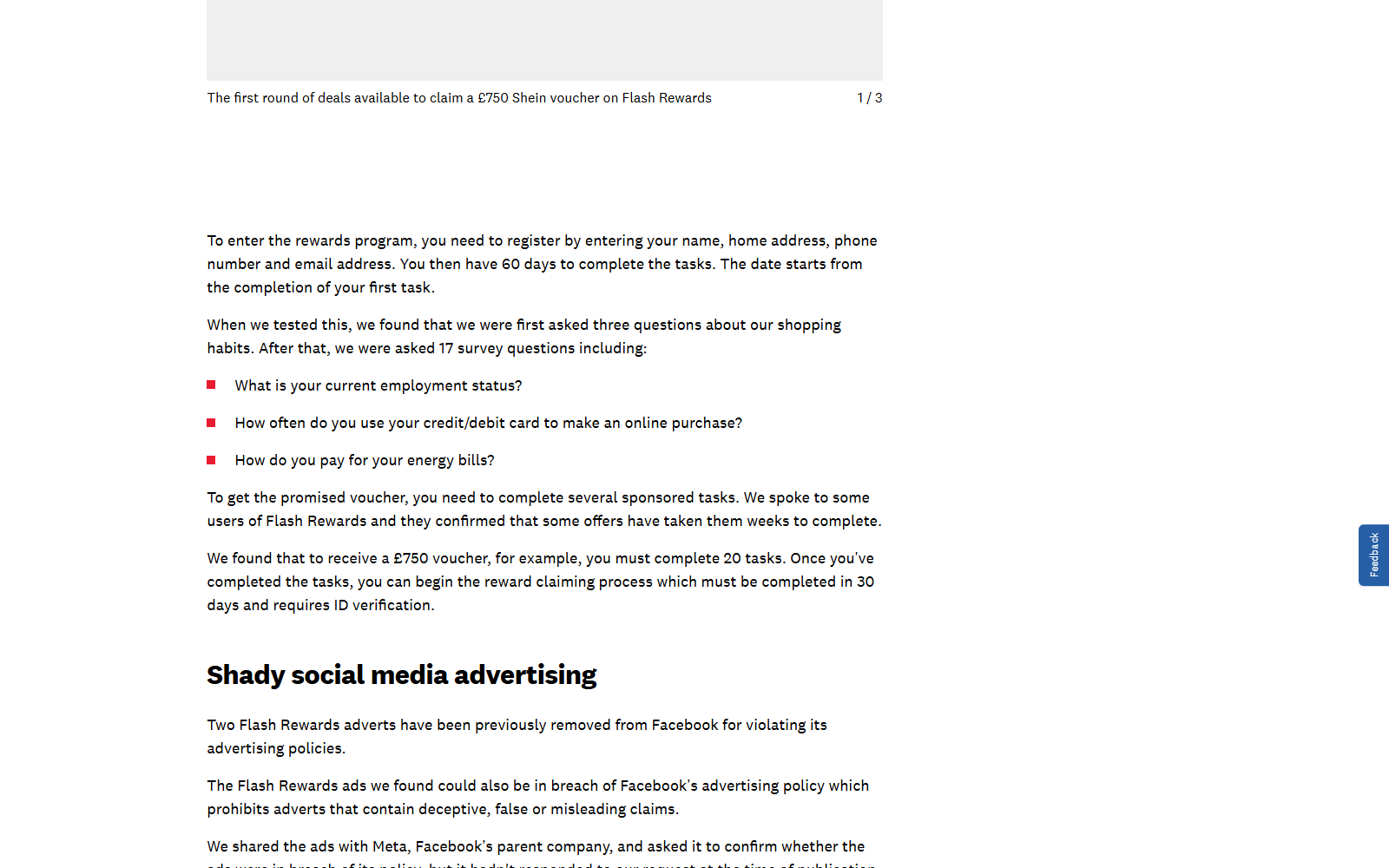
Independent consumer reporting on similar £750 reward funnels has documented people completing many more tasks than the initial advertising suggested.
Those programs are not identical to RewardBasket. The comparison matters because RewardBasket uses the same high-value voucher, survey, affiliate, and sponsored-deal architecture.
Do not assume a testimonial from another program proves RewardBasket will pay. Likewise, one successful claimant would not make every route or advertisement fair.
What You May Pay Without Realizing It
The first cost is time. Participants can spend hours reading offers, registering accounts, preserving evidence, checking progress, and contacting support.
The next cost may be direct spending. Trials, delivery fees, app purchases, entertainment memberships, and subscription products can all appear inside deal networks.
A third cost arrives later when introductory prices renew. Calendar reminders help, but cancellation may require contacting several unrelated merchants separately.
Finally, there is a privacy price. A phone number connected with shopping interests can generate persistent marketing long after the person stops pursuing the card.
Watch for these developments:
- Unexpected confirmation messages from unfamiliar brands
- Small verification charges followed by larger renewals
- Telephone calls referencing survey answers
- Requests for identity documents before payout
- Missing credit for completed activities
- Pressure to finish one more paid requirement
The safest decision is to avoid the funnel. Genuine savings are preferable to gambling money and privacy on a reward whose promoter is unclear at entry.
How a Legitimate £750 Promotion Should Look
A trustworthy competition begins by naming its promoter in full. It includes a registered address, opening and closing dates, eligibility rules, and a defined prize fund.
A deal-based reward program should additionally explain every participation level. Shoppers must see whether purchases, subscriptions, or identity checks are required.
The advertisement should distinguish a guaranteed reward from a prize draw. “Claim,” “earn,” “win,” and “eligible” describe different legal and practical outcomes.
Brand authorization should be independently verifiable. A Tesco-themed page on an unrelated domain cannot validate itself by repeating the supermarket’s name.
Clear programs also provide accessible customer support before enrollment. Users should be able to ask which merchant supplies the card and how rejected tracking is appealed.
Privacy information must name recipients or meaningful categories. “Partners” should not become permission for an unlimited chain of unknown advertisers.
Cancellation terms should sit near any trial button, not several pages away. The future renewal price deserves the same visual prominence as the introductory cost.
Verification should be proportional and explained upfront. Applicants need to know whether identification is required before they spend money qualifying.
Reward delivery needs a concrete timetable. “After validation” is incomplete unless the rules define validation and set a deadline for the operator.
Complaint handling should name the legal jurisdiction and escalation body. UK consumers should not discover after payment that a distant entity controls the dispute.
Finally, the economics should make sense. A program promising £750 for little profitable activity deserves exceptional scrutiny, not optimism.
Fraudsters and aggressive marketers both exploit arithmetic that feels generous. The burden remains on the promoter to explain how the offer works honestly.
RewardBasket does not provide that complete picture on its entry page. Its lack of context is especially concerning because the page actively minimizes perceived effort.
Company, Address, and Fulfillment Checks
The page does not identify the promoter
RewardBasket is presented as a website name, not a complete corporate identity. We found no company registration, responsible officer, or trading entity on the landing page.
That omission prevents visitors from checking insolvency records, regulatory history, or established trading activity before submitting personal details.
No business address is supplied
A high-value UK-facing promotion should provide a correspondence address and governing jurisdiction. The offer page displays neither in its visible content.
Cloudflare hosting information or a registrar’s office does not identify the business running the promotion. Technical infrastructure is not the merchant’s headquarters.
There is no direct support channel
The page provides buttons for starting, but no equally obvious telephone number or email address for questions. Entry is frictionless while accountability is obscure.
Consumers should never begin a reward journey unless they know who will correct missing progress and how that team can be contacted.
Tesco is not shown as the fulfiller
The claim page does not establish Tesco as the card issuer, promotion sponsor, or reward administrator. The supermarket name alone proves none of those roles.
A third-party gift card could exist without Tesco operating the promotion. Participants still need the exact issuer, value, currency, expiry, redemption restrictions, and delivery method.
Request the complete program rules before completing a single paid activity. If the operator cannot provide them, leave rather than investing effort.
Save the original advertisement as well. The wording that persuaded you can disappear after a campaign changes domains or creatives.
What to Do if You Have Fallen Victim to This Scam
- Pause immediately. Do not complete another sponsored offer while trying to unlock the reward. More activity can create additional charges without fixing earlier tracking.
- Map the entire route. Export browser history and gather emails. Record RewardBasket, trksy.org, the final rewards platform, and every merchant involved.
- Check all subscription terms. Open each confirmation message, find renewal dates, and cancel directly with the merchant. Keep screenshots showing successful cancellation.
- Tell your bank what happened. Identify charges you dispute and ask whether recurring card payments can be stopped. Follow the bank’s evidence requirements precisely.
- Protect your identity. If you uploaded identification, monitor credit files and accounts. Report any new application or profile you did not create.
- Lock down email access. Replace reused passwords and turn on multifactor authentication. Reward-related phishing becomes more believable after scammers know which offer attracted you.
- Clean the browser and device. Remove unfamiliar extensions or apps. Use Malwarebytes to check anything downloaded during the deal process.
- Filter dangerous pages. AdGuard can block many malicious advertisements and tracking endpoints. Review its logs carefully so legitimate banking or cancellation pages remain reachable.
- Report the evidence. Notify the UK National Cyber Security Centre, Citizens Advice, the advertising platform, and Tesco when its branding appears in deceptive material.
- Watch future statements. Review transactions weekly for at least three months. Some trial billing uses a descriptor unrelated to the name shown during enrollment.
Frequently Asked Questions
Is the RewardBasket £750 Tesco gift card official?
We found no evidence that it is an official Tesco promotion. The page sits on an unrelated domain and routes buttons through an affiliate tracker.
Does completing three deals guarantee the card?
No guarantee is visible on the landing page. Final qualification depends on the outside program’s full terms, successful tracking, eligibility, and verification.
Why does the website show recent claimant notifications?
Such pop-ups are designed to create social proof and urgency. Without verifiable records, they should not be treated as evidence that a specific person was paid.
Can sponsored deals become subscriptions?
Yes. Some promotions begin with a reduced trial and renew automatically. Read every merchant’s billing schedule before providing payment information.
What if I gave only my phone number?
Be alert for sales calls, verification-code requests, and phishing texts. Block persistent senders and never move money because an unexpected caller mentions the reward.
Can Tesco cancel charges from third-party deals?
Usually not. Contact the merchant shown on your statement and your payment provider. Tesco cannot cancel a contract it did not sell or administer.
The Bottom Line
A legitimate advertiser should make the cost and accountable company easier to find than the claim button. RewardBasket reverses that sensible order.
Its polished simplicity is part of the danger because the difficult questions begin only after visitors leave the page.
RewardBasket turns a £750 Tesco promise into an affiliate journey whose real promoter, full conditions, and potential costs appear only beyond the initial page.
Do not enter the funnel. A genuine promotion should identify its operator, publish complete rules, explain spending obligations, and provide support before collecting information.








