


A trading app can make a complicated market look manageable. RIFT Protocol puts a vault, a demo balance and an automated engine under one name.
They sound like parts of the same account. Before putting up real money, it is worth separating what each one shows and what it can actually prove.
Overview
The vault, demo and trading engine are different products
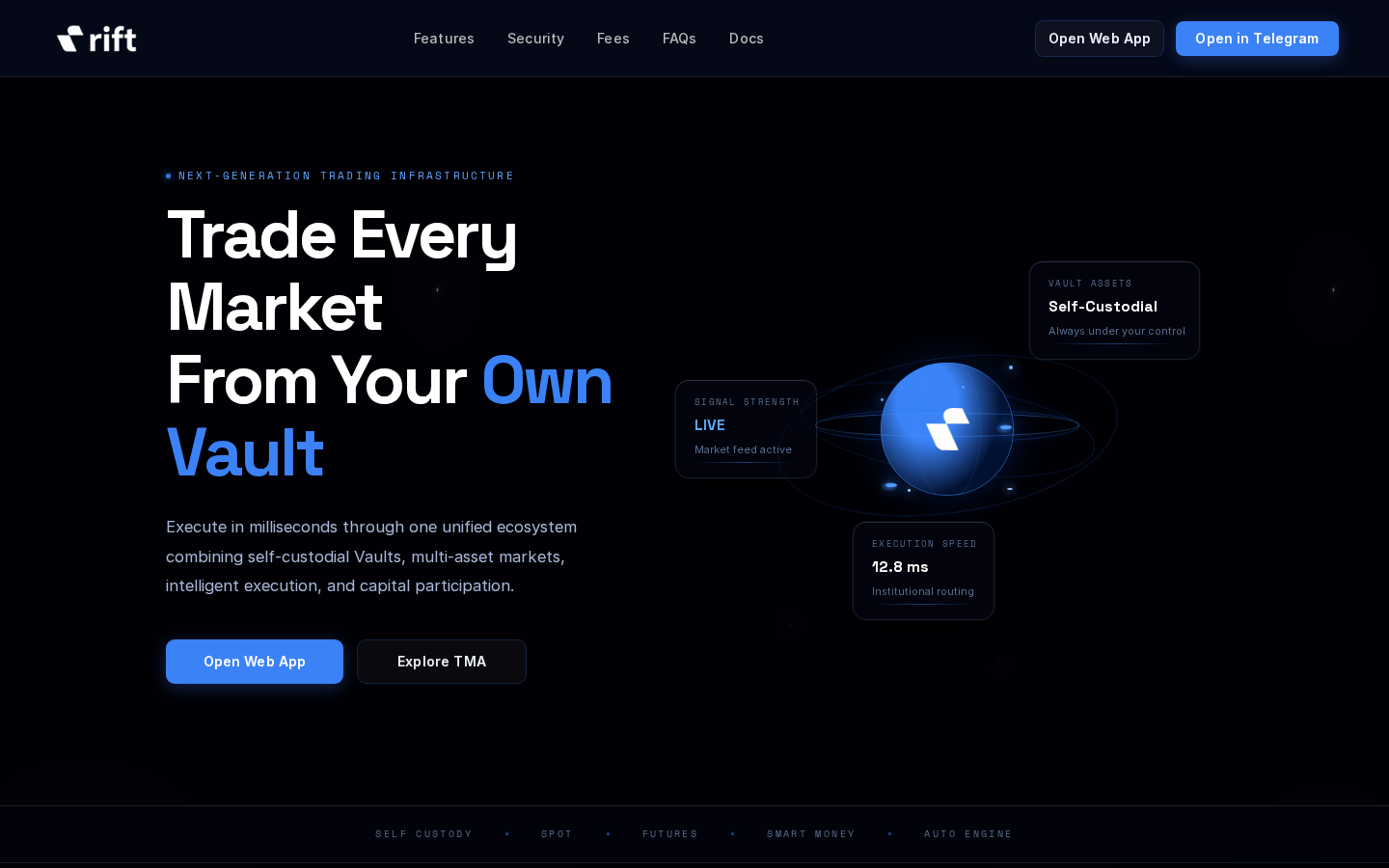
RIFT Protocol describes an interface for trading and more automated participation. Its public pages distinguish spot and futures, a simulation, Auto Engine and a service called Smart Money.
A demo can display positions without risking capital. Automated trading can expose real funds to losses, fees and orders you did not place manually.
The platform says new users get a $10,000 demo balance. That is simulated buying power, not a bonus that becomes eligible for withdrawal after a payment.
The performance page promotes a best result, not a typical result
RIFT’s documents report $46.7 million in trading volume, a 53.11% win rate and a top return of 188.33% under a September 2026 heading.
Trading volume measures what changed hands, not whether trades made money. A win rate says nothing about whether the average losing trade is larger than the average winner.
Top return describes an extreme, not the average experience. To assess it you would need the time period, account selection, losses, and fees included in the number.
- Demo figures: Judge the simulator as a display. Do not confuse its $10,000 balance or hypothetical profits with real funds in a wallet.
- Real trades: A genuine trade record shows that a transaction happened. It does not show what your position earned or whether your funds remain available.
- Withdrawals: Find out which assets are in your wallet, which are allocated elsewhere, what permissions apply and what costs would come out before money reaches you.
One documented earnings period did not match the trading result
An on-chain investigation by CrYptOG compared an August 2026 credit to one participant with activity in the trading account the researcher linked to the platform’s feed.
The researcher found a $1.67 credit to the participant alongside a $14.26 realized loss in the linked account for the same measured period.
That comparison cannot establish the source of every RIFT payment. It does show why the existence of real trades is not enough to accept an earnings explanation.

How the RIFT Offer Moves from Demo to Real Money
Step 1: The app starts with a simulated account
RIFT places a demo alongside its real-money products. Its terms describe demo mode as simulation only, even when it uses familiar trading language and displays balances.
The distinction becomes important when you are watching someone else demonstrate the program. A video showing a positive figure might not involve any real transfer.
Ask which mode you are looking at before treating a screenshot as proof of income. Do not pay to unlock a balance that was never real funds.
Step 2: The platform lists a charge to activate the vault
RIFT’s public schedule lists a $10 account activation fee, then a separate 0.5% bridge fee for deposits or withdrawals, plus applicable blockchain network costs.
The schedule also lists a 0.1% trading fee. Those numbers serve different purposes, so do not read a one-time activation price as the account’s total cost.
For instance, 0.5% on a $1,000 transfer would be $5 before network costs. A similar-sized outgoing transfer could add another bridge charge under the listed schedule.
That example is not an estimate for a specific wallet or asset. The exact fees depend on what happens in the transaction, not just the opening balance.
Step 3: Automated participation introduces more charges
Auto Engine is presented as automated execution with three named flows. Smart Money is presented separately with Mirror Wallets and Trading Books for participating in portfolio strategies.
The public schedule lists a 20% success fee assessed on Auto Engine yield and a 9% yield contribution to its X9 rewards pools.
Those percentages describe deductions from yield, not returns paid to you. The presence of a performance fee should not be read as a promise that performance will be positive.
Ask how the platform handles drawdowns and whether losses are recovered before performance fees can apply again. A useful answer should explain the calculation, not repeat the headline yield.
Step 4: The feed shows activity, not who earned the money
The documentation says eligible trades and vault transfers link to a public Hyperliquid record. A valid record on the right chain can confirm the underlying event.
To check a return you also need the right account, time window and capital base. A trade attributed to the engine may not say anything about your share.
It is possible to show profitable examples and omit losses without falsifying any transaction record. Ask for a full reconciliation rather than a handful of winning trades.
A real trade that lost money is still a real trade. The most useful check is whether the records support the specific claim being made about earnings.
Who Operates the Interface and Who Controls Your Assets
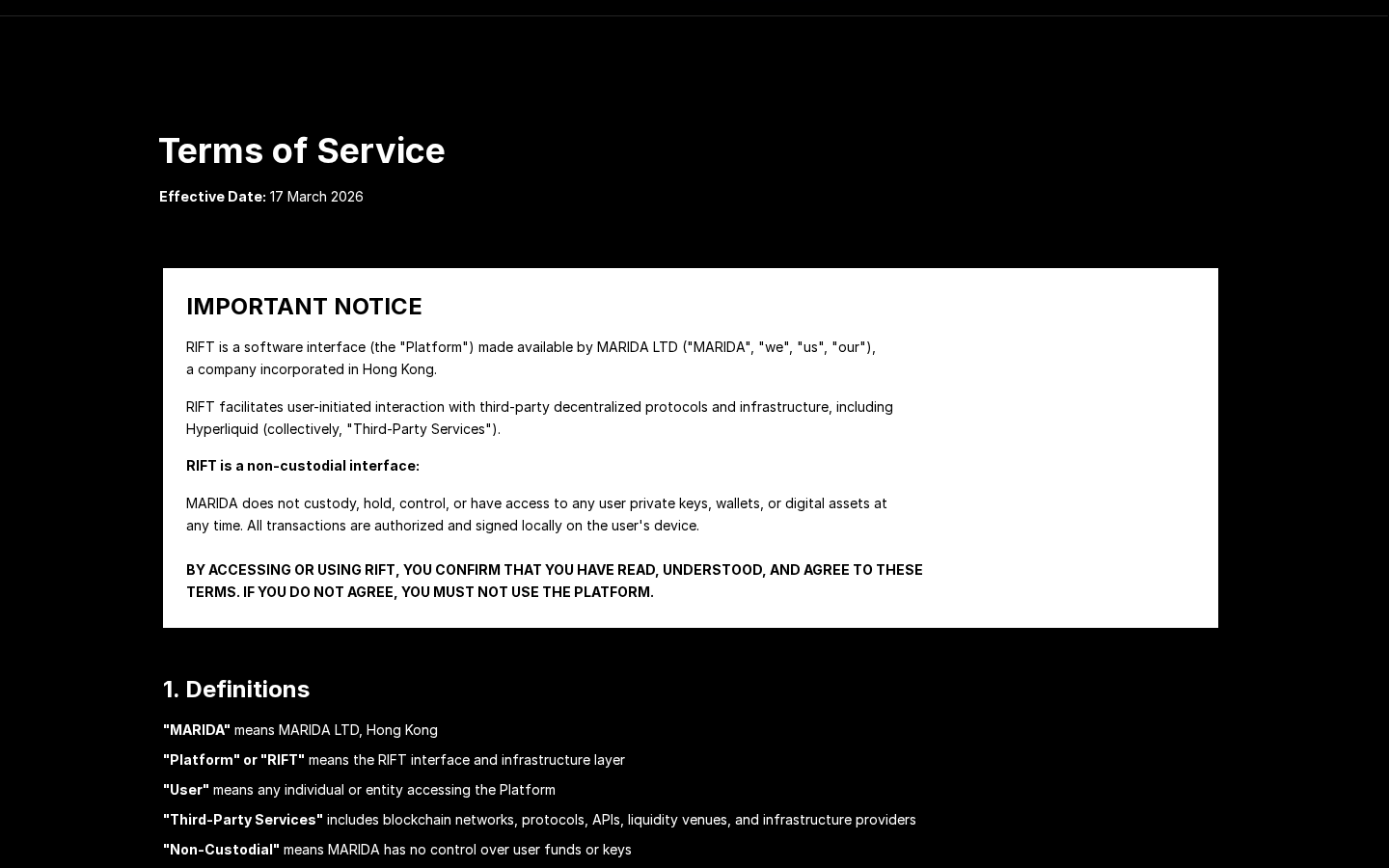
The public terms name MARIDA LTD in Hong Kong
The current terms say MARIDA LTD makes the RIFT interface available and identify it as a Hong Kong company. They describe Hyperliquid separately as third-party infrastructure.
Access to a third-party trading venue is not an endorsement of the interface using it. If you need help, identify which service controls the function you are questioning.
Incorporation information is not, on its own, permission to sell an investment service in your country. Ask who is responsible for the exact feature someone is pitching to you.
Non-custodial describes a claim about control
RIFT’s terms say that private keys are generated and stored locally and that MARIDA does not control user wallets or assets. That is the company’s stated arrangement.
Self-custody does not make every transaction harmless. Sending funds or authorizing a contract can have consequences that outlast a browser session.
Before signing anything, identify the wallet, network and powers the action grants. If you cannot tell whether you are logging in or granting spending authority, do not approve it.
The company’s terms make no promise of profits
RIFT’s terms describe returns and trade metrics as informational and make no guarantee about profitability, execution quality or availability. That matters even if a salesperson uses the word passive.
Automatic execution can change when and how orders go through. It cannot prevent the market from moving against the position or make the entire balance immediately available.
Ask for net performance across complete periods, not only winning trades. Look for the worst decline, the effect of fees and what happens when a withdrawal needs funding.
Keep responsibility and evidence separate
The same display can show a native wallet balance, an open position and an account credit. Each has a different source, and not every line is a transferable asset.
If a broker, protocol or external wallet appears in your records, save the name and the transaction that connects it to your RIFT activity. Do not guess from a logo.
That separation can tell you whether a problem is a disputed fee, a pending transfer, exposure to a losing position or an unauthorized payment from your wallet.
What a Trading Record Would Need to Show
Match the result to the account and the period
Start with the reporting window, including the time zone. A credit booked on one date cannot be explained by a winning trade shown from another month.
Ask whether the return is based on closed positions or positions still open. A favorable price on a screen can reverse before an open trade settles.
A complete account report should separate trading gains and losses from transfers in and out. New deposits make a balance bigger without making the underlying trades more profitable.
The external investigation’s August example is useful precisely because it compared a credit with a defined window. It is not a substitute for a continuing audit of every product.
The public site now lists bridge fees for both deposits and withdrawals. If you joined earlier, compare today’s schedule with the terms you received when you funded the account.
Find out how the fees change the result
If someone cites a winning month, ask whether it includes trading fees, bridge fees and both advertised yield deductions. An attractive gross return can leave a very different net result.
Ask how the yield fee and pool contribution interact. The public schedule states their percentages, but those figures alone do not tell you the exact bill for an actual position.
Look for an explanation of losing periods as well. A table of only winning examples is not enough to show how capital behaves through a wider range of markets.
Distinguish an interface promise from an operating test
A trading interface may display equities, commodities and crypto together. Check what you would actually hold, including whether it is an asset, a derivative position or a simulated quote.
Do not interpret a label for future products as an available service. RIFT’s materials distinguish an existing demo and trading features from future expansion into other environments.
Look for an export that lets you reconcile transactions independently before trusting an account summary. If the explanation requires you to fund the vault first, make the decision without it.
We read the public site, documentation and the unauthenticated entry screen. We did not record a live withdrawal, test wallet custody or audit the platform’s reported performance figures.
What to Do If You Used RIFT Protocol
-
Find out whether you used only the demo. Check whether you sent real assets, paid the activation fee, or gave an external wallet permission.
If you never transferred anything and only saw the simulated balance, do not pay a charge to cash it out. Keep any message that presents the figure as real money.
-
Save your wallet and trade history before changing anything. Record transaction IDs, dates, amounts and networks for deposits, withdrawals or approvals you can identify.
Keep screenshots of stated fees, balances and support messages. Do not post screenshots that expose account details, recovery material or identification documents.
-
Check the transaction on the correct network. A hash that is not found on an unrelated blockchain explorer does not establish that the record was fabricated.
Use the exchange or wallet provider’s help if the network is unclear. Compare the recorded asset, amount and confirmed destination before drawing conclusions from an app label.
-
Check where an active position is held. If you still have market exposure, check through the provider you actually used rather than assuming that logging out closed positions.
Ask for help through the provider’s real support channel if you cannot tell an open position from a completed transfer. Keep the two issues separate in your records.
-
Review approvals through the wallet you already trust. Disconnecting a site can end the session without revoking permissions previously granted on the blockchain.
If you granted unexpected access, use your wallet provider’s official guidance for reviewing approvals. If someone got your recovery phrase, treat that as a separate and more serious exposure.
-
Ask for a written explanation of any disputed transaction. Identify whether you are contesting a fee, a missing transfer or a difference between expected and actual proceeds.
If you are asked to send another payment to get funds back, stop and get the exchange or wallet provider involved. Do not rely on an unfamiliar recovery service.
-
Report suspected crypto fraud with evidence. The FBI’s cryptocurrency reporting guidance explains which transaction records help. From elsewhere, use your local fraud-reporting authority.
The strongest report ties a concrete promise to the transfer you actually made. Include the timing and any later request for payment, not just the balance shown on a dashboard.
Frequently Asked Questions
Does RIFT Protocol guarantee Auto Engine profits?
The public terms decline to guarantee profitability. The promotional top-return figure and the listed fees do not establish what any new user will earn.
Can the $10,000 RIFT demo balance be withdrawn?
The site describes that amount as a simulated balance for practice. It is not a cash deposit or a reward available to withdraw.
Is the 20% figure a RIFT trading return?
RIFT’s public fee schedule uses that number for a success fee on Auto Engine yield. It is not a 20% payout to the account holder.
What does a verified RIFT transaction prove?
A valid on-chain record shows that the recorded action happened on that network. It does not certify an account’s profits, the source of a credit or your ability to withdraw.
Is a non-custodial wallet immune to losses?
Keeping your keys does not remove market risk or cancel permissions you authorize. Know which address controls the funds and what any approval lets another contract do.
Who is named in the public RIFT terms?
The public terms name MARIDA LTD in Hong Kong as the company providing the interface. They treat third-party trading infrastructure separately.
The Bottom Line
Do not fund RIFT Protocol because of a simulator, a top return or a trade feed. None establishes the source of your return or guarantees an exit.
If you already used it, separate simulated balances from real transactions and review your wallet permissions. Save the original records and do not send additional funds to release a balance.

Join the discussion
0 commentsShare your experience or ask a question about this article.
Community experiences
Did this happen to you?
Your experience could help someone recognize the same scam. Submit a private report for our team to review.
I experienced this tooReports are reviewed before publication. Sharing publicly is always your choice.
Discussion
Start the conversation
Have a question or something useful to share? Add the first comment.