

The relationship has been growing for weeks when the online partner introduces a financial problem. Money belongs to him, he says, but cannot be paid into his own account.
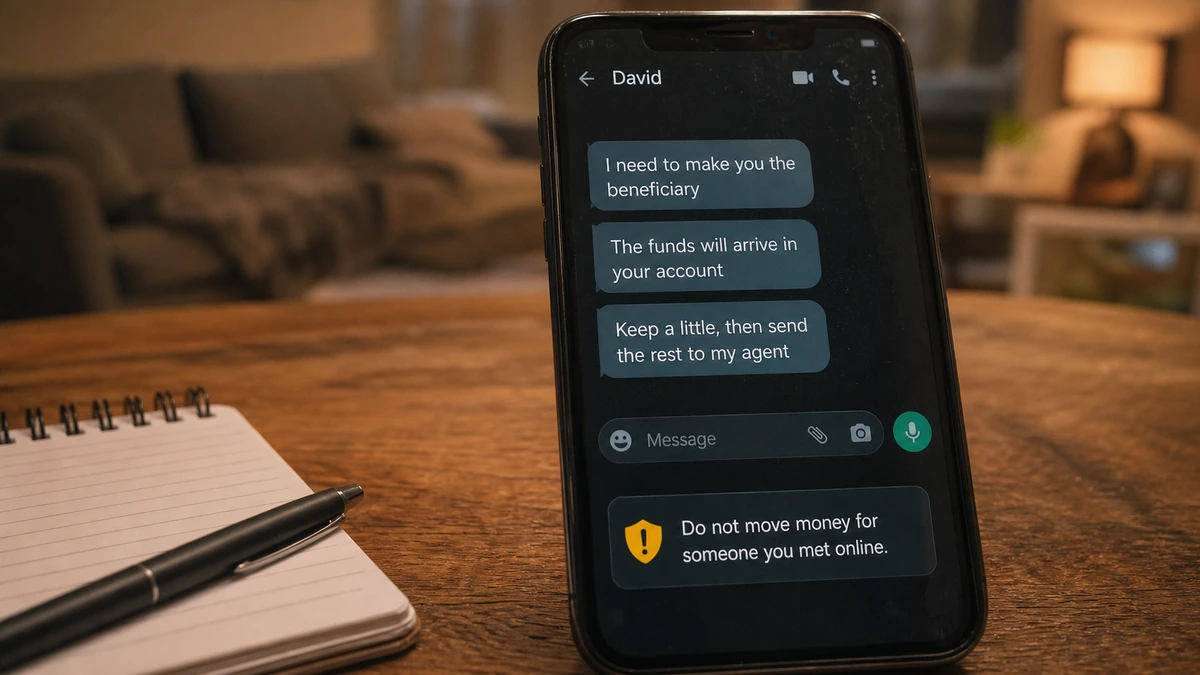
He needs someone trustworthy to become a beneficiary, receive the funds, and send them back. The favor sounds official because the danger is hidden in the forwarding step.
Overview
The relationship comes before the transaction
The contact does not open with a wire request. He spends time building affection, learning the target’s routine, and remembering personal details.
By the time money appears, the woman is not evaluating instructions from a stranger. She believes she is helping someone who knows and cares about her.
That emotional history is the security bypass. The transaction receives trust it could never earn on its own.
“Beneficiary” disguises a money mule role
The proposal is simple: funds enter her account under her name, and she sends them onward to the romantic contact or another person.
That is not harmless paperwork. It resembles a money mule arrangement, where one person becomes the bridge between questionable funds and whoever controls the scheme.
The incoming payment could be fake, stolen, reversible, or sent by another victim. The outgoing payment is usually the part that becomes the account holder’s loss.
A bank employee interrupts the plan
In the case examined here, a bank representative reportedly explained the danger and the woman stopped.
That outside intervention moved the issue away from romance and toward how banks view uncertain deposits, forwarding instructions, reversals, and suspicious transactions.
Warning signs include:
- A relationship that exists only online.
- A partner who knows detailed financial timing.
- Money that belongs to him but cannot enter his account.
- An official-sounding “beneficiary” or “agent” role.
- A request to receive and forward funds.
- Payment instructions controlled by the romantic contact.
- Pressure when family or bank staff ask questions.
- A promise that the arrangement helps recover earlier losses.
How the Romance Beneficiary Scam Works
Step 1: A patient online relationship is built
The person appears attentive, supportive, and unusually consistent. Messages arrive every morning and evening, creating a reliable emotional routine.
Photographs, work stories, military roles, travel, and family history may all be fabricated or stolen. Video calls are avoided or kept brief.
Step 2: Personal details are collected and reflected back
The target talks about benefits, income dates, savings, family tensions, past losses, and banking habits. The scammer remembers these facts.
Later, repeating them feels like care or insider knowledge. In reality, much of the information came from the victim, public records, or exposed accounts.
Step 3: A believable financial blockage appears
The contact claims money is frozen, inherited, recovered, awarded, refunded, or held overseas. There is always a reason it cannot reach his own bank.
The explanation may involve an estate, deceased spouse, legal restriction, failed investment, employment contract, or government process.
Step 4: Formal words make the favor feel safe
Beneficiary, agent, trustee, representative, and business partner give the arrangement a professional surface.
Fake letters, lawyers, portals, bankers, and dashboards can support the story. None proves where the money comes from or why a romantic partner must relay it.
Step 5: Funds appear in the victim’s account
The incoming value may be a fake check, stolen transfer, another victim’s payment, or numbers displayed on a counterfeit bank page.
Banks sometimes make funds available before final settlement. An available balance does not guarantee that the original payment is valid and irreversible.
Step 6: The victim sends real money onward
The scammer requests a wire, cryptocurrency, gift cards, cash withdrawal, or transfer to another account. The victim may be allowed to keep a share.
That commission makes forwarding feel like compensation. It does not change the account holder’s role in moving questionable funds.
Step 7: Romance becomes pressure when questions begin
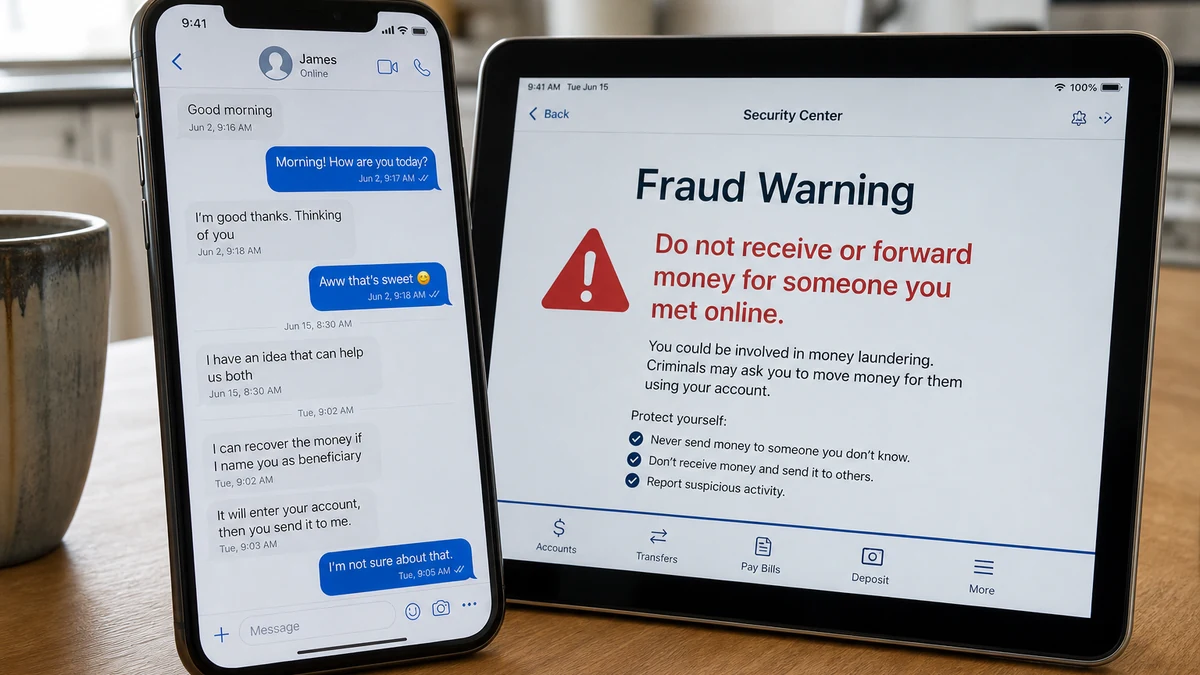
If the target hesitates, the contact describes a crisis, questions her loyalty, promises a future together, or says the recovery will vanish.
Once one transaction succeeds, more may follow. The account and emotional leverage have both been tested.
The Question That Breaks the Story
If the money genuinely belongs to the online contact, why can it not be paid directly to him through a normal documented route?
A legitimate bank, court, insurer, employer, estate, or government agency does not need a stranger’s romantic partner to receive and relay funds.
Real beneficiary designations are created through contracts, account rules, estate records, or formal claim procedures. They are not casually assigned in private chat.
The forwarding instruction is the decisive clue. Once you are told to keep a portion and move the rest, you are being used as a financial intermediary.
Any lawyer or banker introduced by the same romantic contact remains inside the same story. Verification begins with an institution you find independently.
A genuine claim can survive contact with your bank’s fraud team. A scam depends on you hiding the purpose or describing the payment incompletely.
Where the Incoming Money May Come From
A fake check is one possibility. The bank credits it provisionally, the victim forwards good money, and the check is returned later.
A fraudulent electronic transfer is another. Funds stolen from a compromised account are routed through the romance target to distance the thief from the source.
The money may come from a different scam victim. One person thinks they are paying an investment fee while the romance target thinks she is receiving a benefit.
Sometimes no deposit exists. A fake bank email, altered screenshot, or counterfeit portal displays a balance and asks the victim to pay a release fee.
Each route carries different consequences, but the safe action is the same: do not move the money. Call the bank’s fraud department through an official number.
Tell the bank the full story. Asking only “Has this check cleared?” hides the romance and forwarding instructions that reveal the real risk.
Why an Incoming Deposit Can Still Hurt You
People naturally associate danger with money leaving an account. An incoming payment feels like a gain, especially when the victim expects to keep a share.
Availability is not final settlement. A check can appear in the balance while the bank still waits to discover that it is counterfeit, altered, or drawn on a closed account.
If the victim sends money before the original credit fails, the outgoing transaction may remain their responsibility.
Stolen electronic funds create another problem. A transfer may be reversed while records still show that the romance target forwarded it to a different destination.
The FTC’s money mule guidance warns that receiving and moving money for someone met online can lead to loss, closed accounts, and investigation.
A bank warning is not an accusation against the victim. It is a chance to stop uncertain incoming money from becoming a certain outgoing loss.
How Families Can Explain the Risk
Calling the victim foolish can make her defend the relationship. The emotional connection is genuine on her side, even if the identity and financial story are false.
Focus on the transaction. Ask why his own bank cannot receive his own money and which independent institution appointed her as beneficiary.
Invite a neutral professional into the discussion. A bank fraud specialist, attorney, safeguarding worker, or local fraud officer can explain reversals without family conflict.
Set a temporary boundary: no new accounts, checks, crypto, gift cards, forwarding, or identity documents until the story is independently verified.
Do not seize the phone or secretly impersonate the victim unless immediate safety and local professional advice justify it. Those actions can drive the contact underground.
Keep ordinary family connection open. The victim is more likely to disclose a new request when doing so does not guarantee ridicule.
What the Bank Needs to Know
Say plainly that an online romantic contact wants money deposited into this account and then forwarded. Context is more useful than asking whether the balance is available.
Provide the contact’s names, numbers, email addresses, documents, incoming transaction details, and destination instructions.
Ask the bank to note the account and explain whether a deposit, token, linked account, or transfer is pending. Keep the funds untouched.
Do not open another account to bypass a warning. That would show the contact values banking access more than the supposed relationship.
Ask whether the account number or card should change and whether any external accounts were linked.
Continue watching statements for test charges, returned deposits, transfer fees, or new payees after communication stops.
If the victim depends on benefits or retirement income, ask about trusted-contact and vulnerable-customer protections.
If Money Has Already Reached the Account
Leave it where it is. Do not forward part of it, refund it personally, withdraw cash, or move it to a separate account for safekeeping.
Call the bank using the number printed on the card or shown inside its official app. Ask for the fraud department, not ordinary customer service.
Explain who requested the transfer and what you were told to do next. A clear timeline helps the bank connect the incoming and proposed outgoing transactions.
Save the sender name, payment reference, amount, arrival time, and every destination the contact supplied. Do not rely on screenshots alone if statements are available.
The contact may suddenly claim the transfer was accidental or urgent. That does not make a direct refund safe. Let the banks handle any legitimate return.
Watch for a second person posing as a banker, lawyer, courier, or relative. Scammers often introduce another character when the original story begins to fail.
If the bank restricts the account, cooperate and provide the messages. A temporary review is frustrating, but hiding the romantic contact can make the situation harder to untangle.
Stop sharing one-time codes and change any reused passwords. Review email forwarding rules because access to email can help criminals intercept real bank warnings.
Write down each action you take, including call times and case numbers. That record is useful if another bank, police officer, or benefits agency asks what happened.
Most importantly, do not accept replacement funds through another account. A new route does not fix the source of the money; it only repeats the risk.
Company, Address, and Fulfillment Checks
No legitimate institution appointed the beneficiary
The role came from the romantic contact, not a verified bank, court, insurer, employer, or estate administrator.
No independent institution confirmed that the beneficiary arrangement existed.
No address resolved the identity problem
An address supplied in chat or copied document would not prove the contact lived there.
Identity and the transaction’s lawful purpose both require independent verification.
The payment route depended on his instructions
Every banker, lawyer, or agent introduced by the contact remains inside the same trust circle.
Find the named institution separately and ask whether the person and claim exist.
The promised recovery had no safe fulfillment path
Legitimate recovered money should move through documented channels to its lawful owner.
Using the target’s account created risk without proving that any real recovery existed.
What to Do if You Have Fallen Victim to This Scam
- Do not move incoming funds. Leave them untouched and call the bank’s fraud department.
- Stop new transactions. Do not cash checks, buy crypto, purchase gift cards, or open accounts.
- Tell the bank the full story. Explain the online romance, beneficiary role, and forwarding request.
- Preserve communications. Save chats, profiles, numbers, emails, documents, and transaction records.
- Report the scheme. Use the FTC, IC3, platform controls, and appropriate local channels.
- Secure identity and accounts. Change passwords, enable multi-factor authentication, and review sessions and forwarding.
- Contact credit bureaus when needed. Use fraud alerts or freezes after sharing sensitive identity information.
- Run a full Malwarebytes scan. Do this if links, files, or remote-access software were opened.
- Use AdGuard after cleanup. It can reduce malicious pages but cannot authenticate a romantic profile.
- Seek legal advice when funds moved. Do not hide the situation from the bank out of embarrassment.
- Warn family carefully. Keep the victim connected to trusted support.
- Reject recovery offers. Nobody can clear or recover the funds for another upfront payment.
Frequently Asked Questions
What is a romance beneficiary scam?
An online partner asks the target to receive money under an official-sounding role and then forward it elsewhere.
Can money visible in my account be reversed?
Yes. Funds may be available before a bad check or fraudulent transfer is identified. Do not send them onward.
Am I automatically a criminal if I was tricked?
No automatic conclusion follows, but moving questionable funds can trigger account restrictions and investigation. Stop and seek advice quickly.
Why does the contact know financial details?
They may come from conversation, public records, breaches, compromised accounts, or earlier phishing. Accuracy does not validate his identity.
Should I confront the person?
Secure accounts and speak with the bank first. Confrontation can trigger pressure, evidence deletion, or a new story.
How can family help without causing a rupture?
Stay calm, focus on the unsafe transaction, involve a neutral bank professional, and avoid ridicule.
The Bottom Line
The beneficiary offer makes receiving and forwarding money sound like an act of trust. The incoming value may be fake, stolen, reversible, or sent by another victim.
No genuine relationship requires risking a bank account to unlock someone else’s money. Leave the funds untouched, call the bank, secure the victim’s identity, and report the scheme.

Join the discussion
0 commentsShare your experience or ask a question about this article.
Discussion
Start the conversation
Have a question or something useful to share? Add the first comment.