

An encrypted message waiting in webmail sounds private, important, and slightly unusual. A seven-day archive warning adds just enough pressure to invite a quick response.
The notice borrows familiar security language, but the path behind its access button tells a different story about who wants the password.
Overview
A Secure Webmail Notice About Hidden Messages
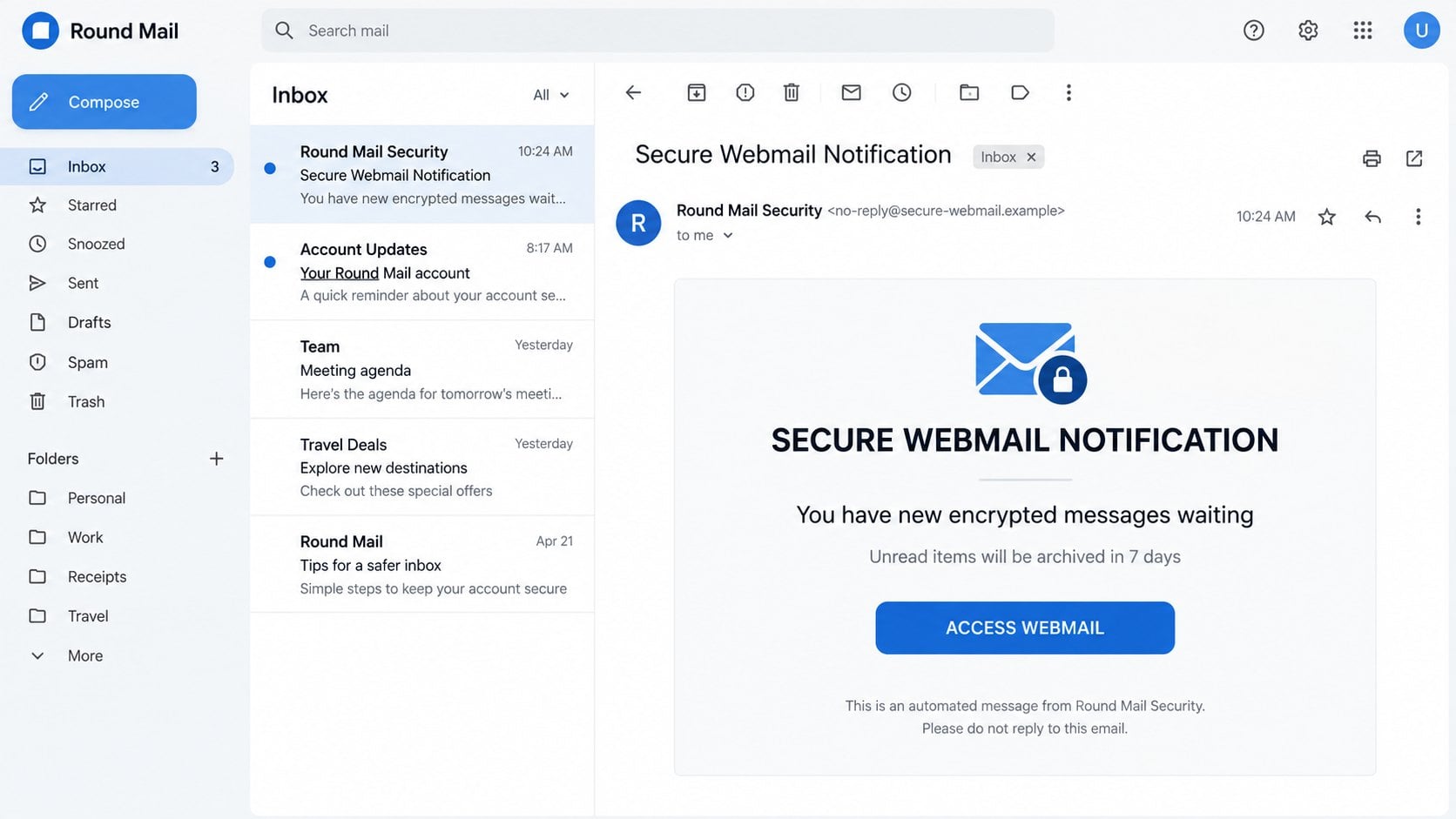
The Roundcube Encrypted Messages Waiting scam claims that unread encrypted mail is sitting inside the recipient’s webmail box.
It suggests updating privacy preferences and reviewing quarantined folders. Those technical phrases create the impression of a legitimate administrative alert.
The email says unread items will be archived after seven days. That deadline encourages action before the recipient asks why encrypted mail appeared unexpectedly.
An “Access Webmail” button promises one unified portal for messages, filters, and forwarders. The convenience sounds plausible to hosted-email users.
No sender names, subjects, encryption service, or server event supports the claim. The valuable details remain hidden behind the button.
The Roundcube Name Does Not Authenticate the Message
Roundcube is legitimate open-source webmail software used by many hosting providers. It is not necessarily the company that administers a particular mailbox.
Scammers exploit that distinction. Recipients recognize the interface or name, even when the message comes from an unrelated sender.
The linked destination may display a cPanel-style login rather than Roundcube. Mixing brands reveals a phishing kit intended for many hosting environments.
A genuine administrator knows which service operates the account. It should not present contradictory login identities through an external host.
Neither Roundcube nor cPanel is responsible for the campaign. Their names and visual patterns are being copied without authorization.
The Password Is the Actual Target
The supposed encrypted messages never appear. The destination instead asks for an email address and the password protecting the real mailbox.
- A security-themed subject creates curiosity and concern.
- Encrypted messages imply private or important content.
- A seven-day deadline limits perceived checking time.
- The button leads to an unrelated web address.
- Roundcube and cPanel styling are combined inconsistently.
- The form collects complete webmail credentials.
- A stolen inbox supports identity and payment fraud.
The campaign is credential phishing. It does not provide encryption, quarantine management, or a legitimate mailbox preference update.
Anyone who merely saw the email has not surrendered a password. Exposure occurs when information is entered into the page selected by the scammer.
How the Roundcube Encrypted Messages Scam Works
Step 1: Encryption Makes an Unknown Message Feel Important
The word “encrypted” suggests a sender deliberately protected sensitive information. Recipients may imagine legal, financial, medical, or workplace correspondence.
Because the message content remains hidden, curiosity does most of the persuasion. The victim cannot dismiss the subject after reading a harmless preview.
Encryption also sounds technical enough to explain an unfamiliar workflow. Users may forgive unusual steps because protected mail sometimes behaves differently.
The email never identifies the encryption provider or expected sender. That omission prevents simple confirmation before clicking.
Step 2: Archive Language Creates a False Expiration
The notice says unread items will be archived within seven days. It presents ordinary archiving as if the messages might become inaccessible.
Real retention policies are configured by the hosting provider or organization. They should be documented and visible inside the normal account.
A deadline motivates people to postpone verification. The reader may believe opening the portal now is the only way to preserve unknown messages.
The scam never explains where archived items go or how legitimate recovery works. Urgency replaces operational detail.
Step 3: Administrative Features Make the Button Sound Useful
The email mentions filters, forwarding, preferences, and a unified portal. These features are real concepts inside many webmail products.
Combining them with the encrypted-message story gives the button a broader purpose. It appears to be an account-management shortcut.
That extra language also distracts from the missing evidence. No message identifier or server record proves any encrypted item exists.
Users should manage forwarding and filters only after opening webmail through the established host address.
Step 4: The Access Button Leaves the Trusted Mail Route
The button’s label hides an external destination. A preview can reveal a domain unrelated to the recipient’s employer, host, or normal webmail portal.
Attackers may place the page on rented infrastructure or a compromised server. A professional host does not endorse customer content stored there.
Redirects can add recognizable words while sending the visitor elsewhere. The final registered domain remains the important ownership signal.
HTTPS does not establish legitimacy. It encrypts communication with the impostor and can make the counterfeit login appear safer.
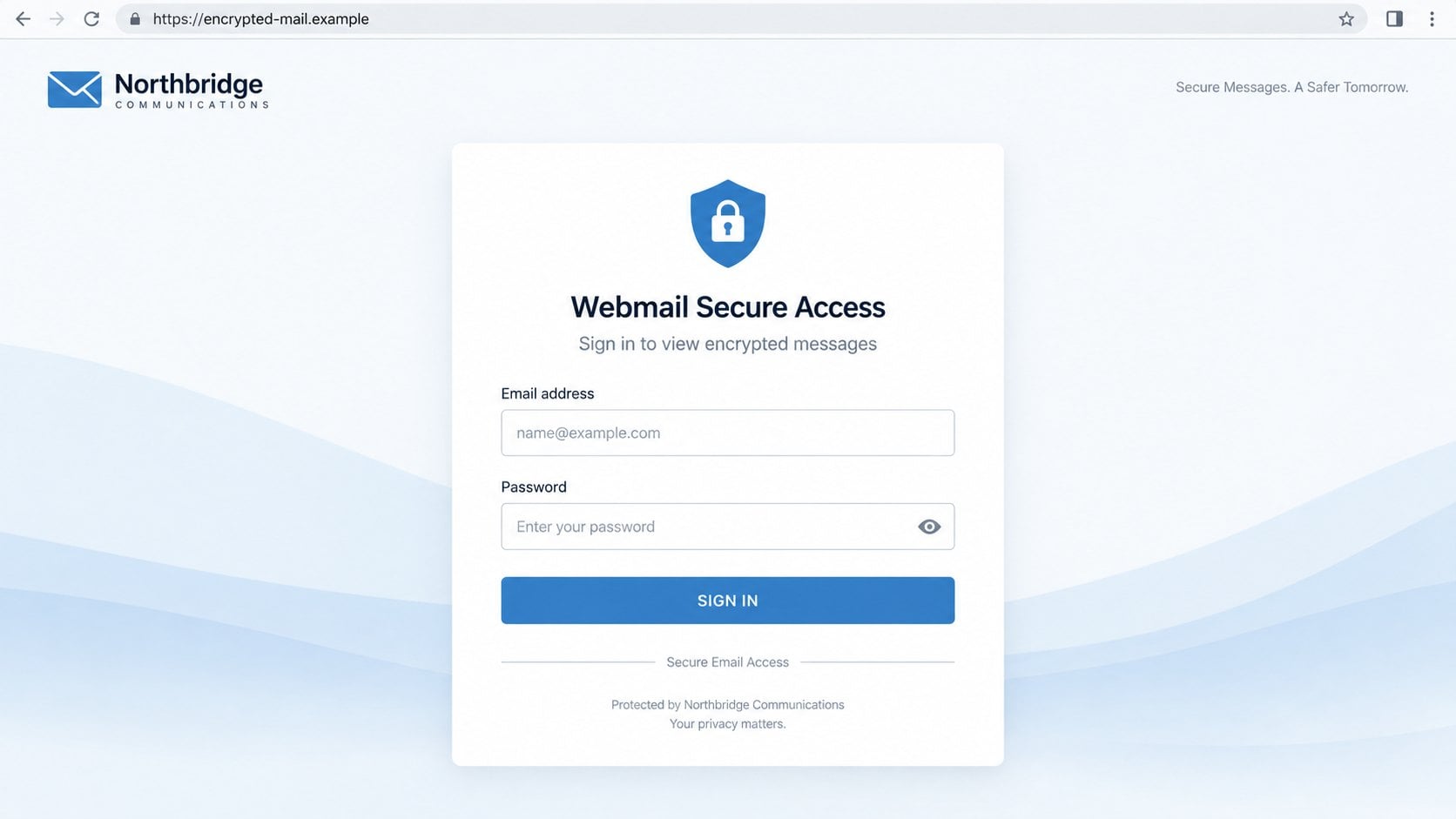
Step 5: A Familiar Login Form Captures the Secret
The landing page requests the full email address and password. It may use an envelope, shield, lock, or familiar color scheme.
Those elements are easily reproduced. The browser’s address identifies the site owner more reliably than artwork inside the page.
After submission, a fake error may request another attempt. Criminals sometimes collect both the first entry and any corrected password.
The page can later redirect to genuine webmail. That final move makes the victim blame a transient error instead of suspecting theft.
Step 6: The Attacker Uses the Inbox as a Recovery Hub
Email accounts receive reset links for numerous services. Controlling the mailbox can let an intruder seize shopping, cloud, social, and workplace accounts.
Private messages reveal names, schedules, contracts, and personal relationships. This context supports convincing impersonation and targeted fraud.
Rules may forward selected mail or hide security notifications. Delegated access and application passwords can provide additional paths back into the account.
Messages sent from the compromised address inherit its reputation. Contacts are more likely to open a new lure that appears inside an existing thread.
How to Verify an Encrypted Webmail Alert
Enter Webmail Through the Known Host Address
Use a saved bookmark, hosting control panel, or address supplied by the organization. Never let an unsolicited email choose the login location.
Check inbox, spam, quarantine, and secure-message areas after signing in normally. A real pending item should be visible within that established environment.
If the interface has no encrypted-message feature, the email’s central claim becomes even less credible.
Ask Who Actually Administers the Mailbox
Roundcube may be only the web interface. The hosting company or workplace administrator controls passwords, storage, retention, and support.
Contact that administrator through a known ticket system or published number. Do not use a support contact introduced by the questionable email.
Ask whether seven-day archiving exists and whether the organization sends alerts from the observed domain.
Review Sender and Destination Details
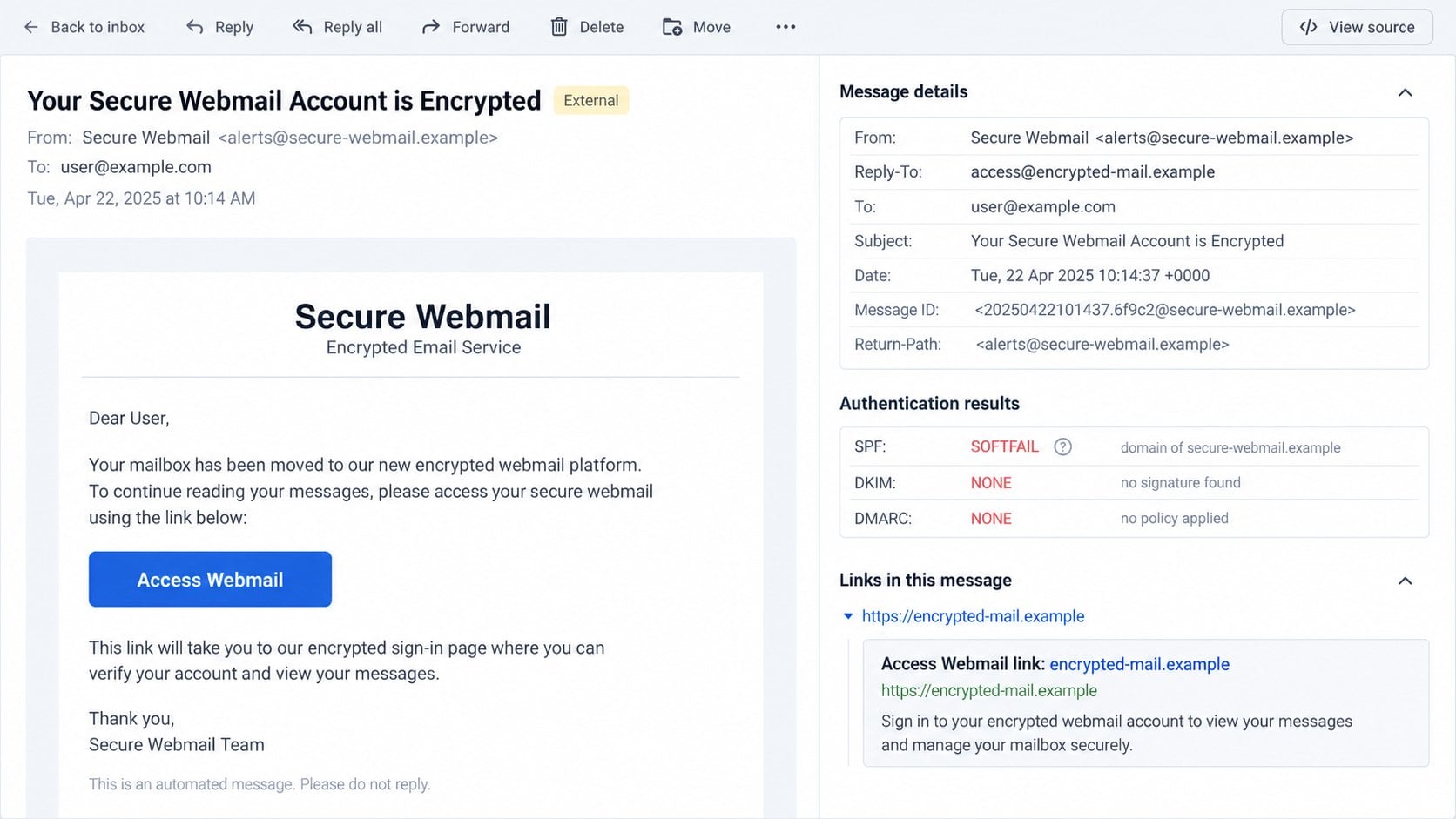
Expand the From, Reply-To, return path, and authentication results. Look for mismatches that show the display name is unsupported.
Preview the access button without visiting it. Compare the destination with the exact host used during ordinary webmail sessions.
A destination that combines mail-related words with an unfamiliar domain remains external, regardless of how technical it sounds.
Send a Controlled Test Message
When delivery is genuinely uncertain, send a harmless test from another account. Ask the administrator to check server logs if it does not arrive.
This procedure produces real evidence without exposing a password. It can identify filtering, quota, DNS, or routing problems safely.
Never type credentials into an unknown page merely to discover whether the underlying message exists.
What to Do If You Fell Victim to the Roundcube Webmail Scam
Respond in order, beginning with control of the mailbox. The sooner an exposed password changes, the less time an attacker has to establish persistence.
- Exit the fake login and record its details.
Close the tab, preserve the original email, and note the destination and interaction time. Capture the full headers if possible.
For a managed account, notify the host or workplace security team. They can locate related attempts across other mailboxes.
- Replace the mailbox password using the real portal.
Reach webmail from the normal control panel or bookmarked address. Choose a long credential used nowhere else.
Update other accounts sharing the old password. Start with financial, hosting, domain, cloud, and administrative services.
- Remove unauthorized sessions and access methods.
Review recent login history, devices, application passwords, connected apps, and session lists. Revoke entries that are unknown or unnecessary.
Ask the mail administrator to invalidate server sessions when the interface lacks that control.
- Examine forwarding, filters, and delegated users.
Inspect every rule for hidden copies, deleted security mail, or diverted financial correspondence. Check delegates and aliases too.
Search sent, trash, spam, and archive folders for activity you did not perform. Save suspicious messages before removing them.
- Add a phishing-resistant second factor.
Prefer a passkey, hardware token, or authenticator application. Avoid leaving SMS as the only strong recovery option when alternatives exist.
Regenerate backup codes after a compromise. Store them securely outside the mailbox they protect.
- Scan if the site delivered a download.
The analyzed lure uses a credential form, but related messages may offer files. Run Malwarebytes fully if anything downloaded or opened.
AdGuard can help block known fraudulent destinations during future browsing. Keep its filters and the browser itself current.
- Warn contacts and watch linked services.
Notify people who received unusual mail from the account. Share the subject and timeframe without redistributing the active phishing URL.
Monitor reset notices, security alerts, orders, and payments. Contact providers immediately when any connected account shows unauthorized changes.
Is Your Device Infected? Run a Free Malware Scan
Slow performance, constant pop-ups, or strange behavior? These are classic signs of a malware infection. The fastest way to find out is to scan your device with Malwarebytes Anti-Malware Free — one of the most trusted malware removal tools available.
The free version detects and removes the most common threats, including:
- Adware — the cause of those annoying pop-ups
- Browser hijackers — unwanted redirects and changed homepages
- Trojans and spyware — hidden programs stealing your data
- Potentially unwanted programs (PUPs) — software you never asked for
👉 Select your device below — Windows, Mac, or Android — then follow the simple steps to download Malwarebytes, scan your system, and remove any threats it finds. The whole process takes about 5 minutes.
Run a Malware Scan with Malwarebytes for Windows
Malwarebytes is one of the most popular and trusted anti-malware tools for Windows — and it’s completely free for removing infections. It catches threats that many antivirus programs miss, including adware, browser hijackers, and trojans. Follow the steps below to scan and clean your PC in just a few minutes.
Download Malwarebytes
Click the button below to download the latest version of Malwarebytes for Windows from the official source. The free version is all you need — it will scan your computer and remove adware, browser hijackers, and other malicious software at no cost.
Download MalwarebytesOfficial installer for Windows 11 and 10. Your download starts right away.Want real-time protection? See Malwarebytes Premium Malwarebytes Free for WindowsScans and removes malware at no cost
-
Install Malwarebytes
When the download finishes, open your Downloads folder and double-click the MBSetup file. If Windows shows a User Account Control pop-up, click “Yes” to allow the installation.

Follow the On-Screen Prompts to Install Malwarebytes
The setup wizard will walk you through a few quick screens:
-
Choose where you’re installing the program — “Personal Computer” or “Work Computer” — then click Next.

-
Malwarebytes will now install on your device. This usually takes under a minute.

-
When installation is complete, the “Welcome to Malwarebytes” screen will open automatically.

-
On the final screen, click Open Malwarebytes to launch the program.

-
Enable “Scan for Rootkits”
Before scanning, turn on rootkit detection so Malwarebytes can find even the most hidden threats. Click the Settings gear icon on the left side of the screen.

In the settings menu, find “Scan for rootkits” and click the toggle so it turns blue.

Done? Click “Dashboard” in the left pane to return to the main screen.
Start the Scan
Click the blue Scan button. Malwarebytes will automatically update its virus database and start checking your computer for malware.

-
Wait for the Scan to Finish
The scan checks your entire system for browser hijackers and other malicious programs, so it can take 5 to 20 minutes depending on your computer. Feel free to do something else — just check back occasionally to see the progress.

-
Quarantine the Detected Threats
When the scan is done, you’ll see a list of everything Malwarebytes found — malware, adware, and potentially unwanted programs. Click the “Quarantine” button to remove all of them at once.

Malwarebytes will now remove the malicious files and registry entries and move them safely into quarantine.

-
Restart Your Computer
Some threats can only be fully removed after a reboot. If Malwarebytes asks you to restart, click Yes. Once you’re logged back in, continue with the next step below to make sure nothing was left behind.

When the scan finishes, click Quarantine to remove everything Malwarebytes found. That’s it — your Windows PC is now clean of trojans, adware, and other malware, and should be back to running smoothly.
If you are still having problems with your computer after completing these instructions, then please follow one of the steps:
- Run a computer scan with ESET Online Scanner
- Ask for help in our Windows Malware Removal Help & Support forum.
Run a Malware Scan with Malwarebytes for Mac
Malwarebytes for Mac is a free on-demand scanner that removes the malware other security software tends to miss — adware, browser hijackers, and unwanted programs included. Cleaning an infected Mac with Malwarebytes has always been completely free, and it’s our go-to recommendation. Follow the steps below to scan and clean your Mac in just a few minutes.
-
Download Malwarebytes for Mac
Click the button below to download the latest version of Malwarebytes for Mac.
Download MalwarebytesOfficial installer for macOS. Your download starts right away.Want real-time protection? See Malwarebytes PremiumMalwarebytes Free for MacScans and removes malware at no cost -
Open the Malwarebytes setup file
When the download finishes, open your Downloads folder and double-click the setup file to begin the installation.

-
Follow the On-Screen Prompts to Install Malwarebytes
The Malwarebytes for Mac Installer will guide you through a few quick screens. Click “Continue” and keep following the prompts until the installation completes.



When the installation is complete, Malwarebytes opens to the Welcome to Malwarebytes screen. Click “Get started“.
-
Select “Personal Computer” or “Work Computer”
Malwarebytes will ask what type of computer you’re installing it on. Click either Personal Computer or Work Computer, whichever applies.

-
Start the Scan
Click the “Scan” button. Malwarebytes will automatically update its detection database and begin checking your Mac for malware.

-
Wait for the Scan to Finish
Malwarebytes will scan your Mac for adware, browser hijackers, and other malicious programs. This can take a few minutes, so feel free to do something else — just check back occasionally to see the progress.

-
Quarantine the Detected Threats
When the scan is done, you’ll see a list of everything Malwarebytes found. Click the “Quarantine” button to remove all the threats at once.

-
Restart Your Mac
Malwarebytes will now remove all the malicious files it found. Some threats can only be fully removed after a reboot — if Malwarebytes asks you to restart, allow it. Once you’re logged back in, your Mac is clean.

Once the scan is done, remove every threat it detected. Your Mac is now free of adware, rogue browser extensions, and other potentially harmful software.
If you are still experiencing problems while trying to remove a malicious program from your computer, please ask for help in our Mac Malware Removal Help & Support forum.
Run a Malware Scan with Malwarebytes for Android
Malwarebytes for Android automatically detects and removes dangerous threats like malware and ransomware so you don’t have to worry about your most-used device being compromised. Aggressive detection of adware and potentially unwanted programs keeps your Android phone or tablet running smooth.
-
Download Malwarebytes for Android.
You can download Malwarebytes for Android by clicking the link below.
MALWAREBYTES FOR ANDROID DOWNLOAD LINK
(The above link will open a new page from where you can download Malwarebytes for Android) -
Install Malwarebytes for Android on your phone.
In the Google Play Store, tap “Install” to install Malwarebytes for Android on your device.

When the installation process has finished, tap “Open” to begin using Malwarebytes for Android. You can also open Malwarebytes by tapping on its icon in your phone menu or home screen.

-
Follow the on-screen prompts to complete the setup process
When Malwarebytes will open, you will see the Malwarebytes Setup Wizard which will guide you through a series of permissions and other setup options.
This is the first of two screens that explain the difference between the Premium and Free versions. Swipe this screen to continue.
Tap on “Got it” to proceed to the next step.
Malwarebytes for Android will now ask for a set of permissions that are required to scan your device and protect it from malware. Tap on “Give permission” to continue.
Tap on “Allow” to permit Malwarebytes to access the files on your phone.
-
Update database and run a scan with Malwarebytes for Android
You will now be prompted to update the Malwarebytes database and run a full system scan.

Click on “Update database” to update the Malwarebytes for Android definitions to the latest version, then click on “Run full scan” to perform a system scan.

-
Wait for the Malwarebytes scan to complete.
Malwarebytes will now start scanning your phone for adware and other malicious apps. This process can take a few minutes, so we suggest you do something else and periodically check on the status of the scan to see when it is finished.

-
Click on “Remove Selected”.
When the scan has been completed, you will be presented with a screen showing the malware infections that Malwarebytes for Android has detected. To remove the malicious apps that Malwarebytes has found, tap on the “Remove Selected” button.

-
Restart your phone.
Malwarebytes for Android will now remove all the malicious apps that it has found. To complete the malware removal process, Malwarebytes may ask you to restart your device.
After the scan, tap Remove Selected to delete all detected threats. Your Android phone is now clean — no more malicious apps, adware, or browser redirects.
If your current antivirus allowed a malicious app on your phone, you may want to consider purchasing the full-featured version of Malwarebytes to protect against these types of threats in the future.
If you are still having problems with your phone after completing these instructions, then please follow one of the steps:
- Restore your phone to factory settings by going to Settings > General management > Reset > Factory data reset.
- Ask for help in our Mobile Malware Removal Help & Support forum.
Stay Protected: Block Ads and Malicious Sites
Now that your device is clean, keep it that way. Most infections start with a malicious ad or a fake download button — so blocking them at the source is your best defense.
We recommend AdGuard, which blocks malicious ads, phishing pages, and dangerous redirects before they can reach you.
👉 Download AdGuard and browse safely
Why Encrypted Message Lures Feel Convincing
Encrypted email is unfamiliar to many users. That uncertainty gives scammers room to invent unusual access rules without immediate contradiction.
The word implies privacy and importance. A recipient may believe the sender chose encryption because the contents are sensitive.
Hidden content creates an information gap. Clicking appears to be the fastest way to determine whether the message matters.
Archive warnings introduce scarcity. The possible loss of an unread item feels more urgent than an ordinary inbox notification.
Technical terminology can also discourage questions. Users may assume administrators understand a process that they personally do not.
Roundcube’s widespread use gives the campaign a broad audience. Many hosting customers have seen the interface even if they rarely remember its exact domain.
The mixed Roundcube and cPanel identity may pass unnoticed because both are associated with hosting. Familiar categories can conceal incompatible details.
Verification works best when users know their own provider. A fixed bookmark removes uncertainty about where credentials belong.
Security Improvements for Hosted Email
Hosting providers should publish one authoritative webmail address and warn customers that passwords are never collected through external document pages.
Organizations should deploy single sign-on where practical. Central identity controls make unfamiliar login prompts easier to reject.
Enable multifactor authentication on mail and hosting panels. Protect domain administration separately because mailbox compromise often targets password resets.
Alert administrators when users create forwarding rules or delegates. External destinations deserve additional review.
Email filters can detect authentication failures, brand impersonation, and newly seen link domains. Quarantine decisions should remain explainable to support staff.
Provide a reporting mechanism inside webmail. Users should not need to forward suspicious credentials lures manually.
Retention and quarantine behavior must be documented. Clear policies prevent attackers from inventing believable seven-day threats.
Train support teams to investigate delivery issues using logs, not passwords. Staff should never ask customers to reveal their mailbox secret.
Back up critical business mail according to policy. Recovery should not depend on opening a surprise “encrypted message” link.
After any compromise, review outbound mail reputation. Attackers may use the account for spam, causing the domain or server to be blocked.
Publish screenshots of the authentic login route inside support documentation. Users can compare navigation patterns without memorizing every visual detail.
Administrators should review failed sign-ins and unusual geographic access. Repeated attempts following one phishing report may identify a broader campaign.
Use separate administrator accounts for hosting control panels. Daily webmail credentials should not unlock DNS, billing, backups, or server configuration.
Rate limits and conditional access can slow automated credential testing. They also create useful alerts when a stolen password is tried repeatedly.
Support messages should name the hosting organization clearly. Consistent sender identities leave less room for vague “Secure Webmail” impersonation.
Customers benefit from periodic account reviews. Old delegates, abandoned devices, and forgotten application passwords create unnecessary entry points.
Frequently Asked Questions
Are encrypted messages actually waiting in Roundcube?
The email provides no evidence. Check through the normal webmail address and ask the actual administrator to verify server records.
Did Roundcube send the seven-day archive warning?
No evidence supports that conclusion. The campaign borrows the software’s identity while directing users to an unrelated password form.
Why does the destination resemble cPanel webmail?
The phishing kit mixes familiar hosting brands to target more users. That inconsistency does not represent a legitimate integration.
What if I clicked but did not submit my password?
Leave the site, report the email, review downloads, and revoke unexpected browser notifications. Password replacement becomes urgent after submission.
Can the attacker keep access after I change my password?
Possibly. Existing sessions, forwarding rules, delegates, or connected applications may persist until they are reviewed and revoked.
Does a padlock mean the webmail login is genuine?
No. HTTPS encrypts the connection to whichever site owns the certificate. It does not prove that site is your provider.
The Bottom Line
The Roundcube Encrypted Messages scam invents private mail and a seven-day archive deadline, then replaces the promised inbox with an external password collector.
Use your established webmail address, verify retention rules with the real administrator, and never let a surprise email decide where you enter credentials.








