

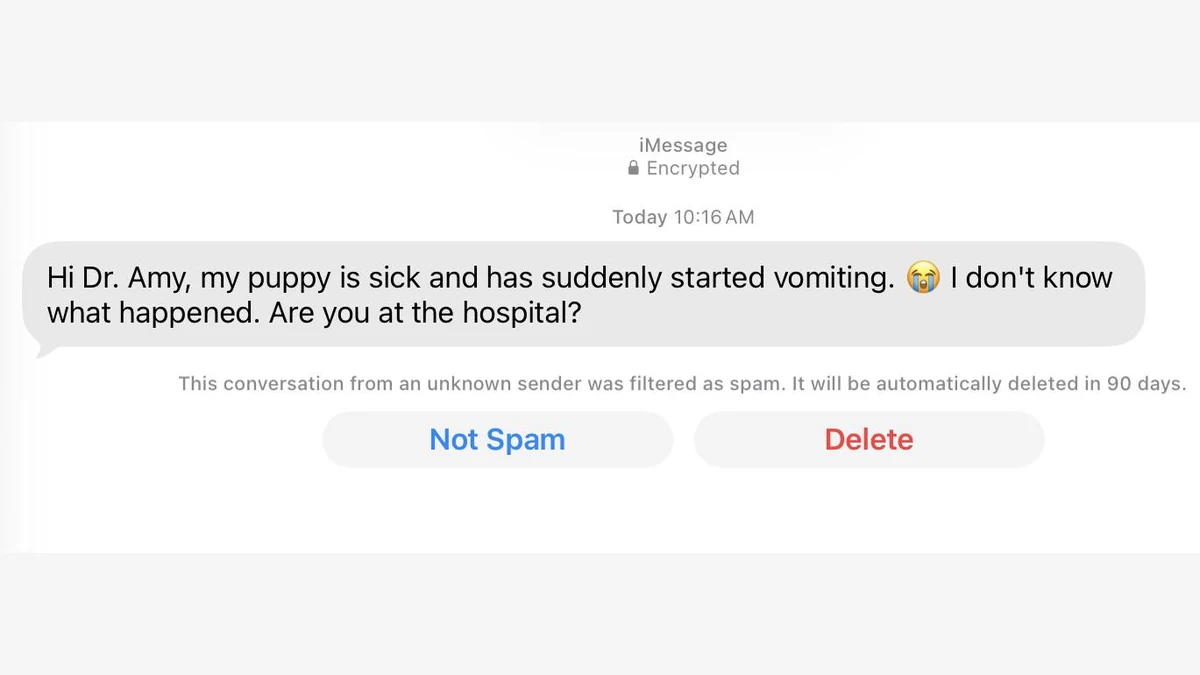
A text from an unknown number says a puppy is vomiting and asks whether “Dr. Amy” is at the hospital. The sender sounds frightened, and correcting the mistake feels like the kind thing to do.
That first reply can be all an operator needs to turn a wrong number into a longer emotional conversation.
Overview
The message creates concern before it asks for anything
A recent consumer report shows an unexpected text that reads, “Hi Dr. Amy, my puppy is sick and has started vomiting. I don’t know what happened. Are you at the hospital?”
There is no link, payment request, or explicit threat in the published message. Its immediate goal appears to be engagement: the recipient is invited to correct an urgent mistake and reassure a worried pet owner.
A real person can text the wrong number. The message alone cannot prove criminal intent. The risk lies in what happens after the recipient replies and the stranger tries to keep the conversation alive.
A sick animal is a strong emotional pretext
Pet distress activates empathy and urgency. The recipient may worry that ignoring the text could delay care for an animal, even though they have no role in the situation.
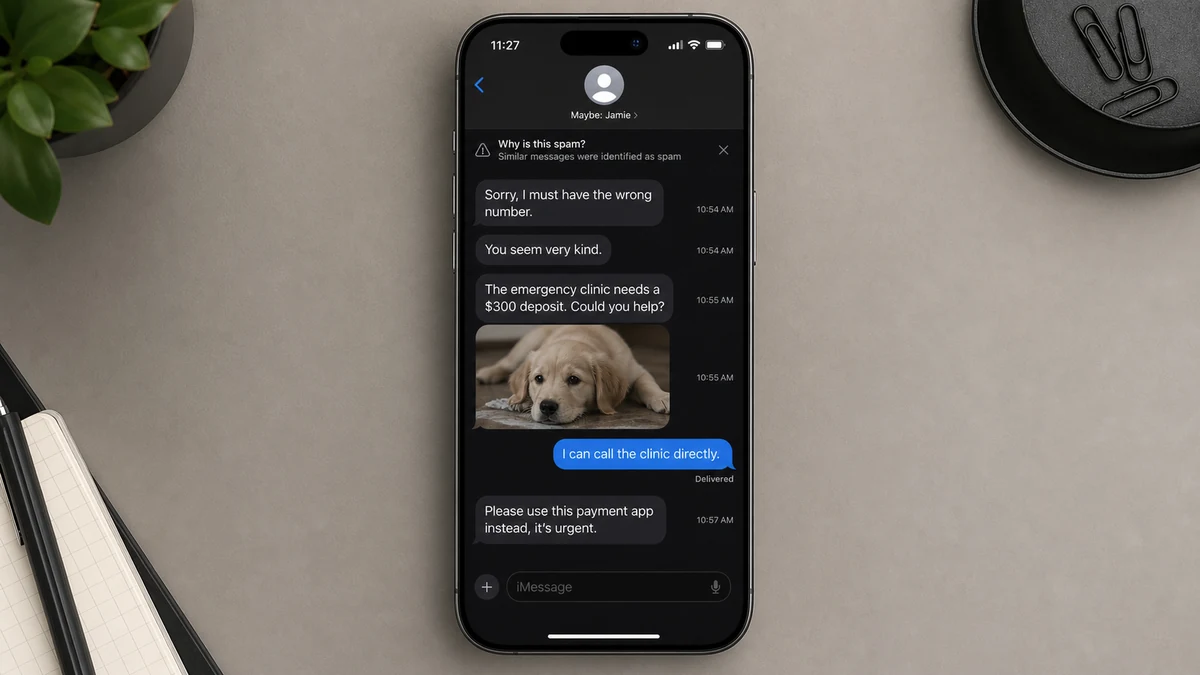
The sender can then apologize, ask for advice, share a photograph, or claim the clinic requires immediate payment. Each step makes the recipient more invested in helping.
The FTC has warned that criminals use sick or injured pet stories, fake shelters, stolen images, and urgent payment methods to exploit animal lovers.
The safest response is verification without engagement
If you are not Dr. Amy and have no connection to the hospital, you do not need to reply. A genuine sender can recheck the number, search for the clinic independently, or contact emergency veterinary care.
Warning signs that the conversation is moving toward fraud include:
- The stranger continues chatting after learning it is a wrong number.
- The sender asks for your name, city, work, or relationship status.
- A payment request appears for treatment, transport, or medicine.
- The clinic or hospital cannot be independently verified.
- Only a payment app, gift card, wire, or cryptocurrency is accepted.
- A pet photograph is used as proof without a verifiable case.
- The story changes when you offer to pay a real clinic directly.
- The sender pressures you to act before calling the facility.
What the Text Proves and What It Does Not
The screenshot proves that someone sent a pet-emergency message to a person who did not recognize the sender or the supposed doctor. It shows a carefully chosen reason to respond.
It does not reveal the sender’s identity, location, carrier, motive, or next message. There is no published payment account, website, clinic name, or evidence that money changed hands.
That means the responsible conclusion is conditional. The text is consistent with a wrong-number engagement hook, but a genuine typing mistake remains possible at the first-message stage.
The distinction does not require the recipient to take a risk. Ignoring an unexplained message does not prevent the sender from finding the correct veterinary number.
If the sender keeps talking after being told the number is wrong, the innocent-error explanation becomes less persuasive. A genuine pet owner should focus on reaching a clinic, not building a friendship with a stranger.
If money, identity data, links, apps, investment talk, or a move to another platform follows, the conversation has crossed into a recognizable fraud pattern.
How the Sick Puppy Text Scam Works
Step 1: A compassionate mistake lands on the phone
The message uses a specific name and urgent animal problem. It looks like a private conversation that reached the wrong person by accident.
The target is encouraged to reply out of courtesy rather than curiosity.
Step 2: The response confirms an active number
Even “wrong number” tells the sender that a real person reads the texts. The operator may also learn language, local time, and communication style.
The number can become more valuable for follow-up spam and targeted approaches.
Step 3: The stranger turns the mistake into rapport
The sender apologizes, thanks the recipient, and says they seem kind. A pet photo or short update can make the exchange feel harmless.
Questions about work, age, city, and family may be disguised as friendly conversation.
Step 4: The story creates a reason for help
The puppy may supposedly need emergency medicine, an examination deposit, transport, or surgery. The sender claims to be short of funds or unable to reach family.
The request can begin small to test whether the recipient will pay.
Step 5: Payment is separated from verifiable care
Instead of allowing direct contact with a real clinic, the sender provides a personal payment handle, gift-card request, crypto wallet, or unknown fundraising page.
A fake invoice or treatment estimate may use a genuine hospital’s name.
Step 6: New emergencies extend the payment chain
After one transfer, the story can add tests, overnight care, transport, discharge fees, or a payment-processing problem.
The recipient’s earlier help makes it harder to walk away from the next request.
Step 7: The relationship may pivot to another scam
Some wrong-number conversations abandon the puppy story and develop into friendship, romance, or investment fraud. The original message only needed to start a reply.
MalwareTips’ wrong-number text scam investigation follows that longer route from an accidental-looking message to financial grooming.
The FTC advises not responding to unexpected wrong-number texts because engagement can lead to longer scams.
Why the Puppy Story Is So Effective
An ordinary greeting can be ignored without guilt. A vomiting puppy suggests that delay has consequences for a vulnerable animal.
The text also places the recipient in the role of a medical professional. Being mistaken for “Dr. Amy” can make a quick correction feel responsible.
The sender does not ask for money immediately. That restraint lowers suspicion and lets the recipient choose to enter the conversation.
Once a person replies, the operator can praise their kindness. That compliment turns a random contact into a small social bond.
A photograph can intensify the effect, but it proves little. Pet images can be copied from social media, rescue pages, breeder listings, or generated and altered.
Medical language also creates plausible complexity. Tests, deposits, prescriptions, and specialist transfers can explain repeated costs that a recipient may not know how to evaluate.
The story is flexible across countries because payment apps and veterinary care exist almost everywhere. The supposed clinic can be changed after the target reveals a location.
Compassion is not the vulnerability. The unsafe step is allowing an unverified stranger to control the facts, payment destination, and deadline.
You can preserve the instinct to help by directing the sender to independently found emergency resources, without sending money or personal information.
How to Verify a Pet Emergency Without Funding a Stranger
Do not use a clinic number, payment link, or invoice supplied in the text. Search for the named facility independently and call its published number.
Ask whether the facility has the animal and whether it accepts direct payment toward a verified account. Many clinics will protect client privacy, so do not expect medical details from an unsolicited inquiry.
A refusal to identify any clinic ends the verification. There is no safe reason to send funds to a personal payment account instead.
Search the pet photograph with more than one reverse-image service. A match can expose a stolen image, but no match does not prove the story is genuine.
Check the fundraiser through the platform’s official site, not a link in the text. Review the organizer identity, creation date, beneficiary, updates, and whether the clinic can confirm the case.
Offer nonfinancial information, such as the phone number of an emergency veterinary service found independently. A real sender can use it without learning anything about you.
Do not disclose your name, address, workplace, pet ownership, travel, or financial situation. Those details can be used to customize the conversation.
If you already replied once, you do not owe a continued explanation. Block the number when the sender persists, changes the subject, or introduces a request.
The FTC’s wrong-number guidance says that replying confirms the number works and can lead to more contact or an investment pitch.
Its animal-scam warning also advises independent verification and caution when urgent pet stories demand hard-to-reverse payments.
Where a Simple Reply Can Lead
The shortest outcome is more spam. A response labels the number as monitored, and the sender or list owner may use it again.
A donation scam may follow. The sender claims the puppy needs help and supplies a personal payment handle or cloned fundraising page.
A friendship scam can develop over days. The puppy becomes a shared emotional topic, then the sender introduces a profitable investment or asks for a temporary loan.
A phishing route sends a clinic invoice, photo album, or payment page. The link may collect card details, account credentials, or device information.
An account-takeover route asks the recipient to forward a verification code, claiming it is needed to reach the hospital, recover a pet account, or confirm a donation.
An extortion route may begin after the recipient shares personal photos or moves to a video conversation. The operator threatens exposure unless money is sent.
A fake-cheque route could claim that a donation was sent accidentally for too much and ask the recipient to forward part to the clinic.
None of these outcomes is proven by the first screenshot. They explain why an apparently harmless reply is useful to a fraud operator.
How to End the Conversation Without Abandoning a Real Animal
The emotional trap presents only two choices: reply and help, or ignore a suffering puppy. In reality, a responsible third option is available.
If you choose to respond once, give no personal information and direct the sender to call a local emergency veterinary service. Do not search for one based on a location the sender asks you to reveal.
A concise message such as “You have the wrong number. Please contact an emergency veterinary clinic directly” provides useful information without beginning a friendship.
Do not continue discussing symptoms. Medical advice from an unknown recipient can delay real care and gives a scammer more material for the story.
If the sender asks you to locate Dr. Amy, do not search staff directories or forward the message to random clinics. The sender must verify the intended contact.
When a named clinic appears, open its official website yourself. Call the published reception number and describe the message without forwarding sensitive screenshots containing your number.
A real clinic may be unable to confirm a patient because of privacy rules. That limitation does not make payment to the stranger appropriate.
If the sender supplies a case number, treat it as a clue, not proof. Ask the clinic whether it recognizes the format and whether it accepts direct contributions.
Never let the sender conference you into a call. The “clinic employee” on the second line may be another scammer. Dial independently after ending the original contact.
Block the number when the stranger keeps chatting, praises your kindness, changes subjects, or resists direct verification. Those actions are unrelated to reaching the intended veterinarian.
Report the message before deleting it. Carrier reports help identify repeated wording and sending infrastructure used against other recipients.
Your compassion is better directed to a known local shelter or veterinary charity whose registration, address, and donation page you can verify independently.
Why the Text May Be Sent to Thousands of Numbers
The message does not need to know anything about the recipient. A bulk sender can use a common doctor’s name and rely on a small share of people replying.
Automation can record which numbers respond, how quickly they answer, and which language they use. A human operator can take over only after the target engages.
Different recipients may see different names, animals, or symptoms. The emotional structure remains the same even when the wording changes.
That scale explains why receiving the text does not prove that your phone, clinic, or pet records were breached. The sender may simply be testing a list.
A reply turns a random entry into a qualified lead. Silence denies the operator that signal and avoids the need to determine whether the first message was a mistake.
Company, Address, and Fulfillment Checks
The sender did not identify a veterinary hospital
The phrase “the hospital” supplies urgency without a name, address, doctor, or case number. Do not suggest a local facility and give the sender a story to adopt.
A real emergency can be directed to an independently found clinic.
The phone number is not identity
A local area code can be spoofed, rented, or used from another country. Reverse searches may provide clues, but they do not verify the current sender.
Do not call back to hear a voice as proof.
The payment recipient must match verified care
A personal payment handle, unrelated name, crypto wallet, or gift-card request does not establish that a clinic will receive the funds.
If helping is appropriate, pay a verified provider directly through its official system.
Fulfillment means documented care, not more messages
Photos, updates, invoices, and gratitude can all be fabricated. A payment receipt only shows where the recipient sent money.
Do not keep paying because the supposed treatment story becomes more detailed.
What to Do if You Have Fallen Victim to This Scam
- Stop replying and paying. Do not send another treatment payment, refund, transport charge, gift card, or account-verification code.
- Preserve the conversation. Save the original number, timestamps, pet images, clinic claims, payment handles, receipts, links, and any voice messages.
- Contact the payment provider. Explain that an authorized transfer was induced by a false pet emergency and ask whether it can be reversed or the recipient account frozen.
- Verify the clinic independently. Use a phone number from the clinic’s official website. Do not use the number or link the sender supplied.
- Report and block the number. Use the messaging app’s report option and forward unwanted US texts to 7726. Report the scheme at ReportFraud.ftc.gov.
- Secure any account used in the payment. Change reused passwords, review sessions, enable strong multi-factor authentication, and remove unfamiliar payment recipients.
- Replace exposed card details. If a linked payment page collected card information, contact the issuer and ask about replacement and transaction monitoring.
- Scan with Malwarebytes if you downloaded anything. A full scan is appropriate after opening an unknown app, attachment, installer, or browser extension. A plain text reply does not prove infection.
- Use AdGuard as preventive support. It can block many known phishing and malicious advertising domains, but it cannot determine whether an emotional story in a text is true.
- Review what personal information was shared. Expect more tailored scams if the sender learned your name, work, address, family, pets, or financial situation.
- Warn contacts if your identity was used. If the sender gained access to your messaging account, tell friends through another channel and revoke linked devices.
- Ignore recovery promises. No stranger can guarantee a payment return or track the operator for an upfront charge.
Frequently Asked Questions
Could the sick puppy text be a genuine wrong number?
Yes. The first message alone cannot prove intent. You still do not need to reply, and a genuine sender can check the number and contact a clinic independently.
What harm comes from replying “wrong number”?
The reply confirms that your number is active and may expose profile details or invite a longer conversation. It does not automatically infect the phone.
Can a pet photograph prove the emergency is real?
No. Images can be stolen, reused, altered, or generated. Verify the clinic and payment route independently instead of relying on the photograph.
Should I offer to pay the veterinary hospital directly?
Only after independently verifying the facility and case. Do not call or pay through contact information supplied by an unknown sender.
Will blocking the number stop every follow-up?
It stops that account from contacting you through the same route, but the number may be shared or reused. Expect other messages and keep privacy settings restrictive.
Did opening the text expose my phone?
Reading a normal text is not the same as installing malware. Risk increases if you click a link, open an unknown attachment, install software, or provide credentials.
The Bottom Line
The Sick Puppy Text Scam is effective because the first message asks for empathy, not money. A recipient can become emotionally committed before a payment request ever appears.
You are not responsible for solving an unexplained stranger’s emergency. Do not reply, click, or send money. If you choose to verify, find the clinic yourself and keep every part of the check outside the sender’s control.








