

If you have seen cozy sweaters, boots and cardigans from “Sinclair Toronto” advertised with up to 80% off, you are not alone. The store looks warm and inviting, the branding feels local and boutique, and the Cyber Week sale sounds too good to miss.
But once you start reading real customer experiences, a different picture appears. Before you type in your card details, it is worth slowing down and asking a simple question: is Sinclair Toronto a genuine Canadian boutique, or is it part of a larger sale scam pattern that has been hurting shoppers all year?
This guide walks through what Sinclair Toronto claims, what buyers say actually happens, and how you can protect yourself if you already placed an order.
What Is Sinclair Toronto?
The story the website tells
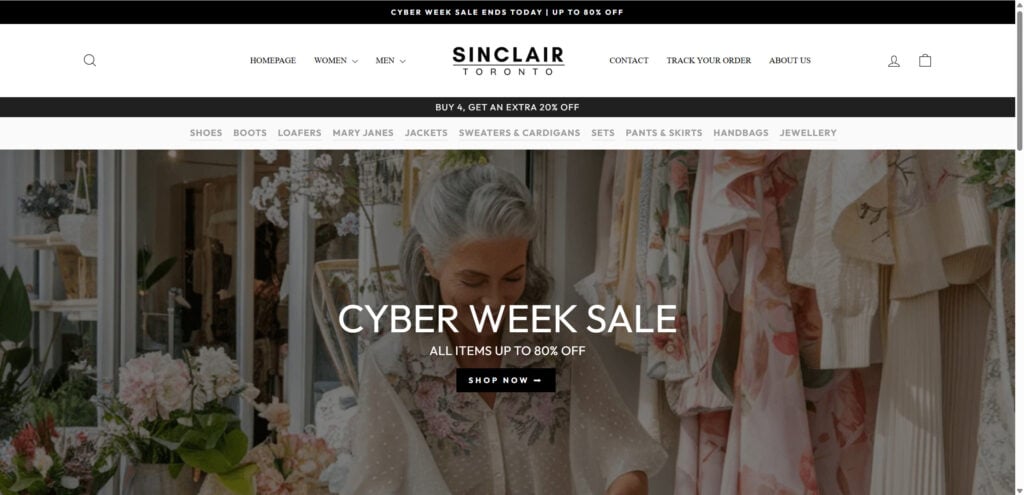
On the surface, Sinclair Toronto presents itself as a stylish Canadian fashion shop. The homepage shows a mature woman in a bright, plant filled boutique. Headlines talk about Cyber Week sales, limited time discounts and “buy 4, get an extra 20% off.”
Navigation menus highlight:
- Shoes, boots, loafers, Mary Janes
- Jackets, sweaters and cardigans
- Pants, skirts, sets and dresses
- Handbags and jewellery
The impression is of a small, curated fashion brand run by people who care about fabrics, fit and timeless style. The About Us page typically speaks about quality, comfort and community, often with language that feels heartfelt and personal.
To a casual visitor, nothing screams “scam” at first glance. The site uses professional images, a modern layout and standard features such as:
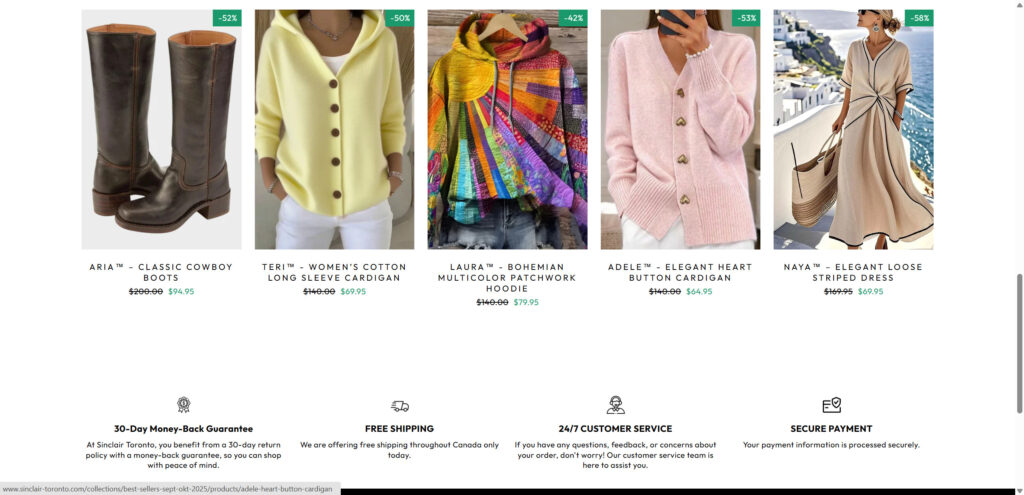
- 30 day money back guarantee
- Free shipping claims
- 24/7 customer service
- Secure payment icons
If you stop there, Sinclair Toronto looks like any other mid range online boutique.
Deep discounts that feel almost permanent
Where things begin to feel off is in the pricing and urgency.
Across the site you see:
- “Cyber Week Sale ends today” banners
- “All items up to 80% off”
- Extra percentage discounts when you buy multiple items, such as “Buy 4, get 20% extra off”
- Original prices shown as $180, $200 or more, slashed down to around $59 or $79
These high reference prices create the illusion that you are buying luxury or premium goods at an incredible bargain. In reality, many of these product photos and designs can be found on generic fast fashion platforms for a fraction of the “original” price.
That combination of emotional storytelling, Canadian branding and huge “ending soon” discounts is exactly what we see in a growing number of questionable boutiques.
Sinclair Toronto Scam Or Legit? A Quick Verdict
The short answer
Based on the pattern of complaints and how the website operates, Sinclair Toronto should be treated as a high risk online store.
That does not mean every single parcel fails to arrive or that every customer is scammed in the strict legal sense. It means that there is a serious mismatch between what the brand promises and what many buyers report receiving, especially when it comes to quality, returns and customer service.
In plain language:
- The site looks like a local Canadian boutique, but behaves more like a dropshipping or overseas fast fashion operation.
- Real customer reviews frequently mention poor quality, items that look nothing like the photos, and big problems getting refunds.
- The business leans heavily on emotional stories and “final sale” urgency instead of transparent information about who they are and where the goods ship from.
If you care about getting items that actually match the pictures and about having a fair return policy, Sinclair Toronto is not a safe bet.
How it fits a known pattern
Over the past few years, many nearly identical stores have appeared with different names and logos, but almost the same:
- Layout and fonts
- Family or local boutique story
- “Final sale” or “revival sale” language
- Very similar clothing photos and product names
Sinclair Toronto fits cleanly into this pattern. That does not happen by accident. It usually means the brand is part of a larger network of white label or dropshipping stores that can be closed and re opened under a new name if reviews become too negative.
For shoppers, the result is the same. The risk is not a one off shipping delay. The risk is feeling misled, receiving something completely different from what you ordered, and then discovering that getting your money back is almost impossible.
Red Flags Shoppers Have Reported
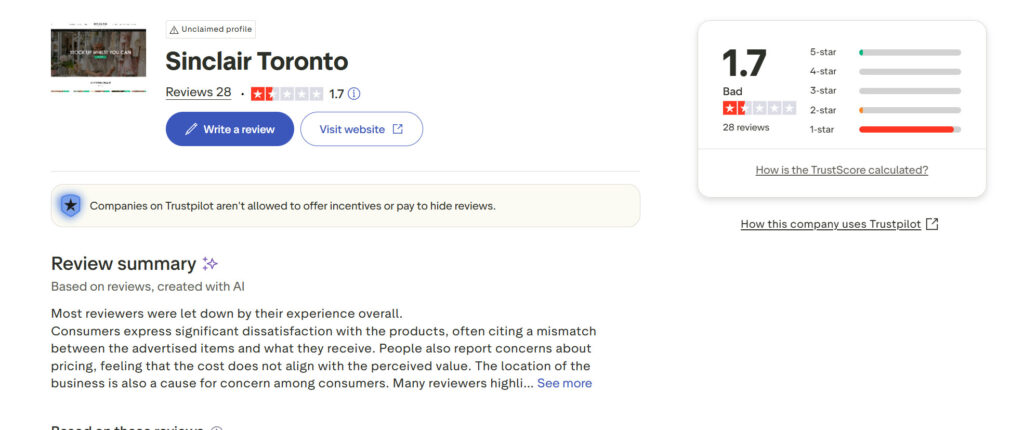
1. Extremely low review scores
Independent review platforms show very low ratings for Sinclair Toronto. The overall theme of these reviews is disappointment and regret. Buyers frequently say they wish they had checked reviews before ordering.
Typical complaints include:
- “Nothing like the photos”
- “Cheap, synthetic fabric instead of what was advertised”
- “Shoes uncomfortable and badly made”
- “Impossible to return without paying high shipping back to China”
When a fashion brand has a long list of issues across fit, material, color and after sales support, you are not seeing a few unlucky orders. You are seeing a systemic problem.
2. Mismatch between photos and reality
The product photos on Sinclair Toronto are polished and aspirational. Sweaters appear soft and thick, boots look well constructed, and dresses look like they belong in a higher price range.
Customers, however, often describe the items they receive as:
- Thin, scratchy fabric that loses shape quickly
- Colors that do not match the photos
- Poor stitching, loose threads and visible glue on shoes
- Sizing that is completely inconsistent with the size chart
These are classic markers of generic factory production using images that may have been lifted from other designers or higher end brands. The website experience feels premium, but the goods are closer to discount chain quality or worse.
3. Confusing or misleading return policy
On the homepage and in the footer you might see references to a “30 day money back guarantee.” This sounds simple and reassuring.
But once customers try to use that guarantee, they often discover:
- Returns must be shipped back at the buyer’s expense, often to an overseas warehouse
- Shipping costs can be so high that returning a $70 sweater is not worth it
- The company may offer only partial refunds or store credits
- Emails to customer support either go unanswered or receive copy paste responses
The net effect is that, in practice, many customers simply give up on returns. A guarantee that is extremely difficult to use is not much of a guarantee at all.
4. “Canadian” branding, overseas shipping
The brand name “Sinclair Toronto” strongly suggests a Canadian origin. Shoppers reasonably expect garments to ship from Canada or at least from a nearby warehouse.
Yet multiple buyers report:
- Long shipping times
- Tracking numbers that show parcels originating in China or other countries
- Packaging that clearly indicates overseas shipment
This kind of misalignment between branding and reality is another common sign of a low transparency operation. The company leverages the trust associated with a Canadian city, while the actual logistics look like any other global dropshipper.
5. Constant urgency and “final” sales
Sinclair Toronto heavily promotes Cyber Week and “final” sales with phrases such as:
- “Cyber Week sale ends today”
- “Almost sold out”
- “Final Cyber Week sale before we close our doors for good”
Shoppers who visit the site days or weeks apart often report seeing the same phrasing. The supposedly final sale appears to be a permanent marketing tactic, not a genuine last chance event.
Perpetual urgency is designed to reduce your time to think, research and compare. Real boutiques might run promotions, but they do not usually claim that every week is the last week they will exist.
How The Sinclair Toronto Operation Works
To understand why so many people feel misled, it helps to walk through the typical path from seeing an ad to fighting for a refund.
Step 1: You see the ad and the story
Most traffic to Sinclair Toronto seems to come from social media ads and sponsored posts. The ads show:
- Stylish women in cozy outfits
- Large text like “Up to 80% off, Cyber Week sale”
- Mentions of Canadian style or Toronto based fashion
Often there is a sense of urgency, such as “Ends tonight” or “Last chance to support a local boutique.”
If you are scrolling quickly and you love the look of the clothes, it is easy to click through without thinking too much about whether this is a long standing brand or a very new website.
Step 2: The website builds emotional trust
Once you land on the site, the story continues.
You may see:
- An About Us section talking about passion for style and comfort
- Photos of a cozy boutique interior and flowers
- Promises of free shipping, money back guarantees and secure payment
The goal here is emotional. You are not just buying a sweater. You are supporting a boutique, a team, maybe a family. It feels nicer than buying from a big anonymous marketplace.
At the same time, you are reminded that this is a rare opportunity because:
- The Cyber Week sale is ending
- Stock is running low
- Extra discounts unlock if you add multiple items to your cart
This combination of warmth and urgency can be very persuasive.
Step 3: You place your order
Encouraged by the large discounts and reassured by the guarantees, you place an order.
Typically:
- Payment is captured immediately through card or PayPal
- You receive an automated confirmation email
- Estimated shipping times might be vague or optimistic
At this stage, you believe you have ordered mid range fashion with big discounts from a Canadian based boutique.
Step 4: The long wait
For many buyers, this is where anxiety starts.
Common experiences include:
- Tracking numbers that take a long time to become active
- Parcels that move slowly through international shipping systems
- Delivery windows that stretch from days to several weeks
Some customers eventually receive their items. Others claim they never did, and say that customer service was dismissive or unhelpful when they asked for updates.
Step 5: The product disappointment
When the parcel does arrive, the difference between expectation and reality is often huge. Buyers report that:
- Materials feel cheap and synthetic, not soft or high quality
- Boots and shoes do not match the structure or shape shown online
- Sizing is inconsistent, with garments much smaller or larger than expected
- Sewing, seams and finishing feel rushed
Because the website shows carefully lit, high resolution photos, customers understandably feel cheated when the real items look like generic budget clothing.
Step 6: Trying to get a refund
At this point, many shoppers decide they want to return the items. This is where they hit the next wall.
Typical obstacles include:
- Return shipping
- Buyers are told to ship items back at their own cost.
- The return address is often in another country, and shipping can cost a large chunk of the order value.
- Refund conditions
- Some customers say they only received partial refunds.
- Others were offered store credit rather than a full refund.
- Customer service issues
- Emails receive generic responses that do not address the specific problem.
- Response times are slow or stop altogether once a complaint becomes firm.
The end result is that many people simply quit trying to return items. They feel it is throwing more money and time at a bad situation.
Step 7: Reputation vs recycling
As negative reviews accumulate on independent platforms, the brand reputation gets worse. Since the website is only one storefront in a larger pattern, it can be quietly downplayed while similar sites with new names and logos appear elsewhere.
For consumers, this cycle is frustrating. It can feel like trying to hold water in your hands. By the time many people realize something is wrong, their legal options feel limited, and the brand might already be shifting focus.
How To Recognize A Boutique Sale Scam Like Sinclair Toronto
Whether you decide to avoid Sinclair Toronto entirely or are still weighing your options, it is useful to know the broader red flags that apply to many similar operations.
Check the domain age
Legitimate brands can be new, but when a site claims a long history, yet its domain was registered very recently, that is a warning sign. You can use free WHOIS lookup tools to see when a domain first went live.
If a “beloved local boutique” only appeared online a few weeks ago, treat the storytelling very cautiously.
Compare photos across the web
Take a screenshot of a product photo and run it through a reverse image search. If the exact same photo appears on multiple unrelated sites, especially on low price marketplaces, it is likely that the boutique does not own those images.
This can indicate:
- Dropshipping from factories that also sell to others
- Use of stock or stolen photos to make cheap items appear luxurious
Read independent reviews, not just testimonials on the site
Internal testimonials are easy to fake. Look for:
- Trustpilot, Sitejabber or other review platforms
- Social media comments that are not heavily moderated
- Reddit or consumer forum discussions
If you see a consistent pattern of complaints around quality and returns, believe those patterns more than the marketing copy.
Inspect the return policy carefully
Before buying, scroll to the footer and read the full returns policy. Check for:
- Who pays for return shipping
- Where items must be returned
- Whether refunds are full, partial or only store credit
- Any extra conditions such as “must be approved in advance”
A fair policy is usually clear, short and easy to follow. A predatory policy is often vague or full of hurdles.
Notice the level of urgency
Sales happen, but a site that constantly claims:
- “Final sale”
- “Closing down”
- “Last chance to support us”
while still running the same promotion for weeks is using urgency as a pressure tactic. That does not always mean the site is a full scam, but it usually means they are prioritizing quick cash over long term trust.
What To Do If You Already Bought From Sinclair Toronto
If you placed an order and are now worried, you are not alone. There are concrete steps you can take to reduce the damage and protect yourself.
1. Keep all records
- Save order confirmations, invoices and shipping notices.
- Take screenshots of the product pages that show the photos, descriptions and prices at the time you bought.
- Save any emails or chat logs with customer service.
These records are essential if you later need to dispute the charge or file a complaint.
2. Give the seller a fair chance, but set a clear deadline
If the items have not yet shipped or have not arrived by the promised time frame, email customer support. Be polite but firm.
- Ask for a clear update and tracking information.
- State that if there is no progress or solution within a reasonable time (for example 7 to 10 days), you will request a refund through your payment provider.
Sometimes this gentle pressure is enough to get a proper response. If it is not, move on to the next step instead of waiting endlessly.
3. Inspect the goods immediately
When your package arrives:
- Open it right away and compare each item to the product photos.
- Try on clothing carefully while keeping tags attached.
- Take photos of any defects, color differences or obvious quality issues.
If the goods are clearly inferior or not as described, document everything.
4. Request a refund from Sinclair Toronto
Use email or the contact form to ask for a refund, referencing specific issues. Attach photos and explain that the items are not as described.
Be clear about what you want:
- Full refund to your original payment method
- Prepaid return label or reasonable return instructions
Sometimes, sellers in this space will offer a small partial refund if you agree to keep the items. If you are truly unhappy with the quality, this does not have to be your only option.
5. Initiate a chargeback or dispute if needed
If Sinclair Toronto:
- Does not respond, or
- Refuses a fair refund, or
- Provides instructions that are unreasonable
then contact your payment provider.
- Credit or debit card: Ask your bank for a chargeback on the basis of “goods not as described” or “defective merchandise.”
- PayPal: Open a dispute in the Resolution Center and upload all your evidence.
Chargebacks are time sensitive, so do not delay. The sooner you act, the better your chances.
6. Monitor your bank statements
While most operations like this only charge what you authorized, it is wise to:
- Check your card statements for the next couple of months.
- Look for any unexpected or repeated charges from unfamiliar names.
If you see anything suspicious, report it to your bank right away and request a new card if necessary.
7. Scan your devices and block shady ads
If you discovered Sinclair Toronto through a strange pop up or redirect, it is a good idea to tidy up your browser security.
- Use a reputable security tool such as Malwarebytes to scan your computer for unwanted software.
- Consider using an ad blocker and tracker blocker like AdGuard in your browser to reduce exposure to misleading shopping ads and fake countdown offers.
This does not fix your purchase issue, but it helps prevent future problems.
8. Leave an honest review
Your experience can help others.
- Post a factual, calm review on platforms such as Trustpilot or relevant forums.
- Mention what you ordered, what arrived and how the company handled your complaint.
Scammers and low quality operators thrive in silence. Honest reviews make it harder for them to keep repeating the same playbook without consequences.
Safer Ways To Shop For Boutique Style Clothing
If you love the look of Sinclair Toronto’s sweaters and jackets, you do not have to give up on that style. You simply need better sources.
Look for transparent, established brands
Safer indicators include:
- Clear business address and company registration details
- Social media accounts with authentic engagement over a long period
- Customer photos and organic comments, not just polished ad creatives
- Reasonable, clearly explained return policies
When a brand is proud of who they are, they do not hide behind vague “About Us” stories.
Use marketplaces with strong protections
Marketplaces are not perfect, but some offer better buyer protection than random standalone sites. If a product you like appears on a marketplace that:
- Holds funds until items are delivered, or
- Offers clear refunds for items that are not as described
then you may have a stronger safety net.
Start with a small test order
If you feel curious about a new boutique but are not sure yet:
- Order one low cost item first.
- Evaluate shipping time, quality and communication.
If everything goes smoothly, then consider a larger purchase. If it goes badly, you have learned an important lesson at a smaller financial cost.
The Bottom Line
Sinclair Toronto presents itself as a charming Canadian fashion boutique with generous Cyber Week deals and heartfelt customer care. In practice, many buyers describe a very different experience.
The recurring themes are huge discounts that never seem to end, clothing that bears little resemblance to the polished product photos, and return policies that are difficult or expensive to use. These are not minor inconveniences. They are core warning signs that Sinclair Toronto operates much more like a low transparency dropshipping store than the local boutique it claims to be.
If you have not ordered yet, the safest move is to stay away and look for clothing from brands with stronger transparency and better independent reviews. If you already ordered, move quickly to document what happened, request a fair refund and, if necessary, escalate through your bank or PayPal.
Online shopping should feel enjoyable, not stressful. With a little caution, some research and the tips in this guide, you can avoid operations like Sinclair Toronto and spend your money with brands that truly respect their customers.

Join the discussion
0 commentsShare your experience or ask a question about this article.
Discussion
Start the conversation
Have a question or something useful to share? Add the first comment.