

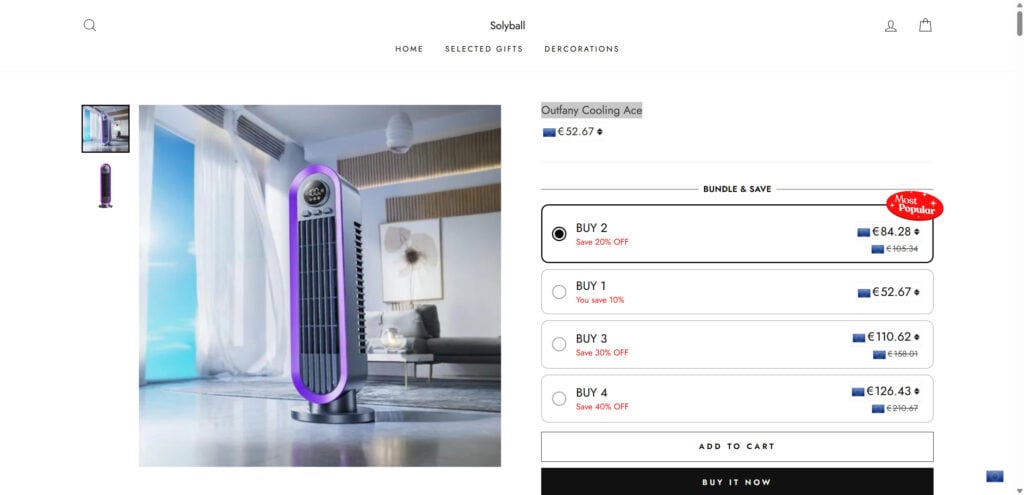
Solyball Outfany Cooling Ace is being promoted online as a powerful personal cooling device that can fight summer heat, refresh rooms, and replace expensive air conditioning.
But the product itself tells a different story.
It appears to be a generic bladeless desk fan sold under different names, often through social media ads that use exaggerated claims, AI-style videos, fake-looking reviews, and urgency tactics.
Overview
Solyball Outfany Cooling Ace is part of a growing wave of viral “portable AC” products advertised online.
The pitch is usually simple.
You are hot. Air conditioning is expensive. This small device looks modern, cheap, quiet, and easy to use. The ads suggest it can cool your room, lower your energy bill, and deliver comfort without installation.
That sounds attractive, especially during summer.
But the product appears to be a small personal fan, not a real air conditioner.
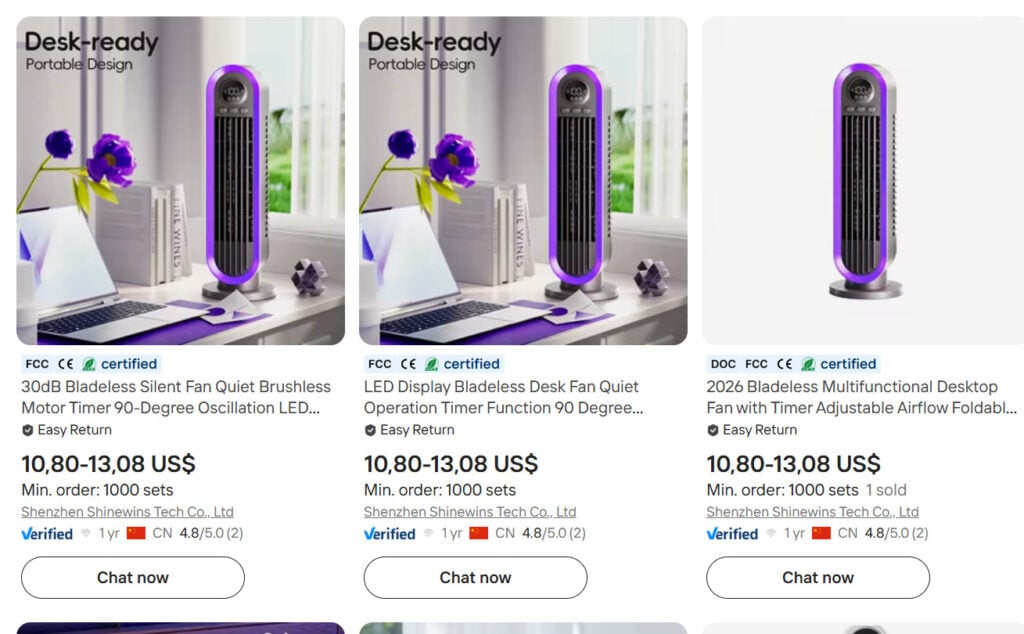
Our research found nearly identical-looking bladeless desk fans listed by Chinese suppliers for around $10.80 to $13.08 per unit, usually with bulk minimum orders. These listings describe the product as a bladeless silent fan, desk fan, brushless motor fan, LED display fan, timer fan, and adjustable airflow desktop fan.
That is important.
Those descriptions are much more realistic than the “portable AC” style claims often used in viral ads.
A bladeless desk fan can move air. It can sit on a desk. It can oscillate. It may have lights, a timer, or several fan speeds. It may feel pleasant if it is close to your face or body.
But it cannot cool a room like a real air conditioner.
That is the central issue with Solyball Outfany Cooling Ace.
A real AC removes heat from indoor air. It needs a refrigeration system, compressor, refrigerant, coils, and a way to move heat outside. That is why real portable air conditioners usually need an exhaust hose or window kit.
A small bladeless desk fan does not remove heat.
It only moves air around.
If your room is already hot, the fan is moving hot air. The airflow may feel better on your skin, but the room temperature will not drop in a meaningful way.
This is where many buyers feel misled.
They see ads showing icy air, dramatic cooling effects, comfortable bedrooms, and people claiming the device changed their summer. They expect a mini air conditioner. What arrives is often a lightweight plastic desk fan.
That does not mean the product is completely useless.
A personal fan can be useful on a desk, nightstand, kitchen counter, or work table. It can make one person feel cooler when used nearby. It can improve airflow in a small personal zone.
But that is very different from cooling a full room.
The problem is not the fan itself. The problem is the way it is sold.
Products like Solyball Outfany Cooling Ace are often marketed with inflated claims. They may be called “portable AC,” “mini air conditioner,” “cooling system,” “rapid cooling device,” or “room cooler.” These phrases create expectations the product likely cannot meet.
A small fan should be sold as a small fan.
When it is marketed like an AC alternative, buyers may overpay.
The price difference is another red flag.
Similar-looking devices can be found on Chinese wholesale platforms for a low unit cost. A reseller can buy or source the product cheaply, give it a new name, build a polished landing page, and sell it for much more.
That is why the same product can appear under many names.
One site may call it Solyball. Another may call it Outfany Cooling Ace. Another may use a completely different brand. The shell, LED display, vertical bladeless design, purple lighting, and desk-ready look may remain almost the same.
The branding changes.
The product does not.
This makes research harder for buyers. If the exact name is new, there may not be many reviews yet. But the same device may already exist under other names or on wholesale sites.
That is why reverse image search is so useful with these products.
If a “breakthrough cooling device” appears on bulk supplier websites as a $10 desk fan, the premium story becomes much less convincing.
Another issue is the use of AI-generated or heavily edited media.
Many viral gadget ads now use artificial-looking videos, fake demonstrations, staged lifestyle scenes, and unrealistic airflow effects. The fan may be shown blasting cool air across a room, freezing objects, or making a hot bedroom comfortable in seconds.
Those visuals are not proof.
They are advertising.
A real product test would show room temperature before and after, room size, humidity, distance from the fan, duration of use, and power draw. Most viral ads do not provide that. They show emotion, not evidence.
Fake-looking reviews also play a major role.
These product pages often show glowing testimonials from supposed customers. The reviews may claim that the device cooled a bedroom, helped people sleep, saved money on AC, or worked better than expected.
But if those reviews are only displayed on the seller’s own page, they should be treated carefully.
Seller-controlled reviews are not the same as independent customer feedback. A sales page can choose which reviews to show. It can hide complaints. It can use stock photos. It can import reviews from another product. In some cases, reviews may be generated or fabricated.
Buyers should look for independent reviews, real buyer photos, mixed feedback, and verified purchases from trusted retailers.
Another major risk is receiving multiple units.
Some viral gadget websites use checkout funnels that push bundles. You may click on one unit, then see offers for two, three, or four. The page may highlight the biggest bundle as the “best deal.” Some buyers click too fast and end up ordering more than intended.
In more aggressive funnels, post-purchase upsells can appear after payment information is entered. A shopper may think they are declining an offer but accidentally accepts it.
That is how people end up with multiple units and a much higher charge than expected.
Returns can also be difficult.
The ad may say there is a money-back guarantee, but the real return process may require contacting support, waiting for approval, paying return shipping, sending the item to another country, or returning it unused in original packaging.
For a cheap fan, that can make the refund nearly pointless.
If return shipping costs too much, many buyers simply give up.
That is why people often describe these offers as having “no returns.” The policy may exist on paper, but the practical process can be slow, expensive, or frustrating.
Solyball Outfany Cooling Ace should be viewed as a high-risk viral gadget product.
It may work as a desk fan.
It should not be trusted as a room-cooling AC.
How The Operation Works
1. A Cheap Desk Fan Is Sourced From China
The operation usually starts with a generic product.
In this case, the product appears to be a bladeless desktop fan with a vertical body, LED display, oscillation, timer, and quiet motor claims.
Similar-looking units are listed by Chinese suppliers for low bulk prices.
The product is not necessarily new or exclusive. It is a mass-produced gadget that can be purchased by resellers and sold under different names.
This is common in dropshipping and viral gadget marketing.
The same physical item can be used for many brands.
2. The Product Gets a New Name
A generic fan does not sound exciting.
So the seller gives it a name.
Names like Solyball, Outfany Cooling Ace, Arctic Fan, Chill Tower, Frost Breeze, or Mini Cool Pro make the device sound more advanced.
The name is part of the product’s perceived value.
A $10 desk fan sounds basic.
A “Cooling Ace” sounds like a smart summer solution.
The product may be the same, but the branding changes how buyers feel about it.
3. The Fan Is Marketed as a Cooling Breakthrough
The next step is the biggest problem.
The product is not only presented as a fan. It is often promoted as a cooling device that can solve room heat.
The ads may use phrases like:
- Portable AC
- Rapid cooling
- Room cooling
- Cooling in seconds
- Energy-saving air conditioner
- Quiet cooling system
- Personal climate device
- Beat the heat without expensive AC
These phrases are designed to blur the line between a fan and an air conditioner.
A fan can provide airflow.
An air conditioner lowers temperature.
Those are different things.
The marketing often makes buyers forget that difference.
4. AI-Style Videos Make the Product Look Stronger
Social media ads are a major part of the operation.
These ads are built for quick attention.
They may show a hot room, someone sweating, then the fan turning on and instantly making the space feel cool.
Some videos may use AI-generated scenes. Others use edited airflow graphics, unrealistic mist effects, stock footage, or staged demonstrations.
The product may look more powerful in the ad than it is in real life.
This is especially common with small fans, mini coolers, posture devices, cleaning gadgets, and other viral products.
The ad does not need to prove anything.
It only needs to make the viewer click.
5. The Website Adds Fake-Looking Trust Signals
After the buyer clicks the ad, they land on a sales page.
That page may show:
- Big discounts
- Countdown timers
- Limited stock warnings
- Five-star reviews
- Fake-looking media logos
- “Verified buyer” testimonials
- Security badges
- Money-back guarantee claims
- Before-and-after style images
Each element is designed to reduce doubt.
The buyer starts thinking, “This looks popular. Other people bought it. It must work.”
But trust signals on a sales page are not proof.
Media logos can be placed on a page without real coverage. Reviews can be selected or fabricated. Countdown timers can reset. Stock warnings can be fake.
The page is designed to sell, not to give a balanced product evaluation.
6. The Product Is Sold at a Large Markup
This is where the profit comes from.
A similar fan may cost around $10 to $13 from a supplier in bulk.
The branded version may be sold for much more through a viral website.
The buyer is not only paying for the fan. They are paying for the advertising funnel, the brand story, the fake urgency, the website design, and the reseller’s margin.
Retail markup is normal.
Misleading markup is different.
If a $10 fan is sold as a basic desk fan for a fair price, that is one thing.
If the same fan is sold as a powerful cooling device that can replace AC, that becomes a problem.
7. Bundle Offers Increase the Charge
Many of these websites push buyers toward multi-unit bundles.
The page may show offers like:
- Buy 1
- Buy 2 and save
- Buy 3 and get the best deal
- Buy 4 for the family
- Summer bundle discount
This increases the order value.
It can also confuse buyers.
Some people accidentally choose more units than they wanted. Others click through upsells too quickly. Some only realize the final price after the charge appears on their bank statement.
This is why buyers should always check the final checkout total before paying.
Look at the quantity, shipping, tax, add-ons, and final amount.
Do not rely on the advertised price.
8. The Product Arrives and Feels Like a Basic Fan
When the package arrives, the buyer may notice that the product looks cheaper than the ad.
It may be lightweight plastic. The airflow may be weak. The cooling effect may only be noticeable when sitting close to it.
The device may look almost identical to the wholesale listings.
This is where the disappointment starts.
The buyer expected a cooling solution.
They received a personal desk fan.
Again, the fan may not be completely useless. It may work as a small fan.
But it cannot cool a room.
That is the key point.
9. Refunds Become Hard
If the buyer asks for a refund, the seller may create obstacles.
They may ask for photos, videos, order details, or explanations. They may offer a small partial refund instead of a full refund. They may require return shipping at the customer’s expense.
If the return address is overseas, the cost may be too high.
Some buyers may not bother returning it.
That is often part of the business model. If enough people give up on refunds, the seller keeps the money.
10. The Product Reappears Under Another Name
When complaints start building around one name, the same product can be sold under a new name.
This is why buyers see so many similar “portable cooling” gadgets.
The device changes names, but the claims stay similar.
The cycle repeats:
- New brand name
- New ads
- New reviews
- New discount
- Same basic product
- Same buyer disappointment
That is why Solyball Outfany Cooling Ace should not be judged only by its name.
Judge the physical product.
It looks like a small bladeless fan, not a real AC.
What To Do If You Have Fallen Victim
- Save screenshots immediately
Take screenshots of the ad, product page, checkout page, refund policy, and all cooling claims.
Save anything that says the product can cool a room, replace AC, lower temperature quickly, or save major energy costs.
These screenshots are useful if the website changes later.
- Take photos of the product
Photograph the item you received.
Include:
- Front of the fan
- Back of the fan
- Control panel
- Power label
- Plug
- Manual
- Packaging
- Shipping label
- Any model number
This helps show what the product actually is.
- Compare it with wholesale listings
Use reverse image search.
Search for the same product image online.
If you find the same fan on Chinese supplier websites for around $10 to $13, save those screenshots.
This can support your claim that the product was marketed as something more advanced than it really is.
- Check your bank statement
Look at the final charge.
Check for:
- Multiple units
- Duplicate charges
- Extra shipping fees
- Add-on warranties
- Priority processing
- Subscription charges
- A strange merchant name
If you were charged for more than you ordered, document it right away.
- Contact the seller in writing
Send a clear message.
Say that the product was advertised as a cooling or portable AC device, but what arrived is a small personal fan that does not cool a room.
Ask for a full refund.
Keep your message calm and factual.
- Do not accept vague excuses
The seller may say the product works best in small rooms, should be placed closer, or needs more time.
If the product cannot cool the room as advertised, repeat your refund request.
Keep every reply.
- Be careful with partial refunds
Some sellers may offer a small refund and tell you to keep the fan.
Think carefully before accepting.
If you accept a partial refund, it may be harder to dispute the full charge later.
- Contact your payment provider
If the seller refuses to help, contact your bank, credit card company, PayPal, or payment provider.
Explain that the product was not as advertised.
Provide:
- Screenshots of the claims
- Photos of the product
- Proof of payment
- Seller emails
- Wholesale comparison screenshots
Ask about a dispute or chargeback.
- Block future charges if needed
If you see unexpected charges, call your bank immediately.
Ask them to block future payments from that merchant.
If you are worried your card details may be misused, request a replacement card.
- Report the ad
Report the ad on the platform where you saw it.
This may include Facebook, Instagram, TikTok, YouTube, Google, or another ad network.
Use the platform’s misleading ad, scam, or false claims option.
The Bottom Line
Solyball Outfany Cooling Ace appears to be a generic bladeless desk fan sold under a more exciting name.
Similar-looking fans are sold by Chinese suppliers at low bulk prices. Viral websites may then rebrand the product, promote it through AI-style social media ads, add fake-looking reviews, and make exaggerated cooling claims.
The product may blow air.
It may be fine as a small personal fan.
But it cannot cool a room like a real air conditioner.
A fan moves air. An AC removes heat. That difference matters.
The main risk is that buyers may pay a premium price for a cheap generic fan, believe it will cool a room, receive multiple units by mistake, and then struggle to get a refund.
If you need real cooling, buy a proper air conditioner from a trusted retailer.
If you only want personal airflow, buy a normal fan from a known brand and avoid viral “cooling miracle” ads.

Join the discussion
0 commentsShare your experience or ask a question about this article.
Discussion
Start the conversation
Have a question or something useful to share? Add the first comment.