

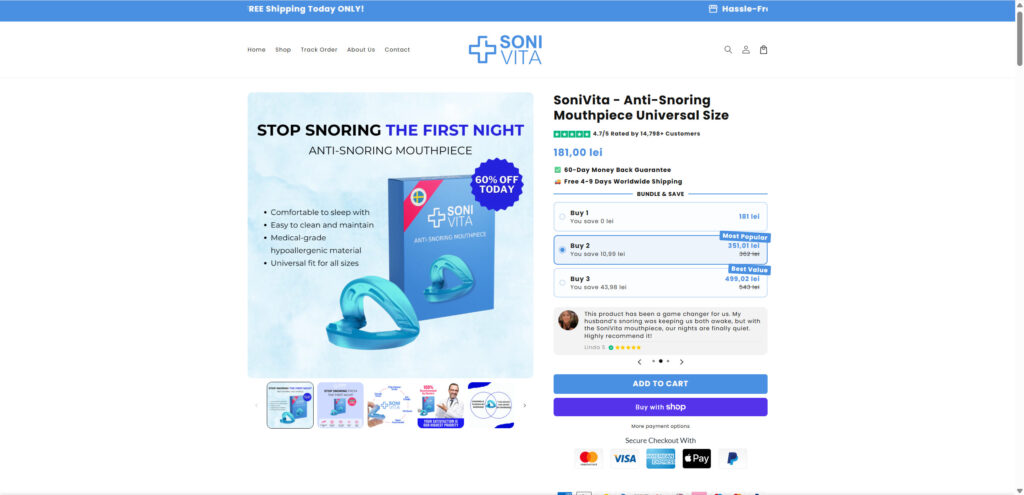
The SoniVita™ Anti-Snoring Mouthpiece promises to stop snoring from the very first night. It’s advertised as a scientifically tested, medical-grade mouthpiece that “keeps your airway open” and helps you and your partner finally enjoy a quiet night’s rest.
The product page features smiling couples, before-and-after diagrams of throats, “FDA approved” claims, and glowing testimonials from supposedly happy users. But behind the soft blue colors and reassuring language lies a very different story.
Is the SoniVita mouthpiece really worth the $40 price tag? Or is it another heavily marked-up dropshipping gadget — sourced for a few dollars from Alibaba and sold with exaggerated promises?
This comprehensive investigation exposes the reality behind the SoniVita Anti-Snoring Mouthpiece — its origins, marketing tricks, false endorsements, and what to do if you’ve already bought it.
Overview
The SoniVita website describes the product as a medical-grade, BPA-free, hypoallergenic anti-snoring mouthpiece that fits all jaw sizes and requires no molding or boiling. It claims to work by gently repositioning the lower jaw forward to keep the airway open and reduce throat vibrations — the mechanism that causes snoring.
It sounds scientific, but nearly every detail on the website is either exaggerated, misleading, or unverifiable.
1. The Real Cost vs. Retail Price
On Alibaba and AliExpress, identical mouthpieces are listed under names like:
- “Anti-Snoring Mouthpiece Comfortable BPA-Free Device” ($3.70 USD)
- “Factory Custom Nighttime Snoring Prevention Mouthpiece” ($0.70 – $5.90 USD)
- “Adjustable Anti-Snoring Kit” ($6.79 USD)
SoniVita sells the same device for ≈ $40 USD – a markup of 500 – 1,000%. There’s no evidence that SoniVita adds any additional functionality, clinical validation, or warranty to justify this price difference.
This pattern is a hallmark of dropshipping operations, where sellers import cheap generic products, create branded landing pages, and use emotional marketing to justify inflated retail prices.
3. Fabricated Clinical Data
The site includes impressive-sounding statistics:
- “94% reported reduced snoring from the first night.”
- “89% experienced improved sleep quality and energy.”
- “93% found it easy to clean and reuse.”
None of these numbers are sourced. There are no links to peer-reviewed studies, independent testing, or real-world trials. The claims are likely invented to build trust and social proof.
Furthermore, the site states that the mouthpiece was “rigorously tested in clinical trials involving over 2,500 participants.” No such study exists in medical journals, PubMed, or clinicaltrials.gov.
3. Misleading Doctor and User Testimonials
The SoniVita page features photos of couples smiling with blue mouthpieces and testimonials from names like Linda S., James O’Connell, and Anna Larsen, all praising how the device “saved their marriage.”
Reverse-image searches show that several of these photos originate from stock photography websites or unrelated online profiles. The text of these reviews also matches templates used in other dropshipping stores — a clear indicator of fabricated testimonials.
No verified purchase system or external review platform (like Trustpilot or BBB) is linked.
4. Fake Urgency and Countdown Tactics
The page prominently advertises:
“60% OFF — Today Only!”
But this “discount” resets every 24 hours. It’s not a genuine limited-time offer; it’s a psychological trick used to trigger impulse buying.
Additionally, SoniVita uses “bundle & save” pricing — 2 packs for 351 lei, 3 packs for 499 lei — to increase average order value through false savings.
5. Unverified Company Information
There’s no corporate address, phone number, or VAT ID on the SoniVita website. The “Contact Us” page provides only a support email form.
Domain records show the website is hosted through Shopify with privacy protection enabled, hiding ownership details. This lack of transparency makes it nearly impossible for customers to reach the company once payment is made.
6. “Scientifically Proven” — Without Science
The SoniVita mouthpiece claims to be “designed in collaboration with leading sleep specialists.” Yet, there is no mention of who these specialists are, nor any certifications from dental or sleep-medicine associations.
Real anti-snoring solutions — such as custom-fitted mandibular advancement devices — require dentist supervision and precise fitting to avoid jaw strain or breathing complications.
The one-size-fits-all SoniVita device cannot offer such precision, and therefore its promise of “instant results” is scientifically implausible.
7. Customer Experiences and Refund Complaints
Early buyers have reported that SoniVita’s “60-day money-back guarantee” is rarely honored. Customers who attempt returns are often met with delayed responses or told to ship the product back to an undisclosed foreign address at their own cost.
In several consumer forums, users describe difficulty contacting customer service after purchase, with no confirmation of refunds even after multiple follow-ups.
How the Operation Works
Understanding the dropshipping process reveals why products like SoniVita appear so professional yet often disappoint customers.
Step 1: Sourcing a Generic Product
Entrepreneurs or marketing agencies identify trending niches (like snoring or posture correction). They browse Alibaba or 1688.com for cheap gadgets with high visual appeal — the anti-snoring mouthpiece costs less than $3 USD in bulk.
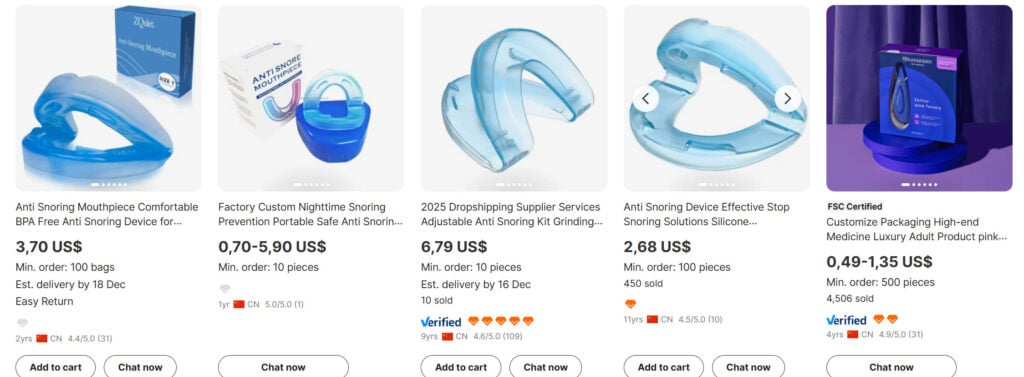
These devices are unbranded, meaning anyone can buy them, repackage them, and sell them under a new name.
Step 2: Rebranding and Website Creation
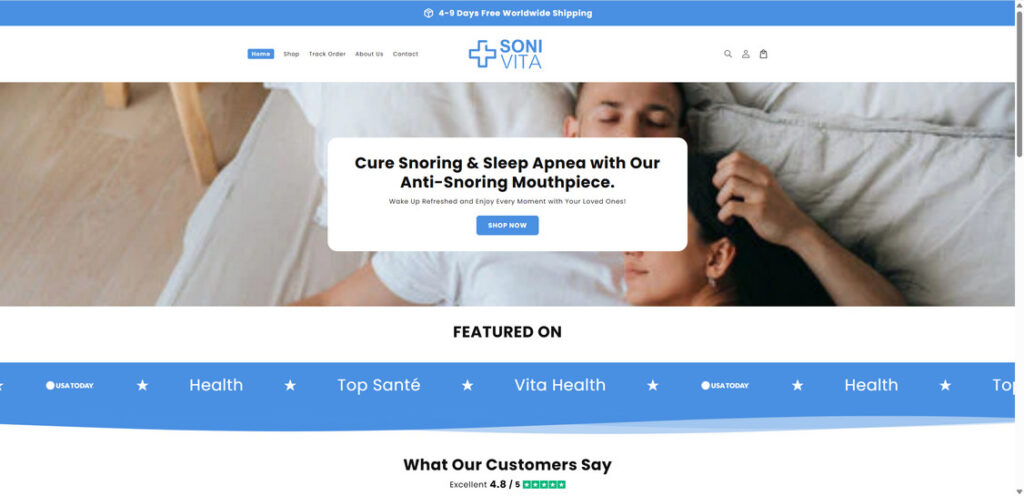
They design a polished Shopify website with a medical-style logo (blue + cross = trust). The store uses fonts, graphics, and colors associated with health institutions.
They name it something scientific-sounding — “SoniVita” (Latin for “sound life”) — and claim it’s a “sleep technology company.”
Professional-looking banners, charts, and anatomical diagrams are pulled from stock image libraries or AI renderings.
Step 3: Creating False Legitimacy
Fake clinical statistics and endorsements are added: “Used by 2,500 people in clinical studies,” “FDA Approved,” and “Loved by Doctors.”
Customer review widgets show high ratings (“4.7 / 5 from 14,798 customers”) but these are manually inserted HTML blocks, not verified review systems.
Step 4: Launching Paid Ads
Aggressive ads are run on Facebook, TikTok, and Instagram, using short testimonials or before-and-after snoring graphs. The goal is to emotionally connect with couples suffering from sleepless nights.
Phrases like “Save your marriage” or “Wake up refreshed” exploit real emotional pain to drive impulse purchases.
Step 5: Inflating the Price
The $3 device is marketed as a premium solution costing €35–€40 USD, justified by “medical-grade materials,” “clinical testing,” and “free e-book bonuses.”
A fake “original price” (such as €100 or 200 lei) creates an illusion of deep discount.
Step 6: Collecting Orders and Forwarding to Suppliers
When a customer orders from SoniVita’s site, the company doesn’t ship from Europe or the U.S. Instead, the order details are forwarded directly to an AliExpress supplier or third-party logistics center in China.
Packages are shipped using cheap international mail and usually arrive in 2 – 4 weeks, not “4–9 days worldwide” as advertised.
Step 7: Minimizing Customer Support
Most dropshipping operations rely on auto-reply email scripts and generic FAQ pages. If a customer requests a refund, the company delays replies until the dispute window closes.
By then, customers have little recourse other than chargebacks.
Step 8: Disappearing or Rebranding
Once complaints accumulate, the store is quietly shut down and relaunched under a new domain, such as SnoreEasePro.com or VitaSleepGuard.com. The cycle repeats, using the same marketing assets.
What to Do If You Have Bought SoniVita
If you’ve already purchased this mouthpiece, here’s exactly what to do to protect yourself and recover your money.
1. Gather Proof
Save all order confirmations, payment receipts, and screenshots of the product page (especially claims like “FDA Approved,” “clinical trial,” and “60-day refund guarantee”). These serve as evidence for disputes.
2. Check Shipping and Tracking
If you haven’t received your product yet, use 17track.net or Cainiao to follow your parcel. Many dropshipped packages take several weeks to arrive, despite the site’s promise of “4–9 days.”
3. Test Carefully
When the mouthpiece arrives:
- Inspect packaging and labeling.
- Verify if it has any manufacturer name or certification marks.
- Be cautious of strong chemical smells or poor fit — many generic devices can cause jaw pain or gag reflex.
Stop using it if discomfort occurs.
4. Request a Refund
Use the SoniVita contact form or email address. Clearly state that the product was not as described and that the medical and FDA claims were misleading.
Request a refund within 60 days, citing violation of consumer-protection laws for false advertising.
5. Escalate the Claim
If SoniVita doesn’t respond within 7–10 days, file a chargeback or dispute through your payment provider:
- PayPal: Go to Resolution Center → Report a Problem → Item Not as Described.
- Credit/Debit Card: Call your bank and request a chargeback under deceptive advertising.
- Shop Pay: Contact Shopify Payments support directly with screenshots.
6. Report the Store
File reports with:
- eConsumer.gov (international fraud reporting)
- FTC.gov/complaint (U.S. consumers)
- Trustpilot.com to warn other buyers
- Facebook Ad Reporting Tool (if you saw their ad there)
These reports help authorities track repeat offenders.
7. Monitor Your Bank Account
If you entered card details directly on the site, monitor for unauthorized charges. Some scam networks reuse payment data across related stores.
8. Consider Legitimate Alternatives
If you genuinely struggle with snoring, speak with a sleep-medicine specialist or dentist. Proven alternatives include:
- Custom-fitted mandibular advancement devices.
- CPAP therapy for sleep apnea.
- Positional therapy and weight management.
These are medically supervised and far safer than unverified gadgets.
The Bottom Line
After analyzing the SoniVita Anti-Snoring Mouthpiece and comparing it with wholesale listings, customer reports, and medical data, the verdict is clear:
SoniVita is a rebranded, over-priced, dropshipped product marketed with deceptive medical claims.
It may provide minor mechanical jaw repositioning — similar to any generic mouthpiece — but there’s no scientific evidence supporting its “stop snoring in one night” promise.
Most concerning is the false FDA endorsement, fake testimonials, and hidden company identity, which together indicate an operation focused on profit, not health outcomes.
Key Takeaways
- The same device sells for under $5 USD on Alibaba.
- Claims of “FDA Approval” and “clinical trials” are false.
- Reviews and photos are fabricated or recycled.
- Refunds are rarely honored.
- Marketing uses urgency and emotional manipulation to drive sales.
If you’ve already purchased it, pursue a chargeback immediately. If you haven’t — don’t fall for the medical-looking website or the “one-night cure” promise.
Real solutions to snoring require personalized, professional assessment — not mass-produced silicone mouthpieces sold through anonymous online stores.
Final Verdict:
The SoniVita Anti-Snoring Mouthpiece is not worth buying. It’s a textbook dropshipping product dressed in medical branding and inflated promises. The only thing guaranteed to stop when you purchase it is your money — not your snoring.

Join the discussion
0 commentsShare your experience or ask a question about this article.
Discussion
Start the conversation
Have a question or something useful to share? Add the first comment.