

A page promising $100 in Starbucks vouchers makes a few online tasks sound worth trying. Star.claims750.com wraps the offer in familiar coffee-shop branding.
The page is short enough to skim between sips. Before moving on, though, slow down over its numbers, its timing, and that claim button.
Overview
The advertised amount is up to $100, not $750
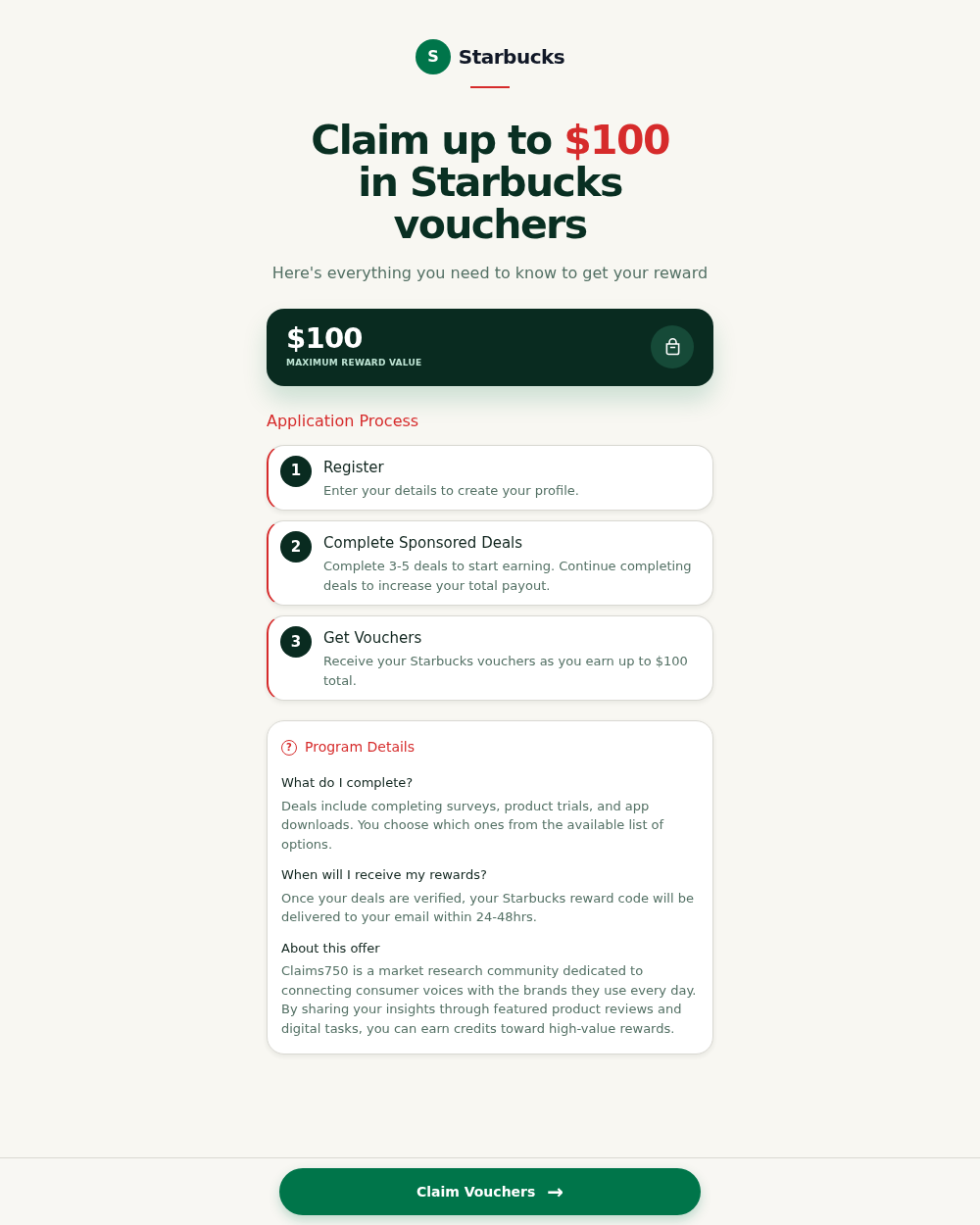
Star.claims750.com displays the headline “Claim up to $100 in Starbucks vouchers.” It also identifies $100 as the maximum reward value.
The 750 in the domain is not the amount offered on this page. Nor does a maximum mean that every participant earns the full amount.
The distinction is easy to miss when a large number dominates the screen. Read the qualification beside the amount before treating it as something you will receive.
This is a sponsored-deal promotion. It is not a screen showing money already credited to your Starbucks account.
Three to five deals are described as a starting point
The page outlines registration, sponsored activities, and voucher delivery. It says participants complete three to five deals to start earning, then continue to increase the payout.
Those deals can include surveys, product trials, and app downloads. The short explanation does not identify every qualifying offer or its possible cost.
There is also a timing condition. The page promises email delivery within 24 to 48 hours after deal verification, not immediately after you register.
How verification works matters just as much as the advertised delivery window. A finished signup and an accepted reward claim are different things.
The button leads toward advertising, not a Starbucks balance
The claim button points to a third-party tracking link. An available route leads to an advertising page containing a survey service and casino promotions.
That is a serious mismatch for someone expecting a straightforward Starbucks voucher application. Before providing anything, consider what the first page leaves unresolved:
- Which deals earn which voucher amounts?
- What purchases, renewals, or eligibility restrictions apply?
- Who verifies completion and resolves missing credit?
- Which business promises to deliver the reward?
- Where are the full redemption terms and a usable support route?
Do not spend money or sign up expecting a guaranteed $100 Starbucks reward. The landing page does not provide the agreement needed to justify that expectation.
How the Star.claims750.com Voucher Funnel Works
Step 1: The voucher amount makes participation seem worthwhile
The pitch starts with a familiar brand and an appealing amount. You can easily picture using the vouchers before asking who supplies them.
Its three numbered stages make the process appear finite. Register, complete activities, receive vouchers sounds simpler than evaluating several separate businesses and their conditions.
Yet the page describes a maximum and a starting number of deals, not a guaranteed payout after a fixed, fully explained task.
The first decision should be whether the obligations are clear. The appeal of the coffee does not answer that question.
Step 2: The claim button hands the visit to a tracker
The button uses trksy.org, with an offer identifier and affiliate information in the link. These fields help an advertising system recognize a referral.
Following that route can open Opportunity Search on edgeoffers.com. One version lists Surveoo alongside casino advertisements rather than a Starbucks redemption form.
The advertising page directs reward questions toward third-party providers. A reader who expected one accountable program is now dealing with a handoff.
Routes can vary by location and visit. Shared advertising infrastructure with another promotion does not identify shared ownership or establish that every visitor sees identical offers.
Step 3: Each sponsored activity brings its own conditions
The landing page mentions product trials and app downloads as well as surveys. These activities are not interchangeable simply because they appear beneath one reward headline.
A trial may require a payment method and later renew. An app may require an account, certain permissions, or progress before a separate promotion credits it.
Read the actual offer before agreeing. Do not infer a specific charge or renewal rule from the Starbucks voucher page, because it does not publish those details.
Gambling deserves a clear boundary: do not make casino deposits to chase this reward. A deposit puts real money at risk without settling the voucher promise.
Step 4: Completion must become accepted credit
The page’s delivery promise depends on deals being verified. That makes the rules for accepting an activity central to whether the reward can be claimed.
For example, a service might confirm that you opened an account while a reward program still requires proof that the signup qualifies.
You would need to know how tracking errors are handled, whether existing customers qualify, and what happens if an activity is rejected.
The landing page does not supply that complete process. Continuing through more offers is not a reliable way to resolve an unexplained credit problem.
Step 5: The advertised delivery window becomes the next concern
A promise of delivery within 24 to 48 hours sounds reassuring. But it starts after verification, so it does not define how long verification itself takes.
Without an identifiable provider and a written claim procedure, it is difficult to establish when a reward should arrive or whom to contact if it does not.
Do not pay an additional processing or release charge to make that uncertainty disappear. A second payment is not proof that a voucher exists.
If you already participated, preserve confirmations and identify each service you joined. Those records are more useful than another round of sponsored activities.
Why Three to Five Deals Do Not Guarantee the Full $100
The important phrase is the starting condition. The page says those first activities begin the earning process and that completing more can increase the total.
That leaves a gap between the prominently advertised maximum and the work a participant must actually complete to reach it.
You should not have to guess whether three activities, five activities, or a larger combination produces the amount that attracted you.
A usable reward schedule should connect each requirement to a clear outcome. It should also tell you whether a purchase is necessary and what disqualifies an activity.
Consider the situation before any signup: you cannot compare a reward with its costs if the qualifying activities and potential charges are still unspecified.
Even a genuine product trial can be a poor decision when you only want a voucher. The trial provider can bill according to its agreement independently of the promotion.
Stopping does not waste money you have already spent. It prevents an uncertain reward from becoming the excuse for further obligations.
Starbucks Rewards Is a Different Program
The official Starbucks Rewards program uses a Starbucks account and Stars earned through eligible purchases and published offers.
Star.claims750.com instead describes sponsored deals and emailed voucher codes. The similarity in branding should not blur those separate arrangements.
Do not enter your existing Starbucks password into a third-party form simply because it mentions Starbucks rewards. Open the real app independently to manage your account.
A website can promote cards for a store without being that store. You still need to identify who makes the promotional promise and what agreement applies.
Starbucks Japan’s March 2026 impersonation warning describes fake social campaigns offering Starbucks gifts for answering surveys and says those campaigns are unrelated to the company.
That warning concerns the campaigns Starbucks describes, rather than naming this domain. It explains why a coffee-shop identity in an offer is not enough to trust it.
A Voucher Promise Needs Redemption Rules
The page refers to vouchers and an emailed reward code. It does not clearly define the format or publish the conditions for spending that code.
Before assigning it a cash-like value, you would need to know what the promised reward actually buys. These details should be available before participation:
- Whether the reward is stored value, a discount, or another promotional benefit.
- Where it can be redeemed and whether country restrictions apply.
- Whether redemption requires additional spending.
- When it expires and how an invalid code is replaced.
A discount requiring more spending is not equivalent to stored value. The format and restrictions should be explained before you join, not after you finish tasks.
If a code arrives, use Starbucks’ own help channels to check an unfamiliar redemption instruction. Do not enter an existing gift card PIN into a third-party checker.
Keep usable codes private when sharing your experience. A screenshot posted to warn others should not expose a card or account that still has value.
What the Page Leaves Unanswered About Your Information
The page describes Claims750 as a market research community connecting consumers with brands. That description does not explain the full handling of a participant’s information.
Before registration, you need to know which business receives your details and whether additional advertisers may contact you.
If a later form asks for a phone number or address, read its consent wording. Sharing information with one provider is not necessarily limited to receiving a voucher.
A survey can collect useful marketing information without asking for a bank password. Treat contact permission as a real decision, not a harmless obstacle before the reward.
The OCC’s gift card fraud guidance identifies unsolicited free-card offers and requests for information or payment to claim prizes as warning signs.
If a business cannot explain its role before taking your information, the sensible response is to stop. You do not owe a promotion another form.
Related Reward Pages Should Still Be Checked Separately
Our GroceryClaims report covers a Costco-branded offer whose current page advertises $700. It is not the Starbucks voucher offer discussed here.
The separate Wool.claims750.com report concerns another reward page. A shared parent-domain name does not make its advertised amount the value offered on Star.claims750.com.
Keep the retailer, reward amount, qualifying activities, and payment provider attached to the exact offer you saw. Otherwise, advice about a different page can cause confusion.
If a promotion changes into a shipping-payment request, the DICK’S YETI giveaway case shows why an apparently small payment deserves attention.
What to Do If You Responded to Star.claims750.com
Start with the practical question: what did you submit, install, join, or pay for? Your next action should follow that answer.
-
Stop accepting more offers while you sort out earlier ones. Save the voucher page, addresses, terms, messages, and any account confirmations.
Make a simple list of completed activities. Include the service name and date, rather than assuming every signup belongs to the same provider.
-
Check the actual status of any promised credit. If you have an identifiable reward provider, ask for its qualifying rules and written explanation of rejected activities.
Do not send extra identity documents to an unsolicited caller who claims your voucher needs verification. Locate the provider’s contact route independently.
-
Cancel services you do not want to keep. Find each trial’s confirmation and deadline, then use the real provider’s account or cancellation channel.
Keep a copy of your request and the response. Walking away from the voucher page does not automatically terminate a separate service.
-
Raise unexpected billing with your card issuer. Describe the charge accurately, including whether you authorized a trial, disputed a purchase, or canceled before further billing.
Give the issuer the statement descriptor and supporting records. Ask about dispute deadlines and preventing additional unwanted transactions without assuming a refund is guaranteed.
-
Secure any existing account credentials you entered elsewhere. Change the affected password through the genuine service and check that its recovery details remain yours.
Use multifactor authentication when available. A supposed voucher agent does not need your Starbucks password, banking login, or a one-time sign-in code.
-
Review the permissions and software you approved. Remove an unwanted app or extension and revoke suspicious notification access if those were part of your visit.
Do not assume a page view caused infection. Investigate a download or unusual device behavior as a separate issue, using trusted assistance when needed.
-
Report misleading messages and reject recovery fees. Use the relevant platform’s reporting tool and submit deceptive-offer details to ReportFraud.ftc.gov.
If somebody wants payment to retrieve your voucher or resolve a missing reward, decline. An unexpected recovery promise can create another loss.
Frequently Asked Questions
Does Star.claims750.com offer a $750 Starbucks gift card?
No. Its current page advertises up to $100 in Starbucks vouchers. The 750 in the domain is not the value promised on the page.
Will completing three to five deals earn the full $100?
The page describes those activities as a starting point and says more deals increase the total. It does not promise the maximum for every participant after five deals.
Does the 24-to-48-hour delivery promise start when I register?
No. The page ties delivery to completed deal verification. It does not provide a full explanation of how long that verification takes.
Is Claims750 the same thing as Starbucks Rewards?
No. This page promotes sponsored activities and voucher codes. Manage your actual Starbucks account and Stars through the official Starbucks app or website.
Should I pay or join trials to qualify for the vouchers?
Do not spend through this offer expecting a guaranteed reward. The landing page leaves qualifying costs, redemption responsibilities, and important conditions unexplained.
What if I completed an offer but received no Starbucks code?
Keep the completion record and seek written answers from the identified provider. Cancel unwanted services and address charges with your issuer rather than chasing more deals.
The Bottom Line
Do not join Star.claims750.com offers expecting guaranteed $100 Starbucks vouchers. The reward ceiling, open-ended sponsored tasks, and advertising handoff leave too much unresolved.
If you already took part, identify the services you joined, keep the records, and stop unwanted billing. Do not pay another fee to rescue the reward.

Reviews & discussion
0 commentsShare a firsthand experience, or ask a question.
Community reviews
star.claims750.com
Moderated reader experiences, not an editorial verdict.
Start the conversation
Have a question or something useful to share? Add the first comment.