


A gift card large enough to cover a serious grocery run is hard to ignore. GroceryClaims.com puts Costco’s name beside an especially tempting number.
Before you start clicking through, look at what the offer actually asks you to do. A few details change the picture considerably.
Overview
What GroceryClaims.com promises
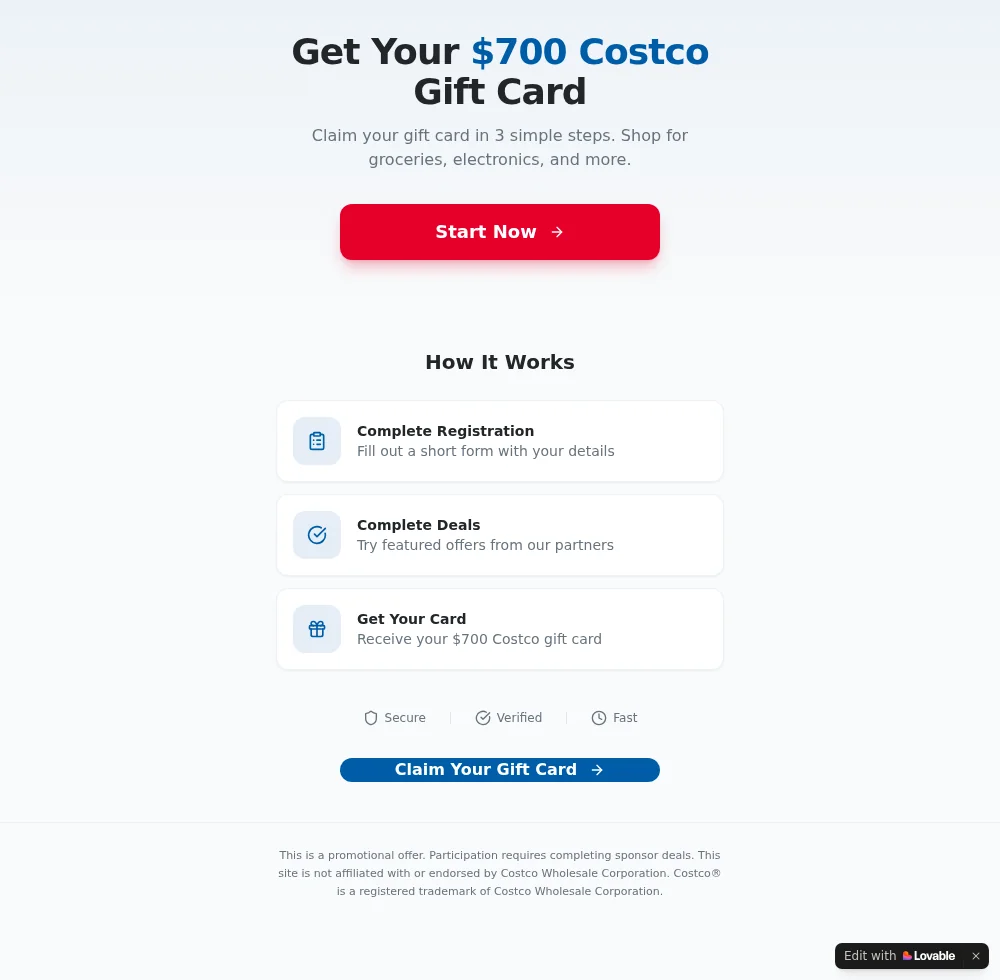
Looking for the GroceryClaims.com $750 Costco gift card offer? Its current destination, groceryclaims.lovable.app, displays a different amount: $700.
The headline says, “Get Your $700 Costco Gift Card.” Underneath, three illustrated boxes describe registration, completing partner deals, and receiving the card.
It sounds like a straightforward task with a valuable reward at the end. The trouble is that the page leaves the important obligations unexplained.
You cannot tell from those boxes how many offers qualify, what they cost, or which business is responsible for delivering the promised card.
Where Costco fits into the offer
Costco is the attraction, not the operator. The page’s own footer says participation involves sponsor deals and denies any Costco affiliation or endorsement.
That distinction matters before you share anything. Joining a promotion outside Costco does not create an entitlement to a Costco membership reward.
The site also displays security and verification labels. Those labels do not explain who checked the promotion or provide a written redemption agreement.
Costco publishes warnings about fraudulent surveys, gift card messages, and social posts. Familiar branding is not enough to authenticate an offer.
The warning signs that affect your decision
Look past the amount and concentrate on the missing link between completing tasks and getting paid. That is where the reader takes the risk.
- The headline presents a specific card, while the explanation refers broadly to partner deals.
- No complete reward contract appears beside the claim button.
- The outbound link passes through an advertising tracker rather than Costco’s website.
- The initial page does not provide a clear reward-fulfillment contact.
- A related search result, star.claims750.com, currently promotes Starbucks vouchers instead of a Costco card.
Do not treat GroceryClaims as an official Costco giveaway or hand over information expecting an already-approved reward. The page offers a marketing journey, not a card balance.
Why the $750 Claim and the $700 Page Do Not Match
If you arrived looking for a $750 Costco gift card, the $700 headline is worth noticing. The amount in an older promotion can outlast its landing page.
A different amount is not a small detail when the reward is the entire reason for participating. You need the terms for the offer in front of you.
Do not assume an earlier screenshot, a search snippet, or somebody else’s video describes the current requirements. The destination and available advertisements can change.
For GroceryClaims.com, the present first stop is a Lovable-hosted page. A website builder supplies the hosting; it does not authenticate the promotional promise.
The page does disclose sponsor deals in its footer. Read that alongside the headline, not as a guarantee that every required purchase will produce a reward.
A usable offer should identify eligibility, qualifying activities, deadlines, reward delivery, and the organization handling disputes. Three simplified boxes are not a substitute.
How the GroceryClaims Gift Card Funnel Works
Step 1: The Costco reward draws you in
The starting point is a promise tied to a retailer people already know. A grocery reward feels immediately useful, especially when household costs are tight.
The page emphasizes the card amount and a short process. It encourages you to imagine spending the reward before considering the obligations needed to earn it.
There is no need for a complicated story. A recognizable store name, a large number, and a bright button can make a promotion feel worth trying.
The important question is not whether a Costco gift card would be useful. It is whether this particular promoter gives you an enforceable, understandable route to one.
Step 2: Registration and partner deals become the conditions
The three-stage explanation begins with a registration form and moves to trying featured partner offers. That is more involved than simply collecting an available card.
Partner offers can have their own accounts, eligibility restrictions, purchase requirements, and privacy terms. The page does not spell those out before inviting you onward.
Keep the two promises separate: what a sponsor sells, and what the reward promoter says it will deliver. Paying the sponsor does not automatically settle the second.
For example, a trial confirmation might prove you enrolled in a service. It does not, by itself, prove that a separate reward program credited the trial.
Step 3: The claim button sends traffic through an affiliate link
The main buttons point to linkthem.net with offer and affiliate identifiers in the address. Those identifiers let an advertising system attribute incoming traffic.
You are leaving the page that advertised the card. This is the point to stop expecting a Costco account or an official retailer redemption screen.
Following the link produced an advertising page on edgeoffers.com, headed Opportunity Search. It listed a paid-survey service and casino promotions rather than a Costco card claim.
That destination described itself as advertising and assigned responsibility for rewards to third-party providers. The handoff makes accountability harder to follow.
Redirects can vary by location and visit, so the offers you are shown may differ.
Step 4: Each new offer creates another decision
A survey signup, a trial, an app, and a gambling offer are different transactions. None should inherit your trust just because you began with Costco branding.
Before accepting a trial, identify its price after the introductory period and cancellation deadline. If those details are unclear, do not provide a payment method.
Before sharing a phone number, check the marketing-consent wording. Permission to contact you may extend beyond the reward page you first intended to use.
Do not make gambling deposits to chase a grocery card. You could lose money immediately while still having no clear explanation of who would issue the reward.
Step 5: The promised card becomes a fulfillment problem
If the card never arrives, you need more than the original headline. You need a named provider, a qualifying activity record, and actual redemption terms.
The GroceryClaims landing page does not supply a detailed process for proving completion or resolving a missing reward. That is a serious practical weakness.
Completing another offer is not a sensible response to an unexplained delay. Stop and find out whether the earlier activity counted before taking on anything else.
The safest decision is to leave this funnel rather than spend money trying to turn an incomplete advertising promise into a grocery budget.
What Is Star.claims750.com, and Why Does It Show Starbucks?
Star.claims750.com answers a different pitch. Its page promotes up to $100 in Starbucks vouchers, with registration, sponsored deals, and voucher delivery shown as stages.
Our dedicated Star.claims750.com Starbucks voucher investigation covers that offer in full.
It says participants start by completing three to five deals and can continue to increase their payout. It describes surveys, product trials, and app downloads.
The page also says reward codes arrive by email within 24 to 48 hours after deal verification. That is the page’s promise, not a completed payment record.
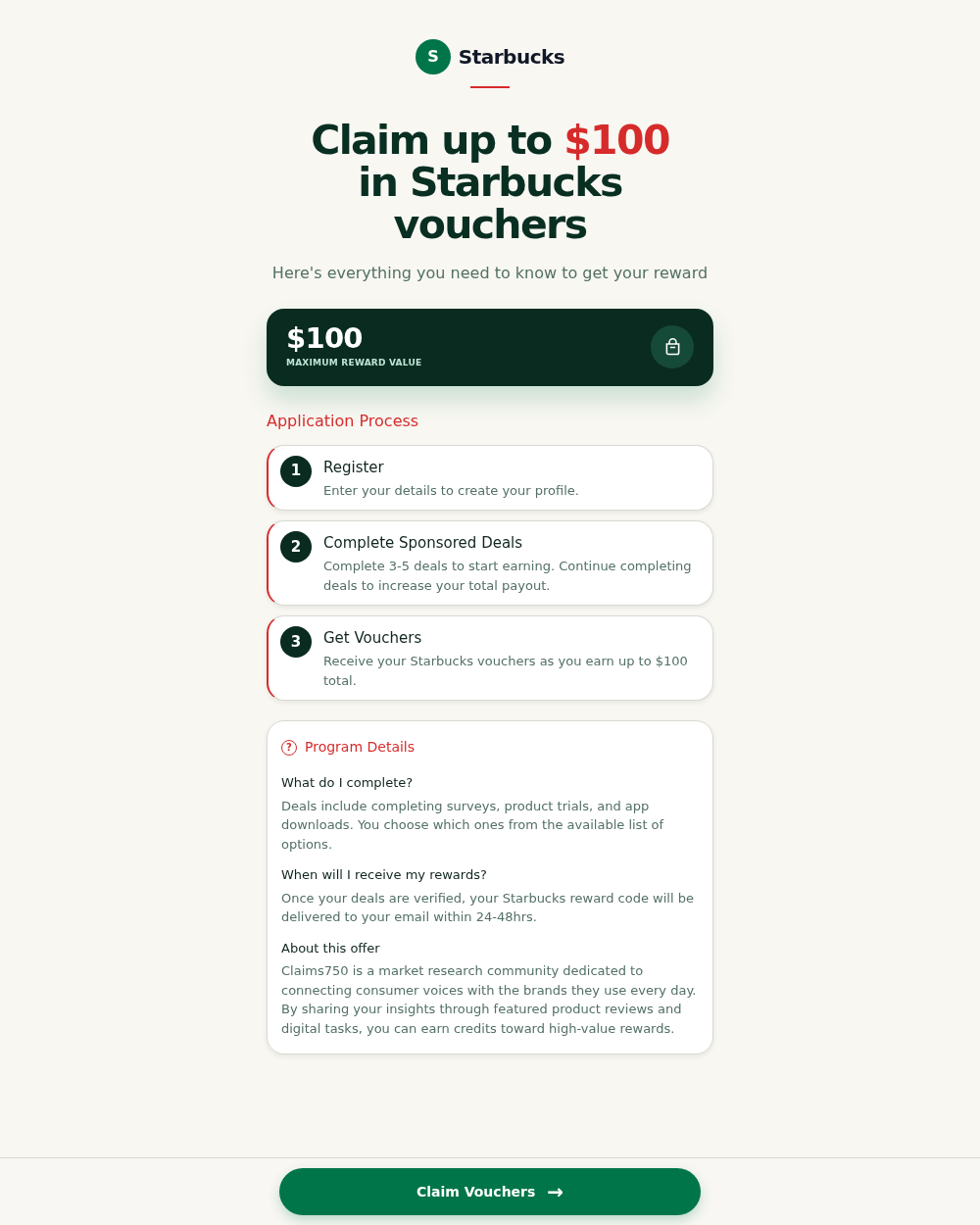
Despite the number in the domain, this is not a page awarding a $750 Costco card. Its displayed brand, amount, and explanation are different.
Its claim button uses another tracking address, trksy.org. A visit led to the same advertising platform as the GroceryClaims button, with survey and casino offers.
Shared routing is useful context, but it does not identify a common owner. Treat the two pages’ promises separately and check the actual destination before agreeing.
The practical lesson is simple: a domain name containing a reward amount is not a promise that the page will deliver that amount or that retailer’s card.
What a Real Reward Agreement Needs to Explain
A genuine conditional rewards program is not the same thing as a retailer handing out free cards. The conditions are the substance of the offer.
Before taking part in any such program, you should be able to understand the entire route without first surrendering your contact details or payment information.
- Who operates the program and handles reward complaints?
- Which countries, ages, and new-customer rules apply?
- How many deals are required, and which purchases qualify?
- What costs, renewals, and cancellation deadlines apply to those deals?
- How is completion tracked, and how do you challenge missing credit?
- What identification, delivery deadline, and redemption rules apply?
If a promoter cannot answer those questions, you cannot sensibly compare the promised reward with the money, time, and information being requested.
A footer disclaimer does not fill in missing terms. Nor does a label suggesting verification explain who would resolve a dispute.
The same distinction helps with BulkSaved’s Costco gift card pitch: the retailer’s name and the party directing your signups are separate things.
How to Check a Costco Message Without Following Its Links
Start a fresh visit to Costco’s website or app. Look for the promotion there, or use customer service reached through Costco itself.
Costco’s email-domain guidance lists its genuine sending domains and identifies the address used for digital Shop Cards.
A familiar sender name is not enough. An email can display Costco while the actual link leads to a completely unrelated host.
Read the hostname between https:// and the next slash. Costco’s name in the page title or later in a link does not make it Costco’s website.
Do not confuse an encrypted connection with an honest offer. HTTPS protects the connection; it does not certify the promotion, sponsor, or reward.
For other versions of this lure, our Costco survey warning explains the distinction between retail branding and an outside offer.
A card request for a supposed shipping charge is another reason to stop. That changes a promised reward into a payment request.
The Costco meat box giveaway scam uses a different prize, but the payment decision deserves the same scrutiny.
What to Do If You Responded to GroceryClaims
You do not need to panic or follow every recovery tip online. Match your response to what you actually shared or authorized.
-
Stop the sequence and keep the evidence. Save the starting page, full address, offer terms, confirmation emails, and any transaction records before closing the tabs.
Write down which service received your information. A list of actual signups is more useful than trying to reconstruct the whole advertising chain later.
-
If you supplied only contact details, watch for follow-up lures. Block unwanted messages and be suspicious of callers who know you wanted a Costco card.
Do not confirm more information to someone claiming they must verify your reward. Use independently located contacts for any service you knowingly joined.
-
Cancel unwanted trials with the actual provider. Find the service in its confirmation email, then open its official account or support page independently.
Request cancellation in writing, keep the response, and check when billing stops. Closing the GroceryClaims page does not cancel a separate signup.
-
If a card was charged, contact the issuer promptly. Explain whether the problem is an unauthorized transaction, a disputed purchase, or continued billing after cancellation.
Provide the statement descriptor, amount, dates, and supporting messages. Ask about dispute deadlines and how to prevent further unwanted charges from that merchant.
-
Secure any password you reused. Change it on the genuine service and every other account using the same password, starting with your email.
Enable multifactor authentication where available. If you entered a one-time code, review the affected account’s sessions and recovery settings immediately.
-
Review anything you installed or allowed. Remove an unwanted app or browser extension, revoke suspicious notification permissions, and use trusted security software if your device behaves unusually.
A page visit alone is not a reason to assume infection. Focus on downloads, installations, permissions, or commands you actually approved.
-
Use identity-recovery help if sensitive identity details were exposed. If you supplied a Social Security number or identity document, visit IdentityTheft.gov for tailored steps.
Keep that response proportionate. Giving an email address is a different exposure from handing over identity documents or banking credentials.
-
Report the promotion and ignore paid recovery offers. Use the platform’s reporting option and submit relevant details at ReportFraud.ftc.gov.
Do not pay a caller who promises to unlock your reward, retrieve a missing card, or guarantee a refund for an advance fee.
Frequently Asked Questions
Is GroceryClaims.com a legitimate Costco giveaway?
No. Its own destination denies Costco affiliation and requires sponsor deals. Do not mistake the retailer’s name for an official reward invitation.
Why does GroceryClaims show $700 instead of a $750 Costco gift card?
The current page advertises $700. An older $750 pitch does not establish today’s conditions, so do not rely on the earlier amount when deciding whether to participate.
Does completing one survey guarantee the Costco card?
No. The page describes partner deals, not a guaranteed card for one survey. It does not provide a complete qualifying-deal and redemption agreement on the landing page.
Is star.claims750.com the same Costco offer?
No. It currently displays Starbucks vouchers worth up to $100, with its own sponsored-deal explanation. The number in its domain does not change that offer.
Should I pay a fee or join trials to unlock the reward?
Do not spend money through this offer expecting a guaranteed reward. Any trial can create a separate obligation, and the landing page leaves key fulfillment terms unanswered.
What if I entered information but never paid?
Stop further signups, save the page, and watch for targeted messages. Change any reused password, and review installations or permissions only if you actually approved them.
The Bottom Line
Do not use GroceryClaims.com as a route to a free Costco card. Its current $700 pitch sends you into advertising without a complete reward agreement.
If you already responded, stop chasing the card. Cancel unwanted services with their providers, document any charges, and ask your card issuer for help when appropriate.
Check genuine Costco offers through Costco. A large reward on somebody else’s landing page is not a reason to trade away money or personal information.

Reviews & discussion
0 commentsShare a firsthand experience, or ask a question.
Community reviews
groceryclaims.com
Moderated reader experiences, not an editorial verdict.
Start the conversation
Have a question or something useful to share? Add the first comment.