


A post promises a YETI backpack cooler through DICK’S Sporting Goods. A short survey and a little postage sound like a surprisingly good deal.
The friendly-post style illustrated below makes the offer easy to share. Before paying, take a closer look at where that link actually leads.
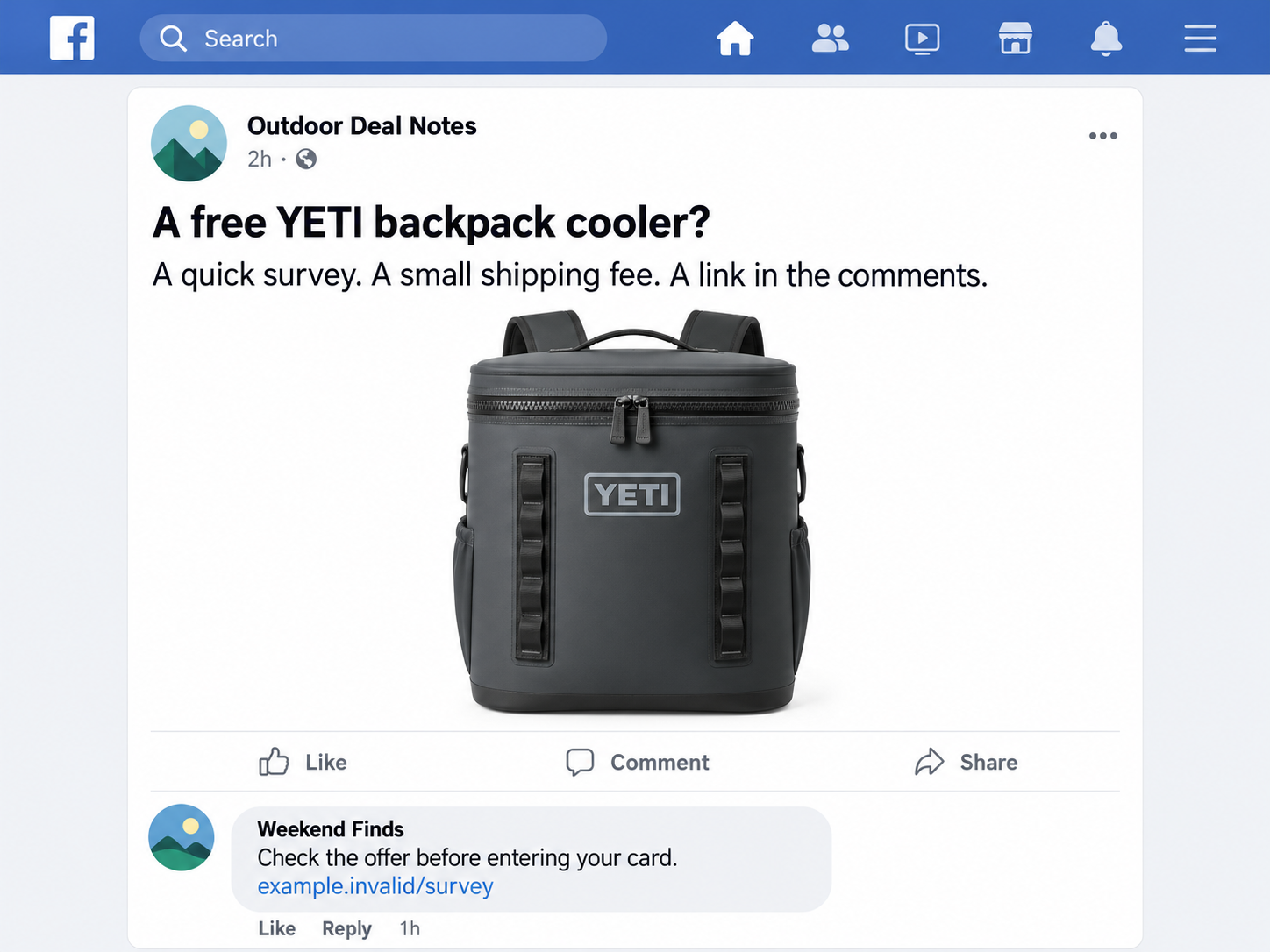
Overview
The giveaway is the bait, not a DICK’S promotion
The DICK’S YETI backpack cooler giveaway scam borrows two recognizable names to make a shipping payment seem reasonable. The retailer and cooler maker are being impersonated.
A survey, a clearance explanation, or a supposed insider deal can supply the excuse. The decisive moment comes when an outside page asks for your card.
DICK’S warns that fraudulent giveaways and advertisements use its branding to collect payment or personal information. It directs customers to its established websites.
You are not authorizing a genuine DICK’S order simply because a page shows its name. The payment destination matters more than the picture of the cooler.
A current complaint names the link readers are searching
A BBB Scam Tracker report dated July 23, 2026 identifies inventory-liquidation.com/dickssporting-yeti-mn1 and reports a $12 loss after a YETI survey offer.
The report labels the business as a DICK’S Sporting Goods impersonator. The retailer’s name in a report describes the borrowed identity, not the real company taking payment.
Another first-person report describes a Facebook cooler survey followed by an extra charge. These accounts show why dismissing a small shipping payment can be expensive.
The first small fee is not a sensible measure of the danger. You are giving an outside payment page access to something more valuable.
What should make you stop before paying
The pitch is built around making the next action feel harmless. Pause when an unfamiliar page wants financial details for a reward you never independently verified.
- The offer exists in a shared post, but you cannot locate matching terms through DICK’S official channels.
- The link uses a generic clearance or inventory domain instead of a verified retailer destination.
- A short survey leads directly to a shipping payment.
- Urgent wording discourages checking the offer with the retailer.
- The checkout does not clearly identify the business, full charge, and any continuing agreement.
Do not pay for this supposed giveaway. If you already entered card details, contact your issuer rather than waiting to see whether a backpack arrives.
What DICK’S Actually Says About These Offers
The retailer’s security alerts, also published by its Going, Going, Gone! business, describe unauthorized giveaways, fake websites, and imitation order confirmations.
Its warning is explicit: “they are not authorized by DICK’S.” That applies to the impersonating ads and sites described in the warning, not legitimate retailer promotions.
A good-looking confirmation email can be part of the deception. An order number displayed by an impersonator does not create an order in the retailer’s system.
This is why checking a logo, a delivery estimate, or a convincing checkout design is not enough. All three can be copied without access to the real business.
Open DICK’S website independently and find its customer-service route there. For questions about genuine YETI products, use YETI’s own support page.
Neither company becomes responsible for an outside payment merely because scammers used its name. Your card issuer needs the actual transaction details to help.
How the DICK’S YETI Backpack Cooler Giveaway Scam Works
Step 1: A believable shopping tip replaces an official announcement
The hook presents a valuable cooler as an easy opportunity. A clearance story or employee connection gives the low price an explanation that feels plausible.
Instead of checking whether the retailer announced anything, readers start thinking about how quickly they can claim a backpack before the opportunity disappears.
When a friend shares the post, it arrives with a second layer of trust. Your friend may simply have believed the same pitch.
Treat a personal recommendation as a starting point, not verification. The person sharing a link usually cannot inspect the payment business behind it.
Step 2: The link takes you outside the real retailer
The inventory-liquidation.com address is one reported example. Adding a retailer’s name to the path after the domain does not make the domain belong to that retailer.
Even if the page copies brand colors and familiar navigation, you have crossed into a different website. That transition is easy to miss on a phone.
Look at the complete address before entering anything. A display title, a preview image, and a shortened social-media link can conceal the eventual destination.
If an old link stops opening, do not search for a replacement claim page. The problem is the unauthorized promotion, not a temporary difficulty collecting the cooler.
Step 3: A survey makes the reward feel earned
Answering a few questions creates a small investment of time. By the payment stage, you may feel that you have qualified and only need to finish.
But completing questions does not authenticate the sponsor or establish that a product has been reserved. A success message can be ordinary webpage text.
The survey also supplies a reason to request contact information. A delivery story then makes a home address and phone number seem like natural next steps.
Keep that distinction clear: information needed for a real shipment is also valuable to someone pretending a shipment exists. The form itself proves nothing.
Step 4: A small shipping charge opens the payment door
The initial fee is easier to accept than the full price of premium outdoor gear. You compare it with the cooler’s apparent value instead of the merchant’s legitimacy.
A $12 payment can feel like a limited risk. Entering full card details creates a separate exposure, even when the amount shown on screen is small.
Watch for terms describing trials, clubs, renewals, or different services. If another agreement appears, it is not ordinary postage for a retailer giveaway.
Do not approve a bank confirmation code just to keep the process moving. Read the merchant and amount in your bank’s prompt before authorizing any transaction.
Step 5: The charges no longer resemble the promised reward
Extra charges may appear under an unfamiliar merchant name. A small initial payment can make it harder to connect that descriptor with the social post.
In one BBB report from June 24, 2025, a shopper described roughly $11 in shipping followed by a $76 charge.
They reported a total loss of $88.93 and a statement descriptor of Imagination World. That is one person’s account, not a fee schedule for every version.
When billing becomes the problem, stop engaging with the prize story. Save the transaction and ask your bank how to dispute it and prevent further charges.
The Subscription Risk: Read the Agreement, Not Just the Shipping Price
A shipping payment and a subscription are different commitments. An offer should never leave you guessing which one you authorized.
Some reward funnels attach a trial or membership to the payment step. Read renewal terms if they are present, including the service name and cancellation deadline.
Check your confirmation for the actual renewal price and date. An extra charge alone does not tell you whether another payment is scheduled.
If your confirmation mentions a membership you did not want, save that message. It may help explain why later billing differs from the postage amount.
Do not assume the solution is simply replacing the card. Ask your issuer about both compromised card details and unwanted recurring payment instructions.
A merchant cancellation and a card dispute solve different problems. Keep records of both rather than relying on an unconfirmed telephone promise.
Why Photos and Comments Are Not Proof of Delivery
A backpack photograph can show that a cooler exists. It cannot tell you who photographed it, how it was obtained, or whether the linked offer supplied it.
The same applies to a cheerful comment about receiving an order. A comment is a claim, not a receipt from the merchant taking your money.
You do not need to prove every image was stolen or generated to reject this pitch. The missing authorized connection to the retailer is already decisive.
Be especially wary when a post treats skepticism as something to overcome quickly. A genuine opportunity should survive a pause to check the official business.
Similar brand-borrowing appears in the broader YETI cooler giveaway scam and the Hopper M20 survey pitch.
For another shipping-fee lure, see the fake Costco YETI wagon offer. The retailer changes; the payment decision remains the important part.
If You Opened the Link but Stopped Before Paying
Reaching the survey is not the same as approving a card transaction. Do not let alarm push you into unnecessary payments or a stranger’s recovery service.
Think through the point where you stopped. That tells you which information, if any, needs attention now.
- Only viewed the page: close it, avoid further interaction, and remove any unwanted notification permission you granted.
- Submitted a name, address, or phone: expect convincing follow-up messages about your supposed package.
- Created an account with a reused password: secure the genuine accounts that use that password.
- Entered or submitted card details: tell the issuer, even if you cannot yet see a completed charge.
An error message after submitting a form is not assurance that nothing was sent. Describe what you entered when asking the issuer for advice.
If you saved a screenshot, keep it private when it contains your address or payment details. Redact those fields before sharing a warning publicly.
You can warn friends without reposting the dangerous link. Name the fake giveaway and tell them to verify promotions through the real retailer.
That avoids giving the same offer another audience while you explain what happened. The useful warning is about the payment trap, not how to reach it.
What to Do if You Have Fallen Victim to This Scam
There is no reason to be embarrassed. The post is designed to make a small payment feel routine. Act on the exposure now.
-
Tell your bank or card issuer what happened today. Use its app or the number on your card, not a contact supplied by the giveaway page.
Explain the promised cooler, the shipping amount, and any later charges. Ask what protective action is appropriate for the card details you entered.
-
Save a record before the post disappears. Keep the full URL, account name, payment screen, terms, receipts, and screenshots of messages about delivery.
Record the statement descriptor exactly. It may be more useful for tracing a charge than the DICK’S or YETI name displayed in the advertisement.
-
Challenge payments you did not authorize or were tricked into making. Give the issuer dates, amounts, and the specific way the offer misled you.
Ask about its dispute process and deadlines. A refund is not guaranteed, but prompt reporting gives the issuer a better opportunity to help.
-
Deal separately with any unwanted membership. Locate the business in the confirmation or card transaction, and keep a written cancellation request.
If the merchant cannot be reached or keeps billing, tell the issuer. Ask how to block further charges rather than assuming a replacement card ends everything.
-
Check account activity and enable transaction notifications. Look for small tests, repeated charges, or unfamiliar merchant names after the original payment.
Do not wait for a promised shipping date before reporting suspicious activity. The payment and the supposed delivery are separate issues.
-
Protect information you actually exposed. If you reused an existing password on a claim page, replace it on the genuine account and review active sessions.
If you only supplied contact details, watch for targeted delivery or refund messages. Do not send identity documents to unlock the cooler.
-
Report the fake post and correct any share. Use the social platform’s fraud-reporting option, warn the friends who received your link, and contact DICK’S independently.
You can also submit a report to ReportFraud.ftc.gov. Include the payment destination and saved offer, not just the impersonated brand.
-
Reject anyone asking for a second payment to help. A supposed delivery agent or refund specialist may use your earlier interaction as a convincing introduction.
Never provide a bank login, one-time code, or remote access to receive a refund. Use your own bank’s established channel instead.
Frequently Asked Questions
Is the DICK’S Sporting Goods YETI cooler giveaway real?
The survey-and-shipping offer described here is an impersonation scam, not an authorized DICK’S promotion. Do not pay through its social-media claim links.
Is inventory-liquidation.com/dickssporting-yeti-mn1 an official retailer page?
No. A July 2026 BBB report names that address in a DICK’S impersonation complaint. A retailer’s name in the path does not authenticate the website.
Why does a free backpack cooler require my credit card?
The shipping explanation moves you from a promised prize to a payment form. That is the point where card details and money become exposed.
How can I stop more charges after paying the shipping fee?
Contact your issuer about preventing further payments. If the transaction also created an unwanted membership, send the identified provider a cancellation request and keep its response.
Does a photo of somebody holding the cooler prove the offer works?
No. A photograph does not connect the pictured item to the payment page. Verify the promotion independently rather than relying on images or comments.
Can DICK’S refund money paid to the impersonator?
The retailer did not process that outside payment. Report the impersonation to DICK’S, but take the transaction dispute to the issuer or provider that handled your payment.
The Bottom Line
The DICK’S YETI backpack cooler giveaway scam turns a desirable product into an excuse for an outside card payment. Skip the survey link and do not pay.
If you already paid, contact your card issuer now, preserve the offer, and address any unwanted billing separately. Waiting for a cooler will not protect your account.

Join the discussion
0 commentsShare your experience or ask a question about this article.
Discussion
Start the conversation
Have a question or something useful to share? Add the first comment.